DSM-5 Somatic Symptoms Disorders work group publishes SSD field trial data

Post #272 Shortlink: http://wp.me/pKrrB-3ke

Update: Somatic Symptom Disorder: An important change in DSM. is now published in the September 2013 issue, J Psychosom Res. A subscription or payment is required to access this paper.

http://www.ncbi.nlm.nih.gov/pubmed/23972410

J Psychosom Res. 2013 Sep;75(3):223-8. Epub 2013 Jul 25.
Dimsdale JE, Creed F, Escobar J, Sharpe M, Wulsin L, Barsky A, Lee S, Irwin MR, Levenson J.

DSM-5 Somatic Symptoms Disorders work group publishes SSD field trial data…behind a paywall

Reports on the findings of the DSM-5 field trials have been slow to emerge.

Kappa results trickled out in dribs and drabs; work group chairs presented limited field trial data at the APA’s 2012 Annual Meeting. There remains a paucity of information on field trial study protocols, patient selection, field test results and analysis.

This is of particular concern where radical changes to DSM-IV definitions and criteria were introduced into DSM-5 and are now out there in the field.

A good example is the new DSM-5 “Somatic Symptom Disorder” category, where there is no substantial body of evidence for the reliability, validity, prevalence, safety, acceptability and clinical utility of the implementation of this new disorder construct – though that did not stop them barrelling it through to the final draft.

In its paper, the SSD Work Group acknowledges the “small amount of validity data concerning SSD”; that much “remains to be determined” about the utility and reliability of the specific SSD criteria and its thresholds when applied in busy, general clinical practice and that there are “vital questions that must be answered” as they go forward.

They don’t sound any too confident about what they’ve barrelled through; but neither do they seem overly concerned.

With remarkable insouciance, SSD Work Group Chair, Joel E Dimsdale, told ABC journalist, Susan Donaldson James, “…If it doesn’t work, we’ll fix it in the DSM-5.1 or DSM-6.” (ABC News, February 27, 2013).

Cavia15The implementation of SSD in the DSM-5 is a Beta trial; the public – adults and children – unwitting guinea pigs.

Members of the DSM-5 Somatic Symptoms Disorders Work Group have just published a report – Somatic Symptom Disorder: An important change in DSM.

APA owns the output of the DSM-5 work groups but this report isn’t posted on the APA’s DSM-5 Development site or on the Field Trials or DSM-5 Resources pages.

It’s being published (currently In Press) in the Journal of Psychosomatic Research, for which DSM-5 SSD Work Group member, James Levenson, is a Co-Editor and for which SSD Work Group member, Francis Creed, a past Editor.

Unless you are a subscriber to JPS or have institution access you will need to cough up $30 to access this paper.

DSM-5 Task Force’s Regier and Kupfer have been banging on for years about how transparent the development process for this most recent iteration of the DSM has been. Yet reports on field trial findings and analysis of studies cited in support of the introduction of radical new constructs for DSM are stuffed behind paywalls.

Why are DSM-5 work group reports not being published on the DSM-5 Development website or other APA platforms or published in journals under Creative Commons Licenses, for ease of public accessibility, professional and consumer stakeholder scrutiny and discussion, and for accountability?

The development of ICD-11 is also being promoted by WHO’s Bedirhan Üstün as an open and transparent process.

But emerging proposals from the two working groups charged with making recommendations for revision of ICD-10′s Somatoform Disorders (the Primary Care Consultation Group, chaired by Prof Sir David Goldberg and the WHO Expert Working Group on Somatic Distress and Dissociative Disorders, chaired by Prof Oje Gureje) were also published, last year, in subscription journals and subject to those journals’ respective copyright restrictions [1] [2].

1. Lam TP et al. Proposed new diagnoses of anxious depression and bodily stress syndrome in ICD-11-PHC: an international focus group study. Fam Pract. 2013 Feb;30(1):76-87. [Abstract: PMID:22843638]
2. Creed F, Gureje O. Emerging themes in the revision of the classification of somatoform disorders. Int Rev Psychiatry 2012;24:556-67. [Abstract: PMID: 23244611]

Why are ICD-11 working group progress reports on emerging proposals for potential new ICD disorders and focus group study reports not being published on platforms accessible, without payment, to all classes of ICD stakeholder?

The SSD Work Group paper is authored by Joel E Dimsdale (Chair), Francis Creed, Javier Escobar, Michael Sharpe, Lawson Wulsin, Arthur Barsky, Sing Lee, Michael R. Irwin and James Levenson.

[Although not a member of the SSD Work Group, Javier Escobar is Task Force liaison to the SSD work group and works closely with the group. Francis J Keefe (not included in the paper’s authors) is a member of the SSD Work Group. Nancy Frasure-Smith (not included in the paper’s authors) served as a member of the Work Group from 2007-2011 and was not replaced following withdrawal.]

The paper describes the DSM-5 Work Group’s rationale for the new SSD diagnosis (which replaces four DSM-IV categories); defines the construct, discusses field trial kappa data (inter-rater reliability), presents limited data for validity of SSD, clinical utility and potential prevalence rates, and briefly discusses tasks for future research, education and clinical practice.

http://www.jpsychores.com/

July 2013, Vol. 75, No. 1

In Press

Somatic Symptom Disorder: An important change in DSM

29 July 2013

Joel E. Dimsdale, Francis Creed, Javier Escobar, Michael Sharpe, Lawson Wulsin, Arthur Barsky, Sing Lee, Michael R. Irwin, James Levenson

Received 4 April 2013; received in revised form 27 June 2013; accepted 29 June 2013. published online 29 July 2013.

Corrected Proof

doi:10.1016/j.jpsychores.2013.06.033

Abstract: http://www.jpsychores.com/article/S0022-3999(13)00265-1/abstract [Free]

Full text: http://www.jpsychores.com/article/S0022-3999(13)00265-1/fulltext  [Paywall]

References: http://www.jpsychores.com/article/PIIS0022399913002651/references  [Paywall]


Commentaries on Somatic Symptom Disorder in recent journal papers

In the June 2013 edition of Journal of Nervous and Mental Disorders, Allen Frances, MD, who chaired the Task Force for DSM-IV, discusses his concerns for the loosely defined DSM-5 category, Somatic Symptom Disorder, sets out his suggestions for revising the criteria prior to finalization, as presented to the SSD Work Group chair, in December 2012, and advises clinicians against using the new SSD diagnosis.

http://www.ncbi.nlm.nih.gov/pubmed/23719325

DSM-5 Somatic Symptom Disorder.

Frances A.

Department of Psychiatry, Duke University, Durham, NC.

J Nerv Ment Dis. 2013 Jun;201(6):530-1. doi: 10.1097/NMD.0b013e318294827c. No abstract available.

PMID: 23719325

+++

Commentary by Allen Frances, MD, and Suzy Chapman in the May 2012 issue of Australian and New Zealand Journal of Psychiatry. The paper discusses the over-inclusive DSM-5 Somatic Symptom Disorder criteria and the potential implications for diverse patient groups. The paper concludes by advising clinicians not to use the new SSD diagnosis.

http://www.ncbi.nlm.nih.gov/pubmed/23653063

DSM-5 somatic symptom disorder mislabels medical illness as mental disorder.

Allen Frances¹, Suzy Chapman²

1 Department of Psychiatry, Duke University 2 DxRevisionWatch.com

Aust N Z J Psychiatry. 2013 May;47(5):483-4. doi: 10.1177/0004867413484525. No abstract available.

PMID: 23653063

+++

The April 22, 2013 edition of Current Biology published a feature article on DSM-5 by science writer, Michael Gross, Ph.D. The article includes quotes from Allen Frances, MD, and Suzy Chapman on potential implications for patients for the application of the new DSM-5 Somatic Symptom Disorder. The article includes concerns for the influence of Somatic Symptom Disorder on proposals for a new ICD category – Bodily Distress Disorder – being field tested for ICD-11.

Current Biology 22 April, 2013 Volume 23, Issue 8

Copyright 2013 All rights reserved. Current Biology, Volume  23, Issue  8, R295-R298, 22 April 2013

doi:10.1016/j.cub.2013.04.009

Feature

Has the manual gone mental?

Michael Gross

Full text: http://www.cell.com/current-biology/fulltext/S0960-9822(13)00417-X

PDF: http://download.cell.com/current-biology/pdf/PIIS096098221300417X.pdf

+++

In a BMJ opinion piece, published March 2013, Allen Frances, MD, opposes the new Somatic Symptom Disorder, discusses lack of specificity, data from the field trials, and advises clinicians to ignore this new category.

http://www.ncbi.nlm.nih.gov/pubmed/23511949

The new somatic symptom disorder in DSM-5 risks mislabeling many people as mentally ill.

Frances A.

Allen Frances, chair of the DSM-IV task force

BMJ. 2013 Mar 18;346:f1580. doi: 10.1136/bmj.f1580. No abstract available.

PMID: 23511949

[PubMed – indexed for MEDLINE]

+++
Somatic Symptom Disorder is also included in Saving Normal: An Insider’s Revolt Against Out-Of-Control Psychiatric Diagnosis, DSM-5, Big Pharma, and the Medicalization of Ordinary Life (pp. 193-6): Allen Frances, William Morrow & Company (May 2013).

Also Essentials of Psychiatric Diagnosis: Responding to the Challenge of DSM-5 (Chapter 16): Allen Frances, Guilford Press (June 2013).

+++

Further reading

APA Somatic Symptom Disorder Fact Sheet APA DSM-5 Resources

Somatic Chapter Drops Centrality Of Unexplained Medical Symptoms Psychiatric News, Mark Moran, March 1, 2013

Somatic Symptoms Criteria in DSM-5 Improve Diagnosis, Care David J Kupfer, MD, Chair, DSM-5 Task Force, defends the SSD construct, Huffington Post, February 8, 2013

The new somatic symptom disorder in DSM-5 risks mislabeling many people as mentally ill Allen Frances, MD, BMJ 2013;346:f1580 BMJ Press Release

Somatic Symptom Disorder could capture millions more under mental health diagnosis Suzy Chapman, May 26, 2012

Mislabeling Medical Illness As Mental Disorder Allen Frances, MD, Psychology Today, DSM 5 in Distress, December 8, 2012

Why Did DSM 5 Botch Somatic Symptom Disorder? Allen Frances, MD, Psychology Today, Saving Normal, February 6, 2013

New Psych Disorder Could Mislabel Sick as Mentally Ill Susan Donaldson James, ABC News, February 27, 2013

Dimsdale JE. Medically unexplained symptoms: a treacherous foundation for somatoform disorders? Psychiatr Clin North Am 2011;34:511-3. [PMID: 21889675]
BDS, BDDs, BSS, BDD unscrambled

Post #268 Shortlink: http://wp.me/pKrrB-3fA

BDS, BDDs, BSS, BDD and ICD-11, unscrambled

There are two WHO convened working groups charged with making recommendations for the revision of ICD-10’s Somatoform Disorders: the Primary Care Consultation Group (known as the PCCG) and the Expert Working Group on Somatic Distress and Dissociative Disorders (known as the S3DWG).

The revision of ICD-11 is being promoted as an open and transparent process. But to date, neither working group has published progress reports for stakeholder consumption and neither group has published its emerging proposals in public access journals.

Content populated in the public version of the ICD-11 Beta drafting platform sheds little light on proposals.

Consequently, there is considerable confusion around what is being recommended for the revision of ICD-10’s Somatoform Disorders, whether consensus between the two working groups has been reached, and what proposals will progress to field testing during the next two years.

ICD-11 Revision has been asked to clarify when it intends to define and characterize its current proposals within the Beta drafting platform.

The notes below set out some of what is known about the two working groups’ emerging proposals, how they diverge and how they compare with DSM-5’s Somatic Symptom Disorder and with Fink et al’s Bodily Distress Syndrome.

Caveat: the proposals of the two ICD-11 working groups may have undergone revision and refinement since emerging proposals were published, in July and December, last year; the two groups may or may not have reached consensus over how this proposed new ICD construct should be defined and characterized, its inclusions, exclusions and differential diagnoses, or what name it should be given.

What is Bodily Distress Syndrome (BDS)?

+++

Bodily Distress Syndrome is the name given to a disorder construct developed by Per Fink and colleagues, Aarhus University, that is already in use in Danish research studies and in clinical settings [1].

BDS is described by its authors as “a unifying diagnosis that encompasses a group of closely related conditions such as somatization disorder, fibromyalgia, irritable bowel syndrome and chronic fatigue syndrome.”

Per Fink and colleagues are lobbying for BDS to be integrated into forthcoming classification systems and adopted as a diagnosis by primary care practitioners.

Their proposal is for reclassifying somatoform disorders, pain disorder, neurasthenia and the so-called functional somatic syndromes, including fibromyalgia, irritable bowel syndrome and chronic fatigue syndrome, under a new classification, Bodily Distress Syndrome.

They consider these should be treated and managed as subtypes of the same disorder with CBT, GET, “mindfulness therapy” and in some cases, antidepressants.

The PDF format slide presentation in reference [2] will give an overview of BDS and there is more information and links in an earlier post, in reference [3].

Is Fink et al’s Bodily Distress Syndrome construct the same as DSM-5’s SSD?

+++

No, Bodily Distress Syndrome is a different construct to DSM-5’s Somatic Symptom Disorder.

Psychological or behavioural characteristics, central for the diagnosis of SSD, do not form part of the BDS criteria.

For BDS, physical symptoms are central to the diagnosis, which is based on identification of symptom patterns (not symptom count) from four body systems:

Cardiopulmonary/autonomic arousal; Gastrointestinal arousal; Musculoskeletal tension; General symptoms.

There is a “Modest” BDS (single-organ type) and a “Severe” BDS (multi-organ type).

If the symptoms are better explained by another disease, they cannot be labelled BDS.

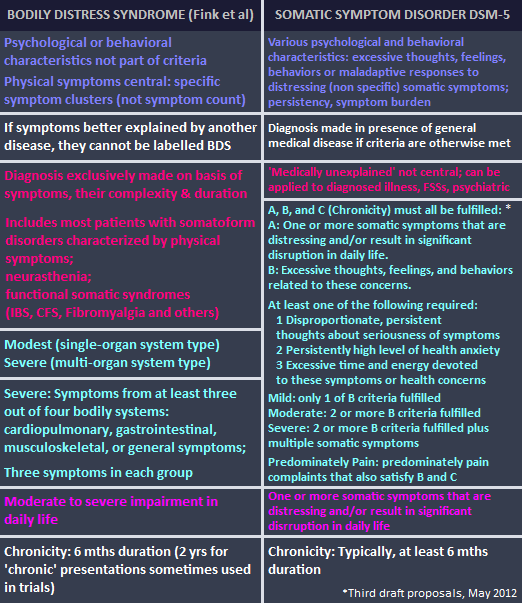
The graphic below compares mutli-organ Bodily Distress Syndrome with Somatic Symptom Disorder, as the DSM-5 draft criteria had stood, in May 2012.

Note the defining characteristics of the DSM-5 SSD construct: the SSD definition calls for positive psychobehavioural characteristics (excessive or maladaptive responses or associated health concerns) in response to persistent distressing somatic symptoms; the requirement that the symptoms are “medically unexplained” is not central to the diagnosis and the symptoms may or may not be associated with a well-recognised medical condition.

The SSD diagnosis can be made in the presence of one or more unspecified, somatic symptoms associated with general medical conditions and diagnosed disease, like multiple sclerosis, cancer, diabetes or angina, or in the so-called “functional somatic syndromes” (for example, IBS, CFS or fibromyalgia) or in complaints with unclear etiology.

Compare Fink et al’s BDS with DSM-5’s SSD, in the table, below:

Depending on screen size/resolution, graphic may not display in full. Click on the image and the image file will load. Graphic: Suzy Chapman

Bodily Distress Syndrome comparison with Somtatic Symptom Disorder

Continued on Page 2

Update on ICD-11 Beta drafting: Bodily Distress Disorder: emerging proposals: Part One

Post #265 Shortlink: http://wp.me/pKrrB-3cr

Update on ICD-11 Beta drafting: Bodily Distress Disorder: emerging proposals: Part One

This report should be read in conjunction with the caveats at the end of the post, on Page 3.

Part One

The technical work associated with the preparation of ICD-11, the field testing and trials evaluation will need to be completed next year if WHO is going to meet its target of presenting ICD-11 for World Health Assembly approval in May 2015, with pilot implementation by 2016.

Three distinct versions of the ICD-11 classification of Mental and Behavioural Disorders are under development: an abridged version for use in primary care, a detailed version for use in specialty settings and a version for use in research.

The ICD-10 Somatoform Disorders are under revision for all three versions and the primary care and speciality versions are being developed simultaneously.

ICD10-PC, the abridged version of ICD, is used in developed and developing countries and in the training of medical officers, nurses and multi-purpose health workers. Globally, more than 90% of patients with mental health problems are managed by practitioners or health workers in general medical or primary care settings – not by psychiatrists.

Over 400 mental disorders are classified in the speciality version of ICD-10 Chapter V. These are condensed to 26 mental disorders for the primary care version – a list can be found on Page 49 of this book chapter, in Table 2.4.

Each disorder in ICD10-PC provides information on patient presentation, clinical descriptions, differential diagnoses, treatments, indications for referrals and information sheets for patients and families.

A revised list of disorders proposed for inclusion in the forthcoming ICD-11-PHC can be viewed on Page 51, in Table 2.5 [1].

For new and revised disorders included in the primary care version there will need to be an equivalent disorder in the core ICD-11 classification.

Existing Somatoform Disorders in the core ICD-10 version can be viewed here: ICD-10 Version: 2010 browser: Somatoform Disorders or from Page 129 in The ICD-10 Classification of Mental and Behavioural Disorders, Clinical descriptions and diagnostic guidelines.

A chart showing the grouping of the detailed core version categories and the 26 corresponding disorders in ICD10-PC can be found here, see Page 8, for F45 Unexplained somatic complaints and F45  Somatoform disorders (ICD-10): Connections between ICD-10 PC and ICD-10 Chapter V.

Where reports of emerging proposals for ICD-11 have been published by ICD revision working group members, the recommendations within them may be subject to refinement or revision following analysis of focus group studies, external review and multicentre field trials to assess the validity and clinical utility of proposals for application in developed and developing countries, in high and low resource settings and across general, speciality and research settings [2].

Not all proposals for new or revised disorders are expected to survive the field trials.

Two working groups are making recommendations for the revision of ICD-10’s Somatoform Disorders:

A WHO Primary Care Consultation Group (known as the PCCG) has been appointed to lead the development of the revision of ICD10-PC, the abridged classification of mental and behavioural disorders for use in primary care settings. The PCCG is charged with developing and field testing the full set of disorders for inclusion in ICD-11-PHC, for which 28 mental disorders are currently proposed.

The PCCG members are SWC Chan, AC Dowell, S Fortes, L Gask, KS Jacob, M Klinkman (Vice Chair), TP Lam, JK Mbatia, FA Minhas, G Reed, and M Rosendal. The PCCG is chaired by Prof, Sir David Goldberg.

A WHO Expert Working Group on Somatic Distress and Dissociative Disorders (known as the S3DWG) was constituted in 2011 to review the scientific evidence for, and clinical utility of the ICD-10 somatoform and dissociative disorders; to review proposals for the DSM-5 somatic symptom disorders and dissociative disorders categories and to consider their suitability or not for global applications; to review proposals and provide draft content for the somatic distress and dissociative disorder categories in line with the overall ICD revision requirements; to propose entities and descriptions for the classification of somatic distress and dissociative disorders for use in diverse global and primary care settings. External reviewers are also consulted on proposals and content.

The full S3DWG membership list is not publicly available but the group is understood to comprise 17 international behavioural health professionals, of which Prof Francis Creed is a member. The S3DWG is Chaired by Prof Oye Gureje.

Responsibilities of ICD-11 working groups are set out on Page 3 (1.1.) of document [3] in the References. Document [3] also includes information on the ICD-11 field trials, from Page 8 (4.).


1. Goldberg DP. Comparison Between ICD and DSM Diagnostic Systems for Mental Disorders. In: Sorel E, (Ed.) 21st Century Global Mental Health. Jones & Bartlett Learning, 2012: 37-53. Free PDF, Sample Chapter Two: http://samples.jbpub.com/9781449627874/Chapter2.pdf
2. PDF WHO ICD Revision Information Note, Field Testing, June 2012
3. Responsibilities of ICD-11 working groups set out on Page 3 of 2012 Annual Report of the International Union of Psychological Science to the American Psychological Association, Revision of World Health Organization’s ICD-10 Mental and Behavioural Disorders, Pierre L.-J. Ritchie, Ph.D., Main Representative to the World Health Organization, International Union of Psychological Science, January, 2013

Continued on Page 2

Bodily Distress Syndrome: Coming soon to a GP Management Pilot near you…

Post #264 Shortlink: http://wp.me/pKrrB-3dG

NHS England: Pilot of Enhanced GP Management of Patients with Medically Unexplained Symptoms

NHS Barnet Clinical Commissioning Group

Pilot of Enhanced GP Management of Patients with Medically Unexplained Symptoms
Open full size PDF:

Click link for PDF document  Pilot of Enhanced GP Management of Patients with MUS

or download here:

http://tinyurl.com/k44xg7d

Note the use of the term “Bodily Distress Syndrome (BDS)” despite the lack of a body of evidence to support the validity, reliability, safety and clinical utility of the application of the BSD construct* in primary care.

Note also, the list of illnesses under the definition of “MUS”: Chronic Pain, Fibromyalgia, Somatic Anxiety/Depression, Irritable Bowel Syndrome (IBS), Chronic Fatigue Syndrome (CFS), Myalgic Encephalomyelitis (ME), Post-viral Fatigue Syndrome.

*For information on the Fink et al concept of “Bodily Distress Syndrome” see Part Two of Dx Revision Watch Post: ICD-11 Beta draft and BDD, Per Fink and Bodily Distress Syndrome


Extracts:

22 May 2013

NHS England

PILOT OF ENHANCED GP MANAGEMENT OF PATIENTS WITH MEDICALLY UNEXPLAINED SYMPTOMS

NHS Barnet Clinical Commissioning Group

Background

Medically Unexplained Symptoms

Definition

The term ‘medically unexplained symptoms (MUS)’ are physical symptoms that cannot be explained by organic pathology, which distress or impair the functioning of the patient. Patients often present with physical symptoms that cannot be explained even after thorough investigation. Other terms used to describe this patient group include: Functional Somatic Syndrome (FSS), Illness Distress Symptoms (IDS), Idiopathic Physical Symptoms (IPS), Bodily Distress Syndrome (BDS) and Medically Unexplained Physical Symptoms (MUPS).

Symptoms and Diagnosis

Symptoms

Headache
Shortness of Breath, palpitations
Fatigue, weakness, dizziness
Pain in the back, muscles, joints, extremity pain, chest pain, numbness
Stomach problems, loose bowels, gas/bloating, constipation, abdominal pain
Sleep disturbance, difficulty concentrating, restlessness, slow thoughts
Loss of appetite, nausea, lump in throat
Weight change

Diagnosis

Chronic Pain
Fibromyalgia
Somatic Anxiety/Depression
Irritable Bowel Syndrome
Chronic Fatigue Syndrome
Myalgic Encephalomyelitis
Post-viral Fatigue Syndrome

PROJECT AIMS AND OBJECTIVES

• To pilot a commissioner initiated, enhanced GP management service for patients with MUS in primary care. Refer to Figure 1 for details.

• The pilot will be carried out at selected Barnet GP practices (approximately 15) managing a minimum of 10 patients with MUS over 12 months.

• To identify patients with MUS using an electronic risk stratification tool the ‘Nottingham Tool’ with a review of the generated list at a multidisciplinary (MDT) GP practice meeting for the final patient selection.

• To enhance post-graduate GP training by providing education and training workshops and focused work group meetings on the management of MUS.

• The project will also test the assertion that identification and management of MUS would result in savings to commissioning budgets.

PROJECT OUTCOMES AND BENEFITS

There are several benefits that could be realised from implementing this project. These are as follows:-

• Improved outcomes for patients with MUS, better patient experience

• Improved quality of life

• Improved GP-Patient relationship

• Reduced GP secondary and tertiary referrals

• Reduced unnecessary GP and hospital investigations and prescribing of medicines

• Reduced GP appointments and out of hours appointments to A&E or GP

CONCLUSIONS

There is a high prevalence of patients with medically unexplained symptoms presenting to primary and secondary care services. Patients with MUS are high healthcare service users having a major impact to our local health economy and health outcomes. GPs are well placed to manage MUS patients as this patient group are 50% more likely to attend primary care. We believe that our proposed enhanced management of care by the GP will result in both market and non-market benefits. This proposal has gained approval from the NHS Barnet CCG Primary Care Strategy and Implementation Board, QIPP Board and the NCL Programme Board for the 2013/14 financial year…

etc.

Related material

+++
IAPT NHS Long Term Conditions and Medically Unexplained Symptoms

IAPT NHS Medically Unexplained Symptoms

PHQ-15

The “Nottingham Tool”

Click link for PDF document   Medically Unexplained Symptoms (MUS): A Whole Systems Approach in Plymouth

In partnership with:

Plymouth Hospitals NHS Trust, Sentinel Healthcare Southwest CIC, Southwest Development Centre, September 2009

+++

Click link for PDF document   Medically Unexplained Symptoms (MUS) A whole systems approach
NHS Commissioning Support for London
July 2009 – December 2010

+++

Somatic Symptom Disorder in recent journal papers

Post #261 Shortlink: http://wp.me/pKrrB-3ah

Somatic Symptom Disorder in recent journal papers

Somatic Symptom Disorder is also included in Saving Normal: An Insider’s Revolt Against Out-Of-Control Psychiatric Diagnosis, Dsm-5, Big Pharma, and the Medicalization of Ordinary Life (pp. 193-6): Allen Frances, William Morrow & Company (20 May 2013).

Also in Essentials of Psychiatric Diagnosis: Responding to the Challenge of DSM-5 (Chapter 16): Allen Frances, Guilford Press (14 June 2013).

In the June edition of Journal of Nervous and Mental Disorders, Allen Frances, MD, who chaired the Task Force for DSM-IV, discusses his concerns for the loosely defined DSM-5 category, Somatic Symptom Disorder, sets out his suggestions for revising the criteria prior to finalization, as presented to the SSD Work Group chair, in December, and advises clinicians against using the new SSD diagnosis.

http://www.ncbi.nlm.nih.gov/pubmed/23719325

DSM-5 Somatic Symptom Disorder.

Frances A.

Department of Psychiatry, Duke University, Durham, NC.

J Nerv Ment Dis. 2013 Jun;201(6):530-1. doi: 10.1097/NMD.0b013e318294827c. No abstract available.

PMID: 23719325

[PubMed – in process]

+++

Commentary by Allen Frances, MD, and Suzy Chapman in the May issue of Australian and New Zealand Journal of Psychiatry. The paper discusses the over-inclusive DSM-5 Somatic Symptom Disorder criteria and the potential implications for diverse patient groups. The paper concludes by advising clinicians not to use the new SSD diagnosis.

http://www.ncbi.nlm.nih.gov/pubmed/23653063

DSM-5 somatic symptom disorder mislabels medical illness as mental disorder.

Allen Frances¹, Suzy Chapman²

1 Department of Psychiatry, Duke University 2 DxRevisionWatch.com

Aust N Z J Psychiatry. 2013 May;47(5):483-4. doi: 10.1177/0004867413484525. No abstract available.

PMID: 23653063

[PubMed – in process]

+++

The April 22 edition of Current Biology published a feature article on DSM-5 by science writer, Michael Gross, Ph.D. The article includes quotes from Allen Frances, MD, and Suzy Chapman on the implications for patients for the application of the new DSM-5 Somatic Symptom Disorder. The article includes concerns for the influence of Somatic Symptom Disorder on proposals for a new ICD category – Bodily Distress Disorder – being field tested for ICD-11 and ICD-11-PHC.

Current Biology 22 April, 2013 Volume 23, Issue 8

Copyright 2013 All rights reserved. Current Biology, Volume  23, Issue  8, R295-R298, 22 April 2013

doi:10.1016/j.cub.2013.04.009

Feature

Has the manual gone mental?

Michael Gross

Full text: http://www.cell.com/current-biology/fulltext/S0960-9822(13)00417-X

PDF: http://download.cell.com/current-biology/pdf/PIIS096098221300417X.pdf

+++

In this opinion piece, published in the BMJ, March 18, Allen Frances, MD, strongly opposes the new Somatic Symptom Disorder, discusses its lack of specificity, data from the field trials and advises clinicians to ignore this new category.

http://www.ncbi.nlm.nih.gov/pubmed/23511949

The new somatic symptom disorder in DSM-5 risks mislabeling many people as mentally ill.

Frances A.

Allen Frances, chair of the DSM-IV task force

BMJ. 2013 Mar 18;346:f1580. doi: 10.1136/bmj.f1580. No abstract available.

PMID: 23511949

[PubMed – indexed for MEDLINE]

+++

Further reading

APA Somatic Symptom Disorder Fact Sheet APA DSM-5 Resources

Somatic Chapter Drops Centrality Of Unexplained Medical Symptoms Psychiatric News, Mark Moran, March 1, 2013

Somatic Symptoms Criteria in DSM-5 Improve Diagnosis, Care David J Kupfer, MD, Chair, DSM-5 Task Force, defends the SSD construct, Huffington Post, February 8, 2013

The new somatic symptom disorder in DSM-5 risks mislabeling many people as mentally ill Allen Frances, MD, BMJ 2013;346:f1580 BMJ Press Release

Somatic Symptom Disorder could capture millions more under mental health diagnosis Suzy Chapman, May 26, 2012

Mislabeling Medical Illness As Mental Disorder Allen Frances, MD, Psychology Today, DSM 5 in Distress, December 8, 2012

Why Did DSM 5 Botch Somatic Symptom Disorder? Allen Frances, MD, Psychology Today, Saving Normal, February 6, 2013

New Psych Disorder Could Mislabel Sick as Mentally Ill Susan Donaldson James, ABC News, February 27, 2013

Dimsdale JE. Medically unexplained symptoms: a treacherous foundation for somatoform disorders? Psychiatr Clin North Am 2011;34:511-3. [PMID: 21889675]

Somatic Symptom Disorder paper in Australian & New Zealand Journal of Psychiatry

Somatic Symptom Disorder paper (Frances and Chapman) published in May edition of Australian & New Zealand Journal of Psychiatry

Post #244 Shortlink: http://wp.me/pKrrB-2Wi

ANZJP is a subscription journal.

Commentary by Frances and Chapman discussing the over-inclusive DSM-5 Somatic Symptom Disorder criteria and potential implications for diverse patient groups. The paper concludes by advising clinicians not to use the new SSD diagnosis.

http://anp.sagepub.com/content/current

Commentaries

DSM-5 somatic symptom disorder mislabels medical illness as mental disorder

Aust N Z J Psychiatry May 2013 47: 483-484, doi:10.1177/0004867413484525

Allen Frances¹, Suzy Chapman²

1 Department of Psychiatry, Duke University
2 DxRevisionWatch.com

http://anp.sagepub.com/content/47/5/483.full
http://anp.sagepub.com/content/47/5/483.full.pdf+html

A further commentary on the Somatic Symptom Disorder criteria by Allen Frances, MD, who had chaired the Task Force for DSM-IV, is in press for the June 2013 edition of The Journal of Nervous and Mental Disease.

+++
A second paper, Catatonia from Kahlbaum to DSM-5, by David Healy, is also published in this month’s edition of ANZJP:

May 2013; 47 (5)

Perspectives

Viewpoint

David Healy

Catatonia from Kahlbaum to DSM-5

Aust N Z J Psychiatry May 2013 47: 412-416, doi:10.1177/0004867413486584

+++
Further reading

APA Somatic Symptom Disorder Fact Sheet

Somatic Chapter Drops Centrality Of Unexplained Medical Symptoms Psychiatric News, Mark Moran, March 1, 2013

Somatic Symptoms Criteria in DSM-5 Improve Diagnosis, Care David J Kupfer, MD, Chair, DSM-5 Task Force, defends the SSD construct, Huffington Post, February 8, 2013

The new somatic symptom disorder in DSM-5 risks mislabeling many people as mentally ill Allen Frances, MD, BMJ 2013;346:f1580 BMJ Press Release

Somatic Symptom Disorder could capture millions more under mental health diagnosis Suzy Chapman, May 26, 2012

Mislabeling Medical Illness As Mental Disorder Allen Frances, MD, Psychology Today, DSM 5 in Distress, December 8, 2012

Why Did DSM 5 Botch Somatic Symptom Disorder? Allen Frances, MD, Psychology Today, Saving Normal, February 6, 2013

New Psych Disorder Could Mislabel Sick as Mentally Ill Susan Donaldson James, ABC News, February 27, 2013

Dimsdale JE. Medically unexplained symptoms: a treacherous foundation for somatoform disorders? Psychiatr Clin North Am 2011;34:511-3. [PMID: 21889675]