Bodily Distress Syndrome: Coming soon to a GP Management Pilot near you…

Post #264 Shortlink: http://wp.me/pKrrB-3dG

NHS England: Pilot of Enhanced GP Management of Patients with Medically Unexplained Symptoms

NHS Barnet Clinical Commissioning Group

Pilot of Enhanced GP Management of Patients with Medically Unexplained Symptoms
Open full size PDF:

Click link for PDF document  Pilot of Enhanced GP Management of Patients with MUS

or download here:

http://tinyurl.com/k44xg7d

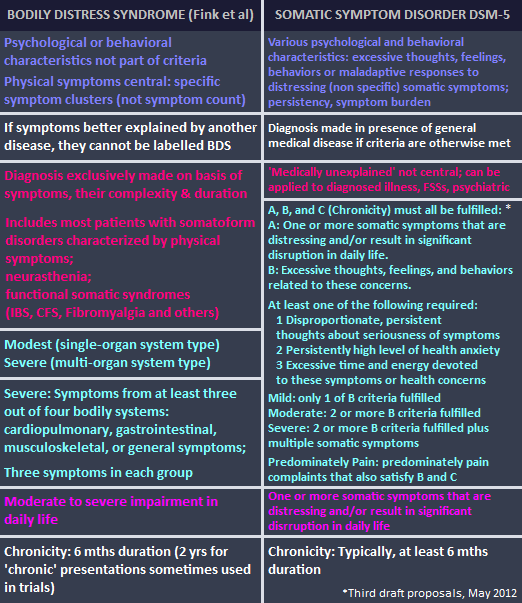
Note the use of the term “Bodily Distress Syndrome (BDS)” despite the lack of a body of evidence to support the validity, reliability, safety and clinical utility of the application of the BSD construct* in primary care.

Note also, the list of illnesses under the definition of “MUS”: Chronic Pain, Fibromyalgia, Somatic Anxiety/Depression, Irritable Bowel Syndrome (IBS), Chronic Fatigue Syndrome (CFS), Myalgic Encephalomyelitis (ME), Post-viral Fatigue Syndrome.

*For information on the Fink et al concept of “Bodily Distress Syndrome” see Part Two of Dx Revision Watch Post: ICD-11 Beta draft and BDD, Per Fink and Bodily Distress Syndrome


Extracts:

22 May 2013

NHS England

PILOT OF ENHANCED GP MANAGEMENT OF PATIENTS WITH MEDICALLY UNEXPLAINED SYMPTOMS

NHS Barnet Clinical Commissioning Group

Background

Medically Unexplained Symptoms

Definition

The term ‘medically unexplained symptoms (MUS)’ are physical symptoms that cannot be explained by organic pathology, which distress or impair the functioning of the patient. Patients often present with physical symptoms that cannot be explained even after thorough investigation. Other terms used to describe this patient group include: Functional Somatic Syndrome (FSS), Illness Distress Symptoms (IDS), Idiopathic Physical Symptoms (IPS), Bodily Distress Syndrome (BDS) and Medically Unexplained Physical Symptoms (MUPS).

Symptoms and Diagnosis

Symptoms

Headache
Shortness of Breath, palpitations
Fatigue, weakness, dizziness
Pain in the back, muscles, joints, extremity pain, chest pain, numbness
Stomach problems, loose bowels, gas/bloating, constipation, abdominal pain
Sleep disturbance, difficulty concentrating, restlessness, slow thoughts
Loss of appetite, nausea, lump in throat
Weight change

Diagnosis

Chronic Pain
Fibromyalgia
Somatic Anxiety/Depression
Irritable Bowel Syndrome
Chronic Fatigue Syndrome
Myalgic Encephalomyelitis
Post-viral Fatigue Syndrome

PROJECT AIMS AND OBJECTIVES

• To pilot a commissioner initiated, enhanced GP management service for patients with MUS in primary care. Refer to Figure 1 for details.

• The pilot will be carried out at selected Barnet GP practices (approximately 15) managing a minimum of 10 patients with MUS over 12 months.

• To identify patients with MUS using an electronic risk stratification tool the ‘Nottingham Tool’ with a review of the generated list at a multidisciplinary (MDT) GP practice meeting for the final patient selection.

• To enhance post-graduate GP training by providing education and training workshops and focused work group meetings on the management of MUS.

• The project will also test the assertion that identification and management of MUS would result in savings to commissioning budgets.

PROJECT OUTCOMES AND BENEFITS

There are several benefits that could be realised from implementing this project. These are as follows:-

• Improved outcomes for patients with MUS, better patient experience

• Improved quality of life

• Improved GP-Patient relationship

• Reduced GP secondary and tertiary referrals

• Reduced unnecessary GP and hospital investigations and prescribing of medicines

• Reduced GP appointments and out of hours appointments to A&E or GP

CONCLUSIONS

There is a high prevalence of patients with medically unexplained symptoms presenting to primary and secondary care services. Patients with MUS are high healthcare service users having a major impact to our local health economy and health outcomes. GPs are well placed to manage MUS patients as this patient group are 50% more likely to attend primary care. We believe that our proposed enhanced management of care by the GP will result in both market and non-market benefits. This proposal has gained approval from the NHS Barnet CCG Primary Care Strategy and Implementation Board, QIPP Board and the NCL Programme Board for the 2013/14 financial year…

etc.

Related material

+++
IAPT NHS Long Term Conditions and Medically Unexplained Symptoms

IAPT NHS Medically Unexplained Symptoms

PHQ-15

The “Nottingham Tool”

Click link for PDF document   Medically Unexplained Symptoms (MUS): A Whole Systems Approach in Plymouth

In partnership with:

Plymouth Hospitals NHS Trust, Sentinel Healthcare Southwest CIC, Southwest Development Centre, September 2009

+++

Click link for PDF document   Medically Unexplained Symptoms (MUS) A whole systems approach
NHS Commissioning Support for London
July 2009 – December 2010

+++

Psychologists’ perspectives on the diagnostic classification of mental disorders: Results from the WHO-IUPsyS Global Survey

Post #263 Shortlink: http://wp.me/pKrrB-3dj

Psychologists’ perspectives on the diagnostic classification of mental disorders: Results from the WHO-IUPsyS Global Survey

Int J Psychol. 2013 Jun 10. [Epub ahead of print]

Psychologists’ perspectives on the diagnostic classification of mental disorders: Results from the WHO-IUPsyS Global Survey.

Evans SC, Reed GM, Roberts MC, Esparza P, Watts AD, Correia JM, Ritchie P, Maj M, Saxena S.
Source
a Clinical Child Psychology Program, University of Kansas, Lawrence , KS, USA.

Abstract

This study examined psychologists’ views and practices regarding diagnostic classification systems for mental and behavioral disorders so as to inform the development of the ICD-11 by the World Health Organization (WHO). WHO and the International Union of Psychological Science (IUPsyS) conducted a multilingual survey of 2155 psychologists from 23 countries, recruited through their national psychological associations. Sixty percent of global psychologists routinely used a formal classification system, with ICD-10 used most frequently by 51% and DSM-IV by 44%. Psychologists viewed informing treatment decisions and facilitating communication as the most important purposes of classification, and preferred flexible diagnostic guidelines to strict criteria. Clinicians favorably evaluated most diagnostic categories, but identified a number of problematic diagnoses. Substantial percentages reported problems with crosscultural applicability and cultural bias, especially among psychologists outside the USA and Europe. Findings underscore the priority of clinical utility and professional and cultural differences in international psychology. Implications for ICD-11 development and dissemination are discussed.

PMID: 23750927

[PubMed – as supplied by publisher]

+++

Slide Presentation: Aug 3, 2012

The WHO-IUPsyS Global Survey of Psychologists’ Attitudes Toward Mental Disorders Classification.

Download PDF WHO-IUPsyS Global Survey slides

+++
More information on this WHO study can be found on Page 7 (3.) of this report:

http://www.apa.org/international/outreach/icd-report-2012.pdf

2012 Annual Report of the International Union of Psychological Science to the American Psychological Association

Revision of World Health Organization’s ICD-10 Mental and Behavioural Disorders

Pierre L.-J. Ritchie, Ph.D., Main Representative to the World Health Organization, International Union of Psychological Science, January, 2013

Click link for PDF document    WHO-IUPsyS ICD Survey Report Report 2012

This report also sets out the responsibilities of ICD Revision working groups, on Page 3 (1.1), and gives some information on the field studies for ICD-11 and ICD11-PHC, on Page 8 (4.)

+++

The earlier study: WPA-WHO Global Survey of Psychiatrists’ Attitudes Towards Mental Disorders Classification can be downloaded here: 

The WPA-WHO Global Survey of Psychiatrists’ Attitudes Towards Mental Disorders Classification

World Psychiatry 2011;10:118-131

Research report

Geoffrey M Reed, João Mendonça Correia, Patricia Esparza, Shekhar Saxena, Mario Maj

+++

DSM-5 released: professional and campaigning reaction: Round up #7

Post #262 Shortlink: http://wp.me/pKrrB-3cF

DSM-5 released: professional and campaigning reaction: Round up #7

A considerable amount of media coverage and commentary on DSM-5 has been published since posting Round up #6, on May 24. Occupied with other matters, I shall likely not catch-up. The world will continue to turn.

Here, though, are some recent commentaries from psychiatry and psychology professionals; a report from Prof Sir Simon Wessely on last week’s Institute of Psychiatry’s two day DSM-5 Conference; below that, new Online Assessment Measures documents from the APA’s DSM-5 Resource pages, including Somatic Symptom assessment instruments for 6-17 year olds, and a clarification from CMS on HIPAA and the status of the DSM-5 code sets.

Via Patrick Landman

Pédopsychiatre, Psychiatre, Président d’Initiative Pour une Clinique du Sujet Stop-Dsm, Psychanalyste Membre d’Espace Analytiquea

A statement written and signed by prominent French psychiatrists in response to recent comments by APA President-Elect, Jeffrey Lieberman, was issued, yesterday:

Full text on the STOP-DSM campaign website:

To oppose the DSM-5 is not to oppose psychiatry

Recently, some of the DSM-5 supporters have been trying to portray the opposition against the fifth edition of this manual of the American Psychiatric Association as an opposition to psychiatry and a form of antipsychiatry. This political argument aims to discredit the movement and to subsume it in its entirety, including its numerous variations, under a single label, one that can easily be identified and connected with a certain history, the sixties. Such specious rhetoric allows its authors not to have to respond to serious and well-documented arguments of the DSM-5 critics. In reality, its many opponents from Europe, Australia, South America and even the United States include a great number of psychiatrists, clinical psychologists, social workers and other mental health practitioners… Read on


Report on the website of South London and Maudsely NHS Foundation Trust from Prof Sir Simon Wessely on the Institute of Psychiatry’s recent DSM-5 Conference.

Prof Wessely is Head of the Department of Psychological Medicine and Vice Dean, Institute of Psychiatry, King’s College London. 

DSM-5 at the IoP

Monday June 10, 2013

The latest and fifth version of the Diagnostic and Statistical Manual of the American Psychiatric Association (APA), invariably known as the DSM, was published on 18 May 2013. To mark the occasion, we hosted an international conference at the Institute of Psychiatry from 3-4 June. This was the first such meeting since the launch and the first platform for Professor David Kupfer, Chair of Psychiatry at the Western Psychiatric Institute in Pittsburgh, but more importantly for us, the man who has directed the compilation and development of DSM-5, and who is justly regarded as its architect…

…I used the somatoform disorders as an example of where “DSM feared to tread”. The latest attempt to come up with something that is both empirically rigorous but also suitable for real world use in this particular area represents a small step forward, at least in simplifying an area of previous mind numbing complexity, but I suggested, was unlikely to represent real progress. This is because the DSM (and for that matter the ICD) are both diagnostic systems that are written by psychiatrists but which in this area need to be used by physicians, who ignore them, and concern patients who don’t like them, often fiercely so… Full Text


Essay by Sarah Kamens MA on the Dx Summit platform

DSM-5′s Somatic Symptom Disorder: From Medical Enigma to Psychiatric Sphinx

Sarah Kamens is a Ph.D. candidate in clinical psychology at Fordham University and in media & communications at the European Graduate School (EGS). Her work focuses on diagnostic discourse and sociopolitics in the psy disciplines.


Spiked Review of Books

‘This manual is, frankly, a disaster for children’

Christopher Lane talks to spiked about the new edition of the bible of psychiatry – ‘a legal document facilitating the medication of millions’.

by Helene Guldberg


http://www.psychiatry.org/dsm5

DSM-5 Online Assessment Measures

APA is inviting clinicians and researchers to provide feedback on the instruments’ usefulness in characterizing patient status and improving patient care. There are a large number of documents that can be downloaded from the link above, including:

For Adults

LEVEL 2–Somatic Symptom–Adult (Patient Health Questionnaire 15 Somatic Symptom Severity Scale [PHQ-15])

For Parents of Children Ages 6–17

LEVEL 2—Somatic Symptom—Parent/Guardian of Child Age 6-17 (Patient Health Questionnaire 15 Somatic Symptom Severity Scale [PHQ-15])

For Children Ages 11–17

LEVEL 2—Somatic Symptom—Parent/Guardian of Child Age 11-17 (Patient Health Questionnaire 15 Somatic Symptom Severity Scale [PHQ-15])

Clinician-Rated

Clinician-Rated Severity of Somatic Symptom Disorder


Finally, a note on the FAQ pages of the CMS.gov website which clarifies the non official status of DSM-5 code sets:

Frequently Asked Questions

(FAQ1817)

[Q] In current practice by the mental health field, many clinicians use the DSM-IV in diagnosing mental disorders. As of May 19, 2013, the DSM-5 was released. Can these clinicians continue current practice and use the DSM-IV and DSM-5 diagnostic criteria?

[A] Yes. The Introductory material to the DSM-IV and DSM-5 code set indicates that the DSM-IV and DSM-5 are “compatible” with the ICD-9-CM diagnosis codes. The updated DSM-5 codes are crosswalked to both ICD-9-CM and ICD-10-CM. As of October 1, 2014, the ICD-10-CM code set is the HIPAA adopted standard and required for reporting diagnosis for dates of service on and after October 1, 2014.

Neither the DSM-IV nor DSM-5 is a HIPAA adopted code set and may not be used in HIPAA standard transactions. It is expected that clinicians may continue to base their diagnostic decisions on the DSM-IV/DSM-5 criteria, and, if so, to crosswalk those decisions to the appropriate ICD-9-CM and, as of October 1, 2014, ICD-10 CM codes. In addition, it is still perfectly permissible for providers and others to use the DSM-IV and DSM-5 codes, descriptors and diagnostic criteria for other purposes, including medical records, quality assessment, medical review, consultation and patient communications.

Dates when the DSM-IV may no longer be used by mental health providers will be determined by the maintainer of the DSM-IV/DSM-5 code set, the American Psychiatric Association, http://www.dsm5.org

(FAQ1817)

Somatic Symptom Disorder in recent journal papers

Post #261 Shortlink: http://wp.me/pKrrB-3ah

Somatic Symptom Disorder in recent journal papers

Somatic Symptom Disorder is also included in Saving Normal: An Insider’s Revolt Against Out-Of-Control Psychiatric Diagnosis, Dsm-5, Big Pharma, and the Medicalization of Ordinary Life (pp. 193-6): Allen Frances, William Morrow & Company (20 May 2013).

Also in Essentials of Psychiatric Diagnosis: Responding to the Challenge of DSM-5 (Chapter 16): Allen Frances, Guilford Press (14 June 2013).

In the June edition of Journal of Nervous and Mental Disorders, Allen Frances, MD, who chaired the Task Force for DSM-IV, discusses his concerns for the loosely defined DSM-5 category, Somatic Symptom Disorder, sets out his suggestions for revising the criteria prior to finalization, as presented to the SSD Work Group chair, in December, and advises clinicians against using the new SSD diagnosis.

http://www.ncbi.nlm.nih.gov/pubmed/23719325

DSM-5 Somatic Symptom Disorder.

Frances A.

Department of Psychiatry, Duke University, Durham, NC.

J Nerv Ment Dis. 2013 Jun;201(6):530-1. doi: 10.1097/NMD.0b013e318294827c. No abstract available.

PMID: 23719325

[PubMed – in process]

+++

Commentary by Allen Frances, MD, and Suzy Chapman in the May issue of Australian and New Zealand Journal of Psychiatry. The paper discusses the over-inclusive DSM-5 Somatic Symptom Disorder criteria and the potential implications for diverse patient groups. The paper concludes by advising clinicians not to use the new SSD diagnosis.

http://www.ncbi.nlm.nih.gov/pubmed/23653063

DSM-5 somatic symptom disorder mislabels medical illness as mental disorder.

Allen Frances¹, Suzy Chapman²

1 Department of Psychiatry, Duke University 2 DxRevisionWatch.com

Aust N Z J Psychiatry. 2013 May;47(5):483-4. doi: 10.1177/0004867413484525. No abstract available.

PMID: 23653063

[PubMed – in process]

+++

The April 22 edition of Current Biology published a feature article on DSM-5 by science writer, Michael Gross, Ph.D. The article includes quotes from Allen Frances, MD, and Suzy Chapman on the implications for patients for the application of the new DSM-5 Somatic Symptom Disorder. The article includes concerns for the influence of Somatic Symptom Disorder on proposals for a new ICD category – Bodily Distress Disorder – being field tested for ICD-11 and ICD-11-PHC.

Current Biology 22 April, 2013 Volume 23, Issue 8

Copyright 2013 All rights reserved. Current Biology, Volume  23, Issue  8, R295-R298, 22 April 2013

doi:10.1016/j.cub.2013.04.009

Feature

Has the manual gone mental?

Michael Gross

Full text: http://www.cell.com/current-biology/fulltext/S0960-9822(13)00417-X

PDF: http://download.cell.com/current-biology/pdf/PIIS096098221300417X.pdf

+++

In this opinion piece, published in the BMJ, March 18, Allen Frances, MD, strongly opposes the new Somatic Symptom Disorder, discusses its lack of specificity, data from the field trials and advises clinicians to ignore this new category.

http://www.ncbi.nlm.nih.gov/pubmed/23511949

The new somatic symptom disorder in DSM-5 risks mislabeling many people as mentally ill.

Frances A.

Allen Frances, chair of the DSM-IV task force

BMJ. 2013 Mar 18;346:f1580. doi: 10.1136/bmj.f1580. No abstract available.

PMID: 23511949

[PubMed – indexed for MEDLINE]

+++

Further reading

APA Somatic Symptom Disorder Fact Sheet APA DSM-5 Resources

Somatic Chapter Drops Centrality Of Unexplained Medical Symptoms Psychiatric News, Mark Moran, March 1, 2013

Somatic Symptoms Criteria in DSM-5 Improve Diagnosis, Care David J Kupfer, MD, Chair, DSM-5 Task Force, defends the SSD construct, Huffington Post, February 8, 2013

The new somatic symptom disorder in DSM-5 risks mislabeling many people as mentally ill Allen Frances, MD, BMJ 2013;346:f1580 BMJ Press Release

Somatic Symptom Disorder could capture millions more under mental health diagnosis Suzy Chapman, May 26, 2012

Mislabeling Medical Illness As Mental Disorder Allen Frances, MD, Psychology Today, DSM 5 in Distress, December 8, 2012

Why Did DSM 5 Botch Somatic Symptom Disorder? Allen Frances, MD, Psychology Today, Saving Normal, February 6, 2013

New Psych Disorder Could Mislabel Sick as Mentally Ill Susan Donaldson James, ABC News, February 27, 2013

Dimsdale JE. Medically unexplained symptoms: a treacherous foundation for somatoform disorders? Psychiatr Clin North Am 2011;34:511-3. [PMID: 21889675]

Karina Hansen initiatives: A clarification

Post #260 Shortlink: http://wp.me/pKrrB-38n

Karina Hansen initiatives: Clarification notice

I have now published three posts on my site in relation to the Hansen family’s situation:

Something rotten in the state of Denmark: Karina Hansen’s story: http://wp.me/pKrrB-2Xc

(In English)

Human Rights denied: Something rotten in the state of Denmark: Karina Hansen’s story: Update 1: http://wp.me/pKrrB-35o

(Update in English)

Menneskerettighederne nægtet: Noget råddent i staten Danmark: Karina Hansen: Opdater 1: http://wp.me/pKrrB-36e

(Update in English and Danish)

Clarification

Reports and updates on Dx Revision Watch site on the Hansen family’s situation are being published as provided by, and in consultation with, Rebecca Hansen, Chairman, ME Foreningen, Danmark (ME Association, Denmark), or edited from reports as provided.

Dx Revision Watch site has no connection with any petitions or initiatives, or with any social media platforms or other platforms set up to promote petitions or initiatives, or to otherwise raise awareness of the Hansen family’s situation.

All enquiries in relation to any petitions or other initiatives, or social media platforms, or any other platforms associated with them should be addressed directly to the organizers, sponsors or owners responsible for them.

+++
The official petition launched and sponsored by ME Foreningen, Danmark and approved by the Hansen family can be found here: http://www.ipetitions.com/petition/postcardtokarina/

For more information on the ME Foreningen, Danmark petition go here on Facebook

Website:

ME Foreningen, Danmark
www.me-foreningen.dk

For first report (in English) see: Something rotten in the state of Denmark: Karina Hansen’s story: http://wp.me/pKrrB-2Xc

For more information on the ME Association of Denmark’s postcard campaign go here on Facebook
For information on Bodily Distress Syndrome see Part Two of Dx Revision Watch Post: ICD-11 Beta draft and BDD, Per Fink and Bodily Distress Syndrome
Menneskerettighederne nægtet: Noget råddent i staten Danmark: Karina Hansen: Opdater 1: http://wp.me/pKrrB-36e
Human Rights denied: Something rotten in the state of Denmark: Karina Hansen’s story: Update 1: http://wp.me/pKrrB-35o
Ontkenning van mensenrechten: Iets verrot in de staat van Denemarken: Het verhaal van Karina Hansen: Update 1: http://wp.me/pKrrB-35o
Menschenrechtsverstoß: Etwas ist faul in Dänemark: Karina Hansens Geschichte: Update 1: http://wp.me/pKrrB-35o
Droits de l’Homme: Il y a quelque chose de pourri au royaume du Danemark: l’histoire de Karina Hansen: Update 1: http://wp.me/pKrrB-35o

New Danish and German guidelines for “Bodily distress” and functional disorders published

Post #259 Shortlink: http://wp.me/pKrrB-36F

New Danish and German guidelines for “Bodily distress” and “functional disorders”

Update:

Slide presentation [23 slides in PDF format]

http://www.regionsyddanmark.dk/dwn225587

Or open on Dx Revision Watch site:

Session 4 – Medicinsk uforklarede symptomer – Marianne Rosendal

Medicinsk uforklarede symptomer og funktionelle lidelser

“Medically unexplained symptoms and functional disorders”

Marianne Rosendal, Research Unit for General Practice, Institute of Public Health, Aarhus University

+++
Related information:

Trygfonden invites applications for funding for research on functional disorders
http://www.kronisktraethedssyndrom.dk/Diverse/Trygfonden.pdf
Trygfonden has allocated 48 million for research on functional disorders. The application deadline for the last 28 million kroner is 6 April 2010.
Lene Toscano får 3,3 mio. kr. til formidling af viden om funktionelle lidelser
Lene Toscano gets 3.3 million kr. for dissemination of knowledge about functional disorders
Specialist in General Medicine Lene Toscano, Aarhus University Hospital, has received 3,336,458 kr. from TrygFonden to examine how best to communicate and share knowledge about functional disorders.

+++
As previously posted:

In February, I published information on the status of current proposals for revision of ICD-10 “Somatoform Disorders” for the ICD-11 core version, as displayed in the ICD-11 Beta drafting platform, and on proposals for ICD-11-PHC, the abridged primary care version of ICD.

In Part Two of that post, I compiled information on “Bodily Distress Syndrome,” a disorder construct developed by Per Fink and colleagues initially for research studies, now used in clinical practice at The Research Clinic for Functional Disorders and Psychosomatics, Aarhus.

See post #222 ICD-11 Beta draft and Bodily Distress Disorders; Per Fink and Bodily Distress Syndrome Parts One and Two

+++

Today, I have three new “Bodily Distress Disorders” related items to bring to your attention:

1. The World Psychiatric Association (WPA) is holding its 2013 International Congress in October, in Vienna. Four topics relating to “Bodily Distress Disorders” are being presented:

Bodily Distress Disorders and the new classifications

Bodily Distress Disorders at the work place: prevention and treatment

A stepped care approach for bodily distress disorders: the new interdisciplinary German guideline

Raising the awareness for the health political relevance of Bodily Distress Disorders – a European agenda

Symposia presenters include:

Francis Creed (member of the DSM-5 Somatic Symptom Disorders Work; member of the WHO Working Group on Somatic Distress and Dissociative Disorders, reporting to the International Advisory Group for the Revision of ICD-10 Mental and Behavioural Disorders; co-author book [1], paper [2]).

Per Fink (The Research Clinic for Functional Disorders and Psychosomatics, Aarhus, Denmark, co-author book [1], paper [3]).

Peter Henningsen (Co-author book [1]).


2] A new German guideline has been published, with summary texts in German and English language:

Neue Leitlinien zu funktionellen und somatoformen Störungen

CLINICAL PRACTICE GUIDELINE Non-Specific, Functional, and Somatoform Bodily Complaints

Rainer Schaefert, Constanze Hausteiner-Wiehle, Winfried Häuser, Joram Ronel, Markus Herrmann, Peter Henningsen. Dtsch Arztebl Int 2012; 109(47): 803−13 [PMID 23341111]

Abstract [in English] here:

New guidelines on functional and somatoform disorders

The S3 guideline “Dealing with patients with non-specific, functional and somatoform bodily symptoms” emphasizes the similarities in the management of the manifold manifestations of so called “medically unexplained symptoms” and gives recommendations for a stepped and collaborative diagnostic and therapeutic approach in all subspecialties and all levels of health care. It has a special focus on recommendations regarding attitude, physician-patient-relationship, communication, the parallelization of somatic and psychosocial diagnostics and a stepped therapeutic approach. The “Evidence-based guideline psychotherapy in somatoform disorders and associated syndromes” provides a differentiated analysis of the current evidence regarding the effectiveness of various psychotherapeutic interventions for the most relevant manifestations of functional and somatoform disorders. In combination, both guidelines pose important advances for treatment quality in Germany, but also illustrate remarkable structural and research deficits.

Abstract [in German] here:

Neue Leitlinien zu funktionellen und somatoformen Störungen

Official summary version texts:

English language version:
S3 Clinical Practice Guideline: Non-specific, Functional, and Somatoform Bodily Complaints” (NFS)
or open PDF on Dx Revision Watch:
S3 Non-specific, Functional and Somatoform Bodily Complaints 2013-01

+++
German language version:

http://www.aerzteblatt.de/archiv/132847
MEDIZIN: Klinische Leitlinie Nicht-spezifische, funktionelle und somatoforme Körperbeschwerden
Clinical Practice Guideline: Non-specific, functional and somatoform bodily complaints
Dtsch Arztebl Int 2012; 109(47): 803-13; DOI: 10.3238/arztebl.2012.0803
or open PDF on Dx Revision Watch:
Nicht-spezifische, funktionelle und somatoforme Körperbeschwerden

Correspondence in response to summary version:

Letter: Iatrogenic Chronification as a Result of Pseudo Diagnosis
Dr. med. Rainer Hakimi, Stuttgart
In Reply:
Dr. med. Rainer Schaefert
Klinik für Allgemeine Innere Medizin und Psychosomatik, Universitätsklinikum Heidelberg

3] New Danish Association for General Practitioners (DSMA) guide for general practice on functional disorders:

Funktionelle lidelser for Almen Praksis

Ny vejledning sætter fokus på funktionelle lidelser Practicus | April 2013

“New guide focuses on functional disorders”

[Article in Danish]

This article introduces the new Danish Association for General Practitioners (DSMA) guide for general practitioners, published this May. The Working Group for the guide, which included Per Fink, was chaired by Marianne Rosendal.

Access document here in PDF [in Danish]:

Funktionelle lidelser Dansk Selskab for Almen Medicin 2013

or open PDF on Dx Revision Watch: Funktionelle lidelser 2013

Related information:
Lene Toscano får 3,3 mio. kr. til formidling af viden om funktionelle lidelser
Lene Toscano gets 3.3 million kr. for dissemination of knowledge about functional disorders
Specialist in General Medicine Lene Toscano, Aarhus University Hospital, has received 3,336,458 kr. from TrygFonden to examine how best to communicate and share knowledge about functional disorders.

Notes:

ICD-11 Beta drafting platform Bodily Distress Disorder: Mild; Moderate; Severe

“Bodily distress disorder” (BDD) is being proposed as a new category for ICD-11 to replace a number of existing ICD-10 “Somatoform Disorders.”

An alternative construct, called Bodily stress syndrome (BSS), has been put out for international primary care focus group evaluation by the working group for the revision of ICD-10-PHC (the abridged primary care version of ICD-10), and will be undergoing ICD-11 field testing and analysis. There is no public domain information available on where BSS will be field tested or on field trial study design, patient selection, criteria etc.

Although ICD-11 is at the Beta drafting stage and scheduled for WHA approval in 2015, the public version of the Beta drafting platform has yet to define this proposed new BDD category, characterize its three, proposed severities: Mild; Moderate; Severe, or populate any of its “Content Model” parameters.

It has sat there since February 2012, a tabula rasa.

At the time of writing, it remains unspecified which disorders BDD is proposed to capture.

It isn’t clear whether its criteria are proposed to be based on unspecified somatic symptoms, symptom counts or specific constellations of symptoms (eg gastrointestinal, musculoskeletal); whether psychological or behavioural responses are central to its definition; whether it is intended to be inclusive of selected of the so-called “functional somatic syndromes”; whether, like DSM-5’s SSD, its reach would be extended to include patients with somatic symptoms in association with diagnosed diseases, such as cancer or diabetes.

It is not possible to determine from what little information displays in the public version of the drafting platform whether ICD-11 proposes that BDD would mirror or incorporate Per Fink’s construct of “Bodily Distress Syndrome” for definition, criteria, severity specifiers, inclusions, exclusions etc; or whether it intends BDD to also incorporate DSM-5’s “Somatic Symptom Disorder” (and if so, how might this be achieved, since BDS and SSD lack congruency); or whether a unique definition for BDD is being developed and tested specifically for ICD-11.

Until ICD-11 defines BDD, it presents barriers to professional and lay stakeholders inputting meaningful comment on this proposal, which has remained undefined for over a year.

If the working groups advising ICD-11 Revision are putting forward a Per Fink “BDS” model for BDD, or an adaptation of Per Fink’s model, it is not known how WHO classification experts view any proposal that might seek to shift several, discrete, ICD-10 categories with long-standing classification locations outside the Mental and behavioural disorders chapter of ICD, into Chapter 5, and subsume them under a new disorder construct, for which there is no body of evidence for its validity as a construct and safety of application outside research settings.

Note that the ICD-11 Beta draft is a work in progress: proposals for new disorders for ICD-11 are subject to field trial evaluation and approval by Topic Advisory Group Managing Editors, the ICD-11 Revision Steering Group and WHO classification experts.

These two papers and a book chapter discuss emerging proposals for ICD-11 and ICD-11-PHC:

Lam TP, Goldberg DP, Dowell AC, Fortes S, Mbatia JK, Minhas FA, Klinkman MS. Proposed new diagnoses of anxious depression and bodily stress syndrome in ICD-11-PHC: an international focus group study. Fam Pract 2012 [PMID: 22843638]*
Creed F, Gureje O. Emerging themes in the revision of the classification of somatoform disorders. Int Rev Psychiatry 2012;24:556-67. [PMID: 23244611]
Goldberg DP. Comparison Between ICD and DSM Diagnostic Systems for Mental Disorders. In: Sorel E, (Ed.) 21st Century Global Mental Health. Jones & Bartlett Learning, 2012: 37-53 [Free PDF, Sample Chapter Two: http://samples.jbpub.com/9781449627874/Chapter2.pdf]
*SHORT REPORT Kuruvilla, A, Jacob KS. Perceptions about anxiety, depression and somatization in general medical settings: A qualitative study. National Medical Journal of India, vol. 25, no. 6, pp. 332–335, 2012

+++

What is “Bodily Distress Syndrome”?

The Per Fink et al construct of BDS is a unifying diagnosis that encompasses a group of what are considered to be closely related conditions such as somatization disorder, fibromyalgia, chronic pain disorder, irritable bowel syndrome, chronic fatigue syndrome and ME, multiple chemical sensitivity (MCS) and whiplash associated disorder. On some BDS presentation slides, “Stress and burn out…and many more…” are added to the list.

From the Aarhus Research Clinic website:

“…recent research suggests that the different diagnoses are all subcategories of one single illness, namely BDS…

“…BDS is a new research diagnosis and therefore unfamiliar to many doctors. Most doctors do know the different diagnoses mentioned in the above box, but they are unaware that they can be viewed as one single illness…”

In May 2010, Per Fink and Andreas Schröder, PhD, MD, Aarhus Universitetshospital, Denmark, published the paper, “One single diagnosis, bodily distress syndrome, succeeded to capture 10 diagnostic categories of functional somatic syndromes and somatoform disorders.” [Abstract: PMID: 20403500].

According to the authors of this 2012 EACLPP Conference Abstract: Bodily Distress Syndrome: A new diagnosis for functional disorders in primary care, the concept of “Bodily Distress Syndrome”

is expected to be integrated into the upcoming versions of classification systems.

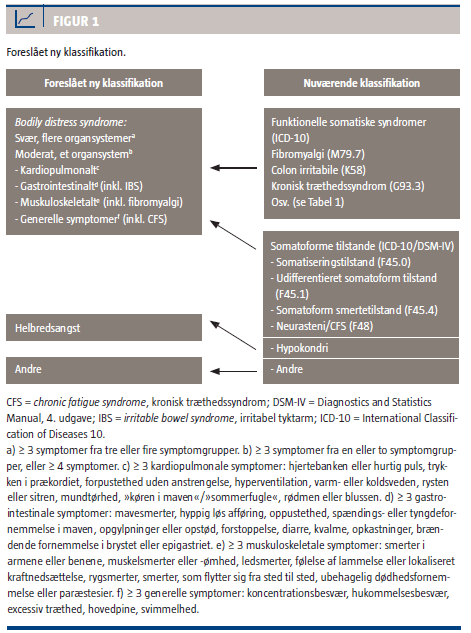
This 2010 Danish journal article sets out proposals by Fink et al for a new classification:

Journal article: Fink P, Rosendal, M et al. Ny fælles diagnose for de funktionelle sygdomme. [PDF, in Danish]

Note: This proposal by Fink, Rosendal et al has three hitherto discrete ICD-10 classifications, Fibromyalgia (M79.7), IBS (K58) and Chronic Fatigue Syndrome (indexed to G93.3 in ICD-10; classified in ICD-11 Beta draft as an ICD Title term within ICD-11 Chapter 6: Diseases of the nervous system) proposed to be relocated under the ICD-11 mental and behavioural disorders chapter (Chapter 5) and subsumed under a single new disorder classification, “Bodily Distress Syndrome,” along with Neurasthenia (F48.0), Hypochondriasis and some other ICD-10/DSM-IV Somatoform Disorders.

Page 1837

Proposed new classification on left;  Current classifications on right:
Danish Journal paper Fink P

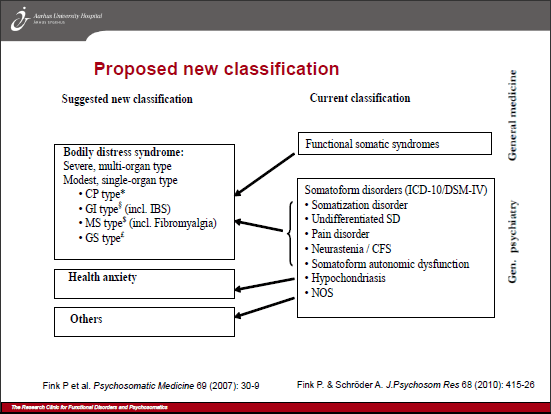
Here, the same proposal set out in English, from a Danish presentation:

(Note: MS type = Musculoskeletal)

Slide Presentation Two [PDF, in Danish; some slides in English]

Bodily Distress Syndrome (BDS), og helbredsangst  Udvikling af diagnoserne, assessment og forskning på området, Oplæg ved Sundhedspsykologisk, Årsmøde 2011

Slide #11 of 97
Fink: Proposed New Classification

For further information on proposals for “Bodily Distress Disorder” for ICD-11 and on Per Fink’s “Bodily Distress Syndrome” see Dx Revision Watch post #222: ICD-11 Beta draft and Bodily Distress Disorders; Per Fink and Bodily Distress Syndrome Parts One and Two

References

1. Medically Unexplained Symptoms, Somatisation and Bodily Distress: Developing Better Clinical Services. Creed, Francis; Henningsen, Peter; Fink, Per, Cambridge University Press, 2011. Sample pages on Google Books
2. Creed F, Gureje O. Emerging themes in the revision of the classification of somatoform disorders. Int Rev Psychiatry 2012;24:556-67. [Abstract: PMID: 23244611]
3. Fink P, Schröder A. One single diagnosis, bodily distress syndrome, succeeded to capture 10 diagnostic categories of functional somatic syndromes and somatoform disorders. J Psychosom Res. 2010 May;68(5):415-26. [Abstract: PMID: 20403500]
4. ICD-11 Beta drafting platform: Bodily Distress Disorder: Mild; Moderate; Severe. Proposed revision to ICD-10 Somatoform Disorders