Summary: September 19 ICD-9-CM Coordination and Maintenance Committee Meeting

Summary: September 19 ICD-9-CM Coordination and Maintenance Committee Meeting

Post #205 Shortlink: http://wp.me/pKrrB-2vc  

The September meeting of the ICD-9-CM Coordination and Maintenance Committee, jointly chaired by CMS and CDC, took place on September 19, 2012.

For further information on this public process see the CDC website page:

http://www.cdc.gov/nchs/icd/icd9cm_maintenance.htm

+++

Meeting Summary document

The meeting Summary document has now been published.  The audio is not yet available.

The Summary document can be downloaded here:

September 19, 2012

Summary (10 pages) [PDF – 59 KB]

http://www.cdc.gov/nchs/data/icd9/2012_September_Summary.pdf

or opened in PDF format here:     Summary September 19 2012

+++

The Proposals and Agenda document can be downloaded here:

http://www.cdc.gov/nchs/icd/icd9cm_maintenance.htm#meeting_materials

ICD-9-CM Coordination and Maintenance Committee Meeting

September 19, 2012

Proposals (74 pages) [PDF – 730 KB]

http://www.cdc.gov/nchs/data/icd9/Topic_packet_for_September_19_2012.pdf

or opened in PDF format here:     Topic packet for September 19 2012

According to the Summary document, the deadline for receipt of public comments on proposals submitted at this meeting is November 16, 2012. If there is any change to this date, I will update.

Comments on proposals presented at the ICD-9-CM Coordination and Maintenance Committee meeting should be sent to the following email address: nchsicd9CM@cdc.gov. See Page One of the Summary document for important information on submission of public comment.

Extract, Summary document

Chronic fatigue syndrome

Andreas Kogelnik, MD, representing the Coalition 4 ME/CFS, was available via telephone to address questions and clinical concerns.

Lori Chapo-Kroger, representing the Coalition 4 ME/CFS, expressed that many nations, and the World Health Organization, put CFS at G93 in ICD-10, and that this would include everyone but the U.S.

Mary Dimmock, representing the Coalition 4 ME/CFS, questioned why the change must wait until after 2014 when they feel that this is an error in the classification right now (and has been since 2001).

Dr. Kogelnik indicated that the term myalgic encephalomyelitis is used in Europe while the U.S. continues to use the term chronic fatigue syndrome, and that the Coalition 4 ME/CFS considers these two conditions (CFS and ME) to be the same. That is why they want both terms included in the same code.

Nelly Leon-Chisen, AHA, noted support for a need for a code for chronic fatigue syndrome distinct from chronic fatigue, unspecified. She indicated also that with the cause being unknown it is better that the classification not be locked into placing CFS as a viral code. Also, if there is no consensus for ME and CFS being the same then it makes sense to keep them as two separate codes. If research later develops that says they are the same then the data can be aggregated together. However, if the research does not show this, then you don’t have them lumped into one code that does not allow you to separate out one from the other.

Sue Bowman, AHIMA, questioned counting all CFS as following a virus infection. She expressed a need for clinical consensus on this condition. Also, she stated that she did not see a rationale for an early change (before 2014).

+++

Note: Dx Revision Watch has no connection with the Coalition 4 ME/CFS or with the development of any proposals submitted by this organization. The views and opinions expressed in Coalition 4 ME/CFS submissions to ICD-9-CM  Coordination and Maintenance Committee meetings represent the views of the Coalition 4 ME/CFS and its representatives and not the views of Dx Revision Watch.

All enquiries about proposals submitted to CMS/CDC on behalf of the Coalition 4 ME/CFS should be addressed directly to the Coalition 4 ME/CFS.

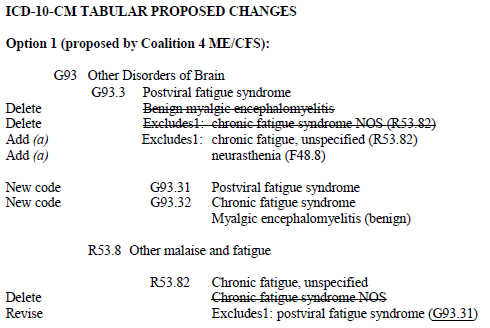
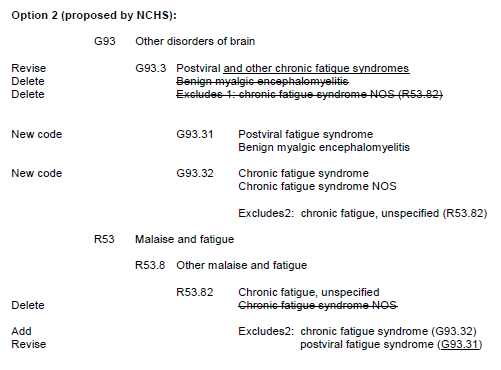
Note also that the proposal from the Coalition 4 ME/CFS (Option 1) and the alternative proposal presented by CMS/CDC (Option 2) at the September meeting are set out in accordance with the requirements of the ICD-9-CM Coordination and Maintenance Committee for the submission of proposals. 

For Options 1 and Option 2 see post Proposals: September 19 ICD-9-CM Coordination and Maintenance Committee Meeting or Proposals document Topic packet for September 19 2012

+++

Related posts:

Proposals: September 19 ICD-9-CM Coordination and Maintenance Committee Meeting

Coding CFS in ICD-10-CM: CFSAC and the Coalition4ME/CFS initiative

Extracts: ICD-9-CM Coordination and Maintenance Committee Meeting Summary document (CFS coding)

Extracts: ICD-9-CM Coordination and Maintenance Committee Meeting September 14, 2011 (Coding of CFS in ICD-10-CM)

Proposals: September 19 ICD-9-CM Coordination and Maintenance Committee Meeting

Proposals: September 19 ICD-9-CM Coordination and Maintenance Committee Meeting

Post #204 Shortlink: http://wp.me/pKrrB-2uL

The next meeting of the ICD-9-CM Coordination and Maintenance Committee, which is jointly chaired by CMS and CDC, takes place on September 19, 2012. 

There is a very full agenda for this meeting. The meeting materials Proposals document has now been published.

For further information on this public process see the CDC website page:

http://www.cdc.gov/nchs/icd/icd9cm_maintenance.htm

+++

The Proposals and Agenda document can be downloaded here:

http://www.cdc.gov/nchs/icd/icd9cm_maintenance.htm#meeting_materials

ICD-9-CM Coordination and Maintenance Committee Meeting

September 19, 2012

Proposals (74 pgs) [PDF – 730 KB]

http://www.cdc.gov/nchs/data/icd9/Topic_packet_for_September_19_2012.pdf

or opened in PDF format here:      Topic packet for September 19 2012

Note: I have no connection with the Coalition 4 ME/CFS or with the development of any proposals submitted by this organization. All enquiries about the proposal submitted to CMS/CDC on behalf of the Coalition 4 ME/CFS should be addressed directly to the Coalition 4 ME/CFS.

Note also that the proposal from the Coalition 4 ME/CFS and the alternative proposal from CMS/CDC are set out in accordance with the requirements of the ICD-9-CM C & M Committee for the submission of proposals.

+++

Coding of CFS in the forthcoming US specific ICD-10-CM

At the ICD-9-CM Coordination and Maintenance Committee’s September 14, 2011 meeting, a presentation had been made on behalf of the Coalition 4 ME/CFS in relation to the formal submission of a proposal.

The proposal requested that consideration be given to moving the classification of Chronic fatigue syndrome from its current proposed location within the ICD-10-CM R code chapter (Chapter 18: Symptoms and signs) to the G code chapter (Chapter 6: Diseases of the nervous system).

This would bring the chapter location of Chronic fatigue syndrome in ICD-10-CM in line with the international version of ICD-10, the Canadian ICD-10-CA and proposals for the forthcoming ICD-11.

No NCHS decision reached in response to the September 2011 proposals and the public comments received in respect of these proposals was conveyed following closure of the public comment period, last November.

However, further discussion of Chronic fatigue syndrome and two additional proposals are tabled on the agenda for discussion at the September 19, meeting, tomorrow.

I am appending the relevant extract from the Diagnosis Agenda and Proposals document which was published on the CDC  website overnight. An official audio and a Summary of the meeting should be available in due course on the CDC website. I will update with these when available.

+++

Extract Topic packet for September 19 2012 (Page 46)

[…]

Chronic fatigue syndrome

Andreas Kogelnik, M.D., Coalition 4 ME/CFS

Chronic fatigue syndrome

A proposal, submitted by the Coalition 4 ME/CFS, to modify codes for chronic fatigue syndrome (CFS) was presented and discussed at the September 2011 ICD Coordination and Maintenance Committee meeting. The National Center for Health Statistics also presented an alternative proposal, Option 2. There were many comments from the audience, and there was general support for the NCHS-proposed Option 2, moving CFS from Chapter 18, Symptoms, signs and abnormal clinical findings, not elsewhere classified, to Chapter 6, Diseases of the Nervous System but retaining separate codes for CFS and myalgic encephalomyelitis (ME). The rationale for retaining separate codes included agreement on the importance of being able to extract data on the two conditions separately or combine, as needed. It was also noted that term ME is not seen in medical record documentation. Written comments received on this issue were inconclusive. There was not agreement that the two conditions are the same. While some comments were from private citizens, others were from advocacy organizations and associations that represent health care providers and other large constituencies that use the classification. The public comment period following the meeting is not meant as a poll or survey. Analysis of public comment focused on the substance of the comments; whether there was a clear scientific consensus regarding the etiology and manifestations of the condition; and an understanding of the classification, its structure and conventions, and its uses by the health care industry.

As noted in the information from the September 2011 presentation, the cause or causes of CFS remain unknown, despite a vigorous search. While a single cause for CFS may yet be identified, another possibility is that CFS represents a spectrum of illnesses resulting from multiple possible pathways. Conditions that have been proposed to trigger the development of CFS include infections, trauma, immune dysfunction, stress, and exposure to toxins. Research in this area is ongoing.

There are several case definitions currently in use, some separating CFS from ME, and others merging the two conditions. The most widely used are the 1994 case definition (http://www.cdc.gov/cfs/case-definition/index.html ), the Canadian and the Oxford definitions. A new case definition for ME was published in the 2011 international consensus criteria that emphasized recent research and clinical experience that strongly point to widespread inflammation and multisystem symptoms and neuropathology. This new definition, which considers ME and CFS as synonymous terms, however, has not been widely vetted by the health care community at large. While there is no consensus on one case definition, there is consensus that this is a serious and complex syndrome, and it is likely that there are multiple subgroups. It has been noted that some providers use the terms interchangeably while others consider one condition a subgroup of the other. There is also some overlap with fibromyalgia and CFS/ME could be considered one of the multiple chronic overlapping pain conditions.

References

1. Fukuda et al. Ann Intern Med (1994) 121:953-959
(http://www.cdc.gov/cfs/case-definition/1994.html )
2. Holmes et al. Ann Intern Med (1988) 108:387-389.
3. Sharpe et al. J Roy Soc Med (1991) 84:118-121
4. Carruthers et al. J CFS (2003) 11:7-97
5. Carruthers et al.. J Intern Med (2011) 270: 327-38.

The Coalition 4 ME/CFS has stated that they do not support Option 2 proposed in September 2011 and have submitted a revised proposal. A revised Option 2 is also being proposed, consistent with comments received supporting Option 2 as noted above. The Coalition is also requesting that their proposal be considered for implementation prior to October 1, 2014 even though the condition is not a new disease and therefore does not meet the criteria for implementation during the partial freeze.

Based on the above, the following proposals for consideration are:

+++

+++
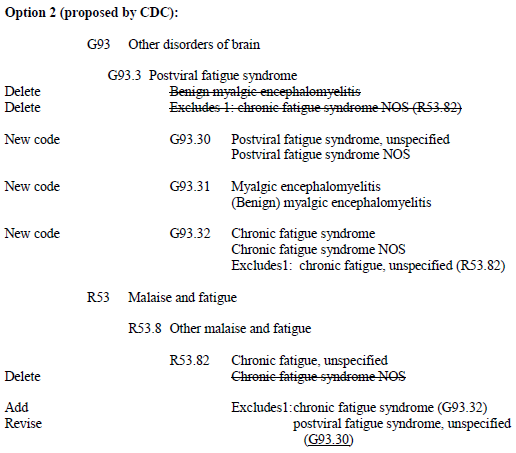
For comparison, the proposal that had been presented by CDC at the September 2011 meeting in counterpoint to an earlier proposal presented by the Coalition 4 ME/CFS at that same meeting was this:


Instead of Title term G93.3 Postviral and other chronic fatigue syndromes (CDC Option 2, September 2011)

CDC suggests retaining the Title term G93.3 Postviral fatigue syndrome (CDC Option 2, September 2012).

+++
Instead of Child category G93.31 Postviral fatigue syndrome, Benign myalgic encephalomyelitis

CDC is now suggesting two categories for Postviral fatigue syndrome, thus:

G93.30 Postviral fatigue syndrome, unspecified, Postviral fatigue syndrome NOS (not otherwise specified)

with a discrete Child category G93.31 Myalgic encephalomyelitis, Benign myalgic encephalomyelitis.

+++
No suggested change to the September 2011 CDC Option 2 suggestion for Child categories:

G93.32 Chronic fatigue syndrome, Chronic fatigue syndrome NOS.

The+++

Related posts:

Coding CFS in ICD-10-CM: CFSAC and the Coalition4ME/CFS initiative

Extracts: ICD-9-CM Coordination and Maintenance Committee Meeting Summary document (CFS coding)

Extracts: ICD-9-CM Coordination and Maintenance Committee Meeting September 14, 2011 (Coding of CFS in ICD-10-CM)

Notice of Meeting of the ICD-9-CM Coordination and Maintenance Committee

Notice of Meeting of the ICD-9-CM Coordination and Maintenance Committee

Post #201 Shortlink: http://wp.me/pKrrB-2tv

Update at August 18:

CMS meeting to address more ICD-10 issues  Round up from Carl Natale for ICD10 Watch

September ICD-9-CM C & M meeting announced

The next meeting of the ICD-9-CM Coordination and Maintenance Committee has been announced for September 19, 2012 and a tentative agenda published.

For further information on this public process see the CDC website page:

The 2013 release of ICD-10-CM is available to download from the CDC site: International Classification of Diseases, Tenth Revision, Clinical Modification (ICD-10-CM)

ICD-9-CM Coordination and Maintenance Committee

Upcoming meeting: September 19, 2012

    Tentative Agenda

Html: Federal Register Notice of Meeting of ICD-9-CM Coordination and Maintenance Committee

A Notice by the Centers for Disease Control and Prevention

Notice of Meeting of the ICD-9-CM Coordination and Maintenance Committee

The National Center for Health Statistics (NCHS), Classifications and Public Health Data Standards Staff announces the following meeting:

Name: ICD-9-CM Coordination and Maintenance (C&M) Committee meeting.

Time and Date: 9 a.m.-5 p.m., September 19, 2012.

Place: Centers for Medicare and Medicaid Services (CMS) Auditorium, 7500 Security Boulevard, Baltimore, Maryland 21244.

Status: Open to the public, limited only by the space available. The meeting room accommodates approximately 240 people.

Security Considerations: Due to increased security requirements CMS has instituted stringent procedures for entrance into the building by non-government employees. Attendees will need to present valid government-issued picture identification, and sign-in at the security desk upon entering the building. Attendees who wish to attend a specific ICD-9-CM C&M meeting on September 19, 2012, must submit their name and organization by September 10, 2012, for inclusion on the visitor list. This visitor list will be maintained at the front desk of the CMS building and used by the guards to admit visitors to the meeting.

Participants who attended previous ICD-9-CM C&M meetings will no longer be automatically added to the visitor list. You must request inclusion of your name prior to each meeting you attend.

Please register to attend the meeting on-line at: http://www.cms.hhs.gov/apps/events/.Show citation box

Please contact Mady Hue (410-786-4510 or Marilu.hue@cms.hhs.gov ), for questions about the registration process.

Matters To Be Discussed: Tentative agenda items include: September 19, 2012.

ICD-10 Topics:
ICD-10 Implementation Announcements
Expansion of Thoracic Aorta Body Part Under Heart and Great Vessels System
Addendum Issues (Temporary Therapeutic Endovascular Occlusion of Vessel, changing body part from thoracic aorta to abdominal aorta)
ICD-10MS-DRGs
ICD-10HAC Translations
ICD-10MCE Translations

ICD-10-CM Diagnosis Topics:
Age related macular degeneration
Bilateral mononeuropathy
Bilateral option for cerebrovascular codes
Chronic Fatigue Syndrome
Complications of urinary devices
Diabetic macular edema
Food Protein Induced Enterocolitis Syndrome (FPIES)
Maternal care for previous Cesarean section/previous uterine incision
Metatarsus varus (congenital metatarsus adductus)
Microscopic colitis
Mid-cervical region and coding of spinal cord injuries
Multifocal motor neuropathy
Parity to supervision of pregnancy codes
Proliferative diabetic retinopathy
Retinal vascular occlusions
Salter Harris fractures
Sesamoiditis
Shin splints
Spontaneous rupture/disruption of tendon

Agenda items are subject to change as priorities dictate.

Note:

CMS and NCHS will no longer provide paper copies of handouts for the meeting. Electronic copies of all meeting materials will be posted on the CMS and NCHS Web sites prior to the meeting at http://www.cms.hhs.gov/ICD9ProviderDiagnosticCodes/03_meetings.asp#  and http://www.cdc.gov/nchs/icd/icd9cm_maintenance.htm

Contact Persons for Additional Information: Donna Pickett, Medical Systems Administrator, Classifications and Public Health Data Standards Staff, NCHS, 3311 Toledo Road, Room 2337, Hyattsville, Maryland 20782, email dfp4@cdc.gov :, telephone 301-458-4434 (diagnosis); Mady Hue, Health Insurance Specialist, Division of Acute Care, CMS, 7500 Security Boulevard, Baltimore, Maryland 21244, email marilu.hue@cms.hhs.gov , telephone 410-786-4510 (procedures).

The Director, Management Analysis and Services Office, has been delegated the authority to sign Federal Register notices pertaining to announcements of meetings and other committee management activities, for both the Centers for Disease Control and Prevention, and the Agency for Toxic Substances and Disease Registry.

Dated: August 9, 2012.

Catherine Ramadei,

Acting Director, Management Analysis and Services Office, Centers for Disease Control and Prevention.

[FR Doc. 2012-20019 Filed 8-14-12; 8:45 am]

BILLING CODE 4160-18-P

(c) 2012 US Federal Register

+++
Related posts:

At the ICD-9-CM Coordination and Maintenance Committee’s September 14, 2011 meeting, a presentation was made on behalf of the Coalition 4 ME/CFS in relation to the formal submission of a proposal that consideration be given to moving the classification of Chronic fatigue syndrome from its current proposed location within the ICD-10-CM R code chapter (Chapter 18: Symptoms and signs) to the G code chapter (Chapter 6: Diseases of the nervous system).

This would bring chapter location and parent class coding of Chronic fatigue syndrome in line with the international version of ICD-10, published in 1990, the Canadian ICD-10-CA and proposals for the forthcoming ICD-11.

No decision in response to the proposal, meeting discussions and public comment received has been conveyed following closure of the public comment period. Further discussion of Chronic fatigue syndrome has been tabled on the tentative agenda for the September 19, 2012 meeting.

I will post Summary documents and other relevant meeting materials as these become available. There are three posts on Dx Revision Watch that relate to and report on the presentation at the September 14, 2011 meeting:

Coding CFS in ICD-10-CM: CFSAC and the Coalition4ME/CFS initiative

Extracts: ICD-9-CM Coordination and Maintenance Committee Meeting Summary document (CFS coding)

Extracts: ICD-9-CM Coordination and Maintenance Committee Meeting September 14, 2011 (Coding of CFS in ICD-10-CM)

ICD-11 Beta drafting platform: Update (2)

ICD-11 Beta drafting platform: Update (2): Neurasthenia, Postviral fatigue syndrome (PVFS), Benign myalgic encephalomyelitis (ME), Chronic fatigue syndrome (CFS), Fibromyalgia (FM), Irritable bowel syndrome (IBS)

Post #193 Shortlink: http://wp.me/pKrrB-2mC

The information in this report relates to proposals for the World Health Organization’s forthcoming ICD-11, currently scheduled for pilot dissemination in 2015+; it does not apply to the existing ICD-10 or to the forthcoming US specific “clinical modification” of ICD-10, known as ICD-10-CM.

Caveat: The ICD-11 Beta drafting process is a work in progress over the next two to three years. The Beta draft is updated on a daily basis. Parent terms, category terms and sorting codes assigned to categories are subject to change as chapter reorganization progresses. Images and text in this posting may not reflect the most recently assigned categories and codes. This post reflects the Beta draft as it stood at July 25, 2012. Please also read the ICD-11 Beta Draft Caveats.

Post #190 Changes to ICD-11 Beta drafting platform: Bodily Distress Disorders (1) reported on proposals for including three Bodily distress disorder categories in the Somatoform Disorders section of the ICD-11 Beta drafting platform which appear potentially to replace or subsume a number of existing ICD-10 Somatoform Disorder categories.

That post has been revised to reflect clarifications from Professor, Sir David Goldberg, M.D., around the Primary care version of ICD-11 and to include additional material.

The report in this post updates on current proposals for the ICD-11 Beta drafting platform for revision of the following ICD-10 categories: Neurasthenia, Postviral fatigue syndrome (PVFS), Benign myalgic encephalomyelitis (ME), Chronic fatigue syndrome (CFS), Fibromyalgia (FM) and Irritable bowel syndrome (IBS) for the full version of ICD-11.

ICD Revision Steering Group and the various Topic Advisory Groups are developing the ICD-11 Beta draft on a non public access collaborative authoring platform where change histories can be tracked, which looks similar to this:
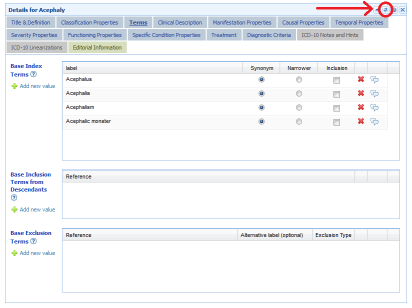
The publicly viewable version of the Beta drafting platform looks like this:
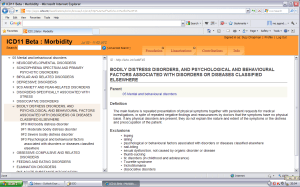
and displays less information. It can be accessed here:

Beta draft Foundation Component (FC) view:

http://apps.who.int/classifications/icd11/browse/f/en

Beta draft Linearization Morbity (LM) view:

http://apps.who.int/classifications/icd11/browse/l-m/en

Increased access to content and interaction with the drafting process can be obtained by registering.
+++
+++
Neurasthenia:

Neurasthenia is not classified in DSM-IV and is not proposed to be classified in DSM-5.

In ICD-10, Neurasthenia is classified in Chapter V Mental and behavioural disorders under parents:

F40-F48 Neurotic, stress-related and somatoform disorders

    F48 Other neurotic disorders
        ›  F48.0 Neurasthenia

+++
For ICD-11 Beta, up until July 3, Neurasthenia was also classified under:

Neurotic, stress-related and somatoform disorders

    9S1 Other neurotic disorders
        ›  9S1.1 Neurasthenia

Inclusions: Fatigue syndrome

Exclusions: psychasthenia
postviral fatigue syndrome
malaise and fatigue
asthenia NOS
burn-out

    9S1.2 Other specified neurotic disorders

Inclusions: Dhat syndrome
Occupational neurosis, including writer’s cramp
Psychasthenia
Psychasthenic neurosis
Psychogenic syncope

     9S1.3 Neurotic disorder, unspecified

Neurosis NOS

+++

On July 4, all child categories classified under parent class, 9S1 Other neurotic disorders, including Neurasthenia and its Inclusion, Fatigue syndrome, were removed from both the FC and LM view and from the PDF for the Chapter 5 Print version and there is currently no listing for any of these categories and child categories under any parent.

As no “Change history” records display in the public version of the Beta draft, it cannot be determined from what information is available whether these categories are temporarily omitted while this section of Chapter 5 is being reorganized, or whether all or selected of these ICD-10 categories are proposed to be retired for ICD-11 or are destined to be subsumed under the proposed Bodily distress disorders categories that ICD Revision has yet to define.

According to the Goldberg February 2011 report, terms included in the ICD11-PHC version of ICD-11 must have an equivalent disorder in the main classification. In February 2011, it was proposed not to include Neurasthenia in the ICD11-PHC version but to subsume under 13 Distress disorder. (It isn’t clear under which disorder group or subcategory Neurasthenia is proposed to be subsumed for the most recently published iteration for ICD11-PHC.)

Neurasthenia remains listed as an Exclusion to Chapter 5 Generalized anxiety disorder and Chapter 18 Malaise and fatigue but these Exclusions may be awaiting attention, if the intention is to retire a number of ICD-10 terms.

I will update when it becomes apparent what the intention is for these currently missing categories.

+++
ICD-11 Chapter 06: Diseases of the nervous system

Postviral fatigue syndrome, Benign myalgic encephalomyelitis, Chronic fatigue syndrome:

In ICD-10, Postviral fatigue syndrome is classified as a Title term within Volume 1: The Tabular List in Chapter VI: Diseases of the nervous system under G00-G99 Other disorders of the nervous system > G93 Other disorders of brain, and coded at G93.3. See: http://apps.who.int/classifications/icd10/browse/2010/en#/G93.3

Benign myalgic encephalomyelitis is also coded in the Tabular List to G93.3 Postviral fatigue syndrome.

Chronic fatigue syndrome is not classified within the Tabular List but is indexed to G93.3 in Volume 3: The Alphabetical Index.

An unauthorised copy of Volume 3: The Alphabetical Index Version for 2006 can be accessed here: (See Page 528)
http://www.scribd.com/doc/7350978/ICD10-2006-Alphabetical-Index-Volume-3 

In indexing Chronic fatigue syndrome to G93.3, ICD-10 does not specify whether it views the term as a synonym, subclass or “best coding guess” to Title term, Postviral fatigue syndrome or to Benign myalgic encephalomyelitis.

Nor does ICD-10 specify the relationship between Postviral fatigue syndrome and Benign myalgic encephalomyelitis.

(For ICD-11, a mechanism will be provided to identify whether an inclusion term is a synonym or a subclass.)

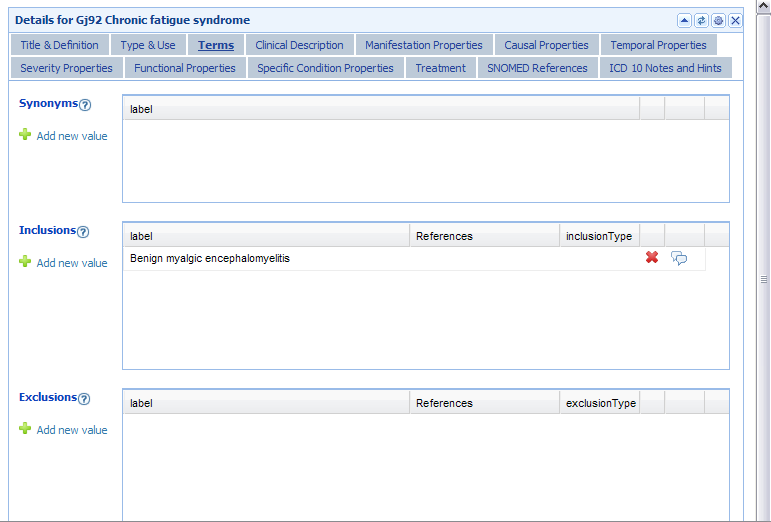
In June 2010, I reported that in May 2010, a change of hierarchy had been recorded in the ICD-11 iCAT Alpha drafting platform “Change History” and “Category Discussion Notes” for class: G93.3 Postviral fatigue syndrome.

See these two screenshots from the original iCAT Alpha drafting platform:

Image 1:

Image 2:

+++
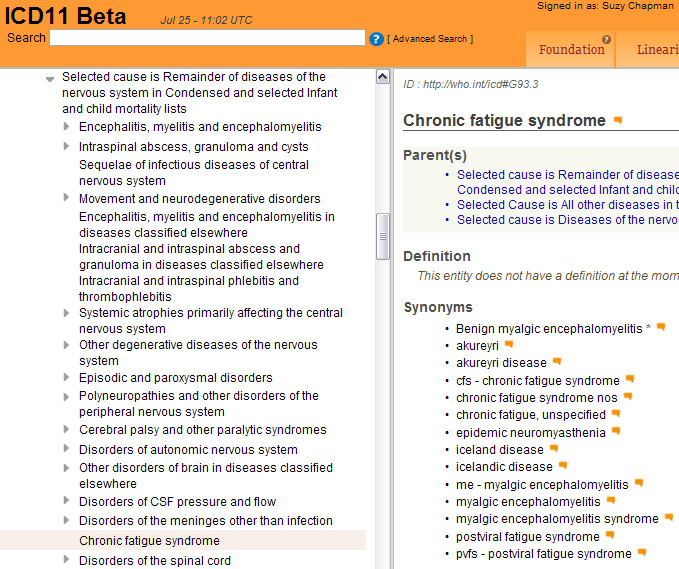
From current information in the Beta draft, it would appear that for ICD-11, the proposal is for a change of hierarchy between Postviral fatigue syndrome and Chronic fatigue syndrome with Chronic fatigue syndrome elevated to an ICD-11 Title term, with a Definition (not currently populated) and with potentially up to 12 other descriptive parameters, populated in accordance with the ICD-11 “Content Model.”

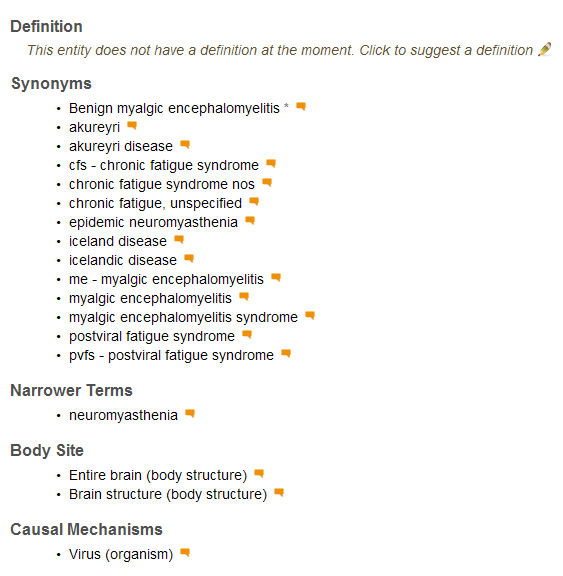
There are a number of terms listed under Synonyms to Title term Chronic fatigue syndrome including Benign myalgic encephalomyelitis and Postviral fatigue syndrome.

Mouse hover over the asterisk at the end of Benign myalgic encephalomyelitis and the following hover text displays, “This term is an inclusion term in the linearizations.”

Also listed under “Synonyms” are “chronic fatigue syndrome nos” and “chronic fatigue, unspecified” (both imported from current proposals for locating Chronic fatigue syndrome in Chapter 18: Symptoms and Signs in the forthcoming US specific, ICD-10-CM).

See this Beta drafting platform page:

http://apps.who.int/classifications/icd11/browse/f/en#/http%3a%2f%2fwho.int%2ficd%23G93
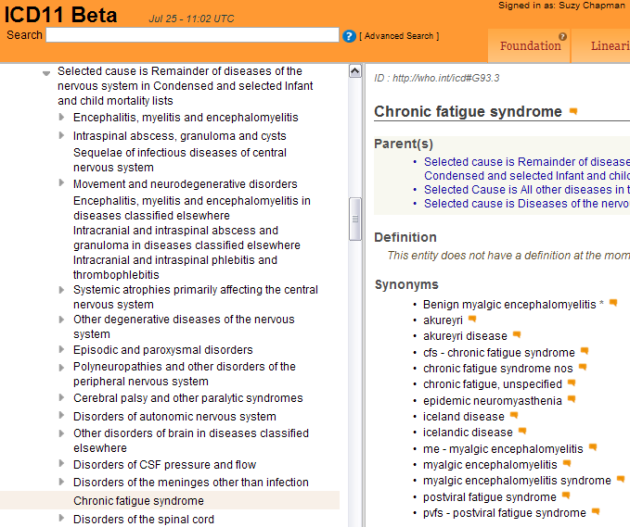
 

There is currently no discrete ICD Title term listed for Postviral fatigue syndrome in either the Foundation Component or Linearization Morbidity view and no discrete ICD Title term for Benign myalgic encephalomyelitis.

It remains unconfirmed, but from the Beta draft as it currently stands, it suggests that for ICD-11:

  • Chronic fatigue syndrome is proposed to become the Chapter 06 Title term
  • Benign myalgic encephalomyelitis is specified as an Inclusion term to CFS under “Synonyms”
  • Postviral fatigue syndrome and a number of other terms are listed under “Synonyms” to CFS

ICD-11 terminology:

For definitions of Synonyms, Inclusions, Exclusions and other ICD-11 terminology see the iCAT Glossary:

http://apps.who.int/classifications/apps/icd/icatfiles/iCAT_Glossary.html

+++
Fibromyalgia (FM):

In ICD-10, Fibromyalgia is classified under:

Chapter XIII: Diseases of the musculoskeletal system and connective tissue > M79 Other soft tissue disorders > M79 Other soft tissue disorders, not elsewhere classified > M79.7 Fibromyalgia 

ICD-10 Version: 2010: http://apps.who.int/classifications/icd10/browse/2010/en#/M79.7

For ICD-11 Beta draft, Fibromyalgia is currently classified under:

Chapter 13: Diseases of the musculoskeletal system and connective tissue > Soft tissue disorders > Other soft tissue disorders > QG6 Other soft tissue disorders, not elsewhere classified > QG6.7 Fibromyalgia

FC: http://apps.who.int/classifications/icd11/browse/f/en#/http%3a%2f%2fwho.int%2ficd%23M79.7
LM: http://apps.who.int/classifications/icd11/browse/l-m/en#/http%3a%2f%2fwho.int%2ficd%23M79.7

+++
Irritable bowel syndrome (IBS):

In ICD-10, Irritable bowel syndrome is classified under:

Chapter XI: Diseases of the digestive system > K55-K63 Other diseases of intestines > K58.0 Irritable bowel syndrome with diarrhoea > K58.9 Irritable bowel syndrome without diarrhoea > Irritable bowel syndrome NOS

ICD-10 Version: 2010: http://apps.who.int/classifications/icd10/browse/2010/en#/K58

For ICD-11 Beta draft, Irritable bowel syndrome is currently classified under:

Chapter 11: Diseases of the digestive system > Functional gastrointestinal disorders > FS6 Irritable bowel syndrome and other functional bowel disorders > FS6.1 Irritable bowel syndrome 

FC: http://apps.who.int/classifications/icd11/browse/f/en#/http%3a%2f%2fwho.int%2ficd%23K58
LM: http://apps.who.int/classifications/icd11/browse/l-m/en#/http%3a%2f%2fwho.int%2ficd%23K58

+++
I shall continue to monitor the Beta drafting process and update on any significant developments for both ICD-11 Chapter 5 and Chapter 6 and for ICD11-PHC for the categories that are the focus of this post and post #190.
+++
+++
References and related material:

1] ICD-10 Version: 2010 Volume 1 Tabular List online:
http://apps.who.int/classifications/icd10/browse/2010/en

2] ICD-11 Beta drafting platform:
http://apps.who.int/classifications/icd11/browse/f/en

3] Goldberg, D. Guest editorial. A revised mental health classification for use in general medical settings: the ICD11–PHC 1. International Psychiatry, Page 1, February 2011.
http://www.rcpsych.ac.uk/pdf/IPv8n1.pdf

4] 21st Century Global Mental Health by Dr Eliot Sorel, Professor, George Washington University, Washington D.C.
Publication date: August, 2012: http://www.jblearning.com/catalog/9781449627874/
Page 51, Sample Chapter 2: http://samples.jbpub.com/9781449627874/Chapter2.pdf

CFSAC announces dates of Spring meeting

CFSAC announces dates of Spring meeting

Post #160 Shortlink: http://wp.me/pKrrB-240

Chronic Fatigue Syndrome Advisory Committee (CFSAC)

http://www.hhs.gov/advcomcfs/index.html

The Chronic Fatigue Syndrome Advisory Committee (CFSAC) provides advice and recommendations to the Secretary of Health and Human Services via the Assistant Secretary for Health of the U.S. Department of Health and Human Services on issues related to chronic fatigue syndrome (CFS). These include:

• factors affecting access and care for persons with CFS;
• the science and definition of CFS; and
• broader public health, clinical, research and educational issues related to CFS.

Administrative and management support for CFSAC activities is provided by the Office of the Assistant Secretary for Health (OASH). However, staffing will continue to be provided primarily from the Office on Women’s Health, which is part of OASH.

Dr. Nancy C. Lee, Deputy Assistant Secretary for Health – Women’s Health, is the Designated Federal Officer for CFSAC.

Chronic Fatigue Syndrome Advisory Committee (CFSAC) Spring Meeting

http://www.hhs.gov/advcomcfs/advcomcfs-cfsacmeeting.html

The Chronic Fatigue Syndrome Advisory Committee (CFSAC), 2012 spring meeting will be held on Wednesday, June 13, 2012 from 9:00 a.m. until 5:00 p.m. EST and Thursday, June 14, 2012 from 9:00 a.m. until 5:00 p.m. EST.

The meeting will be held at the U.S. Department of Health and Human Services, Hubert Humphrey Building, 200 Independence Avenue, S.W., Room 800, Washington, D.C. 20201. For directions please visit
http://www.hhs.gov/about/hhhmap.html .

The meeting will be webcast live and available by audio (listening-only). Additional information and the CFSAC agenda will be posted to the CFSAC website by June 4, 2012.

Update: May 24, 2012

Above notice now reads:

The meeting will provide a live video stream and be available by audio (listening only). Additional information and the CFSAC agenda will be posted to the CFSAC website by June 4, 2012. Instructions for public testimony will be provided at a later date in a Federal Register Notice. We are not accepting requests or testimony at this time.


Related material

Most recent CFSAC postings:

CFSAC November 8-9, 2011 meeting: Minutes and Recommendations to HHS posted (January 14, 2012)

CFSAC November 2011 meeting: videos, presentations and Day One Agenda item (December 27, 2011)

International Classification of Diseases – Clinical Modification (ICD-CM): Presentation by Donna Pickett, RHIA, MPH, National Center for Health Statistics (NCHS)

What’s new in the ICD-11 Alpha drafting platform? (CFS, PVFS, ME)

What’s new in the ICD-11 Alpha drafting platform? (CFS, PVFS, ME)

Post #157 Shortlink: http://wp.me/pKrrB-22h


Screenshot: ICD-11 Alpha Browser Foundation view selected, logged in at April 10, 2012:

Chapter 6: Diseases of the nervous system

http://apps.who.int/classifications/icd11/browse/f/en#/http%3a%2f%2fwho.int%2ficd%23G93.3

Apr 09 – 11:02 UTC


ICD-11 Beta drafting platform to launch in May?

As reported in previous posts, according to the timeline, the ICD-11 Beta drafting platform is supposed to be launching this May.

ICD-11 Revision Steering Group has yet to announce whether the Beta platform remains on target for a May release and if so, on what date it will be launched – so I cannot give you a date yet.

Like the Alpha Drafting Browser, the Beta drafting platform will be a work in progress – not a final Beta draft. The final Beta isn’t scheduled until 2014, after the ICD-11 field trials have been undertaken.

When it does launch, the Beta platform is intended to be accessible to professionals and the public for viewing.

Registered or logged in users will have greater access to content and will be able to interact with the platform to read comments, comment on proposals and make suggestions, as part of the ongoing drafting process.  

In the meantime, the publicly viewable version of the Alpha drafting platform (known as the ICD-11 Alpha Browser) can still be accessed here:

http://apps.who.int/classifications/icd11/browse/f/en

The various ICD-11 Revision Topic Advisory Groups are carrying out their draft preparation work on a separate, more complex multi-author drafting platform that is accessible only to WHO and ICD Revision personnel.


Alpha drafting platform

As before, the publicly viewable version of the Alpha Browser should be viewed with the following caveats in mind:

the Alpha draft is a work in progress; it is incomplete; it may contain errors and omissions; it is in a state of flux and updated daily; textual content, codes and “Sorting labels” are subject to change as chapters are reorganized and content populated; the content has not been approved by Topic Advisory Groups, Revision Steering Group or WHO.

It is possible to register, or sign into the platform using existing accounts with several third party account providers such as Google, Yahoo and myOpenID, for increased access and functionality. Once signed in, Comments and Questions can be read and PDFs of the drafts of the top level linearizations can be downloaded from the Linearization tab.

See the Alpha Browser User Guide for information on how the Alpha Browser functions:

http://apps.who.int/classifications/icd11/browse/Help/en


The ICD-11 “Content Model”

ICD-11 will be available in both print and online versions and unlike most chapters of ICD-10, will include descriptive content for ICD terms.

For the online version of ICD-11, all ICD entities will include a definition and a number of additional key descriptive fields – between 7 and 13 pre-defined parameters, populated according to a common “Content Model” (Content Model Reference Guide January 2011).

For example, ICD entity Title, Definition, Synonyms, Narrower Terms, Exclusions, Body Site, Body System, Signs and Symptoms, Causal Mechanisms, and possibly Diagnostic Criteria for some entities.*

*According to the iCAT User Google Group message board, these fields may have been revised since the January 2011 Content Model Reference Guide was published; Content Model parameters in the Beta draft may therefore differ from those currently displaying in the public Alpha drafting platform.

The print version will use a concise version of Definition due to space constraints.

In the Alpha Browser, not all these Content Model parameters display in the Foundation and Linearization views and not all of the parameters that have been listed for individual entities have had their draft text added yet, as some chapters are more advanced for the population of proposed content than others.

So the Alpha draft is still very patchy and many entities have no Definition and little or no other proposed content filled in.

With no “Category Discussion Notes” or “Change history” pop-up windows visible in the public version of the Alpha, the viewer cannot determine the rationales behind the reorganization of terms and hierarchies within the various chapters.


Chapter location and hierarchy for CFS, PVFS and (Benign) ME in ICD-11

I have been reporting since June 2010 that the proposals for ICD-11 Alpha Draft, as far as one could determine, appeared to be:

1] That a change of hierarchy had been recorded in a “Category Discussion Note”, dated May 1, 2010, between ICD-10 Title term “Postviral fatigue syndrome” and “Chronic fatigue syndrome”. (“Category Discussion Notes” and “Change History” pop-ups did display in the earlier iCAT version of the Alpha drafting platform.)

You can view a screenshot from June 2010 of that “Change history” record here:

https://dxrevisionwatch.com/wp-content/uploads/2010/06/change-history-gj92-cfs.png

The Definition field on the “Chronic fatigue syndrome” description panel in the current Alpha Browser is currently blank but in June 2010, the Definition had stood as in this contemporaneous screenshot:

https://dxrevisionwatch.com/wp-content/uploads/2010/05/2icatgj92cfsdef.png

2] That “Chronic fatigue syndrome” had been designated as an ICD-11 Title term within ICD-11 Chapter 6: Diseases of the nervous system, with the capacity for a Definition and up to 10 additional descriptive parameters.

3] That “Benign myalgic encephalomyelitis” had been specified as an Inclusion term to ICD-11 Title term “Chronic fatigue syndrome” but that the relationships between the three terms, PVFS, (B) ME and CFS had yet to be specified, as in this screenshot from June 2010:

https://dxrevisionwatch.com/wp-content/uploads/2010/05/2icatgj92cfsterms.png


What is currently showing in the Chapter 6 Foundation Component?

It isn’t possible to bring up a discrete ICD Title listing for either “Benign myalgic encephalomyelitis” or “Postviral fatigue syndrome” in either the Foundation Component or the Linearization.

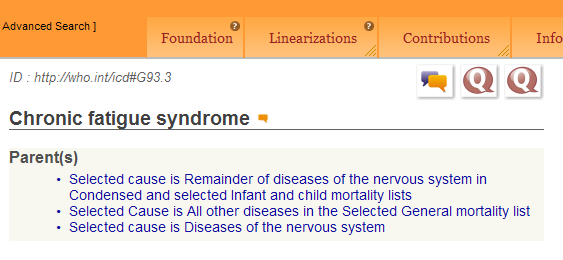
In the Foundation view only, for Chapter 6: Diseases of the nervous system, “Chronic fatigue syndrome” is listed as a Title term with the ICD-10 legacy ID “ID:http://who.int/icd#G93.3”;

the Definition field is currently blank;

a list of terms has recently been added under “Synonyms”;

one term has recently been added under “Narrower Terms”.

(Note: there is a small asterisk at the end of term “Benign myalgic encephalomyelitis” which is listed at the top of the “Synonyms” list. The asterisk “Hover text” reads “This term is an inclusion term in the linearizations.”)

If you want to view the listing directly on the Browser site (note the “Comment” and “Questions” icons which open up pop-up windows next to terms for reading/commenting won’t display unless you have already registered and logged in) go here:

ICD-11 Alpha Browser Foundation view:

http://apps.who.int/classifications/icd11/browse/f/en#/http%3a%2f%2fwho.int%2ficd%23G93.3

ID:http://who.int/icd#G93.3

Chronic fatigue syndrome

Parent(s)

Selected cause is Remainder of diseases of the nervous system in Condensed and selected Infant and child mortality lists
Selected Cause is All other diseases in the Selected General mortality list
Selected cause is Diseases of the nervous system

Definition

This entity does not have a definition at the moment.

Synonyms

Benign myalgic encephalomyelitis *  [Ed: Hover text over asterisk reads: “This term is an inclusion term in the linearizations.”]
akureyri
akureyri disease
cfs – chronic fatigue syndrome
chronic fatigue syndrome nos   [Ed: from current proposals for ICD-10-CM, Chapter 18, R53.82]
chronic fatigue, unspecified   [Ed: from current proposals for ICD-10-CM, Chapter 18, R53.82]
epidemic neuromyasthenia
iceland disease
icelandic disease
me – myalgic encephalomyelitis
myalgic encephalomyelitis
myalgic encephalomyelitis syndrome
postviral fatigue syndrome
pvfs – postviral fatigue syndrome

Narrower Terms

neuromyasthenia

Body Site

Entire brain (body structure)
Brain structure (body structure)

Causal Mechanisms

Virus (organism)


What’s new in Chapter 5: Mental and behavioural disorders?

As reported in Dx Revision Watch post: http://wp.me/pKrrB-1Vx,  the category “Somatoform Disorders” in Chapter 5, Mental and behavioural disorders is currently renamed to “BODILY DISTRESS DISORDERS”, under which currently sit three new child categories:

5M0 Mild bodily distress disorder
5M1 Moderate bodily distress disorder
5M2 Severe bodily distress disorder.

Chapter 5 Linearization view:

http://apps.who.int/classifications/icd11/browse/l-m/en#/http%3a%2f%2fwho.int%2ficd%23F45

Chapter 5 Foundation view:

http://apps.who.int/classifications/icd11/browse/f/en#/http%3a%2f%2fwho.int%2ficd%23F45

(Click on the little grey arrows to display the child categories):

Child categories to parent “BODILY DISTRESS DISORDERS”:

http://apps.who.int/classifications/icd11/browse/f/en#/http%3a%2f%2fwho.int%2ficd%231905_dd0250d2_e8cd_4c48_a93f_7997cc1c8b07

BODILY DISTRESS DISORDERS

5M0 Mild bodily distress disorder
5M1 Moderate bodily distress disorder
5M2 Severe bodily distress disorder
5M3 Somatization disorder
5M4 Undifferentiated somatoform disorder
5M5 Somatoform autonomic dysfunction
5M6 Persistent somatoform pain disorder
      > 5M6.0 Persistent somatoform pain disorder
      > 5M6.1 Chronic pain disorder with somatic and psycological [sic] factors
5M7 Other somatoform disorders
5M8 Somatoform disorder, unspecified

None of these three new (proposed) categories have had any Definitions or other textual content added to the description panels on the right hand side of the Alpha Browser page since I first reported this change in February.

It is still not possible to determine what disorders ICD-11 intends might be captured by these three new (proposed) terms, should ICD-11 Revision Steering Group and WHO classification experts consider these terms to be valid constructs and approve their progression through to the Beta draft.

Because no “Change Notes” or “Change history” pop-up windows display in this version of the Alpha Drafting browser, it is not possible to determine:

whether ICD-11 is proposing to introduce three new terms – 5M0 Mild bodily distress disorder; 5M1 Moderate bodily distress disorder; 5M2 Severe bodily distress disorder, in addition to retaining existing ICD-10 terms, 5M3 thru 5M8;

how ICD Revision intends to define these (proposed) new terms at 5M0, 5M1, 5M2;

how these three (proposed) new terms would relate to the existing ICD-10 “Somatoform Disorders” categories which remain listed as child categories to “BODILY DISTRESS DISORDERS” (apart from “Hypochondriacal disorder” [ICD-10: F45.2], which is now listed as “5H0.5 Illness Anxiety Disorder” in the ICD-11 Alpha Draft).

(See Page 1 and 2 of my report: “Bodily Distress Disorders” to replace “Somatoform Disorders” for ICD-11?: http://wp.me/pKrrB-1Vx  )


References:

ICD-11 Revision: http://www.who.int/classifications/icd/revision/en/

ICD-11 Alpha Browser User Guide: http://www.who.int/classifications/icd/revision/caveat/en/index.html
Alpha Browser Foundation view: http://apps.who.int/classifications/icd11/browse/f/en#
Alpha Browser Linearization view: http://apps.who.int/classifications/icd11/browse/l-m/en#
“Bodily Distress Disorders” to replace “Somatoform Disorders” for ICD-11?: http://wp.me/pKrrB-1Vx