New domain for Dx Revision Watch and new Twitter address

New domain for Dx Revision Watch and new Twitter address

Post #199 Shortlink: http://wp.me/pKrrB-2rE

Please note the domain for this site has changed to

http://dxrevisionwatch.com

Previous links to posts and pages are being mapped across to this domain but you may like to update Bookmarks and update links to the Home Page on websites and blogs.

The Twitter page associated with this site has also changed from

http://twitter.com/meagenda

to

http://twitter.com/dxrevisionwatch

@dxrevisionwatch

These are voluntary changes and not related to the threats of legal action issued on behalf of American Psychiatric Publishing, A Division of American Psychiatric Association, which forced a domain and site name change, last December [1].

1] Media coverage: American Psychiatric Association (APA) “cease and desist” v DSM-5 Watch website; Legal information and resources for bloggers and site owners

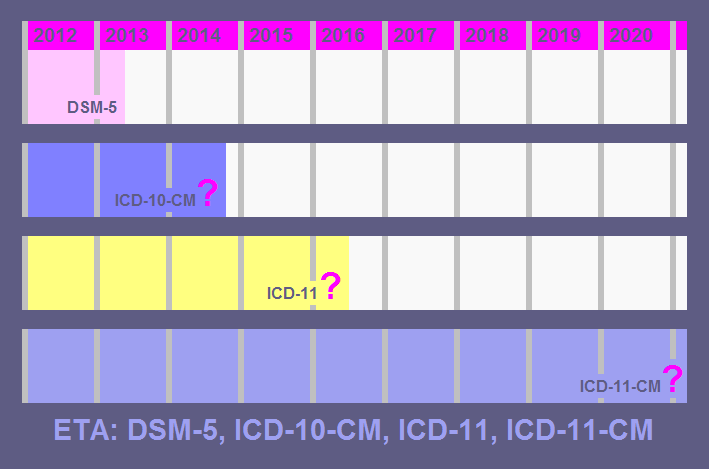
Trouble with timelines (1) DSM-5, ICD-10-CM, ICD-11 and ICD-11-CM

Trouble with timelines (1): DSM-5, ICD-10-CM, ICD-11 and ICD-11-CM

Post #198 Shortlink: http://wp.me/pKrrB-2qr

Update at March 7, 2014: ICD-11 has been postponed by two years. It is now scheduled for presentation for World Health Assembly approval in 2017.

Update at August 15, 2012: On Page 3, I stated that Steven Hyman, MD, is a DSM-5 Task Force Member and that Dr Hyman chairs the meetings of the  International Advisory Group for the Revision of ICD-10 Mental and Behavioural Disorders. According to the DSM-5 Development site, Dr Hyman is no longer a member of the DSM-5 Task Force, having served from 2007-2012. I cannot confirm whether Dr Hyman continues involvement with the International Advisory Group for the Revision of ICD-10 Mental and Behavioural Disorders though his name remains listed on the WHO site page, or on what date or for what reason Dr Hyman stood down from the DSM-5 Task Force.

+++

While the US health care industry, professional bodies and clinical practices sweat on the announcement of a final rule for ICD-10-CM compliance and speculation continues over the feasibility of leapfrogging from ICD-9-CM to ICD-11, I thought I’d run through the timelines.

+++

DSM-5: ETA: May 18-22, 2013

Originally slated for publication in May 2012.

In December 2009, the American Psychiatric Association shifted release of DSM-5 to May 2013, in response to slipping targets. With no changes to the published Timeline and no intimation of further delays, I’m assuming DSM-5 remains on target.

The final manual is scheduled for submission to American Psychiatric Publishing by December 31, 2012, for official release, next May, during APA’s 2013 Annual Meeting in San Francisco.

Following closure of the third and final public review on June 15, 2012, draft proposals for disorder descriptions and criteria sets as published on the DSM-5 Development website were frozen. The DSM-5 website will not be updated with any further revisions made by the work groups between June 15 and going to print. Final criteria sets and manual content are under strict embargo until publication [1].

+++

ICD-10-CM: ETA: Compliance mandatory by October 1, 2013; Final Rule to be announced on CMS’s proposal to delay compliance date to October 1, 2014

The development process for ICD-10-CM is as old as God’s dog.

WHO published ICD-10 in 1992. Twenty years on, while the rest of the world has long since migrated to ICD-10, the US is still waiting to transition from ICD-9-CM to a US specific clinical modification of ICD-10. The US is still using a modification based on WHO’s long since retired, ICD-9, and a code set that is now over 35 years old.

The Tabular List and preliminary crosswalk between ICD-9-CM and ICD-10-CM were posted on the NCHS website for public comment in December 1997. Field testing took place nearly ten years ago, in the summer of 2003.

The proposed rule for the adoption of ICD-10-CM/PCS was published in August 2008 with a proposed compliance date of October 1, 2011. In January 2009, the Department of Health and Human Services (HHS) published a final rule adopting ICD-10-CM/PCS to replace ICD-9-CM in HIPAA transactions, with an effective compliance date of October 1, 2013.

On February 16, 2012, HHS Secretary Kathleen Sibelius announced intent to postpone the compliance date for adoption of ICD-10-CM/PCS codes sets for a further year, to October 1, 2014 to allow more time for providers, payers and vendors to prepare for transition.

Public comment on the proposed rule closed in June. An imminent decision on a final compliance rule is anticipated but no date by which a decision would be announced has been issued.

Annual updated releases of ICD-10-CM and associated documentation have been posted on the CDC website for public viewing since January 2009.

CMS has issued the 2013 release of ICD-10-CM and General Equivalence Mappings (GEMs) which replace the December 2011 release. Until an implementation date is reached, codes in the 2013 release of ICD-10-CM are not currently valid for any purpose or use but are available for public viewing on the CDC website.

+++
Partial Code freeze for ICD-9-CM and ICD-10-CM

At the September 15, 2010 public ICD-9-CM Coordination and Maintenance Committee Meeting it was announced that the committee had finalized its recommendation to impose a partial code freeze for ICD-9-CM and ICD-10-CM/PCS codes prior to implementation of ICD-10-CM. Partial Code Freeze Announcement [PDF]

October 1, 2011 was the last major update of ICD-10-CM/PCS until October 1, 2014. Between October 1, 2011 and October 1, 2014 proposals for revisions to ICD-10-CM/PCS will be considered only for new diseases/new technology procedures and minor revisions to correct reported errors. Regular (at least annual) updates to ICD-10-CM/PCS will resume on October 1, 2014.

These Partial Code Freeze dates are based on the original compliance date of October 1, 2013. It’s reported that postponement of the requirement for compliance until October 1, 2014 would also push back scheduled ICD-10-CM coding updates.

If the proposed compliance date of October 1, 2014 is instituted, adoption of ICD-10-CM would become mandatory around 18 months after publication of DSM-5. The first regular updates to ICD-10-CM would resume one year post compliance date, that is, from October 1, 2015.

Continued on Page 2

Round up: ICD-11 PHC, ICD-11 Classification of Mood and Anxiety Disorders, Monograph: Public Health Aspects of Diagnosis and Classification of Mental and Behavioral Disorders, ASHA DSM-5 comments

Round up: ICD- 11 PHC; ICD-11 Classification of Mood and Anxiety Disorders; Monograph: Public Health Aspects of Diagnosis and Classification of Mental and Behavioral Disorders; ASHA DSM-5 comments

1] Paper: The primary health care version of ICD-11: the detection of common mental disorders in general medical settings By David P. Goldberg, James J. Prisciandaro, Paul Williams

2] The ICD-11 Classification of Mood and Anxiety Disorders: background and options (Guest Editors: Mario Maj, Geoffrey M. Reed), World Psychiatry, Volume 11, Supplement 1, June 2012

3] Monograph: Public Health Aspects of Diagnosis and Classification of Mental and Behavioral Disorders: Refining the Research Agenda for DSM-5 and ICD-11 By Shekhar Saxena, Patricia Esparza, Darrel A. Regier, Norman Sartorius

4] Submissions to DSM-5 public reviews for drafts one, two and three by The American Speech-Language-Hearing Association

Post #195 Shortlink: http://wp.me/pKrrB-2pa

This post relates to the World Health Organization’s ICD-11 and ICD-11 PHC (Primary Care version), both currently under development. It does not apply to the existing ICD-10, ICD-10 PHC or to the forthcoming US specific “clinical modification” of ICD-10, known as ICD-10-CM.

Note on ICD-10 PHC and ICD-11 PHC

ICD-10 PHC (sometimes written as ICD-10-PHC or ICD10-PHC or ICD-10 PC), is a simplified version of the WHO’s ICD-10 chapter for mental and behavioural disorders for use in general practice and primary health care settings. This system has rough but not exact equivalence to mental disorders in the core ICD-10 classification.

The ICD-10 PHC describes 25 disorders commonly managed within primary care as opposed to circa 450 classified within Chapter V of ICD-10.

A chart showing the grouping of categories adapted from the full ICD-10 version for the existing ICD-10 PHC categories can be found here.

The revision of ICD-10 PHC, ICD-11 PHC, is currently under development.

Professor, Sir David Goldberg, M.D., Emeritus Professor, Institute of Psychiatry, King’s College, London, is a member of the DSM-5 Mood Disorders Work Group. Prof Goldberg also chairs the Consultation Group for Classification in Primary Care that is making recommendations for the 28 mental and behavioural disorders proposed for inclusion in ICD-11 PHC.

The majority of patients with mental health problems are diagnosed and managed by general practitioners in primary care – not by psychiatrists and mental health specialists. ICD10-PHC is used in developed and developing countries in general medical settings and also used in the training of medical officers, nurses and multi purpose health workers.

Further information on ICD-10 PHC and the development of the mental health disorders section of ICD-11 PHC can be found in these two documents:

1] Goldberg, D. Guest editorial. A revised mental health classification for use in general medical settings: the ICD11–PHC 1. International Psychiatry, Page 1, February 2011.
http://www.rcpsych.ac.uk/pdf/IPv8n1.pdf

2] 21st Century Global Mental Health by Dr Eliot Sorel, Professor, George Washington University, Washington D.C.
Publication date: August, 2012: http://www.jblearning.com/catalog/9781449627874/
Page 51, Sample Chapter 2: http://samples.jbpub.com/9781449627874/Chapter2.pdf

ICD Revision publishes the names and bios of members of the ICD-11 Revision Steering Group, ICD-11 Topic Advisory Groups, and International Advisory Group for the Revision of ICD-10 Mental and Behavioural Disorders.

But membership of the various sub working groups to the Topic Advisory Groups (TAGs), the names of external peer reviewers recruited by TAG Managing Editors for reviewing proposals and content and the membership of the advisory/consultation groups for the revision of the ICD Primary Care version have not been published by ICD-11 Revision.

The Abstract below lists members of the (WHO) Primary Care Consultation Group for the Revision of ICD-10 Mental and Behavioural Disorders.

1] Paper: The primary health care version of ICD-11: the detection of common mental disorders in general medical settings

http://www.ghpjournal.com/article/S0163-8343(12)00197-1/abstract

The primary health care version of ICD-11: the detection of common mental disorders in general medical settings

26 July 2012

David P. Goldberg, James J. Prisciandaro, Paul Williams

David P. Goldberg
Affiliations Primary Care Consultation Group, World Health Organization; and Institute of Psychiatry, KCL, London, UK

James J. Prisciandaro
Affiliations Department of Psychiatry, Medical University of South Carolina, Charleston SC, USA
Corresponding author.

Paul Williams
Affiliations Health Services & Population Research, Institute of Psychiatry, KCL, London, UK

Received 31 January 2012; accepted 19 June 2012. published online 26 July 2012.
Corrected Proof

Abstract

Background

The primary health care version of the ICD-11 is currently being revised.

Aim
To test two brief sets of symptoms for depression and anxiety in primary care settings, and validate them against diagnoses of major depression and current generalised anxiety made by the CIDI.

Method
The study took place in general medical or primary care clinics in 14 different countries, using the Composite International Diagnostic Interview adapted for primary care (CIDI-PC) in 5,438 patients. The latent structure of common symptoms was explored, and two symptom scales were derived from item response theory (IRT), these were then investigated against research diagnoses.

Results
Correlations between dimensions of anxious, depressive and somatic symptoms were found to be high. For major depression the 5 item depression scale has marked superiority over the usual 2 item scales used by both the ICD and DSM systems, and for anxiety there is some superiority. If the questions are used with patients that the clinician suspects may have a psychological disorder, the positive predictive value of the scale is between 78 and 90%.

Conclusion
The two scales allow clinicians to make diagnostic assessments of depression and anxiety with a high positive predictive value, provided they use them only when they suspect that a psychological disorder is present.

This article is partly based on the work of the World Health Organization (WHO) Primary Care Consultation Group for the Revision of ICD-10 Mental and Behavioural Disorders, of which the first author is Chair. Other members of the group include Michael Klinkman (GP, United States; Vice Chairman); Sally Chan (nurse, Singapore), Tony Dowell (GP, New Zealand) Sandra Fortes (psychiatrist, Brazil), Linda Gask (psychiatrist, UK), KS Jacob (psychiatrist, India), Tai-Pong Lam (GP, Hong Kong), Joseph Mbatia (psychiatrist, Tanzania), Fareed Minhas (psychiatrist, Pakistan), Marianne Rosendal (GP, Denmark), assisted by WHO Secretariat Geoffrey Reed and Shekhar Saxena. The views expressed in this article are those of the authors and, except as specifically noted, are not intended to represent the official policies and positions of the Primary Care Consultation Group or of the WHO.

Competing interests: David Goldberg is a consultant for Ultrasis and advises the World Health Organization and the American Psychiatric Association.

James Prisciandaro and Paul Williams have no competing interests

PII: S0163-8343(12)00197-1

doi:10.1016/j.genhosppsych.2012.06.006

+++
2] The ICD-11 Classification of Mood and Anxiety Disorders: background and options (Guest Editors: Mario Maj, Geoffrey M. Reed), World Psychiatry, Volume 11, Supplement 1, June 2012

The PDF of this publication is free.

Note regarding references within these commentaries to DSM-5 proposals: Some of these commentaries were written prior to the release of the third DSM-5 draft for public review, in May 2012, and quote draft proposals as they had stood for the second draft.

For example, the commentary Hypochondriasis in ICD-11 by D.J. Stein, on Page 100, sets out in narrative form the DSM-5 Somatic Symptom Disorder Work Group proposals and criteria for Complex Somatic Symptom Disorder as they had stood in May 2011 and are not the most recent iteration.

DSM-5 proposals have not been finalized. Proposals as they stood in May 2012 for the third and final public review may be subject to further change before DSM-5 is published in May 2013. Please refer to the DSM-5 Development website for the most recent proposals and criteria sets for the categories and proposed categories that are discussed in these commentaries.

http://www.wpanet.org/uploads/WPA-WHO_Collaborative_Activities/WP_ICD-11%20Supplement.pdf

July 2012

The ICD-11 Classification of Mood and Anxiety Disorders: background and options (Guest Editors: Mario Maj, Geoffrey M. Reed) World Psychiatry, Volume 11, Supplement 1, June 2012

Contents

The development of the ICD-11 classification of mood and anxiety disorders

M. Maj, G.M. Reed Page 3

How global epidemiological evidence can inform the revision of ICD-10 classification of depression and anxiety disorders

L.H. Andrade, Y.-P. Wang Page 6

Specifiers as aids to treatment selection and clinical management in the ICD classification of mood disorders

D.J. Miklowitz, M.B. First Page 11

Challenges in the implementation of diagnostic specifiers for mood disorders in ICD-11

M.B. First Page 17

Cultural issues in the classification and diagnosis of mood and anxiety disorders

S. Chakrabarti, C. Berlanga, F. Njenga Page 26

Bipolar disorders in ICD-11

S.M. Strakowski Page 31

Changes needed in the classification of depressive disorders: options for ICD-11

E. Paykel, L.H. Andrade, F. Njenga, M.R. Phillips Page 37

Differentiating depression from ordinary sadness: contextual, qualitative and pragmatic approaches

M. Maj Page 43

Severity of depressive disorders: considerations for ICD-11

J.L. Ayuso-Mateos, P. Lopez-García Page 48

Dysthymia and cyclothymia in ICD-11

M.R. Phillips Page 53

Psychotic and catatonic presentations in bipolar and depressive disorders

S. Chakrabarti Page 59

Mixed states and rapid cycling: conceptual issues and options for ICD-11

M. Maj Page 65

How should melancholia be incorporated in ICD-11?

D. Moussaoui, M. Agoub, A. Khoubila Page 69

Postpartum depression and premenstrual dysphoric disorder: options for ICD-11

M.L. Figueira, V. Videira Dias Page 73

Disruptive mood dysregulation with dysphoria disorder: a proposal for ICD-11

E. Leibenluft, R. Uher, M. Rutter Page 77

Generalized anxiety disorder in ICD-11

M.K. Shear Page 82

Agoraphobia and panic disorder: options for ICD-11

D.J. Stein Page 89

Specific and social phobias in ICD-11

P.M.G. Emmelkamp Page 94

Hypochondriasis in ICD-11

D.J. Stein Page 100

+++

3] Public Health Aspects of Diagnosis and Classification of Mental and Behavioral Disorders: Refining the Research Agenda for DSM-5 and ICD-11

Note: Substantial extracts from this DSM-5 and ICD-11 monograph can be previewed online on the Amazon site via the “LOOKINSIDE!” function. Greater access to preview content is available to Amazon account holders.  Extracts can also be previewed via Google:

Preview via Amazon “LOOKINSIDE!”:

http://www.amazon.com/Aspects-Diagnosis-Classification-Behavioral-Disorders/dp/0890423490#reader_0890423490

Preview via Google Books:

http://tinyurl.com/DSM5-ICD11-Monograph

Public Health Aspects of Diagnosis and Classification of Mental and Behavioral Disorders: Refining the Research Agenda for Dsm-5 and ICD-11

By Shekhar Saxena, Patricia Esparza, Darrel A. Regier, Norman Sartorius

(c) 2012

Paperback: 303 pages
Publisher: American Psychiatric Publishing; 1 edition (April 30, 2012)

Public Health Aspects of Diagnosis and Classification of Mental and Behavioral Disorders: Refining the Research Agenda for DSM-5 and ICD-11
[Paperback]

Shekhar Saxena (Author), Patricia Esparza (Author), Darrel A. Regier (Author), Benedetto Saraceno (Author), Norman Sartorius (Author)

Shekhar Saxena, M.D.,is Director of the Department of Mental Health and Substance Abuse at the World Health Organization in Geneva, Switzerland.

Patricia Esparza, Ph.D.,is Research Professor and clinical psychologist in the Department of Psychology and Counseling at Webster University in Geneva, Switzerland.

Darrel A. Regier, M.D., M.P.H.,is Director of the American Psychiatric Institute for Research and Education and Director of the Division of Research at the American Psychiatric Association in Arlington, Virginia; and Vice-Chair of the DSM-5 Task Force.

Benedetto Saraceno, M.D.,FRCPsych,is Professor of Psychiatry and Director of the World Health Organization Collaborating Center on Mental Health of the University of Geneva in Geneva, Switzerland.

Norman Sartorius, M.D., Ph.D.,is President of the Association for the Improvement of Mental Health Programs in Geneva, Switzerland.

Book Description
Publication Date: April 30, 2012 | ISBN-10: 0890423490 | ISBN-13:
978-0890423493 | Edition: 1

“Public Health Aspects of Diagnosis and Classification of Mental and Behavioral Disorders: Refining the Research Agenda for DSM-5 and ICD-11” provides a comprehensive summary of the current state of mental health classification in the United States and internationally, fostering a better understanding of primary research and clinical needs and facilitating the efforts of service planners, researchers and trainees to address current use of psychiatric diagnosis in the public health sector. The volume reflects the proceedings of a research planning conference convened by the APA and World Health Organization (WHO) that focused on public health aspects of the diagnosis and classification of mental disorders. Highly relevant to the ongoing development of DSM-5 and ICD-11, the book includes the background papers prepared and presented by the Conference Expert Groups. The resulting collection: – Discusses the current state of mental illness prevention efforts and the role of public health in supporting them–critical topics, given that development of effective strategies to reduce mental illness around the world depends on the accuracy with which risk and protective factors can be identified, defined, and understood. – Features international perspectives on public health implications of psychiatric diagnosis, classification, and service, providing viewpoints that are broad and more globally relevant. – Views mental health education, and awareness on a macro level, including its impact on social and economic policy, forensics and the legal system, and education. This approach facilitates the continued development of a research base in community health and promotes the establishment of programs for monitoring, treating, and preventing mental illness. – Addresses many fascinating and clinically relevant issues, such as those raised by the concept and the definition of mental disorders and how these impact psychiatric services and practice by individual providers.

This collection should prove useful to the advisory groups, task forces, and working groups for the revision of these two classifications, as well as for researchers in the area of diagnosis and classification, and more generally in public health.

+++
4] Submissions to DSM-5 public reviews for drafts one, two and three by The American Speech-Language-Hearing Association (ASHA)

The American Speech-Language-Hearing Association (ASHA) represents people with speech, language, and hearing disorders and advocates for services to help them communicate effectively.

ASHA submitted comments during all three DSM-5 draft comment periods:

ASHA submission April 2010 [PDF]; June 2011 [PDF]; June 2012 [PDF]

ASHA Letter sent June 2012 [PDF]

DSM-V Revisions To Move Forward (ASHA Leader article)

all documents available from this page:

http://www.asha.org/SLP/DSM-5/

+++

Key ICD-11 links and documents

ICD-11 Beta drafting platform  |  Publicly viewable version

WHO ICD Revision  |  Main WHO website: Revision Steering Group and Topic Advisory Groups
ICD-11 Revision site  |  Revision resources [Google site currently unavailable]
ICD-11 Revision site Documents Page  |  Key revision documents and meeting materials  [Google site currently unavailable]

ICD-11 Revision Information  |
ICD-11 Timeline  |

ICD Information Sheet  |

Revision News  |
Steering Group  |
Topic Advisory Groups  |

ICD-11 YouTube Channel  |  Video reports
ICD-11 on Facebook  |
ICD-11 on Twitter  |
ICD-11 Blog  |  Not updated since October 2009

ICD-11 YouTubes collated on Dx Revision Watch ICD-11 YouTubes  |

WHO Publications

ICD-10 Tabular List online Version: 2010  |  International Statistical Classification of Diseases and Related Health Problems 10th Revision Version: 2010, Tabular List of inclusions and Chapter List

ICD-10 Volume 2: Instruction Manual  |  Volume 2 online Version: 2010 PDF Download

ICD-10 for Mental and Behavioural Disorders Diagnostic Criteria for Research  |  PDF download
ICD-10 for Mental and Behavioural Disorders Clinical Descriptions and Diagnostic Guidelines  |  PDF download

ICD-10 Volume 3: The Alphabetical Index  |  WHO does not make ICD-10 Volume 3: The Alphabetical Index available online

About the World Health Organization (WHO)

The WHO Family of International Classifications  

History of ICD
Two resign from DSM-5 Personality Disorders Work Group over “seriously flawed” proposals

Two resign from DSM-5 Personality Disorders Work Group over “seriously flawed” proposals

Post #191 Shortlink: http://wp.me/pKrrB-2kN

Update at July 24, 2012: Additional reporting from Straight.com, Vancouver, on the resignations of two members of the DSM-5 Personality Disorders Work Group:

UBC prof emeritus John Livesley and Dutch expert quit DSM-V committee defining personality disorders

Charlie Smith | July 23, 2012

Update at July 16, 2012:

In the July issue of Clinical Psychology & Psychology there is an Editorial and two Commentaries around DSM-5 proposals for Personality and Personality Disorders.

Clinical Psychology & Psychotherapy

http://onlinelibrary.wiley.com/journal/10.1002/(ISSN)1099-0879/earlyview

Commentary

No abstract is available for this article.

Personality Disorder Proposal for DSM-5: A Heroic and Innovative but Nevertheless Fundamentally Flawed Attempt to Improve DSM-IV

Roel Verheul

Article first published online: 12 JUL 2012 | DOI: 10.1002/cpp.1809

Editorials

No abstract is available for this article.

DSM-5 Personality Disorders: Stop Before it is Too Late

Paul Emmelkamp and Mick Power

Article first published online: 3 JUL 2012 | DOI: 10.1002/cpp.1807

Commentary

No abstract is available for this article.

Disorder in the Proposed DSM-5 Classification of Personality Disorders

W. John Livesley

Article first published online: 3 JUL 2012 | DOI: 10.1002/cpp.1808

Roel Verheul, Ph.D. and W. John Livesley, M.D., Ph.D. resigned as members of the DSM-5 Personality and Personality Disorders Work Group in April.

Dr Roel Verheul is CEO of de Viersprong, Netherlands Institute for Personality Disorders.

Dr. John Livesley is Professor Emeritus at the University of British Columbia.

Allen Frances, M.D. who chaired the DSM-IV Task Force blogs at DSM 5 in Distress. Drs Verheul and Livesley have written to Dr Frances setting out their concerns for what they believe to be “seriously flawed proposals” and “a truly stunning disregard for evidence.”

DSM5 in Distress
The DSM’s impact on mental health practice and research.

by Allen Frances, M.D.

Two Who Resigned From DSM-5 Explain Why
They spell out the defects in the personality section

Allen Frances, M.D. | July 11, 2012

Roel Verheul and John Livesley both felt compelled to resign from the DSM-5 Personality Disorders Work Group. Here is an email from them describing what went wrong in the preparation of this section:

“…Regrettably, the Work Group has been unable to capitalize on the opportunity and has advanced a proposal that is seriously flawed. It has also demonstrated an inability to respond to constructive feedback both from within the Work Group and from the many experts in the field who have communicated their concerns directly and indirectly. We also regret the need to resign because we were the only International members of the Work Group which is now without representation from outside the US…”

“…Early on in the DSM-5 process, we developed major concerns about the Work Group’s mode of working and its emerging recommendations that we communicated to the Work Group and Task Force… We considered the current proposal to be fundamentally flawed and decided that it would be wrong of us to appear to collude with it any longer…As we see it, there are two major problems with the proposal…”

Read full article here

Proposals for the DSM-5 Personality Disorders as issued for the third and final stakeholder review can be read here on the DSM-5 Development site.

Changes to content on DSM-5 Development site (1)

Changes to content on DSM-5 Development site (1)

Post #189 Shortlink: http://wp.me/pKrrB-2jn


Content embargo

According to American Psychiatric Association’s recently published, highly restrictive DSM-5 Permissions Policy – following closure of the third and final public review, the content of DSM-5 will be under strict embargo until the manual is published.

DSM-5 is expected to be finalized by December 31 for publication in May 2013.

APA closed its third stakeholder review of draft proposals for DSM-5 categories and criteria on June 15 and issued a Press Release on June 26 – write-up from Deborah Brauser for Medscape Medical News, below.

Between closure of the final review and Wednesday, June 27, the DSM-5 Development site stated that although comments on proposals could no longer be submitted through the website the site would remain viewable with the draft proposals until DSM-5’s publication.

That line of text was deleted from the DSM-5 Development site home page yesterday, Thursday, June 28.

It remains unconfirmed whether it is now APA’s intention to remove the draft as it stood at the third review from the DSM-5 Development site at some point between now and the slated publication date.


Categories and criteria text frozen during final revisions

According to DSM-5 Development home page text, revisions to categories and criteria will continue to be made between now and the end of 2012 in response to stakeholder feedback; continued analysis of DSM-5 Field Trial results; scrutiny by the DSM-5 Scientific Review Committee which will review scientific validating evidence for revisions; an extensive peer review process; review by an Assembly DSM-5 committee and an overall final review by the DSM-5 Task Force.

Disorder categories and criteria texts as they currently stand on the website are now frozen and the site content will not be updated to reflect any further revisions and edits made between June 15 and submission of final texts, later this year, for approval by APA Board of Trustees.

None of the manual’s extensive textual content that will accompany the new categories has been out on public review.

The remainder of the development process is set out on the Home Page under “Next Steps” and in the APA Board Materials Packet – December 10-11, 2011. This document sets out the DSM-5 Development program from December 2011 until May 2013:

Open here: Item 11.A – DSM Task Force Report


From Medscape Medical News > Psychiatry

Last DSM-5 Public Review Period Ends With 2000 Comments

Deborah Brauser | June 26, 2012

June 26, 2012 — The latest and final public comment period for the upcoming Diagnostic and Statistical Manual of Mental Disorders, Fifth Edition (DSM-5) ended on June 15 — but not before logging 2298 responses from around the world, the American Psychiatric Association (APA) reports.

This was the third public comment period that has been opened for online feedback regarding the manual’s proposed criteria changes. To date, there have been a total of 15,000 public comments posted…

Read full report

Ed: Free registration required for access to most parts of Medscape site.


Comment on closure of third and final draft review from 1 Boring Old Man

1 Boring Old Man

missed opportunity…

Wednesday, June 27, 2012


Related material

1] APA News Release June 26, 2012

2] DSM-5 Development Timeline

3] DSM-5 Development Permissions Policy

4] DSM-5 Terms and Conditions of Use

Three professional organization responses to third and final DSM-5 stakeholder review

Three professional organization responses to the third and final DSM-5 stakeholder review

Post #185 Shortlink: http://wp.me/pKrrB-2hS

According to DSM-5 Task Force Vice-chair, Darrel Regier M.D., the specific diagnostic categories that received most comments during the second public review of draft proposals (May-June 2011) were the sexual and gender identity disorders, followed closely by somatic symptom disorders and anxiety disorders.

The American Psychiatric Association (APA) has yet to report how many comments the DSM-5 Task Force and its 13 Work Groups received during this third and final review period (which closed last Friday), or which categories garnered the most responses, this year.


No publication of field trial data

Following posting of the third draft on May 2, it was anticipated APA would publish full results from the DSM-5 field trials “within a month”. [Source: Deborah Brauser for Medscape Medical News: interview with Darrel Regier, May 8, 2012.]

No report emerged and stakeholders had little choice but submit feedback on this latest iteration without the benefit of scrutiny of reliability data to inform their submissions.

APA has yet to account for its failure to place its field trial results in the public domain while the feedback exercise was in progress, other than releasing some Kappa data at its May 5-9 Annual Conference.

American Psychiatric Association CEO and Medical Director, James H. Scully, Jr., M.D., blogs at Huffington Post. Last week, I asked Dr Scully why the field trial report has been withheld; whether Task Force still intends publishing field trial data and when that report might now be anticipated. 

I’ve received no response from Dr Scully and APA has put out no clarification.


No publication of list of Written Submissions

These three DSM-5 public reviews of draft proposals for changes to DSM-IV categories and criteria have not been managed as formal stakeholder consultation exercises.

APA publishes no aggregations of key areas of concern identified during public comment periods nor publishes Work Group or Task Force responses to key areas of professional or lay public concern on the DSM-5 Development website  – an issue I raised with the Task Force during both the first and second reviews.

Although some published submissions (ACA, British Psychological Society and the DSM-5 Reform Open Letter and Petition Committee) have received responses from the Task Force and which APA has elected to place in the public domain, submissions from the majority of professional bodies and organizations disappear into a black hole.

In the interests of transparency, APA could usefully publish lists of the names of US and international professional bodies, academic institutions, patient advocacy organizations etc. that have submitted comments, in the way that Written Submissions are listed in the annexes to reports and public inquiries.

That way, interested parties might at least approach organizations to request copies of submissions or suggest that these are placed in the public domain.

APA could not legitimately claim it would require permissions before publishing full lists of the names of professional body, academic institution and organization respondents that tendered formal responses – its legal department’s boilerplate Terms and Conditions of Use gives APA carte blanche to make use of and publish uploaded submissions in any way it sees fit.*

*See Terms and Conditions of Use, under “User Submissions” 


The following have released their submissions in response to the third draft:

Submission from The American Mental Health Counselors Association (AMHCA)

The American Mental Health Counselors Association is a nationwide organization representing 6,000 clinical mental health counselors. Their submission includes concerns for the lowering of the “B type” threshold requirement for “Somatic Symptom Disorder” criteria between the second and third drafts.

[In the CSSD field trials, about 15% of the “diagnosed illness” study group (patients with cancer and coronary disease) met the criteria for coding with an additional mental health diagnosis of “SSD” when “one B type” cognition was required; about 10% met the criteria when “two B type” were required. About 26% of the “functional somatic” arm of the study group (patients with irritable bowel and “chronic widespread pain” – a term used synonymously with fibromyalgia) met the criteria for coding with an additional mental health diagnosis of “SSD” when “one B type” cognition was required; about 13% met the criteria when “two B type” were required. AMHCA recommends raising the threshold back to at least two from the three B type criteria, as the criteria for CSSD had stood for the second draft. I consider the category of “SSD” should be rejected in the absence of a substantial body of independent evidence for the reliability, validity and safety of “SSD” as a construct.]

AMHCA Submits Comments on DSM-5 06/19/12

June 18, 2012 – Alexandria, VA – The DSM-5 Task Force of the American Mental Health Counselors Association (AMHCA) has submitted comments for the third period of public comment on the fifth edition of Diagnostic and Statistical Manual of Mental Disorders (DSM-5).

AMHCA’s comments addressed 12 disorder categories and the Cultural Formulation Interview Guide. Per the site requirements, each was sent separately to the particular disorder site.

    Download compilation of comments submitted by AMHCA DSM-5 Task Force

Somatic Symptom Disorders

“Somatic Symptom Disorder

“A major change in this revision is the merger of Complex Somatic Symptom Disorder and Simple Somatic Symptom Disorder into one disorder, Somatic Symptom Disorder. The increased emphasis placed on cognitive distortions (along with the presence of somatic symptoms ) provides greater clarity about the nature of the disorder. However, the notion that a single B.2 criteria could be used as the sole basis for identifying these cognitive aspects seems to open the door to diagnosing individuals who have legitimate “high anxiety” about their symptoms. We recommend considering “two of three” criteria under B be required.”


The British Psychological Society writes:

The British Psychological Society still has concerns over DSM-V

…For all the reasons stated above, the BPS, having reviewed the currently proposed revisions of the new diagnostic criteria in DSM 5, continues to have major concerns. These have, if anything, been increased by the very poor reliabilities achieved in many of the recent field trials (Huffington Post, 2012), especially given the limited time available to attempt to achieve more satisfactory outcomes. Since validity depends, at the very least, on acceptable levels of reliability, the unavoidable conclusion is that many of the most frequently-used categories will be unable to fulfil their purported purposes, i.e. identification of appropriate treatments, signposting to support, providing a basis for research…

Read full submission to third draft here in PDF format.

Response to second draft here.

Christopher Lane comments:

Psychology Today | Side Effects

Arguing Over DSM-5: The British Psychological Society Has Serious Concerns About the Manual

The BPS expresses “serious reservations” about the next DSM.

Christopher Lane, Ph.D. in Side Effects | June 20, 2012

Although the American Psychiatric Association recently closed its window allowing comments on proposed changes to the DSM, the organization has yet to report on the field trials it devised for the next edition of the psychiatric manual, themselves meant to support—indeed, serve as a rationale for—the changes it is proposing in the first place.

While this unhappy outcome points to some of the organization’s chicken-and-egg problems with the manual and the disorders it is seeking to adjust or make official, those wanting to respond to the draft proposals have had to do so in the dark, unaware of the results of the field trials and thus whether the proposals draw from them any actual empirical support…

Read on


Submission from American Counseling Association (ACA)

The American Counseling Association (ACA), represents more than 50,000 counselors – one of the largest groups of DSM-5 users in the US.

ACA provides final comments on the DSM-5

ACA President Don W. Locke has sent the American Psychiatric Association a letter providing final comments for the fifth edition of the Diagnostic and Statistical Manual of Mental Disorders (DSM-5). Based on comments from ACA members and the ACA DSM Task Force, the letter acknowledges useful changes that had been made to previous drafts of the DSM-5: the development of the Cultural Formulation Outline, reversing the pathologizing of normal bereavement, and limiting the expansion of personality disorder types. ACA also calls for addressing the one-dimensional nature of the new Substance Use Disorder category and rejects the proposed dimensional assessments. Click here to view letter.

This is the third letter ACA has sent to the American Psychiatric Association providing feedback for the DSM-5. Click the links below to read the previous letters and a response from APA:

Letter from President Lynn Linde, April 16, 2010

Letter from President Don Locke, November 8, 2011

Response from APA President John Oldham, November 21, 2011


Submission by Coalition for DSM-5 Reform Committee

The Coalition for DSM-5 Reform Open Letter and Petition has garnered support from over 13,700 professionals and concerned stakeholders and the endorsement of nearly 50 organizations, since launching last October.

The DSM-5 Reform Committee continues to call for independent scientific review of draft proposals and submitted the following response during this third and final comment period:

Submission from Coalition for DSM-5 Reform (Society for Humanistic Psychology)Division 32 of the American Psychological Association)

To the DSM-5 Task Force and the American Psychiatric Association

As you know, the Open Letter Committee of the Society for Humanistic Psychology and the Coalition for DSM-5 Reform have been following the development of DSM-5 closely.

We appreciate the opportunity for public commentary on the most recent version of the DSM-5 draft proposals. We intend to submit this brief letter via the dsm5.org feedback portal and to post it for public viewing on our website at http://dsm5-reform.com/

Since its posting in October 2011, the Open Letter to the DSM-5, which was written in response to the second version of the draft proposals, has garnered support from almost 50 mental health organizations and over 13,500 individual mental health professionals and others.

Our three primary concerns in the letter were as follows: the DSM-5 proposals appear to lower diagnostic thresholds, expanding the purview of mental disorder to include normative reactions to life events; some new proposals (e.g., “Disruptive Mood Dysregulation Disorder” and “Attenuated Psychosis Syndrome”) seem to lack the empirical grounding necessary for inclusion in a scientific taxonomy; newly proposed disorders are particularly likely to be diagnosed in vulnerable populations, such as children and the elderly, for whom the over-prescription of powerful psychiatric drugs is already a growing nationwide problem; and the increased emphasis on medico-biological theories for mental disorder despite the fact that recent research strongly points to multifactorial etiologies.

We appreciate some of the changes made in this third version of the draft proposals, in particular the relegation of Attenuated Psychosis Syndrome and Mixed Anxiety-Depression to the Appendix for further research. We believe these disorders had insufficient empirical backing for inclusion in the manual itself. In addition, given the continuing elusiveness of biomarkers, we are relieved to find that you have proposed a modified definition of mental disorder that does not include the phrase “underlying psychobiological dysfunction.”

Despite these positive changes, we remain concerned about a number of the DSM-5 proposals, as well as the apparent setbacks in the development process.

Our continuing concerns are:

 The proposal to include new disorders with relatively little empirical support and/or research literature that is relatively recent (e.g., Disruptive Mood Dysregulation Disorder)

 The lowering of diagnostic thresholds, which may result in diagnostic expansion and various iatrogenic hazards, such as inappropriate treatment and stigmatization of normative life processes. Examples include the newly proposed Minor Neurocognitive Disorder, as well as proposed changes to Generalized Anxiety Disorder, Attention Deficit/Hyperactivity Disorder, Pedophilia, and the new behavioral addictions.

The perplexing Personality Disorders overhaul, which is an unnecessarily complex and idiosyncratic system that is likely to have little clinical utility in everyday practice.

 The development of novel scales (e.g., severity scales) with little psychometric testing rather than utilizing established standards.

In addition, we are increasingly concerned about several aspects of the development process. These are:

Continuing delays, particularly in the drafting and field testing of the proposals.

 The substandard results of the first set of field trials, which revealed kappas below accepted reliability standards.

 The cancelation of the second set of field trials.

The lack of formal forensic review.

Ad hominem responses to critics.

The hiring of a PR firm to influence the interpretation and dissemination of information about DSM-5, which is not standard scientific practice.

We understand that there have been recent attempts to locate a “middle ground” between the DSM-5 proposals and DSM-5 criticism. We believe that, given the extremity and idiosyncrasy of some of the proposed changes to the manual, this claim of a “middle ground” is more rhetorical and polemic than empirical or measured. A true middle ground, we believe, would draw on medical ethics and scientific standards to revise the proposals in a careful way that prioritizes patient safety, especially protection against unnecessary treatment, above institutional needs.

Therefore, we would like to reiterate our call for an independent scientific review of the manual by professionals whose relationship to the DSM-5 Task Force and/or American Psychiatric Association does not constitute a conflict of interest.

As the deadline for the future manual approaches, we urge the DSM-5 Task Force and all concerned mental health professionals to examine the proposed manual with scientific and expert scrutiny.

It is not only our professional standards, but also – and most importantly – patient care that is at stake. We thank you for your time and serious consideration of our concerns, and we hope that you will continue to engage in dialogue with those calling for reform of DSM-5.

Sincerely,

The DSM-5 Open Letter Committee of the Society for Humanistic Society, Division 32 of the American Psychological Association