September ’13 meeting Summary document posted: ICD-9-CM Coordination and Maintenance Committee

Post #279 Shortlink: http://wp.me/pKrrB-3w6

The Summary of Diagnosis Presentations for the September 2013 meeting of the ICD-9-CM Coordination and Maintenance Committee has now been posted on the CDC website.

Deadline for receipt of public comments: November 15, 2013

Comments on the proposals presented at the September meeting should be sent to this email address: nchsicd9CM@cdc.gov

The Summary document and Diagnosis Agenda document can be downloaded here:

http://www.cdc.gov/nchs/icd/icd9cm_maintenance.htm

Summary and Proposals

September 18-19, 2013

Summary Adobe PDF file [PDF – 93 KB] Click link for PDF document   Summary Sept 18-19 2013

http://www.cdc.gov/nchs/data/icd/icd_summary_sept_181913.pdf

Proposals Adobe PDF file [PDF – 347 KB] Click link for PDF document   Topic packet Sept 18-19 2013

http://www.cdc.gov/nchs/data/icd/icd_topic_packet_sept_181913.pdf

According to the instructions for requesters, proposals for a new code should include:

• Description of the code(s)/change(s) being requested

• Rationale for why the new code/change is needed (including clinical relevancy)

• Supporting clinical references and literature should also be submitted.

Proposals should be consistent with the structure and conventions of the classification.

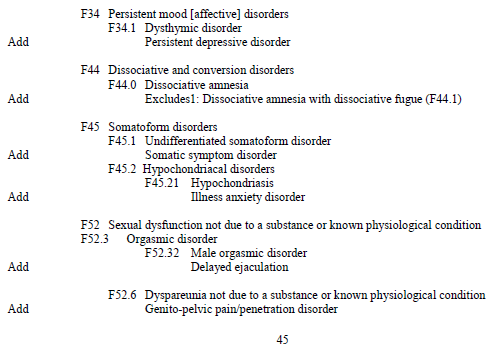
For the proposals to insert Somatic symptom disorder (SSD) and Illness anxiety disorder into ICD-10-CM as inclusion terms under existing F45 Somatoform disorders codes (as listed on Page 45 of the Diagnostic Agenda/Proposals document), no descriptions, no rationales and no supporting clinical references and literature were set out in the Diagnostic Agenda/Proposals document nor presented at the September meeting.

The requesters for each of these additional 17 insertions/changes listed under “Additional Tabular List Inclusion Terms for ICD-10-CM” remain unclear.

If you have comments or objections to the proposed insertion of Somatic symptom disorder (SSD) or in relation to any of the proposals requested via the September ICD-9-CM C & M Committee meeting, please have your submissions in, via email, to Donna Pickett nchsicd9CM@cdc.gov by November 15.

+++

Related posts:

Keep SSD out of ICD-10-CM – November 15 deadline for objections: http://wp.me/pKrrB-3vK

Videos and meeting materials: September 18–19 ICD-9-CM Coordination and Maintenance Committee meeting: http://wp.me/pKrrB-3tV

APA petitions CMS for additions to ICD-10-CM: Deadline for public comment and objections November 15: http://wp.me/pKrrB-3tq

+++

References for key documents and screenshots:

1. Article: ICD Codes for Some DSM-5 Diagnoses Updated, Mark Moran, Psychiatric News, October 07, 2013:
http://psychnews.psychiatryonline.org/newsarticle.aspx?articleID=1757346

2. ICD-9-CM/PCS Coordination and Maintenance Committee Meeting September 18-19, 2013:
http://www.cdc.gov/nchs/icd/icd9cm_maintenance.htm

September meeting Proposals document [PDF – 342 KB]:
http://www.cdc.gov/nchs/data/icd/icd_topic_packet_sept_181913.pdf

3. ICD-9-CM/PCS Coordination and Maintenance Committee Meeting Sept 18-19, 2013 meeting materials and four YouTubes of proceedings:
http://www.cms.gov/Medicare/Coding/ICD9ProviderDiagnosticCodes/ICD-9-CM-C-and-M-Meeting-Materials-Items/2013-09-18-MeetingMaterials.html

4. YouTube Videos from September 18, 2013 Meeting Day One

ICD-9-CM Coordination and Maintenance Committee Meeting (Morning Session) Part 1
http://www.youtube.com/watch?v=Ut3DmV88Dmc

ICD-9-CM Coordination and Maintenance Committee Meeting (Morning Session) Part 2
http://www.youtube.com/watch?v=CAE190sM5AQ

ICD-9-CM Coordination and Maintenance Committee Meeting (Afternoon Session) Part 3
http://www.youtube.com/watch?v=QQOFadq2x6U

September 19, 2013 Meeting Day Two

ICD-9-CM Coordination and Maintenance Committee Meeting Part 4
http://www.youtube.com/watch?v=G-pYdKyr_NE

Videos and meeting materials: September 18–19 ICD-9-CM Coordination and Maintenance Committee meeting

Post #277 Shortlink: http://wp.me/pKrrB-3tV

Update: Crazy Like Us: How the U.S. Exports Its Models of Illness – DSM-5 is Americanizing the world’s understanding of the mind by Christopher Lane, Ph.D. in Side Effects, October 9, 2013

This report relates to proposals submitted via the September ICD-9-CM/PCS Coordination and Maintenance Committee meeting for the inclusion of additional codes to the forthcoming US specific ICD-10-CM.

The twice yearly ICD-9-CM Coordination and Maintenance Committee meetings provide a public forum to discuss proposed code changes to ICD-9-CM and the ICD-10-CM/PCS. Next year, the committee, which is co-chaired by CMS and CDC, will be renamed to the ICD-10-CM Coordination and Maintenance Committee.

ICD-10-CM/PCS is scheduled for implementation in October 2014 and currently subject to partial code freeze.

The meeting scheduled on September 18, 2013 was devoted to both diagnosis and procedure code topics. The second day of the meeting, September 19, continued discussions related to diagnosis code topics.

Below are links for key meeting materials, four videocasts, and agenda item listings for the diagnosis proposals presented on Day Two (videocast Part 4). This includes the presentation of proposals by American Psychiatric Association (APA) Director of Research, Darrel Regier, MD, for insertion of new DSM-5 diagnoses into the ICD-10-CM.

Meeting materials:

From CDC website: ICD-9-CM Coordination and Maintenance Committee webpage:

http://www.cdc.gov/nchs/icd/icd9cm_maintenance.htm

September 18-19, 2013 meeting Proposals (Timeline, Agenda for Diagnosis Proposals) [PDF – 342 KB]

From CMS.gov website:

September 18-19, 2013 meeting materials page

September 18, 2013 Agenda (Timeline, Agenda for ICD-10-PCS Topics, Procedure presentations) [PDF, 326KB]

September 18, 2013 Meeting Materials [ZIP, 4MB]

Download Zip file from CMS.gov meeting materials page | 4MB Zip file unpacks to:

PDF Presenter Slides: Cerapedics ICD-9 9 18 2013 FINAL [712KB]

PDF Presenter Slides: Respicardia ICD-9 Sept 18 FINAL [670KB]

PDF CMS/CDC Meeting Slides: September-ICD9CM-slides [3033KB]

PDF Text version of CMS/CDC Meeting slides: 508-Compliant-Version-of-September-ICD9CM-slides [282KB]

+++

Videocasts for September 18, 2013 | Day One

Pat Brooks (CMS) Co-Chairperson
9:00 AM – 12:30 PM ICD-10-PCS Procedure presentations with public comment
12:30 PM – 1:30 PM Lunch break
1:30 PM – 5:00 PM Diagnosis presentations with public comment

Part 1 1:43 hours duration

Procedure presentations with public comment


+++
Part 2 1:27 hours duration

Procedure presentations with public comment


+++
Part 3 59 minutes duration

Diagnosis presentations with public comment

+++
Videocast for September 19, 2013 | Day Two

Donna Pickett (CDC) Co-Chairperson
+++
Part 4 1:42 hours duration

Diagnosis presentations with public comment

+++
Diagnosis proposals

4:58 mins in: Presenter Lizabeth (Beth) Fisher (CDC) [on behalf of requestor: The American Society of Anesthesiologists]

Page 47 Diagnosis Agenda: Unintended awareness under general anesthesia

Comment from floor: Robert Adams reads out written statement.

13:56 mins in: DSM-5 and ICD-10-CM Discussions on mental health conditions and harmonization with ICD-10-CM.

Presenter: Darrel Regier, MD (Director of Research, APA; served as DSM-5 Task Force Vice-Chair)

Preamble about DSM and DSM-5.

Page 32 Diagnosis Agenda: Binge eating disorder

No questions or comments from the floor or by phone link.

29 mins in: Page 34 Diagnosis Agenda: Gender identity disorder in adolescence and adulthood

No questions or comments from the floor or by phone link.

37 mins in: Page 35 Diagnosis Agenda: Disruptive mood dysregulation disorder (DMDD)

No questions or comments from the floor or by phone link.

45 mins in: Page 37 Diagnosis Agenda: Social (pragmatic) communication disorder

No questions or comments from the floor or by phone link.

54 mins in: Page 39 Diagnosis Agenda: Hoarding disorder

No questions or comments from the floor or by phone link.

1hr:1 min in: Page 41 Diagnosis Agenda: Excoriation (skin picking) disorder

Some questions raised by DP on behalf of other and comment from the floor.

1hr:14 mins in: Page 43 Diagnosis Agenda: Premenstrual dysphoric disorder (PMDD)

Question raised by DP regarding PMDD and Excludes.
No questions or comments from the floor or by phone link.

Dr Regier concludes his presentation and hands podium back to Donna Pickett (CDC).

1hr:22 mins in: Page 45-46 Diagnosis Agenda: Additional Tabular List Inclusion Terms for ICD-10-CM

See screenshots at end of Post #276 for Diagnosis Agenda Pages 45-46.

[Unofficial transcription from videocast]

Donna Pickett (CDC): “…And just to complete the package, there are other Tabular List proposals that appear on Page 45 and 46 that we would also invite your comments on. And again, with some of the terminology changes that Dr Regier has described the intent here is to make sure that if those terms are being used, that they do have a home somewhere within ICD-10-CM to facilitate people looking these up. So we invite comments. We’re showing the Tabular List proposed changes; however, there obviously would be associated Alphabetic Index changes with that which we didn’t show just to keep the package a little bit smaller…”

No questions or comments from the floor or by phone link on any of the proposed inclusion terms listed on Pages 45 and 46 under “Additional Tabular List Inclusion Terms for ICD-10-CM”.

Donna Picket moves on to next set of proposals and turns podium over to Beth Fisher (CDC).

1hr:23 mins in: Page 49 Diagnosis Agenda: Intracranial injury (TBI)

Comment from floor at 1hr:32 mins: Luana Ciccarelli from the American Academy of Neurology. Comment from Sue Bowman read out by Beth Fisher.

1hr:34 mins in: Page 53 Diagnosis Agenda: Placenta Previa vs Low Lying Placenta

Presenter Lizabeth (Beth) Fisher (CDC) on behalf of requestor: The American Congress of Obstetricians and Gynecologists (ACOG).

No questions or comments from the floor or by phone link.

This concluded the diagnosis portion of the presentations.

Note that Agenda items from Page 53 onwards were tabled for presentation and discussion in earlier in the meeting proceedings.

1hr:40 mins in: Donna Pickett (CDC) brings meeting to a close.

[Unofficial transcription from videocast]

Donna Pickett (CDC): “…November 15…is in the Topic Package for receipt of comments on all of the proposals. That is the deadline, but we’d love to have them sooner as this does have implications in terms of what does become part of an addenda or not, and that would be specific to the inclusion terms in the Tabular List and Alphabetical Index because, again, unless the proposal meets the criteria established for the partial freeze, no new codes are being entertained except for the ones that were requested. We invite your comments on that as well…”

Submitting public comment:

The deadline for receipt of public and professional stakeholder comment on any of the proposed ICD-10-CM/PCS code revisions discussed at the September 18-19, 2013 ICD-9-CM Coordination and Maintenance Committee meeting is November 15.

Comments should be sent to the following dedicated NCHS/CMS email addresses:

Procedure comments by email to Pat Brooks, CMS: patricia.brooks2@cms.hss.gov

Diagnosis comments by email to Donna Pickett, CDC: nchsicd9CM@cdc.gov

(Full contact details for submission of written comments/objections to NCHS/CMS on Page 8 of the Proposals/Diagnosis Agenda PDF. Electronic submissions are much preferred in order to ensure timely receipt.)
APA petitions CMS for additions to ICD-10-CM: Deadline for public comment and objections November 15

Post #276 Shortlink: http://wp.me/pKrrB-3tq

Information in this report relates to American Psychiatric Association (APA) proposals, submitted via the September ICD-9-CM/PCS Coordination and Maintenance Committee Meeting, for the inclusion of a number of additions to the forthcoming US specific ICD-10-CM.

ICD-9-CM is the official system of assigning codes to medical diagnoses in the United States. Next year, ICD-9-CM will be replaced by ICD-10-CM, scheduled for implementation on October 1, 2014.

The DSM is widely used by CMS contractors, federal and state agencies and medical insurers to indicate eligibility for provision of services.

Since the official codes required in the United States for records and reimbursement purposes are ICD-CM codes, DSM diagnoses are cross-walked to the closest approximation of ICD-CM codes to classify diagnoses for insurance claims, research, data capture and other public health purposes.

APA petitions ICD-9-CM Coordination and Maintenance Committee:

The ICD-9-CM and ICD-10-CM coding systems are subject to annual revisions by NCHS and CMS via public review meetings held twice a year (in March and September), followed by brief public comment periods.

October 1, 2011 saw the last major update of ICD-10-CM/PCS until October 1, 2015. Between October 1, 2011 and October 1, 2015 revisions to ICD-10-CM/PCS will be for new diseases/new technology procedures, and any minor revisions to correct reported errors in these classifications. Regular (at least annual) updates to ICD-10-CM/PCS will resume on October 1, 2015.

The ICD-9-CM Coordination and Maintenance Committee will continue to meet twice a year during this partial code freeze. At these meetings, the public will be asked to comment on whether or not requests for new diagnosis or procedure codes should be created based on the criteria of the need to capture a new technology or disease. Any code requests that do not meet the criteria will be evaluated for implementation within ICD-10-CM on and after October 1, 2015 once the partial code freeze has ended.

At last month’s Coordination and Maintenance Committee meeting, APA presented seven diagnoses that are new to DSM-5, along with proposals for new codes for addition to the ICD-10-CM [1]. APA states that the new codes, if approved [by NCHS/CMS], would probably not be added to ICD-10-CM until 2015.

Yesterday, APA published an article in Psychiatric News (the PR organ of the APA), listing the additions and changes proposed by APA via the September meeting (about two thirds into the article):

ICD Codes for Some DSM-5 Diagnoses Updated, Mark Moran, Psychiatric News, October 07, 2013 DOI: 10.1176/appi.pn.2013.10b30

The following disorders were proposed by APA for inclusion in ICD-10-CM (Pages 32-44, Diagnosis Agenda).

Dr Regier’s presentation starts on Day Two of the meeting, video Part 4, 13:50 mins in from start and concludes after PMDD.

Binge eating disorder (BED);
Disruptive mood dysregulation disorder (DMDD);
Social (pragmatic) communication disorder;
Hoarding disorder;
Excoriation (skin picking) disorder;
Premenstrual dysphoric disorder (PMDD)

Additionally, the APA has petitioned for revisions to the ICD-10-CM listing for gender dysphoria in adolescents and adults, which is not a new disorder. Dr Regier’s presentation concluded with recommendations for PMDD.

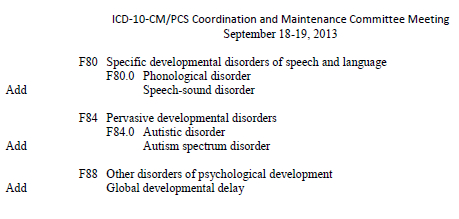
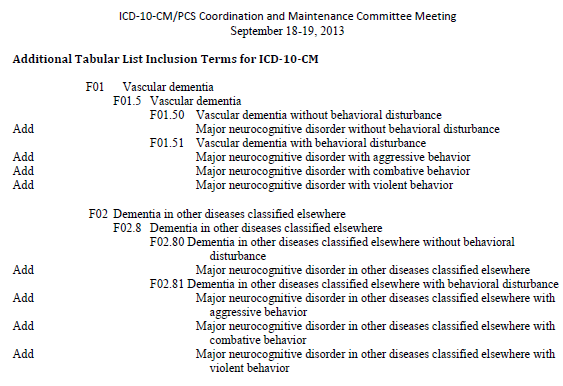
Edit: On Page 45 and 46 of the Agenda, under Additional Tabular List Inclusion Terms for ICD-10-CM a number of other changes to specific Chapter 5 F codes are proposed, including the addition to the ICD-10-CM Chapter 5 codes of the new DSM disorders:

Somatic symptom disorder (proposed as Inclusion term to F45.1 Undifferentiated somatoform disorder)

Illness anxiety disorder (proposed as Inclusion term to F45.21 Hypochondriasis)

None of these 16 proposed additional inclusion terms to the ICD-10-CM Mental and behavioural disorders (Chapter 5) F codes, as listed on Pages 45-46, were presented or discussed by Dr Regier on behalf of the APA but presented briefly and en masse by Donna Pickett.

I have pasted screenshots from the Agenda at the end of this report [Ref 5].

Ms Pickett introduced this section of the Agenda on Day Two, video Part 4, 1 hour 22 mins in from start.

Diagnosis Agenda Item Page 45-46: “Additional Tabular List Inclusion Terms for ICD-10-CM”

Co-Chair Donna Pickett: “…And just to complete the package, there are other Tabular List proposals that appear on Page 45 and 46 that we would also invite your comments on. And again, as with some of the terminology changes that Dr Regier has described the intent here is to make sure that if those terms are being used, that they do have a home somewhere within ICD-10-CM to facilitate people looking these up. So we invite comments. We’re showing the Tabular List proposed changes. However, there obviously would be associated Alphabetic Index changes with that which we didn’t show [in the Agenda] just to keep the package a little bit smaller.”

With no discussion taking place on rationales for individual proposals and no comments or questions being received from the floor or by phone link, Ms Pickett moved swiftly forward to introduce the next Agenda item.

Since these proposals are unattributed in the Agenda, the provenance of these additional 16 code change requests is unclear (that is, whether the requestors are CMS/CDC, Collaborating Centre for the WHO-FIC in North America, WHO ICD-10 Update Committee, WHO ICD-11 Revision, APA or other petitioners).

If the addition of new DSM-5 disorders Somatic symptom disorder and Illness anxiety disorder had been proposed by the APA, it is unclear why these were not included within Dr Regier’s presentation for discussion.

Blink and you might have missed the proposal to incorporate Somatic symptom disorder and Illness anxiety disorder into ICD-10-CM – so little time and attention being devoted to this section of the Agenda.

Note that Hypochondriasis (Illness anxiety disorder) is proposed to be included in the ICD-11 Beta draft under dual parents Obsessive-compulsive and related disorders and Bodily distress disorders, and psychological and behavioural factors associated with disorders or diseases classified elsewhere.

Full proposals from APA and other petitioners can be read in the ICD-9-CM/PCS Coordination and Maintenance Committee Meeting Sept 18–19, 2013: Proposals document at:

http://www.cdc.gov/nchs/icd/icd9cm_maintenance.htm

(Diagnosis Agenda) Proposals document [PDF – 342 KB]:

http://www.cdc.gov/nchs/data/icd/icd_topic_packet_sept_181913.pdf

A Summary report of the Procedure part of the September 18–19, 2013 ICD-9-CM Coordination and Maintenance Committee meeting is not yet available. This is expected to be posted on the CMS webpage in October, at:

http://www.cms.gov/Medicare/Coding/ICD9ProviderDiagnosticCodes/ICD-9-CM-C-and-M-Meeting-Materials.html

and also on the CDC’s website page for the meetings.

Other Meeting materials (Agenda, Proposals and four YouTubes of the two-day September meeting proceedings) are now available from this page [3]:

http://www.cms.gov/Medicare/Coding/ICD9ProviderDiagnosticCodes/ICD-9-CM-C-and-M-Meeting-Materials-Items/2013-09-18-MeetingMaterials.html

There is an ICD-9-CM and ICD-10-CM/PCS revisions Timeline set out on pages 3 thru 7 of the Proposals PDF [2].

Submitting public comment:

The deadline for receipt of public and professional stakeholder comment on any of the proposed ICD-10-CM/PCS code revisions discussed at the September 18-19, 2013 ICD-9-CM Coordination and Maintenance Committee meeting is November 15, 2013.

Comments should be sent to the following NCHS email addresses:

Procedure comments by email to Pat Brooks, CMS: patricia.brooks2@cms.hss.gov

Diagnosis comments by email to Donna Pickett, CDC: nchsicd9CM@cdc.gov

Full contact details for submission of comments/objections to NCHS/CMS are on page 8 of the Proposals PDF. The meeting co-chairs state that electronic submissions are greatly preferred over snail mail in order to ensure timely receipt.

Responders are asked to consider the following:

Whether you agree with a proposal, disagree (and why), or have an alternative proposal to suggest.

But also to comment on the timing of those proposals that are being requested for approval for October 2014.

Does a proposal for a new or changed Index entry and Tabular List entry meet the criteria for implementation in Oct 2014 during a partial code freeze or should consideration for inclusion be deferred to Oct 2015 implementation? And separately, comment on the creation of a specific new code for the condition effective from October 1, 2015.

I shall post reminders before the November 15, 2013 deadline date and also a copy of the September meeting Summary document, once this is available. (Posting of the Summary document may be delayed due to the government shut-down and you may prefer to review the YouTubes of the meeting proceedings rather than wait for the Summary document to appear.)

+++

References for key documents and screenshots:

1. Article: ICD Codes for Some DSM-5 Diagnoses Updated, Mark Moran, Psychiatric News, October 07, 2013:
http://psychnews.psychiatryonline.org/newsarticle.aspx?articleID=1757346

2. ICD-9-CM/PCS Coordination and Maintenance Committee Meeting September 18-19, 2013:
http://www.cdc.gov/nchs/icd/icd9cm_maintenance.htm

September meeting Proposals document [PDF – 342 KB]:
http://www.cdc.gov/nchs/data/icd9/icd9cm_proposals_91819.pdf

3. ICD-9-CM/PCS Coordination and Maintenance Committee Meeting Sept 18-19, 2013 meeting materials and four YouTubes of proceedings:
http://www.cms.gov/Medicare/Coding/ICD9ProviderDiagnosticCodes/ICD-9-CM-C-and-M-Meeting-Materials-Items/2013-09-18-MeetingMaterials.html

4. YouTube Videos from September 18, 2013 Meeting Day One

ICD-9-CM Coordination and Maintenance Committee Meeting (Morning Session) Part 1
http://www.youtube.com/watch?v=Ut3DmV88Dmc

ICD-9-CM Coordination and Maintenance Committee Meeting (Morning Session) Part 2
http://www.youtube.com/watch?v=CAE190sM5AQ

ICD-9-CM Coordination and Maintenance Committee Meeting (Afternoon Session) Part 3
http://www.youtube.com/watch?v=QQOFadq2x6U

September 19, 2013 Meeting Day Two

ICD-9-CM Coordination and Maintenance Committee Meeting Part 4
http://www.youtube.com/watch?v=G-pYdKyr_NE

5. Pages 45-46, Diagnosis Agenda:

ICD10CM 1

ICD10CM 2

ICD10CM 3

WHO considers further extension to ICD-11 development timeline

Post #275 Shortlink: http://wp.me/pKrrB-3sc

Information in this report relates to the World Health Organization’s ICD-11, currently under development. It does not apply to the current ICD version (ICD-10) or to the forthcoming US specific “clinical modification” of ICD-10, known as ICD-10-CM.

Timeline slippage

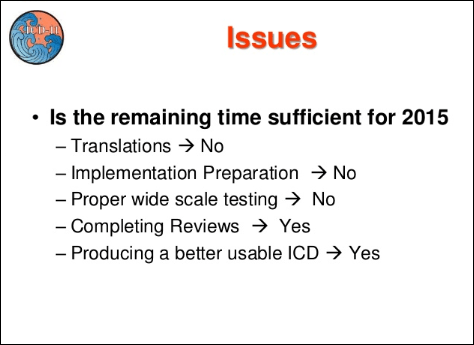
Documents posted recently by the World Health Organization (WHO) indicate that ICD Revision is failing to meet development targets and a further extension to the ICD-11 timeline is under consideration.

ICD serves as the international health information standard for the collection, classification, processing and presentation of disease-related data in national and global health statistics.

The 10th edition (ICD-10) was adopted by the World Health Assembly in 1990.

The development process for the next edition (ICD-11) began in April 2007, with ICD-11 scheduled for dissemination by 2012 and the timelines for the development of ICD-11 and DSM-5 running more or less in parallel [1] [2].

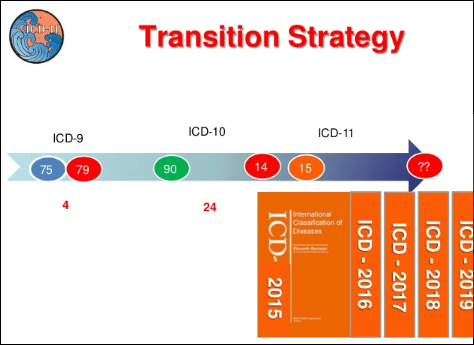
Early on in the revision process, the ICD-11 dissemination date was extended. By 2009, the final draft was scheduled for World Health Assembly (WHA) approval in 2014. In order to be ready for global implementation in 2015, the technical work on ICD-11 would need to be completed by 2012 [3].

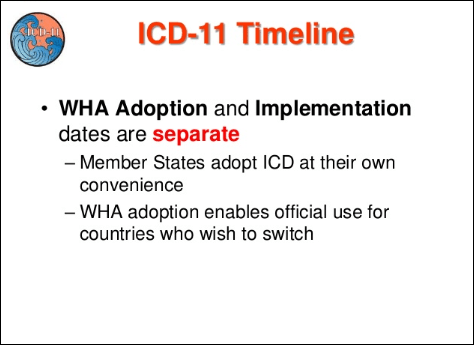
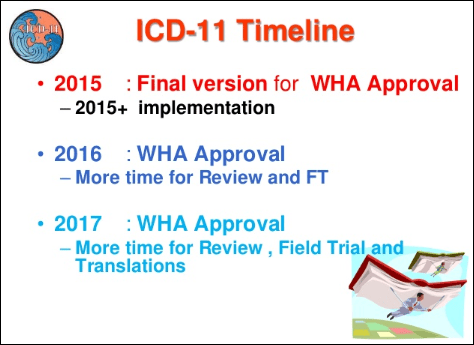
The WHA approval date was subsequently shunted from 2014 to 2015 – four years later than originally planned and the current, projected implementation date is 2016+.
+++

“…And just a small detail: who will do all this work?” [4]

ICD-11 is a very ambitious and under-resourced project. Given the scale of the undertaking, the technical complexity, the limited funding and human resources, the feasibility of the project reaching its targets by May 2015 has proved unrealistic.

I have written a number of times on this site that I did not envisage dissemination of ICD-11 by 2016 without some scaling back of the project’s scope – or an announcement, at some point this year, of a further extension to the timeline.

ICD-11 Revision Steering Group considers its options

WHO has recently posted a meeting materials document [5] and a slide presentation [6] which summarize, inter alia, ICD-11’s progress, current development status and timelines for finalization date and approval by WHO Governing Bodies.

ICD Revision is considering extending the timeline by up to a couple of years.

This 14 page document Committee for the Coordination of Statistical Activities, Twenty-second Session 4-6 September 2013, Items for discussion and decision: Item 8 of the provisional agenda can be downloaded here

or opened on Dx Revision WatchPDF: SA-2013-12-Add1-Health-WHO

It summarizes the status of the ICD Revision process under section headings:

1. Background: need and mandate
2. General organization structure of the multiple streams of work
3. Progress and current status
4. The remaining steps
5. Further maintenance of ICD after finalization
6. Timelines for the finalization date and approval by WHO Governing Bodies

Extracts from the document setting out the rationale and options for postponement of WHA Approval:

[…]

3. Progress and Current Status of ICD Revision:

[…]

BETA PHASE:

At this point in time, 1 September 2013, an ICD2013 Beta version has been produced for review purposes and field trials after 6 years of drafting phases.

The current ICD 2013 Beta version has relatively stable classification lists (i.e. linearizations) for Mortality and Morbidity recording. It will be reviewed by the specific Mortality Reference Group and the Morbidity Reference Group to see how well it fits the purpose and proposed transition from ICD‐10.

In addition, the Beta version has planned processes for:

(i) Systematic international scientific peer review
(ii) Submission of additional proposals from public groups and scientists
(iii) Conducting field trials for its applicability and reliability
(iv) Production support in multiple languages (translations) starting with WHO official languages
(v) Preparations for transitions from ICD‐10 to ICD‐11.

[…]

6. Timelines

The current ICD Revision Process timeline foresees that the ICD is submitted to the WHA in 2015 May and could then be implemented. Between now and 2015, there remains 20 months to conduct the remaining tasks summarized above as: 1. Reviews, 2. Additional Proposals, 3. Field Trials, 4. Translations, and 5. Transition Preparations.

Given the technical requirements these steps could be expedited in the next 20 months. The experience obtained thus far, however, suggests that this timeframe will be extremely tight for paying due diligence to the work especially in terms of: appropriate consultations with expert groups; communication and dissemination with stakeholders; and sufficient time for field testing in multiple countries and settings, and carrying out the resulting edits.

WHO Secretariat would like to discuss this with all stakeholders and evaluate the possible options:

a. Keep ICD submission to WHA to 2015 as originally planned and implementation / adoption date may be free by any Member State (current position – no change).

b. Postpone submission to WHA to a later year to allow longer time for field trials and other transition preparations.

[…]

In conclusion:

(a) WHO Secretariat could produce an ICD 2015 ready including Mortality and Morbidity Linearizations, Reference Guide and Index with the appropriate resolution to go to the World Health Assembly. This timeframe, however, is extremely tight for paying due diligence to the work especially in terms of: appropriate consultations with expert groups; and sufficient time for field testing in multiple countries and settings, and carrying out the resulting edits

(b) If the timeline is advanced to 2016, there will be more time to have ICD 2016 version with more translations and incorporations of some field tests results.

(c) If the timeline is advanced to 2017, ICD 2017 will be ready with most Field Test results incorporated and maintenance scheme tested.

[…]

If WHO/ICD-11 Revision Steering Group does elect to postpone submission for WHA approval until May 2017, dissemination of ICD-11 may not be scheduled before 2018.

Once approved and released, adoption of ICD-11 won’t happen overnight. It may take several years before WHO Member States adopt ICD-11. Low resource and developing countries may also take longer to prepare for and transition to the new edition.

Note for US readers: According to Page 3332 of DHSS Office of Secretary Final Rule document (Federal Register / Vol. 74, No. 11 / Friday, January 16, 2009 / Rules and Regulations):

“…We [ICD-9-CM Coordination and Maintenance Committee] discussed waiting to adopt the ICD-11 code set in the August 22, 2008 proposed rule (73 FR 49805)…

“…However, work cannot begin on developing the necessary U.S. clinical modification to the ICD-11 diagnosis codes or the ICD-11 companion procedure codes until ICD-11 is officially released. Development and testing of a clinical modification to ICD-11 to make it usable in the United States will take an estimated additional 5 to 6 years. We estimated that the earliest projected date to begin rulemaking for implementation of a U.S. clinical modification of ICD-11 would be the year 2020.” [7]

This projection, in early 2009, would have been based on the assumption that ICD-11 was anticipated to be finalized and submitted for WHA Approval by 2014 (now potentially shifting to 2017).

An additional two year delay in the finalization of the ICD-11 code sets would likely impact on the development process for a clinical modification of ICD-11 for US specific use, kicking adaptation and implementation of an ICD-11-CM even further down the road.

+++
This slide presentation, below, was uploaded to Slideshare on September 9 by Dr Bedirhan Üstün, Coordinator, Classification, Terminology and Standards, World Health Organization, and also sets out the postponement options now under consideration:

Slide presentation: World Health Organization Classifications, Terminologies, Standards

ICD Revision: Quality Safety Meeting 2013 September 9-10

Where are we? What remains to be done? Shall we have ICD WHA submission in 2015 or later?

http://www.slideshare.net/ustunb/icd-2013-qs-tag-26027668

Slide 29:

Ustun 29rule

Slide 30:

Ustun 30rule

Slide 34:

Ustun 34rule

Slide 35: [WHA Approval – options under consideration]

Ustun 35rule
+++

References

1. Agenda Item No. 25: Revision of the International Classification of Diseases (ICD-10) and Involvement of Psychology International Union of Psychological Science Committee on International Relations Action, March 28–30, 2008 IUPsyS Mar 08 Agenda Item 25 ICD-10

2. Letter Saxena, WHO, to Ritchie, IUPsyS (International Union for Psychological Science), August 2007 Exhibit 1 WHO Letter Aug 07

3. Dr Geoffrey Reed, Ph.D., May 2009, personal correspondence.

4. Closing remarks, PowerPoint presentation: “Proposal for the ICD Beta Platform”, Stanford team, 12.04.11, WHO, Geneva.

5. Committee for the Coordination of Statistical Activities, Twenty-second Session 4-6 September 2013, Items for discussion and decision: Item 8 of the provisional agenda, 3 September 2013 Full document in PDF format

6. Slide presentation: ICD Revision: Where are we? Bedirhan Ustun, World Health Organization Classifications, Terminologies, Standards, ICD Revision: Quality Safety Meeting 2013, September 9-10, 2013 http://www.slideshare.net/ustunb/icd-2013-qs-tag-26027668

7. DHSS Office of Secretary Final Rule document (Federal Register / Vol. 74, No. 11 / Friday, January 16, 2009 / Rules and Regulations), Page 3332.

ICD-10-CM Release for 2014 now available

Post #270 Shortlink: http://wp.me/pKrrB-3iT

ICD-10-CM Release for 2014 now available

Prior to implementation, the codes in ICD-10-CM are not valid for any purpose or use.

The World Health Organization’s (WHO) International Classification of Diseases (ICD-10) was published in 1992 and is used in over a hundred countries worldwide.

A number of countries have been authorized by WHO to develop “Clinical Modifications” – adaptations of ICD-10 for country specific use. These differ in the number of chapters, codes and subcategories. Specific conditions are present in some adaptations but not all clinical modifications [1]. All modifications to the ICD-10 must conform to WHO conventions for ICD.

Canada uses an adaptation called ICD-10-CA, Australia uses ICD-10-AM, Germany uses ICD-10-GM and Thailand uses ICD-10-TM.

The U.S. lags behind most of the rest of the world and is still using a Clinical Modification of the WHO’s long since retired, ICD-9.

A U.S. specific adaptation of ICD-10 has been under development for a considerable length of time but is scheduled for implementation on October 1, 2014.

Transition to ICD-10-CM is required for everyone covered by the Health Insurance Portability Accountability Act (HIPAA).

Implementation schedules for Large Practices; Small and Medium Practices; Small Hospitals and Payers can be found on the CMS website, here: Implementation Timelines.

+++
2014 release of ICD-10-CM

The 2014 release of ICD-10-CM is now available from the CDC website. It replaces the July 2012 release.

Prior to the implementation date of October 1, 2014, the codes in ICD-10-CM are not valid for any purpose or use.

The ICD-10-CM code set is currently subject to partial code freeze. For information on the code freeze see Partial Freeze of Revisions to ICD-9-CM and ICD-10-CM/PCS.

October 1, 2011 was the last major update of ICD-10-CM/PCS until October 1, 2015. Between October 1, 2011 and October 1, 2015, revisions to ICD-10-CM/PCS will be for new diseases/new technology procedures or minor revisions to correct any reported errors in these classifications. Regular (at least annual) updates to ICD-10-CM/PCS will resume on October 1, 2015.

Information on the ICD-9-CM and ICD-10-CM/PCS update and revision processes and the public NCHS/CDC Coordination and Maintenance Committee meetings can be found on this CDC page: Coordination and Maintenance Committee.

Downloading the ICD-10-CM code sets

The ICD-10-CM Preface, Guidelines, Tabular List, Index and associated documentation can be downloaded from this page: http://www.cdc.gov/nchs/icd/icd10cm.htm#10update.

The PDF of the Preface is in a single PDF file here: ICD-10-CM Preface 2014

The PDF of the Guidelines is in a single PDF file here: ICD-10-CM Guidelines

+++
To access the PDFs for the ICD-10-CM Tabular List and Index, the files need extracting from Zip files from this link:

ICD-10-CM List of codes and Descriptions (updated 7/3/2013)

( ftp://ftp.cdc.gov/pub/Health_Statistics/NCHS/Publications/ICD10CM/2014/ )

Select this file, below, on the CDC site and open it. It is a large file of over 15MB so you will need to allow sufficient time for it to fully load:

06/19/2013 08:28AM 15,223,965 ICD10CM_FY2014_Full_PDF.zip

It will unpack these five PDF files, which can be opened and viewed in situ or saved:

ICD10CM_FY2014_Full_PDF_DIndex  4,222 KB  [ICD-10-CM INDEX TO DISEASES and INJURIES]

or open unzipped PDF on Dx Revision Watch: ICD-10-CM 2014 Full Index

ICD10CM_FY2014_Full_PDF_EIndex   [401 KB]  [ICD-10-CM External Cause of Injuries Index]

ICD10CM_FY2014_Full_PDF_TableOfDrugs   [2,193 KB]

ICD10CM_FY2014_Full_PDF_TableOfNeoplasms   [646 KB]

ICD10CM_FY2014_Full_PDF_Tabular   [7, 398 KB]  [ICD-10-CM TABULAR LIST of DISEASES and INJURIES]

or open unzipped PDF on Dx Revision Watch: ICD-10-CM Tabular List

+++
For five PDF files of Addenda go to this page:

ftp://ftp.cdc.gov/pub/Health_Statistics/NCHS/Publications/ICD10CM/2014/

and select this file:

06/19/2013 08:28AM 582,584 ICD10CM_FY2014_Addenda.zip

+++
Comparison between classifications and codings in ICD-10-CM and ICD-10

The WHO’s ICD-10 Volume 1 The Tabular List isn’t made available as a PDF file but can be accessed on a searchable electronic browser platform here: ICD-10 Version: 2010.

The Tabular List for ICD-10 contains more textual descriptions for the categories in Chapter V (the mental and behavioural disorders chapter) than other chapters in ICD-10.

There are also two “speciality” volumes for ICD-10 Chapter V for Clinical descriptions and diagnostic guidelines (known as the “Blue Book”) and Diagnostic criteria for research (known as the “Green Book”).

The U.S. specific ICD-10-CM will not contain this depth of textual content within its Chapter 5.

CDC’s, Donna Picket, has confirmed that CMS/CDC does not plan to adapt the “Blue Book” specifically for U.S. use in conjunction with Chapter 5 of ICD-10-CM [2]. Nor are there plans for an official CMS/CDC crosswalk between ICD-10-CM’s Chapter 5 classifications and codes and those in ICD-10 Chapter V [3].

In the U.S., since 2003, the ICD-9-CM diagnostic codes have been mandated for third-party billing and reporting by HIPAA for all electronic transactions for billing and reimbursement. Following implementation on October 1, 2014, the ICD-10-CM codes sets will become mandatory.

This also applies to the coding of mental and behavioural disorders. APA’s DSM-IV disorder diagnoses are crosswalked to ICD-9-CM codes, or their nearest equivalent, for billing and reimbursement.

The DSM-5, published in May this year, includes the crosswalk codes for both the existing ICD-9-CM and the forthcoming ICD-10-CM codes.

For comparison between

ICD-10-CM Chapter 5 Mental, Behavioral and Neurodevelopmental disorders (F01-F99)

and ICD-10 Chapter V Mental and behavioural disorders (F00-F99) see the ICD-10 online browser or

The ICD-10 Classification of Mental and Behavioural Disorders Clinical descriptions and diagnostic guidelines (The “Blue Book”)

+++
References and further resources

1. The development, evolution, and modifications of ICD-10: challenges to the international comparability of morbidity data. Jetté N, Quan H, Hemmelgarn B, Drosler S, Maass C, Moskal L, Paoin W, Sundararajan V, Gao S, Jakob R, Ustün B, Ghali WA; IMECCHI Investigators. Med Care. 2010 Dec;48(12):1105-10. doi: 10.1097/MLR.0b013e3181ef9d3e [PMID: 20978452].

The development, evolution and modifications of ICD-10: challenges to the international comparability of morbidity data: Nathalie Jetté MD, November 2009, Slide Presentation [5 MB].

2. Personal communication.

3. Personal communication.

4. Information for providers, payers and vendors on transition to ICD-10-CM can be found here on the CMS website.

5. DEPARTMENT OF HEALTH AND HUMAN SERVICES Centers for Medicare & Medicaid Services: ICD-10-CM/PCS MYTHS AND FACTS ICN 902143, April 2013.

6. American Psychological Association: Nine frequently asked questions about DSM-5 and ICD-10-CM, APA Practice staff answer questions about billing, determining diagnoses and more related to the two diagnostic classification systems. Practice Update, May 16, 2013.

7. American Psychiatric Association: Insurance Implications of DSM-5

8. AAPC What is ICD-9-CM?

Psychologists’ perspectives on the diagnostic classification of mental disorders: Results from the WHO-IUPsyS Global Survey

Post #263 Shortlink: http://wp.me/pKrrB-3dj

Psychologists’ perspectives on the diagnostic classification of mental disorders: Results from the WHO-IUPsyS Global Survey

Int J Psychol. 2013 Jun 10. [Epub ahead of print]

Psychologists’ perspectives on the diagnostic classification of mental disorders: Results from the WHO-IUPsyS Global Survey.

Evans SC, Reed GM, Roberts MC, Esparza P, Watts AD, Correia JM, Ritchie P, Maj M, Saxena S.
Source
a Clinical Child Psychology Program, University of Kansas, Lawrence , KS, USA.

Abstract

This study examined psychologists’ views and practices regarding diagnostic classification systems for mental and behavioral disorders so as to inform the development of the ICD-11 by the World Health Organization (WHO). WHO and the International Union of Psychological Science (IUPsyS) conducted a multilingual survey of 2155 psychologists from 23 countries, recruited through their national psychological associations. Sixty percent of global psychologists routinely used a formal classification system, with ICD-10 used most frequently by 51% and DSM-IV by 44%. Psychologists viewed informing treatment decisions and facilitating communication as the most important purposes of classification, and preferred flexible diagnostic guidelines to strict criteria. Clinicians favorably evaluated most diagnostic categories, but identified a number of problematic diagnoses. Substantial percentages reported problems with crosscultural applicability and cultural bias, especially among psychologists outside the USA and Europe. Findings underscore the priority of clinical utility and professional and cultural differences in international psychology. Implications for ICD-11 development and dissemination are discussed.

PMID: 23750927

[PubMed – as supplied by publisher]

+++

Slide Presentation: Aug 3, 2012

The WHO-IUPsyS Global Survey of Psychologists’ Attitudes Toward Mental Disorders Classification.

Download PDF WHO-IUPsyS Global Survey slides

+++
More information on this WHO study can be found on Page 7 (3.) of this report:

http://www.apa.org/international/outreach/icd-report-2012.pdf

2012 Annual Report of the International Union of Psychological Science to the American Psychological Association

Revision of World Health Organization’s ICD-10 Mental and Behavioural Disorders

Pierre L.-J. Ritchie, Ph.D., Main Representative to the World Health Organization, International Union of Psychological Science, January, 2013

Click link for PDF document    WHO-IUPsyS ICD Survey Report Report 2012

This report also sets out the responsibilities of ICD Revision working groups, on Page 3 (1.1), and gives some information on the field studies for ICD-11 and ICD11-PHC, on Page 8 (4.)

+++

The earlier study: WPA-WHO Global Survey of Psychiatrists’ Attitudes Towards Mental Disorders Classification can be downloaded here: 

The WPA-WHO Global Survey of Psychiatrists’ Attitudes Towards Mental Disorders Classification

World Psychiatry 2011;10:118-131

Research report

Geoffrey M Reed, João Mendonça Correia, Patricia Esparza, Shekhar Saxena, Mario Maj

+++