HHS issue Final Rule: ICD-10-CM compliance deadline set for October 1, 2015

Post #314 Shortlink: http://wp.me/pKrrB-3ZI

CMS Press Release:  Final Rule July 31, 2014

Coding industry and professional body reaction

ICD-10 Testing: Final rule overshadows CMS testing plans

ICD10 Watch | Carl Natale | August 2, 2014

+++
Debunking Myths and Misperceptions of ICD-10 – Journal of AHIMA illustrates why it’s time for 10

AHIMA | News Release | July 30, 2014

+++
DHHS final rule on ICD-10 delay ready for publication

ICD10Watch | Carl Natale | July 31, 2014

+++
CMS Confirms ICD-10 Deadline

Health Leaders Media | Michelle Leppert | August 1, 2014

+++
ICD-10 Final Rule Released, October 2015 Official Compliance Deadline

Journal of AHIMA | Mary Butler | July 31, 2014

+++
ICD-10 Final Rule Stirs Angst, Apprehension

ICD10 Monitor | Chuck Buck | August 1, 2014

+++
(From June 12, 2014)

SNOMED, ICD-11 Not Feasible Alternatives to ICD-10-CM/PCS Implementation

AHIMA | Sue Bowman | June 12, 2014

“For the US, [2017] is the beginning, not the end, of the process toward adoption of ICD-11.”

+++
Resources

Federal Register: HHS ICD-10-CM Compliance FINAL RULE

[PDF] DEPARTMENT OF HEALTH AND HUMAN SERVICES, Office of the Secretary
45 CFR Part 162 [CMS-0043-F] RIN 0938-AS31
Administrative Simplification: Change to the Compliance Date for the International Classification of Diseases, 10th Revision (ICD–10–CM and ICD-10-PCS) Medical Data Code Sets

CMS Press Release:  Final Rule July 31, 2014

CMS NEWS

FOR IMMEDIATE RELEASE    Contact: CMS Media Relations

July 31, 2014                                   (202) 690-6145 or press@cms.hhs.gov


Deadline for ICD-10 allows health care industry ample time to prepare for change

Deadline set for October 1, 2015

The U.S. Department of Health and Human Services (HHS) issued a rule today finalizing Oct. 1, 2015 as the new compliance date for health care providers, health plans, and health care clearinghouses to transition to ICD-10, the tenth revision of the International Classification of Diseases. This deadline allows providers, insurance companies and others in the health care industry time to ramp up their operations to ensure their systems and business processes are ready to go on Oct. 1, 2015.

The ICD-10 codes on a claim are used to classify diagnoses and procedures on claims submitted to Medicare and private insurance payers. By enabling more detailed patient history coding, ICD-10 can help to better coordinate a patient’s care across providers and over time. ICD-10 improves quality measurement and reporting, facilitates the detection and prevention of fraud, waste, and abuse, and leads to greater accuracy of reimbursement for medical services. The code set’s granularity will improve data capture and analytics of public health surveillance and reporting, national quality reporting, research and data analysis, and provide detailed data to enhance health care delivery. Health care providers and specialty groups in the United States provided extensive input into the development of ICD-10, which includes more detailed codes for the conditions they treat and reflects advances in medicine and medical technology.

“ICD-10 codes will provide better support for patient care, and improve disease management, quality measurement and analytics,” said Marilyn Tavenner, Administrator of the Centers for Medicare & Medicaid Services (CMS). “For patients under the care of multiple providers, ICD-10 can help promote care coordination.”

Using ICD-10, doctors can capture much more information, meaning they can better understand important details about the patient’s health than with ICD-9-CM. Moreover, the level of detail that is provided for by ICD-10 means researchers and public health officials can better track diseases and health outcomes. ICD-10 reflects improved diagnosis of chronic illness and identifies underlying causes, complications of disease, and conditions that contribute to the complexity of a disease. Additionally, ICD-10 captures the severity and stage of diseases such as chronic kidney disease, diabetes, and asthma.

The previous revision, ICD-9-CM, contains outdated, obsolete terms that are inconsistent with current medical practice, new technology and preventive services.

ICD-10 represents a significant change that impacts the entire health care community. As such, much of the industry has already invested resources toward the implementation of ICD-10. CMS has implemented a comprehensive testing approach, including end-to-end testing in 2015, to help ensure providers are ready. While many providers, including physicians, hospitals, and health plans, have completed the necessary system changes to transition to ICD-10, the time offered by Congress and this rule ensure all providers are ready.

For additional information about ICD-10, please visit: http://www.cms.gov/ICD10

###


Summary of responses from WHO re: Bodily distress disorder, Bodily stress syndrome, Bodily Distress Syndrome

Post #313 Shortlink: http://wp.me/pKrrB-3YR

+++

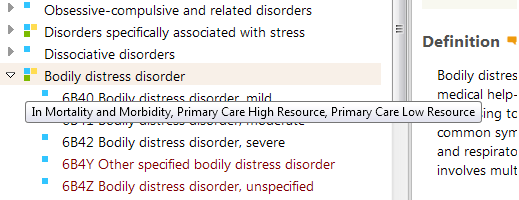
Screenshot: ICD-11 Beta drafting platform, public version, July 31, 2014; Chapter 06 Mental and behavioural disorders: Bodily distress disorder.

+++
BDD310714

Joint Linerarization for Mortality and Morbidity Statistics view selected; “show availability in main linearizations” view selected. Categories designated with three coloured key hover text: “In Mortality and Morbidity, Primary Care High Resource, Primary Care Low Resource. Categories designated with single blue key hover text: “In Mortality and Morbidity.”

+++
Summary of responses from Dr Geoffrey Reed, WHO

On July 23, I submitted an analysis and four questions via the ICD-11 Beta drafting platform for the attention of the Managing Editors for Topic Advisory Group (TAG) Mental Health, the advisory group that is revising ICD-10’s Chapter V.

A copy has been posted in Dx Revision Watch Post #311: Questions raised on ICD-11 Beta draft re: Bodily distress disorder http://wp.me/pKrrB-3Yh

Comments and suggestions submitted by registered users of the ICD-11 Beta drafting platform are screened and forwarded to the appropriate TAG Managing Editors for review.

I also sent a copy of my comments to Dr Geoffrey Reed. Dr Reed is Senior Project Officer overseeing the revision of the ICD Mental and behavioural disorders chapter.

On July 24, I received a response from Dr Reed, via email.

Dr Reed’s responses do not address all the points I had raised via the Beta platform and in my covering email. I am providing a summary of selected of Dr Reed’s responses, below.

I had also drawn Dr Reed’s attention to the absence, since early 2013, of the three G93.3 terms from the public version of the Beta draft and collective concerns for ICD Revision’s failure, to date, to respond to multiple requests to provide an explanation for the continued absence of these terms from the Beta draft and to clarify ICD Revision’s intentions and proposals for the classification of these three ICD-10 terms within ICD-11 [i.e. chapter location(s), parent code(s), hierarchies, Definitions, Synonyms, Inclusion terms etc.].

+++
Dr Reed provided the following information on July 24:

The placement of ME and related conditions within the broader ICD-11 classification is still unresolved.

There has been no proposal and no intention to include ME or other conditions such as fibromyalgia or chronic fatigue syndrome in the classification of mental disorders.

That ME and related conditions be clearly identified as NOT being part of this section of the classification could be made absolutely clear through the use of exclusion terms.

However, Dr Reed will be unable to request that exclusion terms be added to relevant Mental and behavioural disorders categories (e.g., Bodily Distress Disorder) until the conditions that are being excluded exist in the classification. At such time, he would be happy to request exclusion terms.

ICD Revision is currently involved in testing the proposals of the ICD-11 Primary Care Consultation Group* in primary care settings around the world, in part to compare how they work with the proposals of the ICD-11 Expert Working Group on Somatic Distress and Dissociative Disorders**.

Whether the primary care proposal ends up capturing specific groups of patients in primary care who are likely to have underlying medical conditions will certainly be one of the issues for examination and further discussion. Study data would be used as a basis for modifying proposals.

That he considers my analysis is accurate.

That it is not WHO policy to make research protocols for field trial studies that are planned or currently being implemented publicly available for comment.

Details of the study methodology at the time the data are published are expected to be provided, in order that others may examine and critique the methodology, their interpretation of results and their subsequent decisions based on the studies.

Further modifications of the proposals will be based on data evaluation, and justifications made available.

In due course, ICD Revision will make more detailed diagnostic guidelines for all Mental and behavioural disorders available for review and comment before they are finalized, but ICD Revision is not yet ready to do that.

Dr Reed will notify me when that occurs, but anticipates this will be before the end of the year and considers there is plenty of time for review as the approval of ICD-11 is now currently planned for May, 2017.

Dr Reed’s purview does not extend to the section on classification of Diseases of the nervous system or other areas outside the Mental and behavioural disorders chapter, and is therefore unable to provide any information related to how these conditions will be classified in other chapters***.

He is unable to comment about the management of correspondence by other TAG groups**** and signposts to another member of WHO staff [a senior classification expert who had been copied into the joint organizations’ letter to WHO/ICD Revision, in March].

+++
Footnotes:

* Back in 2012, the ICD-11 Primary Care Consultation Group (the PCCG) were proposing a disorder construct that presented a modified version of the Fink et al (2010) Bodily Distress Syndrome (BDS) construct which, at that point, the Primary Care group were proposing to call, “Bodily stress syndrome (BSS).”

The PCCG hasn’t published a progress report since 2012 and the group’s current proposals are not available for scrutiny. If a modified version of BDS is currently being proposed by the PCCG, it isn’t known what changes have been made to the group’s proposals since the Lam et al paper was published in 2012, a paper which is now in the public domain [1].

An editorial co-authored by Prof David Goldberg, in June 2013, implied that Prof Goldberg, at least, was advancing that BDS should be progressed to ICD-11 field testing. It is unclear from Dr Reed’s responses to what extent the PCCG’s most recent proposals correspond to the disorder descriptions and criteria for Fink et al’s, already operationalized, BDS, or whether the group has retained the “BSS” disorder name for the purposes of the field tests and a modified construct/criteria set.

+++
** In 2012, the ICD-11 Expert Working Group on Somatic Distress and Dissociative Disorders (the S3DWG) were proposing an alternative and divergent disorder construct that had good concordance with DSM-5’s Somatic symptom disorder, and poor concordance with Fink et al’s BDS [2].

Perversely, the S3DWG were proposing to call their disorder construct, “Bodily distress disorder (BDD)” – a term already used outside ICD Revision, interchangeably, with Bodily Distress Syndrome [3].

It is the S3DWG’s BDD disorder construct that has been entered into the ICD-11 Beta drafting platform.

The Beta draft entry for BDD has recently had characterizations inserted for three BDD severity specifiers: BDD, Mild; BDD, Moderate; BDD, Severe. This post (which was written before I received responses from Dr Reed) sets out these recent additions to the draft in the context of the two divergent sets of proposals: Definitions for three severities of Bodily distress disorder now inserted in ICD-11 Beta draft, July 19, 2014 http://wp.me/pKrrB-3X9

+++
*** This February 8, 2014 post: http://wp.me/pKrrB-3IX tracks the history of the progression of the three ICD-10 G93.3 categories, PVFS, (B)ME and CFS within the ICD-11 drafting platform, from May 2010 to early 2013.

Under the subheading “So why have these three ICD-10 terms disappeared and why is ICD Revision reluctant to respond?” I have suggested a number of potential reasons for the current absence of these three terms from the Beta draft.

+++
**** On March 17, a joint letter signed by Sonya Chowdhury, CEO, Action for M.E., Annette Brooke MP, Chair, All Party Parliamentary Group on M.E., The Countess of Mar, Chair, Forward M.E. and Dr Charles Shepherd, ME Association, was sent to key Topic Advisory Group for Neurology members and copied to WHO’s Dr Margaret Chan, Dr Geoffrey Reed and Dr Robert Jakob.

The letter had requested, inter alia, clarification for the absence of the three ICD-10 G93.3 terms, Postviral fatigue syndrome, Benign myalgic encephalomyelitis and Chronic fatigue syndrome from the public version of the ICD-11 Beta drafting platform.

Prior to early 2013, in the public version of the Beta draft, Chronic Fatigue Syndrome had been listed in the Beta Foundation Component as an ICD Title entity under the Diseases of the nervous system chapter, with Benign Myalgic encephalomyelitis specified as an Inclusion term to Title term CFS, and Postviral fatigue syndrome listed under Synonyms to Title term, CFS.

The joint letter can be read here:

http://www.actionforme.org.uk/Resources/Action%20for%20ME/Documents/get-informed/who-icd-11-letter-17-3-14-sc.pdf

At the July 1 meeting of the APPG on M.E. it was agreed that in the absence of a response, Annette Brooke MP (Chair) would follow up the correspondence. Minuted here (under 3 Matters arising; d) ICD-11):

http://www.meassociation.org.uk/2014/07/minutes-of-the-appg-on-me-meeting-and-the-agm-held-on-1-july-2014/

I have advised Sonya Chowdhury, Dr Charles Shepherd, Neil Riley and Jane Colby of Dr Reed’s responses and suggested that Annette Brooke MP is updated.

+++
Forthcoming Symposium:

In September, Professor Oye Gureje, who chairs the ICD-11 Expert Working Group on Somatic Distress and Dissociative Disorders, will be presenting on “Proposals and evidence for the ICD-11 classification of Bodily Distress Disorders” as part of series of symposia on the development of the ICD-11 chapter for mental and behavioural disorders, at the World Psychiatric Association XVI World Congress, in Madrid, Spain, 14–18 September 2014.

+++
References:

1. Lam TP, Goldberg DP, Dowell AC, Fortes S, Mbatia JK, Minhas FA, Klinkman MS: Proposed new diagnoses of anxious depression and bodily stress syndrome in ICD-11-PHC: an international focus group study. Family Practice (2013) 30 (1): 76-87. Full free text: http://fampra.oxfordjournals.org/content/30/1/76.long

2. Creed F, Gureje O. Emerging themes in the revision of the classification of somatoform disorders. Int Rev Psychiatry. 2012 Dec;24(6):556-67. http://www.ncbi.nlm.nih.gov/pubmed/23244611 [Full text behind paywall]

3. Fink P, Toft T, Hansen MS, Ornbol E, Olesen F. Symptoms and syndromes of bodily distress: an exploratory study of 978 internal medical, neurological, and primary care patients. Psychosom Med. 2007 Jan;69(1):30-9.

+++
Caveats: The ICD-11 Beta drafting platform is not a static document: it is a work in progress, subject to daily edits and revisions, to field test evaluation and to approval by ICD Revision Steering Group and WHO classification experts. Not all new proposals may survive ICD-11 field testing. Chapter numbering, codes and Sorting codes currently assigned to ICD categories may change as chapters and parent/child hierarchies are reorganized. The public version of the Beta draft is incomplete; not all “Content Model” parameters display or are populated; the draft may contain errors and category omissions.

Call for Expressions of Interest to review the ICD revision process

Post #312 Shortlink: http://wp.me/pKrrB-3Yw

(If the consulting team that secures the ICD Revision interim assessment contract extends their outreach to include analysis of advocate stakeholder views and experience of interacting with the revision process, I shall be happy to discuss key concerns.)

The World Health Organization (WHO) Office of the Assistant Director General, Health Systems and Innovation, has posted a call for expressions of interest from suitable contractors to conduct an interim assessment of the 11th Revision for International Classification of Disease (ICD).

Deadline for expressions of interest is July 31, 2014. Following the selection process, WHO will inform the contracted party by 15 August 2014.

Lead time is four months

Target date for the completed first draft of the deliverable is by 10 October 2014. Due date for the completed final product submitted to WHO will be 15 December 2014 latest.

“WHO keeps the right to publicize the report and its contents as a whole or in parts.”

+++

Call for Expressions of Interest to review the ICD revision process

+++
Terms of Reference:

Review of

WHO’s Revision Process
for the International Classification of Diseases (ICD)

Request for Expressions of Interest

+++
Table of Contents

(…)

1. INTRODUCTION

WHO Office of the Assistant Director General, Health Systems and Innovation, solicits expressions of interest from a suitable Contractor(s) to conduct an interim assessment of the 11th Revision for International Classification of Disease (ICD) to carry out the following work:

1.1 Objective of the Request

WHO Office of the Assistant Director General, Health Systems and Innovation, solicits expressions of interest from a suitable Contractor(s) to carry out the following work:

1. Conduct an interim assessment of the 11th Revision for International Classification of Disease (ICD) in terms of:

Progress towards the goals of the Revisions
• Process and mechanisms put in place for the ICD revision
Project resources (financial & human) in relation to the proposed outcomes of the revision
• Project Plans and proposed timeline for the completion of ICD 11 for 2017
• Organization for maintenance and updates of ICD beyond 2017

2. Analyze the relevance and effectiveness of the planned features of ICD 11 in meeting the needs of the key stakeholders in WHO Member States including its:

a. Use in Mortality statistics – e.g. Cause of Death statistics, Verbal Autopsy, others…
b. Use in Morbidity statistics – e.g. Discharge summaries, Case-mix groupings, others…
c. Use in Primary Care – in low and intermediate resource settings…
d. Use in Clinical Care – for diagnosis, guidance, quality and safety indicators
e. Use in Scientific Research for epidemiology, genetic studies and other

3. Compile an assessment report summarizing the findings and making recommendations for improvement.

Potential contractors are requested to state the reason why they consider themselves suitable for this work and explain how they will respond to the requirements stated in this request with (a) a proposed draft work plan; (b) timeline; (c) budget with annotation.

1.2 Deadline for Expressions of Interest

Expressions of interest must be submitted on or before July 31, 2014 in order to be considered. The description of the contracting agency and curriculum vitae of the proposed team members, and proposed methods for assessment and timeline should be attached to the expressions of interest (see also 2.3). A point of contact for inquiries should be identified. WHO may contact the parties for further clarification. WHO will inform the contracted party following the selection process by 15 August 2014.

(…)

+++
Full document here:

http://www.who.int/classifications/icd/revision/en/

or open PDF on Dx Revision Watch here:

Click link for PDF document  Call for Expressions of Interest to review the ICD revision process


Annex I to this document (Page 12) contains a Summary of the ICD Revision Process

“This document summarizes the ICD Revision Process, in particular, in terms of the timelines for the finalization date and submission to WHO Governing Bodies. Following various consultations with the WHO Member States and relevant international stakeholders, it was decided decided to postpone the submission to WHA to 2017 May in various consultations with the WHO Member States and relevant international stakeholders taking into account [sic]*: the developmental stage of ICD 2013 Beta, and allowing for reasonable time to complete the remaining tasks: reviews; additional proposals; field trials; translations; and the transition preparations.”

Section 2 (Page 23) sets out ICD Revision Process: Tasks for Beta Phase and Finalization 2013-2017

Annex II contains The Detailed List of Multiple Stakeholders to be contacted

*I guess no-one at WHO reviewed and edited this document before posting it?

Questions raised on ICD-11 Beta draft re: Bodily distress disorder

Post #311 Shortlink: http://wp.me/pKrrB-3Yh

+++

Screenshot: ICD-11 Beta drafting platform, public version, July 31, 2014; Chapter 06 Mental and behavioural disorders: Bodily distress disorder.

+++
BDD310714

 
Joint Linerarization for Mortality and Morbidity Statistics view selected; “show availability in main linearizations” view selected. Categories designated with three coloured key hover text: “In Mortality and Morbidity, Primary Care High Resource, Primary Care Low Resource. Categories designated with single blue key hover text: “In Mortality and Morbidity.”

+++

Yesterday, I left the following comments and questions for TAG Mental Health Managing Editors via the ICD-11 Beta drafting platform.

In order to read the comment in situ you will need to be registered with the Beta drafting platform, logged in, then click on the grey and orange quote icon at the end of the category Title.

http://apps.who.int/classifications/icd11/browse/f/en#/http://id.who.int/icd/entity/1121638993

Bodily distress disorder, severe

Comments on title

Suzy Chapman 2014-Jul-23 – 14:01 UTC

Definitions for three uniquely coded severities for Bodily distress disorder: Mild; Moderate; Severe, have recently been inserted into the Beta draft.

The Definition for Bodily distress disorder (BDD) and its three severity characterizations appears to be based on the BDD disorder descriptions in the 2012 Creed, Gureje paper: Emerging themes in the revision of the classification of somatoform disorders [1].

As conceptualized by the ICD-11 Expert Working Group on Somatic Distress and Dissociative Disorders (S3DWG), BDD is proposed to replace the seven ICD-10 Somatoform disorders categories F45.0 to F45.9, and F48.0 Neurasthenia.

The S3DWG’s BDD eliminates the requirement that symptoms be “medically unexplained” as the central defining feature; focuses on identification of positive psychobehavioural responses (excessive preoccupation with bodily symptoms, unreasonable illness fear, frequent or persistent healthcare utilization, activity avoidance for fear of damaging the body) in response to any (unspecific) persistent, distressing, single or multiple bodily symptom(s), resulting in significant impairment of functioning or frequent seeking of reassurance; makes no assumptions about aetiology, and in “[d]oing away with the unreliable assumption of its causality, the diagnosis of BDD does not exclude the presence of (…) a co-occurring physical health condition.”

The S3DWG’s BDD has no requirement for symptom counts, or for symptom patterns or symptom clusters from body or organ systems, which describes a disorder framework with good concordance with DSM-5 Somatic Symptom Disorder (SSD).

According to the Beta draft, BDD’s three severity specifiers are proposed to be characterized on the basis of the extent to which responses to persistent, distressing bodily symptoms are perceived as excessive and on the degree of impairment, not on the basis of number of bodily symptoms and number of body or organ systems affected.

In comparison, psychobehavioural responses do not form part of Fink et al’s (2010) Bodily Distress Syndrome criteria. BDS’s criteria and two severities are based on symptom patterns from body systems (a BDS Modest, single-organ type and a BDS Severe, Multi-organ type).

In 2012, the Lam et al paper [2], set out emerging proposals for the ICD-11 Primary Care Consultation Group’s (PCCG) recommendations for a “Bodily stress syndrome (BSS).”

The PCCG’s proposals described a disorder construct that had good concordance with Fink et al’s Bodily Distress Syndrome, drawing heavily on Fink et al’s criteria set. Although at that point, the PCCG proposed to incorporate some SSD-like psychobehavioural features within their tentative criteria. The PCCG appeared to be proposing a modified version of the Fink et al (2010) BDS construct.

In an Ivbijaro G, Goldberg D (June 2013) editorial [3], the co-authors advance the position that the forthcoming revision of ICD provides an opportunity to include BDS in a revised classification for primary care. According to this June 2013 editorial, the PCCG’s proposal for a modified BDS disorder construct, which it had earlier proposed to call “Bodily stress syndrome (BSS),” appears to have been revised to using the Fink et al “Bodily distress syndrome (BDS)” term.

The editorial implies that BDS (which subsumes the so-called “functional somatic syndromes,” CFS, ME, IBS, Fibromyalgia, chronic pain disorder, MCS and some others, under a single, overarching disorder) was expected to be progressing, imminently, to ICD-11 field trials.

(A revision of the earlier BSS disorder name is not discussed within the editorial; nor whether any modifications to, or deviance from a “pure” BDS construct and criteria were being recommended for the purposes of field testing; nor are the alternative proposals of the S3DWG referenced or discussed; nor are the views of the Revision Steering Group on either set of proposals discussed.)

According to Lam et al (2012) and Ivbijaro and Goldberg (June 2013), the model proposed is that of “autonomic over-arousal,” which the authors consider may be responsible for most or all of the somatic symptoms that are experienced.

Again, compare with the S3DWG’s BDD construct, which makes no assumptions about aetiology and does not exclude the presence of a co-occurring physical health condition, whereas, for both Lam et al’s 2012 BSS and for Fink et al’s BDS, “If the symptoms are better explained by another disease, they cannot be labelled BDS.”

Potential for confusion between divergent disorder constructs:

The term “Bodily distress disorder” and the term “Bodily distress syndrome” (Fink et al, 2010), which is already operationalized in Denmark in research and clinical settings, are often seen being used interchangeably in the literature. For example, in this very recent editorial by Rief and Isaac [4]. Also in papers by Fink and others from 2007 onwards [5].

However, the S3DWG’s defining of a “Bodily distress disorder” construct has stronger conceptual alignment and criteria congruency with DSM-5’s SSD and poor conceptual and criteria congruency with Fink et al’s BDS. That SSD and BDS are very different concepts is acknowledged by Fink, Creed and Henningsen [6] [7].

Although the 2013 Ivbijaro and Goldberg editorial implies that Fink et al’s BDS construct was going forward to ICD-11 field testing, it is the S3DWG’s Bodily distress disorder name and construct that has been entered into the Beta draft – the construct that has stronger conceptual alignment with DSM-5’s SSD.

So the current proposals and intentions for field testing a potential replacement for the SDs remain unclear. This is severely hampering professional and consumer stakeholder scrutiny, discourse and input.

Four questions for TAG Mental Health Managing Editors:

1. Have the S3DWG sub working group, the PCCG working group and the Revision Steering Group reached consensus over a potential replacement framework and disorder construct for ICD-10’s Somatoform disorders and F48.0 Neurasthenia, and the ICD-10-PHC categories: F45 Unexplained somatic symptoms/medically unexplained symptoms, and F48 Neurasthenia?

2. Which recommendations are being progressed to international field testing and does ICD-11 intend to release the protocol or other information on finalized characteristics, diagnostic guidelines, criteria, inclusions, exclusions, differential diagnoses etc, that are planned to be used for the field tests and which would provide the level of detail lacking in the public version of the Beta drafting platform?

3. If, in the context of ICD-11 usage, the S3DWG working group’s proposal for a replacement for the Somatoform disorders remains for a disorder model with good concordance with the DSM-5 SSD construct, what is the rationale for proposing to name this disorder “Bodily distress disorder”?

4. Have the S3DWG, PCCG and Revision Steering Group given consideration to the significant potential for confusion if its replacement construct for the Somatoform disorders has greater conceptual alignment with the SSD construct but is assigned a disorder name that sounds very similar to, and is already being used interchangeably with an operationalized but divergent construct and criteria set?

References:

1. Creed F, Gureje O. Emerging themes in the revision of the classification of somatoform disorders. Int Rev Psychiatry. 2012 Dec;24(6):556-67. http://www.ncbi.nlm.nih.gov/pubmed/23244611 [Full text behind paywall]

2. Lam TP, Goldberg DP, Dowell AC, Fortes S, Mbatia JK, Minhas FA, Klinkman MS: Proposed new diagnoses of anxious depression and bodily stress syndrome in ICD-11-PHC: an international focus group study. Family Practice (2013) 30 (1): 76-87. Full free text: http://fampra.oxfordjournals.org/content/30/1/76.long

3. Ivbijaro G, Goldberg D. Bodily distress syndrome (BDS): the evolution from medically unexplained symptoms (MUS). Ment Health Fam Med. 2013 Jun;10(2):63-4. Full free text available on 2014/6/1: http://www.ncbi.nlm.nih.gov/pmc/articles/PMC3822636/pdf/MHFM-10-063.pdf

4. Rief W, Isaac M. The future of somatoform disorders: somatic symptom disorder, bodily distress disorder or functional syndromes? Curr Opin Psychiatry (2014). Full free: http://journals.lww.com/co-psychiatry/Fulltext/2014/09000/The_future_of_somatoform_disorders___somatic.2.aspx

5. Fink P, Toft T, Hansen MS, Ornbol E, Olesen F. Symptoms and syndromes of bodily distress: an exploratory study of 978 internal medical, neurological, and primary care patients. Psychosom Med. 2007 Jan;69(1):30-9.

6. Medically Unexplained Symptoms, Somatisation and Bodily Distress: Developing Better Clinical Services, Francis Creed, Peter Henningsen, Per Fink (Eds), Cambridge University Press, 2011.

7. Discussions between Prof Francis Creed and Prof Per Fink during Research Clinic for Functional Disorders Symposium presentations, Aarhus University Hospital, May 15, 2014, noted that Fink et al BDS and DSM-5 SSD are “very different concepts.”

+++

September symposium presentation on BDD:

In September, Professor Oye Gureje (who chairs the ICD-11 Expert Working Group on Somatic Distress and Dissociative Disorders), will be presenting on Proposals and evidence for the ICD-11 classification of Bodily Distress Disorders, as part of series of symposia on the development of the ICD-11 chapter for mental and behavioural disorders, at the World Psychiatric Association XVI World Congress in Madrid, Spain, 14–18 September 2014.

Unfortunately, I cannot attend this September symposia but would be pleased to hear from anyone who may be planning to attend.

Caveats: The ICD-11 Beta drafting platform is not a static document: it is a work in progress, subject to daily edits and revisions, to field test evaluation and to approval by ICD Revision Steering Group and WHO classification experts. Not all new proposals may survive ICD-11 field testing. Chapter numbering, codes and Sorting codes currently assigned to ICD categories may change as chapters and parent/child hierarchies are reorganized. The public version of the Beta draft is incomplete; not all “Content Model” parameters display or are populated; the draft may contain errors and category omissions.

+++
Further reading:

Dx Revision Watch Post: Definitions for three severities of “Bodily distress disorder” now inserted in ICD-11 Beta draft, July 19, 2014 http://wp.me/pKrrB-3X9

Dx Revision Watch Post: Editorial: Bodily distress syndrome (BDS): the evolution from medically unexplained symptoms (Goldberg and ICD-11-PHC), June 3, 2014: http://wp.me/pKrrB-3Uh
Definitions for three severities of “Bodily distress disorder” now inserted in ICD-11 Beta draft

Post #310 Shortlink: http://wp.me/pKrrB-3X9

Caveats: The ICD-11 Beta drafting platform is not a static document: it is a work in progress, subject to daily edits and revisions, to field test evaluation and to approval by ICD Revision Steering Group and WHO classification experts. Not all new proposals may survive ICD-11 field testing. Chapter numbering, codes and Sorting codes currently assigned to ICD categories may change as chapters and parent/child hierarchies are reorganized. The public version of the Beta draft is incomplete; not all “Content Model” parameters display or are populated; the draft may contain errors and category omissions.

This report updates on recent additions to the listing for Bodily distress disorder in the public version of the ICD-11 Beta draft.

This is an edited version of the report published on July 19.

+++
Bodily distress disorder (BDD) is a new, single diagnostic category that has been proposed for ICD-11. It is intended to subsume the seven ICD-10 Somatoform disorders categories F45.0 – F45.9, and F48.0 Neurasthenia.

Bodily distress disorder (BDD) is the term that has been entered into the Beta drafting platform since February 2012.

It is the term and disorder construct that has been proposed by the ICD-11 Expert Working Group on Somatic Distress and Dissociative Disorders (S3DWG), which is chaired by Professor Oye Gureje [1].

Note: the term Bodily stress syndrome (BSS) (Lam et al, 2012) is an alternative disorder term and diagnostic construct that has been proposed by the ICD-11 Primary Care Consultation Group (PCCG), which is chaired by Professor Sir David Goldberg [2].

The disorder term and construct Bodily distress syndrome (BDS) has also been advanced for ICD-11 in a June 2013 editorial by Ivbijaro G and Goldberg D [3].

Neither of the terms Bodily stress syndrome (BSS) or Bodily distress syndrome (BDS) has been entered into the ICD-11 Beta draft.

+++
ICD-11 Beta drafting platform (public version):

A Definition for category Bodily distress disorder was inserted into the Beta draft in late January 2014.

At that point, no definitions or characterizations for any of the uniquely coded BDD severity specifiers (currently, BDD, mild; BDD, moderate; BDD, severe) had been inserted.

+++
How is BDD being defined for the purposes of ICD-11?

The psychological and behavioural features that characterize Bodily distress disorder, as currently defined in the Beta draft, are drawn from the disorder conceptualizations in the 2012 Creed, Gureje paper on emerging proposals for the revision of the classification of somatoform disorders [1].

This paper sits behind a paywall but I have had a copy since it was first published.

The paper describes a disorder model that has poor concordance with Fink et al’s Bodily Distress Syndrome construct.

The 2012 Creed, Gureje paper defines BDD as:

“a much simplified set of criteria”;

eliminates the requirement that symptoms be “medically unexplained” as the central defining feature;

focuses on identification of positive psychobehavioural responses (excessive preoccupation with bodily symptoms, unreasonable illness fear, frequent or persistent healthcare utilization, activity avoidance for fear of damaging the body) in response to any (unspecific) persistent, distressing, single or multiple bodily symptom(s), resulting in significant impairment of functioning or frequent seeking of reassurance;

makes no assumptions about aetiology and in “[d]oing away with the unreliable assumption of its causality the diagnosis of BDD does not exclude the presence of (…) a co-occurring physical health condition”;

has no requirement for symptom counts, or for symptom patterns or symptom clusters from body or organ systems

– which describes a disorder framework into which DSM-5′s “Somatic Symptom Disorder (SSD)” could potentially be integrated, facilitating harmonization between a replacement for the ICD-10 Somatoform disorders and DSM-5’s new SSD.

+++
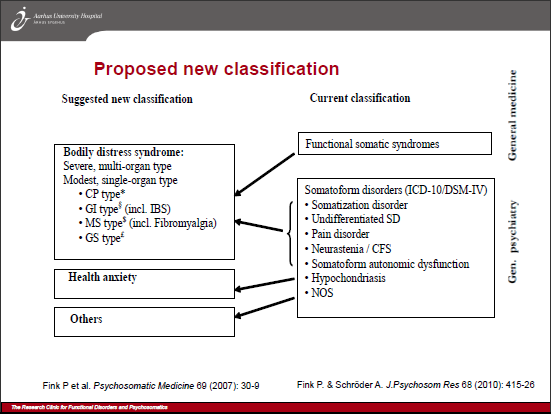
Whereas, Fink et al’s 2010 Bodily Distress Syndrome criteria are based on impairment and symptom patterns from body systems. Positive psychobehavioural features do not form part of the Fink et al criteria [4–6].

For ICD-11’s BDD, patients may be preoccupied with any bodily symptoms and the presence of a co-occurring physical health condition is not an exclusion.

But for Fink et al’s BDS, “If the symptoms are better explained by another disease, they cannot be labelled BDS.”

BDD’s three severity specifiers are proposed to be characterized on the basis of the extent to which responses to persistent, distressing symptoms are perceived as excessive and on degree of impairment, not on the basis of the number of bodily symptoms and the number of body or organ systems that are affected by the disorder.

In contrast, BDS’s two severities are based on symptom patterns (a BDS Modest, single-organ type and a BDS Severe, Multi-organ type).

Both BDD and BDS are intended to subsume the Somatoform disorders and Neurasthenia.

But BDS seeks to arrogate the so-called “functional somatic syndromes,” CFS, ME, IBS, Fibromyalgia, chronic pain disorder, MCS and some others, and subsume them under a single, overarching BDS diagnosis [6].

So although the BDD and BDS disorder names sound very similar (and the terms are sometimes seen used interchangeably), as defined in the 2012 Creed, Gureje paper and as defined by the recently inserted Beta draft Definitions, ICD-11’s BDD and Fink et al’s BDS present divergent constructs*.

It is the ICD-11 Primary Care Consultation Group‘s 2012 proposals for a “Bodily stress disorder” [2] that had stronger conceptual alignment and criteria congruency with Fink et al’s BDS.

*Discussions between Profs Creed and Fink during the Research Clinic for Functional Disorders Symposium presentations, Aarhus University Hospital, May 15, 2014, noted that Fink et al’s BDS and DSM-5’s SSD are “very different concepts.” That SSD and BDS are divergent constructs is also discussed in: Medically Unexplained Symptoms, Somatisation and Bodily Distress: Developing Better Clinical Services, Francis Creed, Peter Henningsen, Per Fink (Eds), Cambridge University Press, 2011.

+++
ICD-11 BDD, mild; moderate and severe specifiers, now defined:

In the last few days, Definitions for the three uniquely coded Severity specifiers:

6B40 Bodily distress disorder, mild

6B41 Bodily distress disorder, moderate

6B42 Bodily distress disorder, severe

have been inserted into the Beta draft.

+++
The Definition for the Title term Bodily distress disorder remains the same as previously reported:

http://apps.who.int/classifications/icd11/browse/f/en#/http://id.who.int/icd/entity/767044268

http://apps.who.int/classifications/icd11/browse/l-m/en#/http://id.who.int/icd/entity/767044268

Chapter 06 Mental and behavioural disorders

Bodily distress disorder [In Mortality and Morbidity, Primary Care High Resource, Primary Care Low Resource Linearizations]

Foundation Id: http://id.who.int/icd/entity/767044268

Parent(s)

Mental and behavioural disorders            ICD-10 : F45

Definition

Bodily distress disorder is characterized by high levels of preoccupation regarding bodily symptoms, unusually frequent or persistent medical help-seeking, and avoidance of normal activities for fear of damaging the body. These features are sufficiently persistent and distressing to lead to impairment in personal, family, social, educational, occupational or other important areas of functioning. The most common symptoms include pain (including musculoskeletal and chest pains, backache, headaches), fatigue, gastrointestinal symptoms, and respiratory symptoms, although patients may be preoccupied with any bodily symptoms. Bodily distress disorder most commonly involves multiple bodily symptoms, though some cases involve a single very bothersome symptom (usually pain or fatigue).

Synonyms

somatoform disorders
Somatization disorder

Exclusions [Ed: with the exception of Hypochondriasis, Exclusions are imported from ICD-10 F45 Somatoform disorders Exclusions.]

lisping
lalling
psychological or behavioural factors associated with disorders or diseases classified elsewhere
nail-biting
sexual dysfunction, not caused by organic disorder or disease
thumb-sucking
tic disorders (in childhood and adolescence)
Tourette syndrome
trichotillomania
dissociative disorders
hair-plucking
Hypochondriasis

+++
This is the recently added Definition for 6B40 Bodily distress disorder, mild:

http://apps.who.int/classifications/icd11/browse/f/en#/http://id.who.int/icd/entity/1472866636

http://apps.who.int/classifications/icd11/browse/l-m/en#/http://id.who.int/icd/entity/1472866636

6B40 Bodily distress disorder, mild [In Mortality and Morbidity Linearizations]

Foundation Id: http://id.who.int/icd/entity/1472866636

Parent(s)

Definition 

Bodily distress disorder, mild is a form of Bodily distress disorder in which there is excessive attention to bothersome symptoms and their consequences, which may result in frequent medical visits. The person is not preoccupied with the symptoms (e.g., spends less than an hour per day focusing on them). Although the individual expresses distress about the symptoms and they may have some impact on his or her life (e.g., strain in relationships, less effective academic or occupational functioning, abandonment of specific leisure activities) there is no substantial impairment in the person’s personal, family, social, educational, occupational, or other important areas of functioning.

All Index Terms

  • Bodily distress disorder, mild

+++
Here’s the Definition for 6B41 Bodily distress disorder, moderate:

http://apps.who.int/classifications/icd11/browse/f/en#/http://id.who.int/icd/entity/1967782703

http://apps.who.int/classifications/icd11/browse/l-m/en#/http://id.who.int/icd/entity/1967782703

6B41 Bodily distress disorder, moderate [In Mortality and Morbidity Linearizations]

Foundation Id : http://id.who.int/icd/entity/1967782703

Parent(s)

Definition 

Bodily distress disorder, moderate is a form of bodily distress disorder in which there is persistent preoccupation with bothersome symptoms and their consequences (e.g., spends more than an hour a day thinking about them), typically associated with frequent medical visits such that the person devotes much of his or her energy to focusing on the symptoms and their consequences, with consequent moderate impairment in personal, family, social, educational, occupational, or other important areas of functioning (e.g., relationship conflict, performance problems at work, abandonment of a range of social and leisure activities).

All Index Terms

  • Bodily distress disorder, moderate

+++
  And here’s the Definition for 6B42 Bodily distress disorder, severe:

http://apps.who.int/classifications/icd11/browse/f/en#/http://id.who.int/icd/entity/1121638993

http://apps.who.int/classifications/icd11/browse/l-m/en#/http://id.who.int/icd/entity/1121638993

6B42 Bodily distress disorder, severe [In Mortality and Morbidity Linearizations]

Foundation Id: http://id.who.int/icd/entity/1121638993

Parent(s)

Definition

Bodily distress disorder, severe is a form of bodily distress disorder in which there is pervasive and persistent preoccupation to the extent that the symptoms may become the focal point of the person’s life, typically requiring extensive interactions with the health care system. Preoccupation with the experienced symptoms and their consequences causes serious impairment in personal, family, social, educational, occupational, or other important areas of functioning (e.g., unable to work, alienation of friends and family, abandonment of nearly all social and leisure activities). The person’s interests may become so narrow so as to focus almost exclusively on his or her bodily symptoms and their negative consequences.

All Index Terms

  • Bodily distress disorder, severe

+++
What will ICD-11 be field testing?

Field testing of a potential replacement for the existing ICD-10 Somatoform disorders framework is expected to be conducted over the next year or two. Disorders that survive the ICD-11 PHC field tests will require an equivalent disorder in the main ICD-11 classification.

So whatever replaces the existing ICD-10 PHC categories, F45 Unexplained somatic symptoms/medically unexplained symptoms and F48 Neurasthenia, (which is also proposed to be eliminated for the ICD-11 primary care version), will need an equivalent disorder in the main classification.

International field tests across a range of primary care settings had been anticipated to start from June, last year, but there were reported delays. It isn’t known whether consensus has been reached yet over disorder construct and diagnostic criteria for use in the field tests, or whether field testing is now underway.

I cannot confirm whether ICD-11 intends to release a protocol into the public domain for whatever construct it plans to field test, or may already be field testing.

Currently, there is no publicly available protocol or other information on finalized characteristics, diagnostic guidelines, criteria, inclusions, exclusions, differential diagnoses etc. that are planned to be used for the field tests which would provide the level of detail lacking in the public version of the Beta drafting platform.

+++

So which construct does ICD-11 Revision Steering Group favour?

Although BDD (and now its three severities) have been defined within the Beta draft, much remains unclear for proposals for the revision of this section of ICD-11 Mental and behavioural disorders.

The ICD-11 Primary Care Consultation Group’s alternative 2012 Bodily stress syndrome (BSS) construct – a near clone of Fink et al’s BDS criteria but with some SSD-like psychobehavioural responses tacked on – isn’t the construct that is entered and defined within the Beta draft.

In June 2013, Prof Gabriel Ivbijaro (not, himself, a member of the PCCG) and Prof Sir David Goldberg (who chairs the PCCG) published a joint editorial in Mental Health in Family Medicine, the official journal of The World Organization of Family Doctors (Wonca) Working Party on Mental Health, for which Prof Ivbijaro is Editor in Chief.

The authors advance the position that the forthcoming revision of ICD “provides an opportunity to include BDS in a revised classification for primary care” and imply that BDS (at least at that point) was progressing, imminently, to ICD-11 field trials.

This brief editorial was embargoed from June 2013 to June 2014 and I was unable to obtain a copy until last month, but you can read it now for free and in full here: Bodily distress syndrome (BDS): the evolution from medically unexplained symptoms (MUS).

Note, firstly, that the editorial does not declare Professor Goldberg’s interest as chair of the ICD-11 Primary Care Consultation Group.

It does not clarify whether the views and opinions expressed within the editorial represent the views of the authors or are the official positions of the PCCG working group, or of the International Advisory Group for the Revision of ICD-10 Mental and Behavioural Disorders, or of the ICD-11 Revision Steering Group (RSG), or of any committees on which co-author, Prof Ivbijaro, sits or of any bodies to which Prof Ivbijaro is affiliated.

No publicly posted progress reports are being issued by ICD-11 or by either of the two groups making recommendations for the revision of this section of ICD and I do not have a second source that confirms the status of proposals as they stood in June 2013.

But taking the editorial at face value, it would appear that the PCCG had revised its earlier proposals for a BSS construct (that drew heavily on Fink et al’s BDS criteria but had included the requirement for some psychobehavioural responses) and were now recommending that the Fink et al BDS construct and criteria should progress for ICD-11 PHC field testing and evaluation, that is, using the same disorder name and (presumably) the same criteria set that is already operationalized in research and clinical settings, in Denmark.

(The rationale for the apparent revision of the earlier BSS disorder name is not discussed within the editorial; nor whether any modifications to, or deviance from a “pure” BDS construct and criteria were being recommended for the purposes of ICD-11 field testing.)

The editorial doesn’t clarify whether the PCCG, the S3DWG and the ICD-11 Revision Steering Group (RSG) had reached consensus – it does not mention the alternative proposals of the S3DWG, at all, or discuss what is entered into the Beta draft, or discuss the views and preferences of the Revision Steering Group for any of recommendations made by the two advisory groups, to date.

It is unclear whether a “pure” BDS construct (as opposed to the PCCG’s earlier BSS modification) had already gained Revision Steering Group approval for progressing to field testing, at the point the editorial was drafted, or whether Prof Goldberg was using this Wonca house journal as a platform on which to promote his own opinions and expectations, in a purely personal capacity.

Crucially, it doesn’t explain why, if a BDS-like construct were anticipated to be progressed to field trials in the second half of 2013, it is the S3DWG’s Bodily distress disorder diagnostic construct that has been listed and defined in the Beta draft for Foundation, Mortality and Morbidity, Primary Care High Resource, Primary Care Low Resource linearizations – not the PCCG’s 2012 BSS modification, or the “pure” BDS that Prof Goldberg evidently champions.

As a source of information on the current status of proposals for the revision of the Somatoform disorders this June 2013 editorial is problematic (and now also over a year out of date).

I suspect the politics between the 12 member PCCG (which includes Marianne Rosendal*), the 17 member S3DWG and the ICD-11 Revision Steering Group are intensely fraught given Professor Goldberg’s agenda for the revision of the Somatoform disorders, since fitting BDS into ICD-11 hasn’t proved to be the shoo in that Fink, Rosendal and colleagues had hoped for**, and given that BDS cannot be harmonized with DSM-5’s SSD, as they are conceptually divergent.

*Dr Marianne Rosendal (Department of Public Health, Aarhus University), who has published with Prof Per Fink, is the European representative on WONCA’s International Classification Committee. The vice-chair of the PCCG is Dr Michael Klinkman, a GP who represents WONCA (World Organization of Family Doctors). Dr Klinkman is current convenor of WONCA’s International Classification Committee (WICC) that is responsible for the development of ICPC-2.
**Presentation, Professor Per Fink, March 19, 2014 Danish parliamentary hearing on Functional Disorders. Prof Fink stated that he and his colleagues had tried to get WHO to incorporate a section for a special group of disorders where BDS could be placed that was located neither in psychiatry nor in general medicine, but had not been successful.

+++
Requests for clarification repeatedly stonewalled:

ICD Revision has been asked several times, via the Beta drafting platform, to clarify current proposals for the framework and disorder construct for a replacement for the ICD-10 Somatoform disorders and to clarify which construct it intends to take forward to field testing. ICD Revision has also been asked to comment on the following:

“If, in the context of ICD-11 usage, the S3DWG working group’s proposal for a replacement for the Somatoform disorders remains for a disorder model with good concordance with DSM-5′s SSD construct, what is the rationale for proposing to name this disorder “Bodily distress disorder”?

“Have the S3DWG, PCCG and Revision Steering Group given consideration to the significant potential for confusion if its replacement construct for the Somatoform disorders has greater conceptual alignment with the SSD construct but is assigned a disorder name that sounds very similar to, and is already being used interchangeably with an operationalized but divergent construct and criteria set?”

No response has been forthcoming.

Lack of publicly posted progress reports by both working groups, confusion over the content of the Beta draft and ICD Revision’s failure to respond to queries from stakeholders is hampering stakeholder scrutiny, discourse and input. It is time clinicians, researchers, allied professionals and advocacy organizations demanded transparency from ICD Revision around current proposals and field trial intentions.

+++
September symposium presentation on BDD:

In September, Professor Oye Gureje (who chairs the ICD-11 Expert Working Group on Somatic Distress and Dissociative Disorders), will be presenting on Proposals and evidence for the ICD-11 classification of Bodily Distress Disorders, as part of series of symposia on the development of the ICD-11 chapter for mental and behavioural disorders, at the World Psychiatric Association XVI World Congress, in Madrid, Spain, 14–18 September 2014 [7].

Unfortunately, I cannot attend this symposium presentation but would be pleased to hear from anyone who may be planning to attend.

+++
References:

1. Creed F, Gureje O. Emerging themes in the revision of the classification of somatoform disorders. Int Rev Psychiatry. 2012 Dec;24(6):556-67. http://www.ncbi.nlm.nih.gov/pubmed/23244611 [Full text behind paywall]

2. Lam TP, Goldberg DP, Dowell AC, Fortes S, Mbatia JK, Minhas FA, Klinkman MS: Proposed new diagnoses of anxious depression and bodily stress syndrome in ICD-11-PHC: an international focus group study. Fam Pract Feb 2013 [Epub ahead of print July 2012]. [Abstract: PMID: 22843638] Full free text: http://fampra.oxfordjournals.org/content/30/1/76.long

3. Ivbijaro G, Goldberg D. Bodily distress syndrome (BDS): the evolution from medically unexplained symptoms (MUS). Ment Health Fam Med. 2013 Jun;10(2):63-4. Full free text available on 2014/6/1: http://www.ncbi.nlm.nih.gov/pmc/articles/PMC3822636/pdf/MHFM-10-063.pdf

4. http://funktionellelidelser.dk/en/about/bds/

5. Fink P and Schröder A. One single diagnosis, bodily distress syndrome, succeeded to capture 10 diagnostic categories of functional somatic syndromes and somatoform disorders. Journal of Psychosomatic Research 2010;68:415–26.

6. Fink et al Proposed new BDS diagnostic classification

7. World Psychiatric Association XVI World Congress, Madrid, Spain, 14–18 September 2014.

+++
Further reading:

Dx Revision Watch Post: Editorial: Bodily distress syndrome (BDS): the evolution from medically unexplained symptoms (Goldberg and ICD-11-PHC), June 3, 2014: http://wp.me/pKrrB-3Uh