DSM-5 and ICD-10-CM Round up: February #3

DSM-5 and ICD-10-CM Round up: February #3

Post #227 Shortlink: http://wp.me/pKrrB-2FY

Updates:

American Psychiatric Association News release:

Release No. 13-11: February 28, 2013

APA Annual Meeting in San Francisco, May 18-22; DSM-5 to be Released

ARLINGTON, Va. (Feb. 28, 2013) – The American Psychiatric Association’s 166th Annual Meeting, the world’s largest psychiatric meeting, will run Saturday, May 18 to Wednesday, May 22, 2013 in San Francisco at the Moscone Convention Center. The much anticipated DSM-5, the latest revision of the Diagnostic and Statistical Manual of Mental Disorders, will be released at the meeting…

Clinical Psychiatry News Digital Network

DSM-5 expected to be more ‘user-friendly’

Doug Brunk | March 3, 2013

ABC News Radio

An edited version of the ABC News coverage of concerns for new DSM-5 disorder ‘Somatic Symptom Disorder’ that replaces four DSM-IV Somatoform Disorder categories has been published on ABC News Radio:

Guidelines for Diagnosing Psychiatric Disorder May Overlook Physical Illnesses

CMS pledges commitment to October 1, 2014 ICD-10-CM compliance:

Click link for PDF document   CMS letter

CMS: No Further Delays in ICD-10-CM/PCS Implementation

Chris Dimick | AHIMA & ICD-10 | February 27, 2013

The Centers for Medicare and Medicaid Services (CMS) will maintain their commitment to the current ICD-10-CM/PCS compliance date of October 1, 2014, according to a letter sent to AHIMA President Kathleen A. Frawley.

The letter was sent in response to AHIMA’s call for CMS to stand firm on its ICD-10 implementation date after more than 80 physician groups represented by the American Medical Association called on CMS in January to delay or abandon the ICD-10 conversion…

Susan Donaldson James reports for ABC News on DSM-5‘s ‘Somatic Symptom Disorder’:

Contributions from Allen Frances, MD, Joel E Dimsdale, MD (Chair, DSM-5 Somatic Symptom Disorder Work Group), Lori Chapo-Kroger (P.A.N.D.O.R.A), Suzy Chapman (Dx Revision Watch), Bridget Mildon (FND Hope) and Marianne Russo (The Coffee Klatch)

ABC News

New Psych Disorder Could Mislabel Sick as Mentally Ill

Susan Donaldson James | February 27, 2013

Critics worry that patients will be misdiagnosed as mentally ill and won’t get treatment, affecting mostly those with chronic and difficult to diagnose neurological disorders and multi-system diseases like ME/CFS, ones that are poorly understood and can take years to get medical answers.

“A lot of people will be written off as crocks — it’s just in their head,” said Dr. Allen Frances, who was chair of the task force that created the DSM-4 and professor emeritus of psychiatry at Duke University. “They won’t get the medical work-up they need.”

…But [SSD work group chair] Dimsdale defends the updated DSM…”If it doesn’t work, we’ll fix it in the DSM-5.1 or DSM-6.”

Robert Sibley, senior writer for Ottawa Citizen, comments on DSM-5‘s ”Somatic Symptom Disorder’:

Ottowa Citizen (and  a number of syndications)

Column: Is life itself a sickness in need of a cure?

Robert Sibley | February 20, 2013

…In a recent article, Postmedia’s Sharon Kirkey quotes a statement from the American Psychiatric Association, which will publish a new edition of the DSM in May: “Some patients with illnesses like heart disease or cancer will indeed experience thoughts, feelings or behaviours related to their illness that will be extreme or overwhelming.” These individuals “may qualify for an SSD diagnosis…”

Results of recent American Psychiatric Association Trustee elections:

Helio

APA releases election results

February 25, 2013

DSM-5 (published by American Psychiatric Publishing Inc.) is planned for release at the APA’s 166th Annual Meeting, in San Francisco (May 18-22).

Psychiatric News | February 15, 2013
Volume 48 Number 4 page 21-21
10.1176/appi.pn.2013.2b24

American Psychiatric Association
Annual Meeting Highlights

Sessions Will Provide In-Depth Look at New DSM

Kuhl Emily, Ph.D.

Sidney Zizook, M.D., who served as an advisor to the DSM-5′s Mood Disorder Work Group, defends the removal of the DSM ‘bereavement exclusion’:

Scientific American

Getting Past the Grief over Grief

Sidney Zisook | February 25, 2013

These days, I get a lot of grief about grief. I am part of the work group that changed some of the ways that grief and clinical depression are described and differentiated in the new Diagnostic and Statistical Manual of Mental Disorders, typically referred to as DSM-5. That has led to a lot of conversations with colleagues who are upset about bereavement…

Kupfer DJ, Regier DA, et al in JAMA ONLINE FIRST

JAMA ONLINE FIRST

DSM-5—The Future Arrived FREE ONLINE FIRST

David J. Kupfer, MD; Emily A. Kuhl, PhD; Darrel A. Regier, MD, MPH

Author Affiliations: University of Pittsburgh School of Medicine, Department of Psychiatry, Western Psychiatric Institute and Clinic, Pittsburgh, Pennsylvania (Dr Kupfer); and American Psychiatric Institute for Research and Education, Division of Research, American Psychiatric Association, Arlington, Virginia (Drs Kuhl and Regier).

JAMA. 2013;():1-2. doi:10.1001/jama.2013.2298.
Published online February 25, 2013

Jerome C. Wakefield, PhD, DSW, for Psychiatry Weekly, on the DSM ‘bereavement exclusion’ issue:

Remember the Bereavement Exclusion

Psychiatric Weekly

Jerome C. Wakefield, PhD, DSW | February 18, 2013

School of Social Work, Department of Psychiatry; New York University, NY

First published in Psychiatry Weekly, Volume 8, Issue 4, February 18, 2013

Summary: September 19 ICD-9-CM Coordination and Maintenance Committee Meeting

Summary: September 19 ICD-9-CM Coordination and Maintenance Committee Meeting

Post #205 Shortlink: http://wp.me/pKrrB-2vc  

The September meeting of the ICD-9-CM Coordination and Maintenance Committee, jointly chaired by CMS and CDC, took place on September 19, 2012.

For further information on this public process see the CDC website page:

http://www.cdc.gov/nchs/icd/icd9cm_maintenance.htm

+++

Meeting Summary document

The meeting Summary document has now been published.  The audio is not yet available.

The Summary document can be downloaded here:

September 19, 2012

Summary (10 pages) [PDF – 59 KB]

http://www.cdc.gov/nchs/data/icd9/2012_September_Summary.pdf

or opened in PDF format here:     Summary September 19 2012

+++

The Proposals and Agenda document can be downloaded here:

http://www.cdc.gov/nchs/icd/icd9cm_maintenance.htm#meeting_materials

ICD-9-CM Coordination and Maintenance Committee Meeting

September 19, 2012

Proposals (74 pages) [PDF – 730 KB]

http://www.cdc.gov/nchs/data/icd9/Topic_packet_for_September_19_2012.pdf

or opened in PDF format here:     Topic packet for September 19 2012

According to the Summary document, the deadline for receipt of public comments on proposals submitted at this meeting is November 16, 2012. If there is any change to this date, I will update.

Comments on proposals presented at the ICD-9-CM Coordination and Maintenance Committee meeting should be sent to the following email address: nchsicd9CM@cdc.gov. See Page One of the Summary document for important information on submission of public comment.

Extract, Summary document

Chronic fatigue syndrome

Andreas Kogelnik, MD, representing the Coalition 4 ME/CFS, was available via telephone to address questions and clinical concerns.

Lori Chapo-Kroger, representing the Coalition 4 ME/CFS, expressed that many nations, and the World Health Organization, put CFS at G93 in ICD-10, and that this would include everyone but the U.S.

Mary Dimmock, representing the Coalition 4 ME/CFS, questioned why the change must wait until after 2014 when they feel that this is an error in the classification right now (and has been since 2001).

Dr. Kogelnik indicated that the term myalgic encephalomyelitis is used in Europe while the U.S. continues to use the term chronic fatigue syndrome, and that the Coalition 4 ME/CFS considers these two conditions (CFS and ME) to be the same. That is why they want both terms included in the same code.

Nelly Leon-Chisen, AHA, noted support for a need for a code for chronic fatigue syndrome distinct from chronic fatigue, unspecified. She indicated also that with the cause being unknown it is better that the classification not be locked into placing CFS as a viral code. Also, if there is no consensus for ME and CFS being the same then it makes sense to keep them as two separate codes. If research later develops that says they are the same then the data can be aggregated together. However, if the research does not show this, then you don’t have them lumped into one code that does not allow you to separate out one from the other.

Sue Bowman, AHIMA, questioned counting all CFS as following a virus infection. She expressed a need for clinical consensus on this condition. Also, she stated that she did not see a rationale for an early change (before 2014).

+++

Note: Dx Revision Watch has no connection with the Coalition 4 ME/CFS or with the development of any proposals submitted by this organization. The views and opinions expressed in Coalition 4 ME/CFS submissions to ICD-9-CM  Coordination and Maintenance Committee meetings represent the views of the Coalition 4 ME/CFS and its representatives and not the views of Dx Revision Watch.

All enquiries about proposals submitted to CMS/CDC on behalf of the Coalition 4 ME/CFS should be addressed directly to the Coalition 4 ME/CFS.

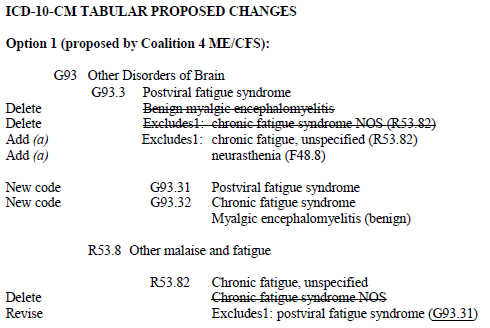
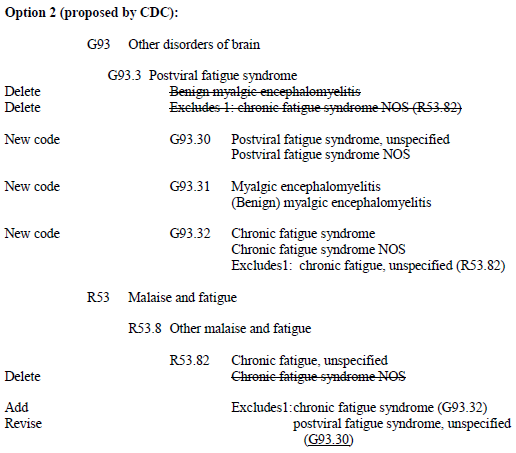
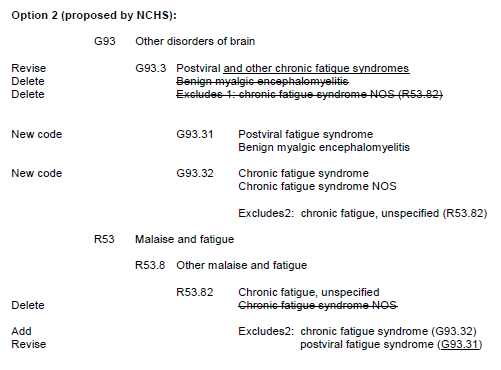
Note also that the proposal from the Coalition 4 ME/CFS (Option 1) and the alternative proposal presented by CMS/CDC (Option 2) at the September meeting are set out in accordance with the requirements of the ICD-9-CM Coordination and Maintenance Committee for the submission of proposals. 

For Options 1 and Option 2 see post Proposals: September 19 ICD-9-CM Coordination and Maintenance Committee Meeting or Proposals document Topic packet for September 19 2012

+++

Related posts:

Proposals: September 19 ICD-9-CM Coordination and Maintenance Committee Meeting

Coding CFS in ICD-10-CM: CFSAC and the Coalition4ME/CFS initiative

Extracts: ICD-9-CM Coordination and Maintenance Committee Meeting Summary document (CFS coding)

Extracts: ICD-9-CM Coordination and Maintenance Committee Meeting September 14, 2011 (Coding of CFS in ICD-10-CM)

Proposals: September 19 ICD-9-CM Coordination and Maintenance Committee Meeting

Proposals: September 19 ICD-9-CM Coordination and Maintenance Committee Meeting

Post #204 Shortlink: http://wp.me/pKrrB-2uL

The next meeting of the ICD-9-CM Coordination and Maintenance Committee, which is jointly chaired by CMS and CDC, takes place on September 19, 2012. 

There is a very full agenda for this meeting. The meeting materials Proposals document has now been published.

For further information on this public process see the CDC website page:

http://www.cdc.gov/nchs/icd/icd9cm_maintenance.htm

+++

The Proposals and Agenda document can be downloaded here:

http://www.cdc.gov/nchs/icd/icd9cm_maintenance.htm#meeting_materials

ICD-9-CM Coordination and Maintenance Committee Meeting

September 19, 2012

Proposals (74 pgs) [PDF – 730 KB]

http://www.cdc.gov/nchs/data/icd9/Topic_packet_for_September_19_2012.pdf

or opened in PDF format here:      Topic packet for September 19 2012

Note: I have no connection with the Coalition 4 ME/CFS or with the development of any proposals submitted by this organization. All enquiries about the proposal submitted to CMS/CDC on behalf of the Coalition 4 ME/CFS should be addressed directly to the Coalition 4 ME/CFS.

Note also that the proposal from the Coalition 4 ME/CFS and the alternative proposal from CMS/CDC are set out in accordance with the requirements of the ICD-9-CM C & M Committee for the submission of proposals.

+++

Coding of CFS in the forthcoming US specific ICD-10-CM

At the ICD-9-CM Coordination and Maintenance Committee’s September 14, 2011 meeting, a presentation had been made on behalf of the Coalition 4 ME/CFS in relation to the formal submission of a proposal.

The proposal requested that consideration be given to moving the classification of Chronic fatigue syndrome from its current proposed location within the ICD-10-CM R code chapter (Chapter 18: Symptoms and signs) to the G code chapter (Chapter 6: Diseases of the nervous system).

This would bring the chapter location of Chronic fatigue syndrome in ICD-10-CM in line with the international version of ICD-10, the Canadian ICD-10-CA and proposals for the forthcoming ICD-11.

No NCHS decision reached in response to the September 2011 proposals and the public comments received in respect of these proposals was conveyed following closure of the public comment period, last November.

However, further discussion of Chronic fatigue syndrome and two additional proposals are tabled on the agenda for discussion at the September 19, meeting, tomorrow.

I am appending the relevant extract from the Diagnosis Agenda and Proposals document which was published on the CDC  website overnight. An official audio and a Summary of the meeting should be available in due course on the CDC website. I will update with these when available.

+++

Extract Topic packet for September 19 2012 (Page 46)

[…]

Chronic fatigue syndrome

Andreas Kogelnik, M.D., Coalition 4 ME/CFS

Chronic fatigue syndrome

A proposal, submitted by the Coalition 4 ME/CFS, to modify codes for chronic fatigue syndrome (CFS) was presented and discussed at the September 2011 ICD Coordination and Maintenance Committee meeting. The National Center for Health Statistics also presented an alternative proposal, Option 2. There were many comments from the audience, and there was general support for the NCHS-proposed Option 2, moving CFS from Chapter 18, Symptoms, signs and abnormal clinical findings, not elsewhere classified, to Chapter 6, Diseases of the Nervous System but retaining separate codes for CFS and myalgic encephalomyelitis (ME). The rationale for retaining separate codes included agreement on the importance of being able to extract data on the two conditions separately or combine, as needed. It was also noted that term ME is not seen in medical record documentation. Written comments received on this issue were inconclusive. There was not agreement that the two conditions are the same. While some comments were from private citizens, others were from advocacy organizations and associations that represent health care providers and other large constituencies that use the classification. The public comment period following the meeting is not meant as a poll or survey. Analysis of public comment focused on the substance of the comments; whether there was a clear scientific consensus regarding the etiology and manifestations of the condition; and an understanding of the classification, its structure and conventions, and its uses by the health care industry.

As noted in the information from the September 2011 presentation, the cause or causes of CFS remain unknown, despite a vigorous search. While a single cause for CFS may yet be identified, another possibility is that CFS represents a spectrum of illnesses resulting from multiple possible pathways. Conditions that have been proposed to trigger the development of CFS include infections, trauma, immune dysfunction, stress, and exposure to toxins. Research in this area is ongoing.

There are several case definitions currently in use, some separating CFS from ME, and others merging the two conditions. The most widely used are the 1994 case definition (http://www.cdc.gov/cfs/case-definition/index.html ), the Canadian and the Oxford definitions. A new case definition for ME was published in the 2011 international consensus criteria that emphasized recent research and clinical experience that strongly point to widespread inflammation and multisystem symptoms and neuropathology. This new definition, which considers ME and CFS as synonymous terms, however, has not been widely vetted by the health care community at large. While there is no consensus on one case definition, there is consensus that this is a serious and complex syndrome, and it is likely that there are multiple subgroups. It has been noted that some providers use the terms interchangeably while others consider one condition a subgroup of the other. There is also some overlap with fibromyalgia and CFS/ME could be considered one of the multiple chronic overlapping pain conditions.

References

1. Fukuda et al. Ann Intern Med (1994) 121:953-959
(http://www.cdc.gov/cfs/case-definition/1994.html )
2. Holmes et al. Ann Intern Med (1988) 108:387-389.
3. Sharpe et al. J Roy Soc Med (1991) 84:118-121
4. Carruthers et al. J CFS (2003) 11:7-97
5. Carruthers et al.. J Intern Med (2011) 270: 327-38.

The Coalition 4 ME/CFS has stated that they do not support Option 2 proposed in September 2011 and have submitted a revised proposal. A revised Option 2 is also being proposed, consistent with comments received supporting Option 2 as noted above. The Coalition is also requesting that their proposal be considered for implementation prior to October 1, 2014 even though the condition is not a new disease and therefore does not meet the criteria for implementation during the partial freeze.

Based on the above, the following proposals for consideration are:

+++

+++
For comparison, the proposal that had been presented by CDC at the September 2011 meeting in counterpoint to an earlier proposal presented by the Coalition 4 ME/CFS at that same meeting was this:


Instead of Title term G93.3 Postviral and other chronic fatigue syndromes (CDC Option 2, September 2011)

CDC suggests retaining the Title term G93.3 Postviral fatigue syndrome (CDC Option 2, September 2012).

+++
Instead of Child category G93.31 Postviral fatigue syndrome, Benign myalgic encephalomyelitis

CDC is now suggesting two categories for Postviral fatigue syndrome, thus:

G93.30 Postviral fatigue syndrome, unspecified, Postviral fatigue syndrome NOS (not otherwise specified)

with a discrete Child category G93.31 Myalgic encephalomyelitis, Benign myalgic encephalomyelitis.

+++
No suggested change to the September 2011 CDC Option 2 suggestion for Child categories:

G93.32 Chronic fatigue syndrome, Chronic fatigue syndrome NOS.

The+++

Related posts:

Coding CFS in ICD-10-CM: CFSAC and the Coalition4ME/CFS initiative

Extracts: ICD-9-CM Coordination and Maintenance Committee Meeting Summary document (CFS coding)

Extracts: ICD-9-CM Coordination and Maintenance Committee Meeting September 14, 2011 (Coding of CFS in ICD-10-CM)

Response to Recommendations from November 2011 CFSAC meeting

Response to Recommendations from November 2011 CFSAC meeting

Post #203 Shortlink: http://wp.me/pKrrB-2ur

The response from the Assistant Secretary for Health to Recommendations from the November 2011 CFSAC meeting is now available on the CFSAC website at: http://1.usa.gov/OghDXF

http://www.hhs.gov/advcomcfs/asst-sect-letter2012.pdf

or open here  asst-sect-letter2012

Text:

DEPARTMENT OF HEALTH & HUMAN SERVICES Office of the Secretary

Office of the Assistant Secretary for Health Washington, D.C. 20201
AUG -3 2012
Gailen Marshall Jr., MD, PhD

Chair, Chronic Fatigue Syndrome Advisory Committee
Professor and Chair Professor of Medicine and Pediatrics
The University of Mississippi Medical Center 2300
North State Street, N416 Jackson, MS 39216-4505

Dear Dr. Marshall:

I have received the recommendations developed by the Chronic Fatigue Syndrome Advisory Committee (CFSAC) during its November 8-9, 2011, meeting. The advice and counsel provided by CFSAC serves as a valuable resource in the Department of Health and Human Services’ (HHS) efforts to properly address the issues and concerns pertaining to chronic fatigue syndrome.

Since the meeting the Department has carefully considered your recommendations. Dr. Nancy Lee, the Designated Federal Officer for CFSAC, has worked collaboratively with the ex officio representatives to the committee to provide responses to the recommendations developed at the meeting. The enclosed document contains information about activities currently undertaken by HHS to work with public health experts and members of the chronic fatigue syndrome community to increase knowledge and provide a better understanding of this debilitating health condition.

I have shared the committee’s recommendations with Secretary Kathleen Sebelius.

The Department is committed to addressing this condition. I commend you and your committee members for the important work you do.

Sincerely yours,
/s/Howard K. Koh
Howard K. Koh, M.D., M.P.H. Assistant Secretary for Health

Enclosure

cc: Dr. Christopher R. Snell
U.S. Public Health Service

RESPONSES TO RECOMMENDATIONS FROM THE CHRONIC FATIGUE SYNDROME ADVISORY COMMITTEE (CFSAC)

REF: November 8-9, 2011 CFSAC Meeting

Recommendation 1: This recommendation addresses the process by which CFSAC transmits recommendations to the Secretary and the Secretary communicates back to CFSAC whether or not a recommendation was acted upon. CFSAC recommends that this process be transparent and clearly articulated to include regular feedback on the status of the Committee’s recommendations. This communication could originate directly from the Office of the Secretary or be transmitted via the relevant agency or agencies.

Procedures are in place to ensure that recommendations made by federal advisory committees are properly handled. The CFSAC charter stipulates that the Committee provides advice and recommendations to the Secretary, through the Assistant Secretary for Health (ASH). Initially, the CFSAC recommendations are sent to the ASH for review. After reviewing the recommendations, the ASH forwards them to appropriate officials within the Office of the Secretary and the Operating and/or Staff Divisions that may be impacted by the Committee’s recommendations. A letter is sent to acknowledge receipt of the recommendations. A response may be prepared to accompany the letter which describes any actions that the Department may take in response to the recommendations made by the Committee. All pertinent information about the recommendations is provided to the designated Federal officer (DFO). The DFO then provides the information to the Chair and the Committee.

Recommendation 2: CFSAC recommends to the Secretary that the NIH or other appropriate agency issue a Request for Application (RFA) for clinical trials research on chronic fatigue syndrome/myalgic encephalomyelitis (ME/CFS).

The National Institutes of Health (NIH) funds research on myalgic encephalomyelitis/chronic fatigue syndrome (ME/CFS); investigators are encouraged to submit proposals for ME/CFS research, including clinical trials, through two funding announcements that are currently open for submission of applications. The next deadline for receipt of applications is October 24, 2012. In fiscal year 2011, NIH funded two applications for clinical trials on ME/CFS. NIH has received few applications proposing ME/CFS research, and even fewer applications proposing ME/CFS clinical trials. It is unclear whether the paucity of ME/CFS clinical trial applications reflects the current status of the field or an acknowledgement that clinical trials are difficult to design for a complex and multi-faceted illness. Clinical trials are challenging to design and conduct for all diseases, with basic requirements of a well-defined patient population, valid measurement instruments, appropriate safeguards for subjects, and generalizability of the clinical trial outcomes to the larger affected patient population. NIH is taking action to stimulate ME/CFS research across NIH through the regular monthly meetings of the Trans-NIH ME/CFS Working Group (WG). The WG discusses the current status of ongoing research on ME/CFS and proposes methods to increase the number and quality of research applications submitted to NIH ranging from preclinical research to clinical trials. In addition, the WG is focusing on the recommendations from the April 2011 State of the Knowledge Workshop on ME/CFS to develop priorities. The outcome from these planning sessions will suggest a range of activities and research.

Recommendation 3: CFSAC would like to encourage and support the creation of the DHHS Interagency Working Group on Chronic Fatigue Syndrome and ask this group to work together to pool resources that would put into place the “Centers of Excellence” concept that has been recommended repeatedly by this advisory committee. Specifically, CFSAC encourages utilizing HHS agency programs and demonstration projects, available through the various agencies, to develop and coordinate an effort supporting innovative platforms that facilitate evaluation and treatment, research, and public and provider education. These could take the form of appropriately staffed physical locations, or be virtual networks comprising groups of qualified individuals who interact through a variety of electronic media. Outreach and availability to underserved populations, including people who do not have access to expert care, should be a priority in this effort.

HHS leadership has identified the need for a Department-wide plan to address ME/CFS. The Department established the HHS Ad Hoc Workgroup on ME/CFS to develop a plan and to identify opportunities for interagency collaboration. The HHS ME/CFS plan will highlight recently initiated programs and future agency-specific and cross-agency activities. In developing the report, the Ad Hoc Workgroup will consider recommendations made by CFSAC. After completion, the ME/CFS plan will be posted on the CFSAC website. The DFO, Nancy C. Lee, M.D. is responsible for providing leadership and coordination for development of the HHS ME/CFS report.

Recommendation 4: This multi-part recommendation pertains to classification of CFS in ICD classification systems:

a) CFSAC considers CFS to be a multi-system disease and rejects any proposal to classify ME/CFS as a psychiatric condition in the U.S. disease classification systems.

b) CFSAC rejects the current classification of ME/CFS in Chapter 18 of ICD-9-CM under R53.82, chronic fatigue unspecified, chronic fatigue syndrome, not otherwise specified.

c) CFSAC continues to recommend that ME/CFS should be classified in ICD-IO-CM in Chapter 6 under Diseases of the Nervous System at G93.3 in line with ICD-IO, the World Health Organization, and ICD-I-CA [sic], the Canadian Clinical Modification and in accordance with CFSAC’s recommendations of August 2005 and May 2011. CFSAC rejects CDC’s National Center for Health Statistics (NCHS) Option 2 and recommends that ME/CFS remain in the same code and the same subcode as myalgic encephalomyelitis because CFS includes both viral and non-viral triggers.

d) CFSAC recommends that an “excludes one”* be added to G93.3 for chronic fatigue, R53.82, and neurasthenia, F48.8. CFSAC recommends that these changes be made in ICD-10-CM prior to its rollout in 2013.**

[*Ed: Should read “Excludes 1”. For definitions for “Excludes1″ and “Excludes2″ see Post #118]

[**Ed: On August 3, HHS announced Final Rule to delay compliance date for ICD-10-CM/PCS to October 1, 2014.]

Development and implementation of the guidelines for the lCD-10 fall within HHS under the purview of the Centers for Disease Control and Prevention (CDC) and the Centers for Medicare and Medicaid Services. Use of the revised codes will provide robust and specific data that will improve patient care and enable the international comparability of health care data. On February 16, 2012, the Department issued a press release announcing that HHS would initiate a process to postpone the date that certain health care entities must comply with the ICD-10.

A proposal to change the classification of ME/CFS in ICD-10-CM was presented at the September 2011 Coordination and Maintenance (C & M) Committee/CDC/NCHS; a subsequent proposal was received on January 12, 2012 and will be presented at the September 19, 2012 C & M meeting for additional discussion.

+++
Related posts

Notice of Meeting of the ICD-9-CM Coordination and Maintenance Committee

Coding CFS in ICD-10-CM: CFSAC and the Coalition4ME/CFS initiative

Extracts: ICD-9-CM Coordination and Maintenance Committee Meeting Summary document (CFS coding)

Extracts: ICD-9-CM Coordination and Maintenance Committee Meeting September 14, 2011 (Coding of CFS in ICD-10-CM)

HHS announces Final Rule on ICD-10-CM compliance date

HHS announces Final Rule on ICD-10-CM compliance date

Post #202 Shortlink: http://wp.me/pKrrB-2uk

Update at August 26:

HHS Announces: ICD-10 Delayed One Year

The American Health Information Management Association (AHIMA) | August 24, 2012

Press release


…and finally…

Yesterday, August 24, Department of Health and Human Services (HHS) Secretary Kathleen Sebelius announced a final rule to delay compliance for adopting ICD-10-CM and ICD-10-PCS (ICD-10) code sets to October 1, 2014.

“The rule also makes final a one-year proposed delay – from Oct. 1, 2013, to Oct. 1, 2014– in the compliance date for use of new codes that classify diseases and health problems.”

http://www.hhs.gov/news/press/2012pres/08/20120824e.html

News Release
FOR IMMEDIATE RELEASE
August 24, 2012 Contact: U.S. Department of Health & Human Services
202-690-6343

New health care standards to save up to $6 billion

Today, Department of Health and Human Services (HHS) Secretary Kathleen Sebelius announced a final rule that will save time and money for physicians and other health care providers by establishing a unique health plan identifier (HPID). The rule is one of a series of changes required by the Affordable Care Act to cut red tape in the health care system and will save up to $6 billion over ten years.

“These new standards are a part of our efforts to help providers and health plans spend less time filling out paperwork and more time seeing their patients,” Secretary Sebelius said.

Currently, when a health care provider bills a health plan, that plan may use a wide range of different identifiers that do not have a standard format. As a result, health care providers run into a number of time-consuming problems, such as misrouting of transactions, rejection of transactions due to insurance identification errors, and difficulty determining patient eligibility. The change announced today will greatly simplify these processes.

The rule also makes final a one-year proposed delay – from Oct. 1, 2013, to Oct. 1, 2014– in the compliance date for use of new codes that classify diseases and health problems. These code sets, known as the International Classification of Diseases, 10th Edition diagnosis and procedure codes, or ICD-10, will include codes for new procedures and diagnoses that improve the quality of information available for quality improvement and payment purposes.

The rule announced today is the fourth administrative simplification regulation issued by HHS under the health reform law:

On July 8, 2011, HHS adopted operating rules for two electronic health care transactions to make it easier for health care providers to determine whether a patient is eligible for coverage and the status of a health care claim submitted to a health insurer. The rules will save up to $12 billion over ten years.

On Jan. 10, 2012, HHS adopted standards for the health care electronic funds transfers (EFT) and remittance advice transaction between health plans and health care providers. The standards will save up to $4.6 billion over ten years.

On Aug. 10, 2012, HHS published an IFC that adopted operating rules for the health care EFT and electronic remittance advice transaction. The operating rules will save up to $4.5 billion over ten years.

More information on the final rule is available in a fact sheet at http://www.cms.gov/apps/media/fact_sheets.asp  

The final rule may be viewed at www.ofr.gov/inspection.aspx  

###

Note: All HHS press releases, fact sheets and other press materials are available at http://www.hhs.gov/news  
You can follow HHS on Twitter @HHSgov and sign up for HHS Email Updates.
Last revised: August 24, 2012

CENTERS FOR MEDICARE & MEDICAID SERVICES

RULES

Administrative Simplification:

Adoption of Standard for Unique Health Plan Identifier; Addition to National Provider Identifier Requirements, etc.

2012-21238
[CMS 0040 F; Filed: 08/24/12 at 12:00pm; Publication Date: 9/5/2012]

http://www.ofr.gov/OFRUpload/OFRData/2012-21238_PI.pdf

or download here:     2012-21238_PI

Extract:

(3) ICD-10-CM and ICD-10-PCS Code Sets

In the January 16, 2009 Federal Register (74 FR 3328), HHS published a final rule in which the Secretary of HHS (the Secretary) adopted the ICD-10-CM and ICD-10-PCS (ICD-10) code sets as the HIPAA standards to replace the previously adopted International Classification of Diseases, 9th Revision, Clinical Modification, Volumes 1 and 2 (diagnoses), and 3 (procedures) including the Official ICD–9–CM Guidelines for Coding and Reporting. The compliance date set by the final rule was October 1, 2013.

Since that time, some provider groups have expressed strong concern about their ability to meet the October 1, 2013 compliance date and the serious claims payment issues that might ensue if they do not meet the date. Some providers’ concerns about being able to meet the ICD-10 compliance date are based, in part, on difficulties they had meeting the compliance deadline for the adopted Associated Standard Committee’s (ASC) X12 Version 5010 standards (Version 5010) for electronic health care transactions. Compliance with Version 5010 and ICD-10 by all covered entities is essential to a smooth transition to the updated medical data code sets, as the failure of any one industry segment to achieve compliance would negatively affect all other industry segments and result in returned claims and provider payment delays. We believe the change in the compliance date for ICD-10 gives covered health care providers and other covered entities more time to prepare and fully test their systems to ensure a smooth and coordinated transition by all covered entities.

Notice of Meeting of the ICD-9-CM Coordination and Maintenance Committee

Notice of Meeting of the ICD-9-CM Coordination and Maintenance Committee

Post #201 Shortlink: http://wp.me/pKrrB-2tv

Update at August 18:

CMS meeting to address more ICD-10 issues  Round up from Carl Natale for ICD10 Watch

September ICD-9-CM C & M meeting announced

The next meeting of the ICD-9-CM Coordination and Maintenance Committee has been announced for September 19, 2012 and a tentative agenda published.

For further information on this public process see the CDC website page:

The 2013 release of ICD-10-CM is available to download from the CDC site: International Classification of Diseases, Tenth Revision, Clinical Modification (ICD-10-CM)

ICD-9-CM Coordination and Maintenance Committee

Upcoming meeting: September 19, 2012

    Tentative Agenda

Html: Federal Register Notice of Meeting of ICD-9-CM Coordination and Maintenance Committee

A Notice by the Centers for Disease Control and Prevention

Notice of Meeting of the ICD-9-CM Coordination and Maintenance Committee

The National Center for Health Statistics (NCHS), Classifications and Public Health Data Standards Staff announces the following meeting:

Name: ICD-9-CM Coordination and Maintenance (C&M) Committee meeting.

Time and Date: 9 a.m.-5 p.m., September 19, 2012.

Place: Centers for Medicare and Medicaid Services (CMS) Auditorium, 7500 Security Boulevard, Baltimore, Maryland 21244.

Status: Open to the public, limited only by the space available. The meeting room accommodates approximately 240 people.

Security Considerations: Due to increased security requirements CMS has instituted stringent procedures for entrance into the building by non-government employees. Attendees will need to present valid government-issued picture identification, and sign-in at the security desk upon entering the building. Attendees who wish to attend a specific ICD-9-CM C&M meeting on September 19, 2012, must submit their name and organization by September 10, 2012, for inclusion on the visitor list. This visitor list will be maintained at the front desk of the CMS building and used by the guards to admit visitors to the meeting.

Participants who attended previous ICD-9-CM C&M meetings will no longer be automatically added to the visitor list. You must request inclusion of your name prior to each meeting you attend.

Please register to attend the meeting on-line at: http://www.cms.hhs.gov/apps/events/.Show citation box

Please contact Mady Hue (410-786-4510 or Marilu.hue@cms.hhs.gov ), for questions about the registration process.

Matters To Be Discussed: Tentative agenda items include: September 19, 2012.

ICD-10 Topics:
ICD-10 Implementation Announcements
Expansion of Thoracic Aorta Body Part Under Heart and Great Vessels System
Addendum Issues (Temporary Therapeutic Endovascular Occlusion of Vessel, changing body part from thoracic aorta to abdominal aorta)
ICD-10MS-DRGs
ICD-10HAC Translations
ICD-10MCE Translations

ICD-10-CM Diagnosis Topics:
Age related macular degeneration
Bilateral mononeuropathy
Bilateral option for cerebrovascular codes
Chronic Fatigue Syndrome
Complications of urinary devices
Diabetic macular edema
Food Protein Induced Enterocolitis Syndrome (FPIES)
Maternal care for previous Cesarean section/previous uterine incision
Metatarsus varus (congenital metatarsus adductus)
Microscopic colitis
Mid-cervical region and coding of spinal cord injuries
Multifocal motor neuropathy
Parity to supervision of pregnancy codes
Proliferative diabetic retinopathy
Retinal vascular occlusions
Salter Harris fractures
Sesamoiditis
Shin splints
Spontaneous rupture/disruption of tendon

Agenda items are subject to change as priorities dictate.

Note:

CMS and NCHS will no longer provide paper copies of handouts for the meeting. Electronic copies of all meeting materials will be posted on the CMS and NCHS Web sites prior to the meeting at http://www.cms.hhs.gov/ICD9ProviderDiagnosticCodes/03_meetings.asp#  and http://www.cdc.gov/nchs/icd/icd9cm_maintenance.htm

Contact Persons for Additional Information: Donna Pickett, Medical Systems Administrator, Classifications and Public Health Data Standards Staff, NCHS, 3311 Toledo Road, Room 2337, Hyattsville, Maryland 20782, email dfp4@cdc.gov :, telephone 301-458-4434 (diagnosis); Mady Hue, Health Insurance Specialist, Division of Acute Care, CMS, 7500 Security Boulevard, Baltimore, Maryland 21244, email marilu.hue@cms.hhs.gov , telephone 410-786-4510 (procedures).

The Director, Management Analysis and Services Office, has been delegated the authority to sign Federal Register notices pertaining to announcements of meetings and other committee management activities, for both the Centers for Disease Control and Prevention, and the Agency for Toxic Substances and Disease Registry.

Dated: August 9, 2012.

Catherine Ramadei,

Acting Director, Management Analysis and Services Office, Centers for Disease Control and Prevention.

[FR Doc. 2012-20019 Filed 8-14-12; 8:45 am]

BILLING CODE 4160-18-P

(c) 2012 US Federal Register

+++
Related posts:

At the ICD-9-CM Coordination and Maintenance Committee’s September 14, 2011 meeting, a presentation was made on behalf of the Coalition 4 ME/CFS in relation to the formal submission of a proposal that consideration be given to moving the classification of Chronic fatigue syndrome from its current proposed location within the ICD-10-CM R code chapter (Chapter 18: Symptoms and signs) to the G code chapter (Chapter 6: Diseases of the nervous system).

This would bring chapter location and parent class coding of Chronic fatigue syndrome in line with the international version of ICD-10, published in 1990, the Canadian ICD-10-CA and proposals for the forthcoming ICD-11.

No decision in response to the proposal, meeting discussions and public comment received has been conveyed following closure of the public comment period. Further discussion of Chronic fatigue syndrome has been tabled on the tentative agenda for the September 19, 2012 meeting.

I will post Summary documents and other relevant meeting materials as these become available. There are three posts on Dx Revision Watch that relate to and report on the presentation at the September 14, 2011 meeting:

Coding CFS in ICD-10-CM: CFSAC and the Coalition4ME/CFS initiative

Extracts: ICD-9-CM Coordination and Maintenance Committee Meeting Summary document (CFS coding)

Extracts: ICD-9-CM Coordination and Maintenance Committee Meeting September 14, 2011 (Coding of CFS in ICD-10-CM)