Slide presentation: Per Fink: Somatoform disorders – functional somatic syndromes – Bodily distress syndrome (EACLPP lecture, June 2012)

Slide presentation: Per Fink: Somatoform disorders – functional somatic syndromes – Bodily distress syndrome (EACLPP lecture, June 2012)

Post #197 Shortlink: http://wp.me/pKrrB-2pN

Slide presentation: Per Fink: Somatoform disorders – functional somatic syndromes – Bodily distress syndrome (EACLPP lecture, June 2012)

23 slides in PDF format (i.e. no PowerPoint viewer required)

       EACLPP Per Fink Somatoform Disorders

Aarhus University Hospital

The Research Clinic for Functional Disorders and Psychosomatics

Somatoform disorders – functional somatic syndromes – Bodily distress syndrome.

Need for care and organisation of care in an international perspective – EACLPP Lecture

Prof. Per Fink

MD, Ph.D, Dr.Med.Sc.

www.functionaldisorders.dk

+++

June 2012 EACLPP Annual Conference*

*The European Association of Consultation-Liaison Psychiatry and Psychosomatics (EACLPP) and the European Network of Psychosomatic Medicine (ECPR) have recently merged the two associations to create a new society – the European Association of Psychosomatic Medicine (EAPM).

The Annual Scientific Meeting of the European Association for Consultation-Liaison Psychiatry and Psychosomatics (EACLPP) and the European Conference on Psychosomatic Research (ECPR) was entitled

“Towards a New Agenda: Cross-disciplinary Approach to Psychosomatic Medicine”

The conference was held in the city of Aarhus, Denmark, on 27 – 30 June 2012.

For last year’s conference, a report was published. I will post any report coming out of this year’s conference.

A Conference Abstract document be accessed here:

http://www.eaclpp-ecpr2012.dk/Home/DownloadOral

Selected Extracts:

Page 61 Nagel A

Department of Psychosomatic Medicine and Psychotherapy, University Medical Center Hamburg-Eppendorf & Schön Klinik Hamburg-Eilbek, Germany, Voigt K Department of Psychosomatic Medicine and Psychotherapy, University Medical Center Hamburg- Eppendorf & Schön Klinik Hamburg-Eilbek, Germany

Diagnostic validity of Complex Somatic Symptom Disorder: Which combination of psychological criteria is best suited for DSM-5?

Page 17 Budtz-Lilly A

The Research Unit for General Practice, School of Public Health, Aarhus University, Denmark

Bodily Distress Syndrome: A new diagnosis for functional disorders in primary care

Page 19 Escobar J

Robert Wood Johnson Medical School, New Brunswick, NJ, USA

An Update on DSM-5

Page 32 Fjorback L

Aarhus University Hospital, Research Clinic for Functional Disorders and Psychosomatics

Mindfulness Therapy for Bodily Distress Syndrome – randomized trial, one-year follow-up, active control

+++

Notes on Fink et al and Bodily Distress Syndrome (BDS)

According to Fink and colleagues, Bodily Distress Syndrome is a unifying diagnosis that encompasses somatization disorder, so-called “medically unexplained symptoms” (MUS), fibromyalgia, irritable bowel syndrome and chronic fatigue syndrome and some other conditions which they consider to be closely related, with a likely shared underlying aetiology.

See paper: Fink P, Schröder A. One single diagnosis, bodily distress syndrome, succeeded to capture 10 diagnostic categories of functional somatic syndromes and somatoform disorders J Psychosom Res. 2010 May;68(5):415-26.

See article: Per Fink,a Marianne Rosendal b Understanding and Management of Functional Somatic Symptoms in Primary Care: The Concept of Functional Somatic Symptoms

aResearch Clinic for Functional Disorders and Psychosomatics, Aarhus University Hospital, Denmark
bResearch Unit for General Practice, University of Aarhus, Denmark

See Per Fink’s clinical trial for BDS: http://clinicaltrials.gov/ct2/show/NCT01518647

See BDS clinician/patient manual: Specialised Treatment for Severe Bodily Distress Syndromes (STreSS)

According to a June 2012 EACLPP Conference Abstract, the concept of Bodily Distress Syndrome (BDS) “is expected to be integrated into the upcoming versions of classification systems.”

The potential for inclusion of Bodily Distress Disorder/Syndrome within ICD-11 could have significant implications for patients, globally, who are diagnosed with one of the so-called “functional somatic syndromes.” These proposals require very close monitoring by patient organizations in those countries that will be implementing ICD-11, post 2015.

Research and clinical professionals, patient organizations and their professional advisors can register now with ICD Revision for input into the ongoing drafting process and urge organizations and professionals to engage in this process.

Abstracts, oral presentations, EACLPP Conference: 27 – 30 June 2012, Aarhus University Campus, Aarhus – Denmark

http://www.eaclpp-ecpr2012.dk/Home/DownloadOral

Extracts

Page 17 Budtz-Lilly A

The Research Unit for General Practice, School of Public Health, Aarhus University, Denmark

Bodily Distress Syndrome: A new diagnosis for functional disorders in primary care

Aim: Medically unexplained or functional symptoms and disorders are common in primary care. Empirical research has proposed specific criteria for a new unifying diagnosis for functional disorders and syndromes: Bodily Distress Syndrome (BDS). This new concept is expected to be integrated into the upcoming versions of classification systems.

And from Page 31 of the Conference Abstracts:

Fjorback L

Aarhus University Hospital, Research Clinic for Functional Disorders and Psychosomatics

Mindfulness Therapy for Bodily Distress Syndrome – randomized trial, one-year follow-up, active control

Objective: To conduct a feasibility and efficacy trial of mindfulness therapy in somatization disorder and functional somatic syndromes such as fibromyalgia, irritable bowel syndrome, and chronic fatigue syndrome, defined as bodily distress syndrome (BDS)…

+++

References and related material:

1] Patients with medically unexplained symptoms and somatisation – a challenge for European health care systems: A white paper of the EACLPP Medically Unexplained Symptoms study group by Peter Henningsen and Francis Creed: http://www.eaclpp.org/working_groups.html
http://www.eaclpp.org/documents/Patientswithmedicallyunexplainedsymptomsandsomatisation_000.doc

2] Creed F, Guthrie E, Fink P, Henningsen P, Rief W, Sharpe M and White. Is there a better term than “Medically unexplained symptoms”? J Psychosom Res: Volume 68, Issue 1, Pages 5-8 January 2010) discusses the deliberations of the EACLPP MUS study group. Editorial also includes references to the DSM and ICD revision processes: http://www.ncbi.nlm.nih.gov/pubmed/20004295

3] Fink P, Schröder A. One single diagnosis, bodily distress syndrome, succeeded to capture 10 diagnostic categories of functional somatic syndromes and somatoform disorders. J Psychosom Res. 2010 May;68(5):415-26. The Research Clinic for Functional Disorders and Psychosomatics, Aarhus University Hospital, 8000 Aarhus, Denmark:
http://www.ncbi.nlm.nih.gov/pubmed/20403500

Fink P, Toft T, Hansen MS, Ørnbøl E, Olesen F. Symptoms and syndromes of bodily distress: an exploratory study of 978 internal medical, neurological, and primary care patients. Psychosom Med. 2007 Jan;69(1):30-9.
http://www.ncbi.nlm.nih.gov/pubmed/17244846
Full text: http://www.psychosomaticmedicine.org/content/69/1/30.full

Fink P, Rosendal, M. Recent developments in the understanding and management of functional somatic symptoms in primary care. Current Opinion in Psychiatry 2008, 21:182–188

Rosendal M, Fink P, Falkoe E, Schou Hansen H, Olesen F. Improving the Classification of Medically Unexplained Symptoms in Primary Care. Eur. J. Psychiat. v.21 n.1 Zaragoza ene.-mar. 2007
Text: http://scielo.isciii.es/scielo.php?script=sci_arttext&pid=S0213-61632007000100004
PDF: http://scielo.isciii.es/pdf/ejpen/v21n1/improv3.pdf

4] EURASMUS  http://eurasmus.net/
The multidisciplinary European Research Association for Somatisation and Medically Unexplained Symptoms(EURASMUS) was formed to study the genetic, psychological and physiological mechanisms underlying bodily distress. Co-convenors: Francis Creed, Peter Henningsen

5] Notes from EACLPP Workgroup meeting in Budapest July 2011

EACLPP_WG_Medically_Unexplained_Symptoms_Budapest_2011

Report from Working group meeting on MUS/somatisation/bodily distress, Budapest July 1st 2011

“…We should find out whether the WHO group for classification of somatic distress and dissociative disorders will provide a better diagnostic system for these disorders.”

6] Article: ‘Heartsinks’ and weird symptoms by Tony Dowell, June 15, 2011.

Article Table: Functional somatic syndromes according to medical speciality:
http://www.nzdoctor.co.nz/media/671495/heartsinks.pdf
ICD-11 Beta drafting platform: Update (2)

ICD-11 Beta drafting platform: Update (2): Neurasthenia, Postviral fatigue syndrome (PVFS), Benign myalgic encephalomyelitis (ME), Chronic fatigue syndrome (CFS), Fibromyalgia (FM), Irritable bowel syndrome (IBS)

Post #193 Shortlink: http://wp.me/pKrrB-2mC

The information in this report relates to proposals for the World Health Organization’s forthcoming ICD-11, currently scheduled for pilot dissemination in 2015+; it does not apply to the existing ICD-10 or to the forthcoming US specific “clinical modification” of ICD-10, known as ICD-10-CM.

Caveat: The ICD-11 Beta drafting process is a work in progress over the next two to three years. The Beta draft is updated on a daily basis. Parent terms, category terms and sorting codes assigned to categories are subject to change as chapter reorganization progresses. Images and text in this posting may not reflect the most recently assigned categories and codes. This post reflects the Beta draft as it stood at July 25, 2012. Please also read the ICD-11 Beta Draft Caveats.

Post #190 Changes to ICD-11 Beta drafting platform: Bodily Distress Disorders (1) reported on proposals for including three Bodily distress disorder categories in the Somatoform Disorders section of the ICD-11 Beta drafting platform which appear potentially to replace or subsume a number of existing ICD-10 Somatoform Disorder categories.

That post has been revised to reflect clarifications from Professor, Sir David Goldberg, M.D., around the Primary care version of ICD-11 and to include additional material.

The report in this post updates on current proposals for the ICD-11 Beta drafting platform for revision of the following ICD-10 categories: Neurasthenia, Postviral fatigue syndrome (PVFS), Benign myalgic encephalomyelitis (ME), Chronic fatigue syndrome (CFS), Fibromyalgia (FM) and Irritable bowel syndrome (IBS) for the full version of ICD-11.

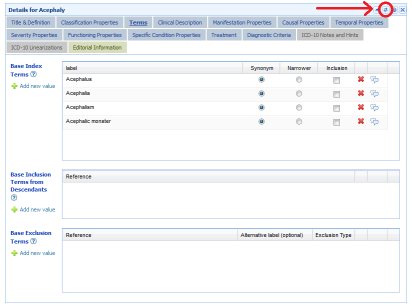
ICD Revision Steering Group and the various Topic Advisory Groups are developing the ICD-11 Beta draft on a non public access collaborative authoring platform where change histories can be tracked, which looks similar to this:

The publicly viewable version of the Beta drafting platform looks like this:

and displays less information. It can be accessed here:

Beta draft Foundation Component (FC) view:

http://apps.who.int/classifications/icd11/browse/f/en

Beta draft Linearization Morbity (LM) view:

http://apps.who.int/classifications/icd11/browse/l-m/en

Increased access to content and interaction with the drafting process can be obtained by registering.
+++
+++
Neurasthenia:

Neurasthenia is not classified in DSM-IV and is not proposed to be classified in DSM-5.

In ICD-10, Neurasthenia is classified in Chapter V Mental and behavioural disorders under parents:

F40-F48 Neurotic, stress-related and somatoform disorders

    F48 Other neurotic disorders
        ›  F48.0 Neurasthenia

+++
For ICD-11 Beta, up until July 3, Neurasthenia was also classified under:

Neurotic, stress-related and somatoform disorders

    9S1 Other neurotic disorders
        ›  9S1.1 Neurasthenia

Inclusions: Fatigue syndrome

Exclusions: psychasthenia
postviral fatigue syndrome
malaise and fatigue
asthenia NOS
burn-out

    9S1.2 Other specified neurotic disorders

Inclusions: Dhat syndrome
Occupational neurosis, including writer’s cramp
Psychasthenia
Psychasthenic neurosis
Psychogenic syncope

     9S1.3 Neurotic disorder, unspecified

Neurosis NOS

+++

On July 4, all child categories classified under parent class, 9S1 Other neurotic disorders, including Neurasthenia and its Inclusion, Fatigue syndrome, were removed from both the FC and LM view and from the PDF for the Chapter 5 Print version and there is currently no listing for any of these categories and child categories under any parent.

As no “Change history” records display in the public version of the Beta draft, it cannot be determined from what information is available whether these categories are temporarily omitted while this section of Chapter 5 is being reorganized, or whether all or selected of these ICD-10 categories are proposed to be retired for ICD-11 or are destined to be subsumed under the proposed Bodily distress disorders categories that ICD Revision has yet to define.

According to the Goldberg February 2011 report, terms included in the ICD11-PHC version of ICD-11 must have an equivalent disorder in the main classification. In February 2011, it was proposed not to include Neurasthenia in the ICD11-PHC version but to subsume under 13 Distress disorder. (It isn’t clear under which disorder group or subcategory Neurasthenia is proposed to be subsumed for the most recently published iteration for ICD11-PHC.)

Neurasthenia remains listed as an Exclusion to Chapter 5 Generalized anxiety disorder and Chapter 18 Malaise and fatigue but these Exclusions may be awaiting attention, if the intention is to retire a number of ICD-10 terms.

I will update when it becomes apparent what the intention is for these currently missing categories.

+++
ICD-11 Chapter 06: Diseases of the nervous system

Postviral fatigue syndrome, Benign myalgic encephalomyelitis, Chronic fatigue syndrome:

In ICD-10, Postviral fatigue syndrome is classified as a Title term within Volume 1: The Tabular List in Chapter VI: Diseases of the nervous system under G00-G99 Other disorders of the nervous system > G93 Other disorders of brain, and coded at G93.3. See: http://apps.who.int/classifications/icd10/browse/2010/en#/G93.3

Benign myalgic encephalomyelitis is also coded in the Tabular List to G93.3 Postviral fatigue syndrome.

Chronic fatigue syndrome is not classified within the Tabular List but is indexed to G93.3 in Volume 3: The Alphabetical Index.

An unauthorised copy of Volume 3: The Alphabetical Index Version for 2006 can be accessed here: (See Page 528)
http://www.scribd.com/doc/7350978/ICD10-2006-Alphabetical-Index-Volume-3 

In indexing Chronic fatigue syndrome to G93.3, ICD-10 does not specify whether it views the term as a synonym, subclass or “best coding guess” to Title term, Postviral fatigue syndrome or to Benign myalgic encephalomyelitis.

Nor does ICD-10 specify the relationship between Postviral fatigue syndrome and Benign myalgic encephalomyelitis.

(For ICD-11, a mechanism will be provided to identify whether an inclusion term is a synonym or a subclass.)

In June 2010, I reported that in May 2010, a change of hierarchy had been recorded in the ICD-11 iCAT Alpha drafting platform “Change History” and “Category Discussion Notes” for class: G93.3 Postviral fatigue syndrome.

See these two screenshots from the original iCAT Alpha drafting platform:

Image 1:

Image 2:

+++
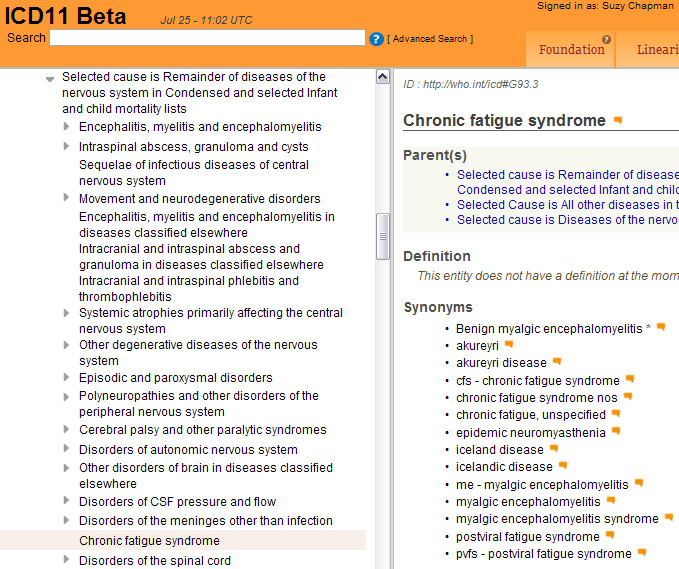
From current information in the Beta draft, it would appear that for ICD-11, the proposal is for a change of hierarchy between Postviral fatigue syndrome and Chronic fatigue syndrome with Chronic fatigue syndrome elevated to an ICD-11 Title term, with a Definition (not currently populated) and with potentially up to 12 other descriptive parameters, populated in accordance with the ICD-11 “Content Model.”

There are a number of terms listed under Synonyms to Title term Chronic fatigue syndrome including Benign myalgic encephalomyelitis and Postviral fatigue syndrome.

Mouse hover over the asterisk at the end of Benign myalgic encephalomyelitis and the following hover text displays, “This term is an inclusion term in the linearizations.”

Also listed under “Synonyms” are “chronic fatigue syndrome nos” and “chronic fatigue, unspecified” (both imported from current proposals for locating Chronic fatigue syndrome in Chapter 18: Symptoms and Signs in the forthcoming US specific, ICD-10-CM).

See this Beta drafting platform page:

http://apps.who.int/classifications/icd11/browse/f/en#/http%3a%2f%2fwho.int%2ficd%23G93


There is currently no discrete ICD Title term listed for Postviral fatigue syndrome in either the Foundation Component or Linearization Morbidity view and no discrete ICD Title term for Benign myalgic encephalomyelitis.

It remains unconfirmed, but from the Beta draft as it currently stands, it suggests that for ICD-11:

  • Chronic fatigue syndrome is proposed to become the Chapter 06 Title term
  • Benign myalgic encephalomyelitis is specified as an Inclusion term to CFS under “Synonyms”
  • Postviral fatigue syndrome and a number of other terms are listed under “Synonyms” to CFS

ICD-11 terminology:

For definitions of Synonyms, Inclusions, Exclusions and other ICD-11 terminology see the iCAT Glossary:

http://apps.who.int/classifications/apps/icd/icatfiles/iCAT_Glossary.html

+++
Fibromyalgia (FM):

In ICD-10, Fibromyalgia is classified under:

Chapter XIII: Diseases of the musculoskeletal system and connective tissue > M79 Other soft tissue disorders > M79 Other soft tissue disorders, not elsewhere classified > M79.7 Fibromyalgia 

ICD-10 Version: 2010: http://apps.who.int/classifications/icd10/browse/2010/en#/M79.7

For ICD-11 Beta draft, Fibromyalgia is currently classified under:

Chapter 13: Diseases of the musculoskeletal system and connective tissue > Soft tissue disorders > Other soft tissue disorders > QG6 Other soft tissue disorders, not elsewhere classified > QG6.7 Fibromyalgia

FC: http://apps.who.int/classifications/icd11/browse/f/en#/http%3a%2f%2fwho.int%2ficd%23M79.7
LM: http://apps.who.int/classifications/icd11/browse/l-m/en#/http%3a%2f%2fwho.int%2ficd%23M79.7

+++
Irritable bowel syndrome (IBS):

In ICD-10, Irritable bowel syndrome is classified under:

Chapter XI: Diseases of the digestive system > K55-K63 Other diseases of intestines > K58.0 Irritable bowel syndrome with diarrhoea > K58.9 Irritable bowel syndrome without diarrhoea > Irritable bowel syndrome NOS

ICD-10 Version: 2010: http://apps.who.int/classifications/icd10/browse/2010/en#/K58

For ICD-11 Beta draft, Irritable bowel syndrome is currently classified under:

Chapter 11: Diseases of the digestive system > Functional gastrointestinal disorders > FS6 Irritable bowel syndrome and other functional bowel disorders > FS6.1 Irritable bowel syndrome 

FC: http://apps.who.int/classifications/icd11/browse/f/en#/http%3a%2f%2fwho.int%2ficd%23K58
LM: http://apps.who.int/classifications/icd11/browse/l-m/en#/http%3a%2f%2fwho.int%2ficd%23K58

+++
I shall continue to monitor the Beta drafting process and update on any significant developments for both ICD-11 Chapter 5 and Chapter 6 and for ICD11-PHC for the categories that are the focus of this post and post #190.
+++
+++
References and related material:

1] ICD-10 Version: 2010 Volume 1 Tabular List online:
http://apps.who.int/classifications/icd10/browse/2010/en

2] ICD-11 Beta drafting platform:
http://apps.who.int/classifications/icd11/browse/f/en

3] Goldberg, D. Guest editorial. A revised mental health classification for use in general medical settings: the ICD11–PHC 1. International Psychiatry, Page 1, February 2011.
http://www.rcpsych.ac.uk/pdf/IPv8n1.pdf

4] 21st Century Global Mental Health by Dr Eliot Sorel, Professor, George Washington University, Washington D.C.
Publication date: August, 2012: http://www.jblearning.com/catalog/9781449627874/
Page 51, Sample Chapter 2: http://samples.jbpub.com/9781449627874/Chapter2.pdf

Two resign from DSM-5 Personality Disorders Work Group over “seriously flawed” proposals

Two resign from DSM-5 Personality Disorders Work Group over “seriously flawed” proposals

Post #191 Shortlink: http://wp.me/pKrrB-2kN

Update at July 24, 2012: Additional reporting from Straight.com, Vancouver, on the resignations of two members of the DSM-5 Personality Disorders Work Group:

UBC prof emeritus John Livesley and Dutch expert quit DSM-V committee defining personality disorders

Charlie Smith | July 23, 2012

Update at July 16, 2012:

In the July issue of Clinical Psychology & Psychology there is an Editorial and two Commentaries around DSM-5 proposals for Personality and Personality Disorders.

Clinical Psychology & Psychotherapy

http://onlinelibrary.wiley.com/journal/10.1002/(ISSN)1099-0879/earlyview

Commentary

No abstract is available for this article.

Personality Disorder Proposal for DSM-5: A Heroic and Innovative but Nevertheless Fundamentally Flawed Attempt to Improve DSM-IV

Roel Verheul

Article first published online: 12 JUL 2012 | DOI: 10.1002/cpp.1809

Editorials

No abstract is available for this article.

DSM-5 Personality Disorders: Stop Before it is Too Late

Paul Emmelkamp and Mick Power

Article first published online: 3 JUL 2012 | DOI: 10.1002/cpp.1807

Commentary

No abstract is available for this article.

Disorder in the Proposed DSM-5 Classification of Personality Disorders

W. John Livesley

Article first published online: 3 JUL 2012 | DOI: 10.1002/cpp.1808

Roel Verheul, Ph.D. and W. John Livesley, M.D., Ph.D. resigned as members of the DSM-5 Personality and Personality Disorders Work Group in April.

Dr Roel Verheul is CEO of de Viersprong, Netherlands Institute for Personality Disorders.

Dr. John Livesley is Professor Emeritus at the University of British Columbia.

Allen Frances, M.D. who chaired the DSM-IV Task Force blogs at DSM 5 in Distress. Drs Verheul and Livesley have written to Dr Frances setting out their concerns for what they believe to be “seriously flawed proposals” and “a truly stunning disregard for evidence.”

DSM5 in Distress
The DSM’s impact on mental health practice and research.

by Allen Frances, M.D.

Two Who Resigned From DSM-5 Explain Why
They spell out the defects in the personality section

Allen Frances, M.D. | July 11, 2012

Roel Verheul and John Livesley both felt compelled to resign from the DSM-5 Personality Disorders Work Group. Here is an email from them describing what went wrong in the preparation of this section:

“…Regrettably, the Work Group has been unable to capitalize on the opportunity and has advanced a proposal that is seriously flawed. It has also demonstrated an inability to respond to constructive feedback both from within the Work Group and from the many experts in the field who have communicated their concerns directly and indirectly. We also regret the need to resign because we were the only International members of the Work Group which is now without representation from outside the US…”

“…Early on in the DSM-5 process, we developed major concerns about the Work Group’s mode of working and its emerging recommendations that we communicated to the Work Group and Task Force… We considered the current proposal to be fundamentally flawed and decided that it would be wrong of us to appear to collude with it any longer…As we see it, there are two major problems with the proposal…”

Read full article here

Proposals for the DSM-5 Personality Disorders as issued for the third and final stakeholder review can be read here on the DSM-5 Development site.

Changes to ICD-11 Beta drafting platform: Bodily Distress Disorders (1)

Changes to ICD-11 Beta drafting platform: Bodily Distress Disorders (1)

Post #190 Shortlink: http://wp.me/pKrrB-2jB


+++

This four page post is a revised version of content first published on July 2, 2012.

Information in this report relates to proposals for the World Health Organization’s forthcoming ICD-11, currently scheduled for pilot dissemination in 2015+; it does not relate to the existing ICD-10 or to the forthcoming US specific “clinical modification” of ICD-10, known as ICD-10-CM.

Caveat: The ICD-11 Beta drafting process is a work in progress over the next two to three years. The Beta draft is updated on a daily basis. Parent terms, category terms and sorting codes assigned to categories are subject to change as work on chapter reorganization progresses. Images and text in this posting may not reflect the most recently assigned categories and codes. This post reflects the Beta draft as it stood at July 24, 2012. Please also read the ICD-11 Beta Draft Caveats.

This report updates on recent changes to the Somatoform Disorders section of the ICD-11 Beta drafting platform. The Beta drafting platform can be accessed here:

Beta draft Foundation view:

http://apps.who.int/classifications/icd11/browse/f/en

Beta draft Linearization view:

http://apps.who.int/classifications/icd11/browse/l-m/en
+++

How do the Somatoform Disorders categories currently stand in ICD-10?

ICD-10 Tabular List Version: 2010 can be accessed here: http://apps.who.int/classifications/icd10/browse/2010/en

ICD-10 Chapter V “Somatoform Disorders”

This is the section of ICD-10 that corresponds with the Somatoform Disorders section in DSM-IV. There is a degree of correspondence between current categories for this section of ICD-10 and for DSM-IV, as set out in the (simplified) table, below.

For clinical descriptions and diagnostic guidelines for ICD-10 Somatoform Disorders see Page 129 of the “Blue book”:

ICD-10 Classification of Mental and Behavioural Disorders: Clinical descriptions and diagnostic guidelines: http://www.who.int/classifications/icd/en/bluebook.pdf

Current DSM-IV Codes and Categories for Somatoform Disorders and ICD-10 Chapter V Equivalents

[Ed: Neurasthenia is not categorized within DSM-IV.]

Source: Mayou R, Kirmayer LJ, Simon G, Kroenke K, Sharpe M: Somatoform disorders: time for a new approach in DSM-V. Am J Psychiat. 2005;162:847–855.
+++
+++
This screenshot shows how the ICD-11 Beta draft had stood at June 24, 2012:

ICD-11 Beta Draft: Morbidity Linearization view


+++

For ICD-11 Beta draft, the proposal in June 2012 had been to rename ICD-10’s F45 Somatoform Disorders parent category to Bodily Distress Disorders.

Three new proposed terms: 9R0 Mild bodily distress disorder; 9R1 Moderate bodily distress disorder; 9R2 Severe bodily distress disorder were inserted above the 9R3 thru 9R8 legacy categories imported from ICD-10.

ID : http://who.int/icd#F45

05 Mental and behavioural disorders [Chapter V in ICD-10]

[…]

BODILY DISTRESS DISORDERS  [F45 Somatoform Disorders > F40-F48 Neurotic, stress-related and somatoform disorders in ICD-10]

9R0 Mild bodily distress disorder  [New term to ICD]
9R1 Moderate bodily distress disorder   [New term to ICD]
9R2 Severe bodily distress disorder  [New term to ICD]
9R3 Somatization disorder  [F45.0 in ICD-10]
9R4 Undifferentiated somatoform disorder  [F45.1 in ICD-10]
9R5 Somatoform autonomic dysfunction   [F45.3 in ICD-10]
9R6 Persistent somatoform pain disorder  [F45.4 in ICD-10] 
    ›  9R6.1 Persistent somatoform pain disorder
      9R6.2 Chronic pain disorder with somatic and psychological factors  [Not in ICD-10]
9R7 Other somatoform disorders  [F45.8 in ICD-10]
9R8 Somatoform disorder, unspecified  [F45.9 in ICD-10]

+++

Hypochondriacal disorder, coded at F45.2 in ICD-10, is currently renamed to Illness Anxiety Disorder for ICD-11 Beta draft and relocated under ANXIETY AND FEAR-RELATED DISORDERS:

http://apps.who.int/classifications/icd11/browse/l-m/en#/http%3a%2f%2fwho.int%2ficd%23F45.2

ID : http://who.int/icd#F45.2

9C5  ANXIETY AND FEAR-RELATED DISORDERS

      ›  9C5.6 Illness Anxiety Disorder

Continued on Page Two

Changes to content on DSM-5 Development site (1)

Changes to content on DSM-5 Development site (1)

Post #189 Shortlink: http://wp.me/pKrrB-2jn


Content embargo

According to American Psychiatric Association’s recently published, highly restrictive DSM-5 Permissions Policy – following closure of the third and final public review, the content of DSM-5 will be under strict embargo until the manual is published.

DSM-5 is expected to be finalized by December 31 for publication in May 2013.

APA closed its third stakeholder review of draft proposals for DSM-5 categories and criteria on June 15 and issued a Press Release on June 26 – write-up from Deborah Brauser for Medscape Medical News, below.

Between closure of the final review and Wednesday, June 27, the DSM-5 Development site stated that although comments on proposals could no longer be submitted through the website the site would remain viewable with the draft proposals until DSM-5’s publication.

That line of text was deleted from the DSM-5 Development site home page yesterday, Thursday, June 28.

It remains unconfirmed whether it is now APA’s intention to remove the draft as it stood at the third review from the DSM-5 Development site at some point between now and the slated publication date.


Categories and criteria text frozen during final revisions

According to DSM-5 Development home page text, revisions to categories and criteria will continue to be made between now and the end of 2012 in response to stakeholder feedback; continued analysis of DSM-5 Field Trial results; scrutiny by the DSM-5 Scientific Review Committee which will review scientific validating evidence for revisions; an extensive peer review process; review by an Assembly DSM-5 committee and an overall final review by the DSM-5 Task Force.

Disorder categories and criteria texts as they currently stand on the website are now frozen and the site content will not be updated to reflect any further revisions and edits made between June 15 and submission of final texts, later this year, for approval by APA Board of Trustees.

None of the manual’s extensive textual content that will accompany the new categories has been out on public review.

The remainder of the development process is set out on the Home Page under “Next Steps” and in the APA Board Materials Packet – December 10-11, 2011. This document sets out the DSM-5 Development program from December 2011 until May 2013:

Open here: Item 11.A – DSM Task Force Report


From Medscape Medical News > Psychiatry

Last DSM-5 Public Review Period Ends With 2000 Comments

Deborah Brauser | June 26, 2012

June 26, 2012 — The latest and final public comment period for the upcoming Diagnostic and Statistical Manual of Mental Disorders, Fifth Edition (DSM-5) ended on June 15 — but not before logging 2298 responses from around the world, the American Psychiatric Association (APA) reports.

This was the third public comment period that has been opened for online feedback regarding the manual’s proposed criteria changes. To date, there have been a total of 15,000 public comments posted…

Read full report

Ed: Free registration required for access to most parts of Medscape site.


Comment on closure of third and final draft review from 1 Boring Old Man

1 Boring Old Man

missed opportunity…

Wednesday, June 27, 2012


Related material

1] APA News Release June 26, 2012

2] DSM-5 Development Timeline

3] DSM-5 Development Permissions Policy

4] DSM-5 Terms and Conditions of Use

DSM-5 draft criteria draws nearly 2,300 responses in final public comment period

DSM-5 draft criteria draws nearly 2,300 responses in final public comment period

Post #187 Shortlink: http://wp.me/pKrrB-2j0

According to a Press Release issued yesterday by the American Psychiatric Association (APA), the final public comment period on draft diagnostic criteria for the forthcoming Diagnostic and Statistical Manual of Mental Disorders (DSM-5) drew 2,298 responses.

APA previously reported receiving around 8,600 comments in the first stakeholder comment period and around 2,100 submissions in the second review.

During the second public comment period (May-June 2011), the specific diagnostic categories that received the most comments had been the sexual and gender identity disorders, followed closely by somatic symptom disorders and anxiety disorders.  (As reported by DSM-5 Task Force Vice-chair, Darrel Regier M.D.)

For this final review that closed on June 15, APA reports, “Although each disorder area drew a wide range of comments, the two Work Groups with the highest number were the Neurodevelopmental Work Group (397 comments) and the Anxiety, Obsessive-Compulsive Spectrum, Posttraumatic Stress and Dissociative Disorders Work Group (545 comments). APA also received more than 800 comments focused broadly on DSM-5.”


No publication of field trial data

What the News Release fails to address is APA’s withholding of its field trial results while the third and final feedback exercise was in progress, other than releasing some Kappa data to press and conference at its Annual Meeting, in May. Professional stakeholders, advocacy organizations and lay public have been obliged to submit feedback on the third draft without the benefit of scrutiny of reliability and prevalence data to inform their submissions.

[See: Deborah Brauser for Medscape Medical News: interview with Darrel Regier, May 8, 2012 and reports by 1 Boring Old Man]

APA has given no indication of whether it still intends placing Kappa results and other field trial findings in the public domain or whether reports on its field trial findings will only be accessible at some point in the future published in subscription only or pay by the paper peer review journals, from which many stakeholders would be disenfranchised.

On June 17, I asked American Psychiatric Association’s CEO and Medical Director, Dr James H. Scully, why the field trial report was withheld; whether Task Force still intends placing field trial data in the public domain and when a report might be anticipated. I’ve received no response.


Collating submissions

I continue to collate copies of submissions from patient organizations, patients and advocates on these pages in response to the proposals of the Somatic Symptom Disorders Work Group. If professional body submissions include comment on this specific section of DSM-5, I would be interested in receiving copies with a view to publication of extracts or links to full submissions.

Given that thresholds for the Somatic Symptom Disorder criteria have been lowered for the third draft and given the implications for their constituencies, the response of US, UK and international patient organizations to calls for submissions in this third and final review was abysmal.

I’d like to thank patients, advocates and those organizations that did submit comment in response to the proposals of the Somatic Symptom Disorders Work Group.  I’d also like to thank Maarten Maartensz for his commentaries on DSM-5 proposals over the past two years.


APA News Release June 26, 2012 appended:

Open PDF Press Release No. 12-30

DSM-5 Draft Criteria Draws Nearly 2,300 Responses

Mental health diagnostic manual closes final public comment period

ARLINGTON, Va. (June 26, 2012) – The final public comment period for the draft diagnostic criteria of the upcoming Diagnostic and Statistical Manual of Mental Disorders (DSM-5) drew 2,298 responses from across the country and abroad. The six-week comment period ended June 15.

This feedback, submitted online to the American Psychiatric Association (APA), adds to the extensive responses submitted during the two other open comment periods. In total, more than 15,000 comments about the proposed DSM-5 criteria have been received since 2010 from mental health clinicians and researchers, the overall medical community, and patients, families and advocates. As was the case following the other comment periods, the DSM-5 Task Force and Work Groups will now review and consider each response as they begin final revisions to the criteria.

“Every comment period has provided valuable perspective from a wide range of professionals, consumers and advocates,” said APA President Dilip V. Jeste, MD. “We are grateful for their participation and willingness to review the draft proposals and to share their opinions and experiences. The Work Groups consider the feedback a huge asset as they shape the final DSM-5 proposals.”

Although each disorder area drew a wide range of comments, the two Work Groups with the highest number were the Neurodevelopmental Work Group (397 comments) and the Anxiety, Obsessive-Compulsive Spectrum, Posttraumatic Stress and Dissociative Disorders Work Group (545 comments). APA also received more than 800 comments focused broadly on DSM-5.

After the Work Groups make their last revisions to the draft diagnostic criteria, the proposals will receive multi-level reviews by the entire DSM-5 Task Force, a separate Scientific Review Committee and a Clinical and Public Health Committee. The latter two committees will be working to evaluate the strength of scientific evidence supporting significant changes and to assess the impact of changes for clinicians and public health.

The Task Force will make recommendations to the APA Board of Trustees for its final decisions on the manual’s fifth edition late this year.

The American Psychiatric Association is a national medical specialty society whose more than 36,000 physicians specialize in the diagnosis, treatment prevention and research of mental illnesses, including substance abuse disorders. Visit the APA at www.psych.org  and www.healthyminds.org.