WHO releases ICD-11 Beta drafting platform

WHO releases ICD-11 Beta drafting platform

Post #170 Shortlink: http://wp.me/pKrrB-28K

Yesterday, May 14, the World Health Organization (WHO) announced the launch of the ICD-11 Beta drafting platform.

Press Release here and below.

This publicly viewable platform replaces the Alpha drafting platform that has been viewable since mid 2011. ICD-11 Revision Topic Advisory Groups are using a separate drafting platform with greater functionality than the platform launched yesterday.

Interested stakeholders can register for increased access and to interact with the Beta drafting platform.

In terms of functionality, the Beta platform does not appear to incorporate any additional features over the Alpha. 

In terms of population of content, some entities have text populated for Definitions, others are still waiting for provisional definitions. Some entities have very few “Content Model” parameters listed, others have the following: Parents; Definition; Synonyms; Exclusions; Narrower Terms; Causal Mechanisms; Body Site.

It’s not evident how many of the proposed 13 “Content Model” parameters that describe an ICD-11 entity term will eventually be populated for any given entity. The original list of 13 “Content Model” parameters has been modified since early 2011, but no new documentation has been publicly released that sets out the new parameters.

More information on the Beta drafting platform here:

http://www.who.int/classifications/icd/revision/en/

The International Classification of Diseases 11th Revision is due by 2015

Participate in the ICD Revision

Beta phase participants will have the opportunity to:

• Make Comments
• Make Proposals
• Propose definitions of diseases in a structured way
• Participate in Field Trials
• Assist in translating ICD into other languages

Video invitation to participate
Frequently Asked Questions About ICD-11
ICD Information Sheet

WHO video invitation from Dr Marie-Paule Kieny on ICD-11

For the first time, experts in the public health community who work with patient diagnosis and treatment have an opportunity to contribute to the development of the next version of the ICD. This is WHO’s publication that ensures all aspects of the health community refer to diseases and health conditions in a consistent way.

WHO is calling on experts, health providers and stakeholders from around the world to participate in the 11th revision process. The final ICD-11 will be released in 2015.

With your help, this classification will be more comprehensive than ever before.


The Beta drafting platform can be found here:

Linearizations:

http://apps.who.int/classifications/icd11/browse/l-m/en

Foundation Component:

http://apps.who.int/classifications/icd11/browse/f/en#

User Guide:

http://apps.who.int/classifications/icd11/browse/Help/en

Listing for Chronic fatigue syndrome:

http://apps.who.int/classifications/icd11/browse/f/en#/http%3a%2f%2fwho.int%2ficd%23G93.3

WHO Press Release

May 2102

http://www.who.int/features/2012/international_classification_disease/en/

WHO seeks health experts’ input for 11th International Classification of Diseases

For the first time, experts in the public health community who work with patient diagnosis and treatment have an opportunity to contribute to the development of the next version of the International Classification of Diseases (ICD), which is WHO’s publication that ensures all members of the health community refer to diseases and health conditions in a consistent way.

WHO/Jim Holmes

WHO is releasing the beta version of what will be ICD-11 on a wiki-type platform that allows stakeholder comments to be added after peer review. The final ICD-11 will be released in 2015.

WHO encourages anyone interested to comment to develop a more comprehensive classification.

Foundation for reliable health data

The ICD is the foundation for the identification of health trends and statistics globally. Receiving input from health experts will greatly improve the representation from current medical practice and create insight from a broader diversity of medicine.

“Literally this is what doctors use to diagnose a patient,” says Tevfik Bedirhan Ustun, coordinator in the Department of Health Statistics and Information Systems. “It is how we define the cause of death when a person dies. In research, it is how we classify health problems based on evidence.”

The ICD is the gold standard for defining and reporting diseases and health conditions. It allows the world to compare and share health information using a common language.

In addition to health providers, the ICD is a key tool used by epidemiologists to study disease patterns, insurers, national health programme managers, data collection specialists, and others who track global health progress and how health resources are spent.

ICD-11 innovations

Using advances in information technology, this ICD revision will allow users to collect data on cause of death, advances in science and medicine, emerging diseases and health conditions, and compare information across the globe with more ease and diversity in the service of public health and clinical reporting.

Some of the key new features of the 11th version will include:

• a new chapter on traditional medicine, which constitutes a significant part of health care in many parts of the world;
• it will be ready to use with electronic health records and applications;
• it will updated through the development phase to reflect new knowledge as it is added to the classification; and
• it will be produced in multiple languages through the development phase.

Further coverage:

http://www.dailypioneer.com/nation/65415-who-seeks-inputs-for-key-disease-database.html

WHO seeks inputs for key disease database

Tuesday, 15 May 2012 00:29
Pioneer News Service | New Delhi

The World Health Organisation (WHO) in a maiden initiative has invited experts and users to contribute online to the development of its next version of the International Classification of Diseases (ICD) capturing mortality and morbidity data.

The world’s standard tool provides a picture of the general health of countries and populations and its 11th version is now being developed through an innovative, collaborative process to be released in 2015.

“This is for the first time WHO is calling on experts and users to participate in the revision process through a web-based platform. The outcome will be a classification that is based on user input and needs,” a WHO official said.

Users include physicians, nurses, other providers, researchers, health information managers and coders, health information technology workers, policy-makers, insurers and patient organisations.

WHO will soon be releasing the beta version of what will be ICD-11 on a wiki-type platform that allows stakeholder comments to be added after peer review.

All Member States are expected to use the most current version of the ICD for reporting death and disease statistics (according to the WHO Nomenclature Regulations adopted by the World Health Assembly in 1967), the official added.

Regarding the steps for participating, he elaborated that experts and stakeholders will have to register for a participant account on the web portal which will be open for comments over the next three years and accepted changes will be reflected immediately.

Some of the key new features of the 11th version will include a new chapter on traditional medicine, which constitutes a significant part of health care in many parts of the world and ready to use with electronic health records and applications.

The ICD is translated into 43 languages and is used by all 117 member countries. The ICD holds importance as it provides a common language for reporting and monitoring diseases. This allows the world to compare and share data in a consistent and standard way – between hospitals, regions and countries and over periods of time. It facilitates the collection and storage of data for analysis and evidence-based decision-making, the official said.

What’s new in the ICD-11 Alpha drafting platform? (CFS, PVFS, ME)

What’s new in the ICD-11 Alpha drafting platform? (CFS, PVFS, ME)

Post #157 Shortlink: http://wp.me/pKrrB-22h


Screenshot: ICD-11 Alpha Browser Foundation view selected, logged in at April 10, 2012:

Chapter 6: Diseases of the nervous system

http://apps.who.int/classifications/icd11/browse/f/en#/http%3a%2f%2fwho.int%2ficd%23G93.3

Apr 09 – 11:02 UTC


ICD-11 Beta drafting platform to launch in May?

As reported in previous posts, according to the timeline, the ICD-11 Beta drafting platform is supposed to be launching this May.

ICD-11 Revision Steering Group has yet to announce whether the Beta platform remains on target for a May release and if so, on what date it will be launched – so I cannot give you a date yet.

Like the Alpha Drafting Browser, the Beta drafting platform will be a work in progress – not a final Beta draft. The final Beta isn’t scheduled until 2014, after the ICD-11 field trials have been undertaken.

When it does launch, the Beta platform is intended to be accessible to professionals and the public for viewing.

Registered or logged in users will have greater access to content and will be able to interact with the platform to read comments, comment on proposals and make suggestions, as part of the ongoing drafting process.  

In the meantime, the publicly viewable version of the Alpha drafting platform (known as the ICD-11 Alpha Browser) can still be accessed here:

http://apps.who.int/classifications/icd11/browse/f/en

The various ICD-11 Revision Topic Advisory Groups are carrying out their draft preparation work on a separate, more complex multi-author drafting platform that is accessible only to WHO and ICD Revision personnel.


Alpha drafting platform

As before, the publicly viewable version of the Alpha Browser should be viewed with the following caveats in mind:

the Alpha draft is a work in progress; it is incomplete; it may contain errors and omissions; it is in a state of flux and updated daily; textual content, codes and “Sorting labels” are subject to change as chapters are reorganized and content populated; the content has not been approved by Topic Advisory Groups, Revision Steering Group or WHO.

It is possible to register, or sign into the platform using existing accounts with several third party account providers such as Google, Yahoo and myOpenID, for increased access and functionality. Once signed in, Comments and Questions can be read and PDFs of the drafts of the top level linearizations can be downloaded from the Linearization tab.

See the Alpha Browser User Guide for information on how the Alpha Browser functions:

http://apps.who.int/classifications/icd11/browse/Help/en


The ICD-11 “Content Model”

ICD-11 will be available in both print and online versions and unlike most chapters of ICD-10, will include descriptive content for ICD terms.

For the online version of ICD-11, all ICD entities will include a definition and a number of additional key descriptive fields – between 7 and 13 pre-defined parameters, populated according to a common “Content Model” (Content Model Reference Guide January 2011).

For example, ICD entity Title, Definition, Synonyms, Narrower Terms, Exclusions, Body Site, Body System, Signs and Symptoms, Causal Mechanisms, and possibly Diagnostic Criteria for some entities.*

*According to the iCAT User Google Group message board, these fields may have been revised since the January 2011 Content Model Reference Guide was published; Content Model parameters in the Beta draft may therefore differ from those currently displaying in the public Alpha drafting platform.

The print version will use a concise version of Definition due to space constraints.

In the Alpha Browser, not all these Content Model parameters display in the Foundation and Linearization views and not all of the parameters that have been listed for individual entities have had their draft text added yet, as some chapters are more advanced for the population of proposed content than others.

So the Alpha draft is still very patchy and many entities have no Definition and little or no other proposed content filled in.

With no “Category Discussion Notes” or “Change history” pop-up windows visible in the public version of the Alpha, the viewer cannot determine the rationales behind the reorganization of terms and hierarchies within the various chapters.


Chapter location and hierarchy for CFS, PVFS and (Benign) ME in ICD-11

I have been reporting since June 2010 that the proposals for ICD-11 Alpha Draft, as far as one could determine, appeared to be:

1] That a change of hierarchy had been recorded in a “Category Discussion Note”, dated May 1, 2010, between ICD-10 Title term “Postviral fatigue syndrome” and “Chronic fatigue syndrome”. (“Category Discussion Notes” and “Change History” pop-ups did display in the earlier iCAT version of the Alpha drafting platform.)

You can view a screenshot from June 2010 of that “Change history” record here:

https://dxrevisionwatch.com/wp-content/uploads/2010/06/change-history-gj92-cfs.png

The Definition field on the “Chronic fatigue syndrome” description panel in the current Alpha Browser is currently blank but in June 2010, the Definition had stood as in this contemporaneous screenshot:

https://dxrevisionwatch.com/wp-content/uploads/2010/05/2icatgj92cfsdef.png

2] That “Chronic fatigue syndrome” had been designated as an ICD-11 Title term within ICD-11 Chapter 6: Diseases of the nervous system, with the capacity for a Definition and up to 10 additional descriptive parameters.

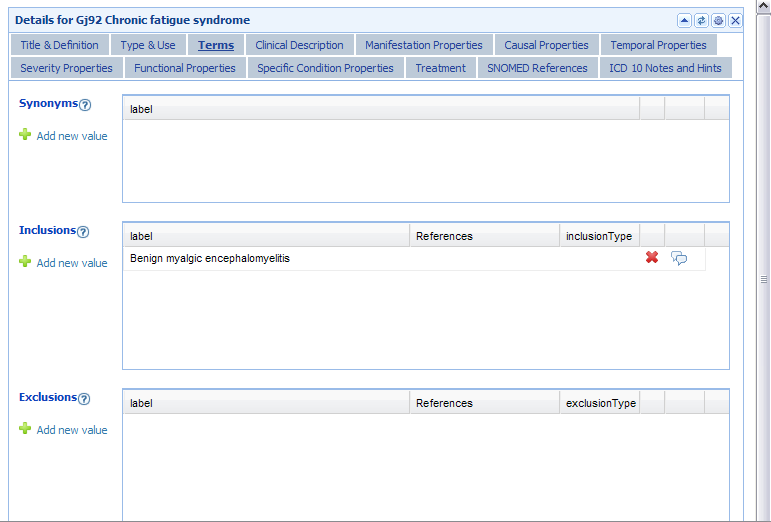
3] That “Benign myalgic encephalomyelitis” had been specified as an Inclusion term to ICD-11 Title term “Chronic fatigue syndrome” but that the relationships between the three terms, PVFS, (B) ME and CFS had yet to be specified, as in this screenshot from June 2010:

https://dxrevisionwatch.com/wp-content/uploads/2010/05/2icatgj92cfsterms.png


What is currently showing in the Chapter 6 Foundation Component?

It isn’t possible to bring up a discrete ICD Title listing for either “Benign myalgic encephalomyelitis” or “Postviral fatigue syndrome” in either the Foundation Component or the Linearization.

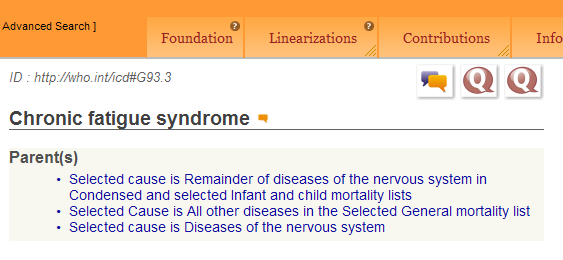
In the Foundation view only, for Chapter 6: Diseases of the nervous system, “Chronic fatigue syndrome” is listed as a Title term with the ICD-10 legacy ID “ID:http://who.int/icd#G93.3”;

the Definition field is currently blank;

a list of terms has recently been added under “Synonyms”;

one term has recently been added under “Narrower Terms”.

(Note: there is a small asterisk at the end of term “Benign myalgic encephalomyelitis” which is listed at the top of the “Synonyms” list. The asterisk “Hover text” reads “This term is an inclusion term in the linearizations.”)

If you want to view the listing directly on the Browser site (note the “Comment” and “Questions” icons which open up pop-up windows next to terms for reading/commenting won’t display unless you have already registered and logged in) go here:

ICD-11 Alpha Browser Foundation view:

http://apps.who.int/classifications/icd11/browse/f/en#/http%3a%2f%2fwho.int%2ficd%23G93.3

ID:http://who.int/icd#G93.3

Chronic fatigue syndrome

Parent(s)

Selected cause is Remainder of diseases of the nervous system in Condensed and selected Infant and child mortality lists
Selected Cause is All other diseases in the Selected General mortality list
Selected cause is Diseases of the nervous system

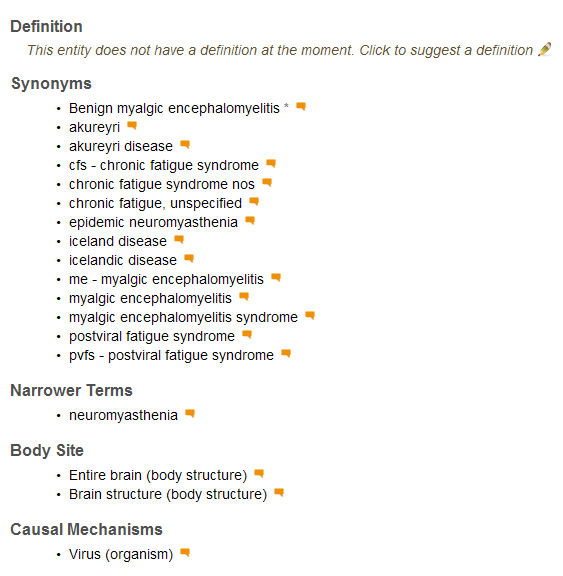
Definition

This entity does not have a definition at the moment.

Synonyms

Benign myalgic encephalomyelitis *  [Ed: Hover text over asterisk reads: “This term is an inclusion term in the linearizations.”]
akureyri
akureyri disease
cfs – chronic fatigue syndrome
chronic fatigue syndrome nos   [Ed: from current proposals for ICD-10-CM, Chapter 18, R53.82]
chronic fatigue, unspecified   [Ed: from current proposals for ICD-10-CM, Chapter 18, R53.82]
epidemic neuromyasthenia
iceland disease
icelandic disease
me – myalgic encephalomyelitis
myalgic encephalomyelitis
myalgic encephalomyelitis syndrome
postviral fatigue syndrome
pvfs – postviral fatigue syndrome

Narrower Terms

neuromyasthenia

Body Site

Entire brain (body structure)
Brain structure (body structure)

Causal Mechanisms

Virus (organism)


What’s new in Chapter 5: Mental and behavioural disorders?

As reported in Dx Revision Watch post: http://wp.me/pKrrB-1Vx,  the category “Somatoform Disorders” in Chapter 5, Mental and behavioural disorders is currently renamed to “BODILY DISTRESS DISORDERS”, under which currently sit three new child categories:

5M0 Mild bodily distress disorder
5M1 Moderate bodily distress disorder
5M2 Severe bodily distress disorder.

Chapter 5 Linearization view:

http://apps.who.int/classifications/icd11/browse/l-m/en#/http%3a%2f%2fwho.int%2ficd%23F45

Chapter 5 Foundation view:

http://apps.who.int/classifications/icd11/browse/f/en#/http%3a%2f%2fwho.int%2ficd%23F45

(Click on the little grey arrows to display the child categories):

Child categories to parent “BODILY DISTRESS DISORDERS”:

http://apps.who.int/classifications/icd11/browse/f/en#/http%3a%2f%2fwho.int%2ficd%231905_dd0250d2_e8cd_4c48_a93f_7997cc1c8b07

BODILY DISTRESS DISORDERS

5M0 Mild bodily distress disorder
5M1 Moderate bodily distress disorder
5M2 Severe bodily distress disorder
5M3 Somatization disorder
5M4 Undifferentiated somatoform disorder
5M5 Somatoform autonomic dysfunction
5M6 Persistent somatoform pain disorder
      > 5M6.0 Persistent somatoform pain disorder
      > 5M6.1 Chronic pain disorder with somatic and psycological [sic] factors
5M7 Other somatoform disorders
5M8 Somatoform disorder, unspecified

None of these three new (proposed) categories have had any Definitions or other textual content added to the description panels on the right hand side of the Alpha Browser page since I first reported this change in February.

It is still not possible to determine what disorders ICD-11 intends might be captured by these three new (proposed) terms, should ICD-11 Revision Steering Group and WHO classification experts consider these terms to be valid constructs and approve their progression through to the Beta draft.

Because no “Change Notes” or “Change history” pop-up windows display in this version of the Alpha Drafting browser, it is not possible to determine:

whether ICD-11 is proposing to introduce three new terms – 5M0 Mild bodily distress disorder; 5M1 Moderate bodily distress disorder; 5M2 Severe bodily distress disorder, in addition to retaining existing ICD-10 terms, 5M3 thru 5M8;

how ICD Revision intends to define these (proposed) new terms at 5M0, 5M1, 5M2;

how these three (proposed) new terms would relate to the existing ICD-10 “Somatoform Disorders” categories which remain listed as child categories to “BODILY DISTRESS DISORDERS” (apart from “Hypochondriacal disorder” [ICD-10: F45.2], which is now listed as “5H0.5 Illness Anxiety Disorder” in the ICD-11 Alpha Draft).

(See Page 1 and 2 of my report: “Bodily Distress Disorders” to replace “Somatoform Disorders” for ICD-11?: http://wp.me/pKrrB-1Vx  )


References:

ICD-11 Revision: http://www.who.int/classifications/icd/revision/en/

ICD-11 Alpha Browser User Guide: http://www.who.int/classifications/icd/revision/caveat/en/index.html
Alpha Browser Foundation view: http://apps.who.int/classifications/icd11/browse/f/en#
Alpha Browser Linearization view: http://apps.who.int/classifications/icd11/browse/l-m/en#
“Bodily Distress Disorders” to replace “Somatoform Disorders” for ICD-11?: http://wp.me/pKrrB-1Vx

Update on timelines: DSM-5, ICD-11, ICD-10-CM

Update on timelines: DSM-5, ICD-11, ICD-10-CM

Post #155 Shortlink: http://wp.me/pKrrB-21N

Update @ April 10, 2012: CMS issues press release – proposes one year delay for ICD-10-CM compliance

See: http://wp.me/pKrrB-22q for press release and full Proposal document

I will update as more information becomes available.

DSM-5

The DSM-5 clinical settings field trials, scheduled to complete by December, last year, but extended in order that more participants might be recruited, were expected to conclude this March. (Source: DSM-5 Disorganization, Disarray, and Delays, Dr Dayle Jones, American Counseling Association, January 3, 2012)

In November, DSM-5 Task Force Vice-chair, Darrel Regier, MD, predicted the pushing back of the final public review and comment period for revised draft diagnostic criteria from January-February to “no later than May 2012,” in response to DSM-5 timeline slippage and delays in completion of the field trials. (Source: APA Answers DSM-5 Critics, Deborah Brauser, November 9, 2011)

The timeline on the DSM-5 Development site was updated to reflect a “Spring” posting of draft diagnostic criteria but thus far, APA has released no firm date for a final public review and feedback exercise in May.

The second release of draft proposals was posted on May 4, last year, with no prior announcement or news release by APA and caught professional bodies, patient organizations and advocates unprepared.

It is hoped that APA will give reasonable notice before releasing their third and final draft – though how much influence professional and public feedback might have at this late stage in the DSM-5 development process is moot.

DSM-5 is slated for publication in May 2013.

Extract from revised Timeline

Spring 2012: Revised draft diagnostic criteria will be posted on http://www.dsm5.org and open to a third public feedback period for 2 months. Feedback will be shared directly with work group members, and further edits to proposals will be made as needed.

The full DSM-5 Timeline (as it stands at April 8, 2012) can be found here.


ICD-11

The current timeline schedules presentation of the ICD-11 to the World Health Assembly in May 2015 – a year later than the 2009 timeline.

According to a paper published by Christopher Chute, MD, (Chair, ICD-11 Revision Steering Group) et al, implementation of ICD-11 is now expected around 2016. (Source: Chute CG, Huff SM, Ferguson JA, Walker JM, Halamka JD. There Are Important Reasons For Delaying Implementation Of The New ICD-10 Coding System. Health Aff March 2012 DOI: 10.1377/hlthaff.2011.1258) 

The ICD-11 Beta drafting platform is scheduled to be launched and open to the public this May for comment and interaction. It will be a work in progress – not a final Beta draft. The final Beta draft isn’t scheduled until 2014.

No announcement that the Beta platform remains on target for a May release has been issued by WHO or ICD-11 Revision Steering Group and no date is given on the ICD Revision website for the launch.

The publicly viewable version of the Alpha drafting platform (the ICD-11 Alpha Browser) can be accessed here. The various ICD-11 Revision Topic Advisory Groups work on a separate, more layered multi-author drafting platform.

NB: The Alpha drafting platform is a work in progress. It is incomplete, in a state of flux, updated daily and subject to WHO Caveats.

ICD-11 Alpha Browser User Guide here.

Foundation view here.

Linearization view here.

PDFs of Draft Print versions of the Linearization are available from the Linearization tab to logged in users.

The ICD-11 timeline (as it stands at April 8, 2012) can be found on the WHO website here.


ICD-10-CM

Note: ICD-10-CM is the forthcoming US specific “Clinical Modification” of the WHO’s ICD-10. Following implementation of ICD-10-CM, the US is not anticipated to move on to ICD-11, or a Clinical Modification of ICD-11, for a number of years after global transition to ICD-11.

On February 16, Health and Human Services Secretary, Kathleen G. Sebelius, announced HHS’s intent to initiate a process to postpone the date by which certain health care entities have to comply with ICD-10-CM diagnosis and procedure codes. (Source: CMS Public Affairs/HHS Press Release, February 16, 2012)

The final rule adopting ICD-10-CM as a standard was published in January 2009, when a compliance date of October 1, 2013 had been set – a delay of two years from the compliance date initially specified in the 2008 proposed rule.

CMS plans to announce a new ICD-10 implementation date sometime this April, according to CMS Regional Office, Boston. (Source: Healthcare News: CMS targets April for release of new ICD-10-CM/PCS implementation date, March 20, 2012)

It is anticipated that CMS will make an announcement in the Federal Register, take public comment for 60 days, consider feedback on its proposed ruling, then issue a final rule.

For developments on the new ICD-10-CM compliance date, watch the CMS site or sign up for CMS email alerts: http://www.cms.hhs.gov/Medicare/Coding/ICD10/Latest_News.html


Related information:

DSM-5 Development

ICD-11 Revision

ICD10 Watch

Federal Register

CMS Latest News

DHHS Newsroom

ICD-10-CM CDC Site

“Bodily Distress Disorders” to replace “Somatoform Disorders” for ICD-11?

“Bodily Distress Disorders” to replace “Somatoform Disorders” for ICD-11?

Post #145 Shortlink: http://wp.me/pKrrB-1Vx

The information in this report relates only to proposals for the WHO’s forthcoming ICD-11; it does not relate to ICD-10 or to the forthcoming US specific “clinical modification” of ICD-10, known as ICD-10-CM.

Codes assigned to ICD-11 Beta draft categories are subject to change as chapter reorganization progresses. Images and text in this posting may not reflect the most recently assigned codes. This post has been updated to reflect the launch of the Beta drafting platform and revisions to codes assigned during the drafting process as they stand at June 24, 2012.

Part One


This report contains an important update on proposals for ICD-11 Chapter 5: Mental and behavioural disorders.

In a February 16, 2012 report by Tom Sullivan for Health Care Finance News, Christopher Chute, MD, who chairs the ICD Revision Steering Group, warned of a possible delay for completion of ICD-11 from 2015 to 2016.

The ICD-11 Beta drafting platform was launched in May 2012.

The Beta drafting platform is a publicly viewable browser similar to the Alpha drafting platform that had been in the public domain since May, 2011.

You can view the Beta Drafting Browser here:

Foundation Component view:

http://apps.who.int/classifications/icd11/browse/f/en

Morbidity Linearization view:

http://apps.who.int/classifications/icd11/browse/l-m/en

The Morbidity Linearization is the view that includes (what may be temporarily assigned) sorting codes. These codes are likely to change as chapter organization progresses. Click on the small grey arrows next to the chapters and categories to display parent > child > grandchildren hierarchies. Click on individual terms to display descriptive content in the right hand frame of the Beta Browser.

Textual content for ICD-11 is in the process of being drafted and the population of content for some chapters is more advanced than others. Content for some of the “ICD-11 Content Model” parameters may display: ID legacy code from ICD-10 (where applicable); Parent(s); Definition; Synonyms; Inclusions; Narrower Terms; Exclusions; Body Site; Causal Mechanism; Signs and Symptoms.

(For ICD-11, entities will be defined across all chapters through up to 13 “Content Model” parameters – considerably more descriptive content than in ICD-10 and a significant workload for the Topic Advisory Group members and managers who are generating the content for ICD-11.)

The Beta Browser User Guide is here:

http://apps.who.int/classifications/icd11/browse/Help/en

This page of the User Guide sets out differences between Foundation view and Morbidity Linearization view.

The various ICD Revision Topic Advisory Groups (TAGs) are carrying out their work on a separate, more complex, multi-author drafting platform. On their platform, editing histories and “Category and Discussion Notes” are recorded so the progress of proposals and reorganization of ICD entities can be tracked, as the draft evolves.

For the Beta drafting platform, interested stakeholders may register for increased access and interaction with the drafting process by submitting comments and suggestions on draft content and proposals.

For those registered for increased access, it is possible to download PDFs of drafts for the “Print Versions for the ICD-11 Beta Morbidity Linearization” for all 25 chapters of ICD-11. These are obtainable, once registered and logged in, from the Linearization > Print Versions tab.

Caveats

I’m going to reiterate the ICD-11 Alpha Browser Caveats because it’s important to understand that the ICD-11 Beta draft is a work in progress – not a static document – and is subject to change.

The draft is updated on a (usually) daily basis; when you view the Beta Browser, you are viewing a “snapshot” of how the publicly viewable draft stood at the end of the previous day; not all chapters are as advanced as others for reorganization or population of content; the draft is incomplete and may contain errors and omissions.

The codes and “sorting labels” assigned to ICD parent classes, child and grandchildren terms are subject to change as reorganization of the chapters progresses. The Beta draft has not yet been approved by the Topic Advisory Groups, Revision Steering Group or WHO and proposals for, and content in the draft may not progress to the Beta drafting stage; field trials have not yet been completed – so be mindful of the fact that the draft is in a state of flux.

As it currently stands, the Beta draft lacks clarity; not all textual content will have been generated and uploaded for terms imported from ICD-10 and there may be no definitions or other textual content displaying for proposed new terms.

Two chapters that are a focus of this site are Chapter 5: Mental and behavioural disorders and Chapter 6: Disorders of the nervous system (the Neurology chapter). (ICD-11 is dropping the use of Roman numerals.)

I won’t be reporting on specific categories in Chapter 6 in this post but will do a follow up post for Chapter 6 in a forthcoming post; again, there is a lack of clarity for Chapter 6 and requests for specific clarifications, last year, from the chair of Topic Advisory Group Neurology and the lead WHO Secretariat for TAG Neurology have met with no response.

Continued on Page 2: Somatoform Disorders in ICD-10; Somatoform Disorders to Bodily Distress Disorders for ICD-11?

ICD-11 Beta drafting platform for release in May 2012

ICD-11 Beta drafting platform for release in May 2012

Post #139 Shortlink: http://wp.me/pKrrB-1SE

ICD-11 Beta drafting platform

ICD Revision on Facebook has announced that a ‎4th Face to Face meeting of the ICD Revision Topic Advisory Group for Internal Medicine (TAG IM) was held recently, in Tokyo.

No agenda, meeting materials or documents have been posted on the ICD-11 Revision Google site but a PowerPoint presentation prepared by WHO’s, Dr Bedirhan Üstün, is viewable here on the “Slideshare” platform.

Dr Bedirhan Üstün is Coordinator, Classifications, Terminology and Standards, Department of Health Statistics and Information, WHO, Geneva.

You won’t need a PowerPoint .pptx format viewer to view this presentation on the Slideshare site, but you will need a .pptx viewer if you want to download and view the file. (A free .pptx viewer can be downloaded for free from the Microsoft site.)

In order to download the file, you will first need to register with Slideshare or use a Facebook membership as Sign in. If you do agree to download through a Facebook membership, please read and digest the T & C before you agree to Slideshare accessing your Facebook profile data.

View the presentation here:

http://www.slideshare.net/ustunb/tokyo-2012-ustun-show

Tokyo 2012 ustun (show) by Bedirhan Ustun on Feb 10, 2012

for which it states:

“WHO is revising the ICD to be completed by 2015. It is going to enter into a Beta phase by 2012 May during which all stakeholders could see and comment on the ICD as well as propose changes, test in practice.”

Slide #7 states:

2011  : Alpha version (ICD 11 alpha draft)

– + 1 YR  : Commentaries and consultations

2012  : Beta version & Field Trials Version

– + 2 YR Field Trials

2014   : Final version for public viewing

– 2015  : WHA Approval

2015+  implementation

Slides #11 and #12, set out the thirteen parameters of the ICD-11 “Content Model”.


The “Content Model”

ICD Revision says that the most important difference between ICD-10 and ICD-11 will be the Content Model.

Content in ICD-11 will be populated in accordance with the ICD-11 Content Model Reference Guide. There is the potential for considerably more content to be included for diseases, disorders and syndromes in ICD-11 than appears in ICD-10, across all chapters:

“Population of the Content Model and the subsequent review process will serve as the foundation for the creation of the ICD-11. The Content Model identifies the basic characteristics needed to define any ICD category through use of multiple parameters (e.g. Body Systems, Body Parts, Signs and Symptoms, Diagnostic Findings, Causal Agents, Mechanisms, Temporal Patterns, Severity, Functional Impact, Treatment interventions, Diagnostic Rules).”

This is the most recent available version of the Content Model Reference Guide January 2011

This iCAT Glossary page gives an overview of the 13 Content Model parameters.

See also Post #62: ICD-11 Content Model Reference Guide: version for December 2010


New Beta drafting browser

In May 2011, a publicly viewable ICD-11 Alpha Browser platform was launched.

In July 2011, this platform was opened up to professionals and other interested stakeholders who can register via the site for fuller access and for reading and submitting comments. See the ICD-11 Alpha Browser User Guide for information on how the Browser functions and how to register for increased access. (This is the Alpha/Beta “hybrid” referred to in the WHO-FIC Council conference call report, February 16, 2011: Page 6: PDF for Report)

ICD-11 Revision and Topic Advisory Groups are continuing to use a separate platform for drafting purposes.

Stakeholder participation at the Beta stage

In preparation for the Beta drafting stage, another publicly viewable platform is being developed. According to ICD Revision presentations, this platform will invite and support a higher level of professional and public interaction with the drafting process, with various levels of input and editing authority for interested stakeholders who register for participation. According to editing status, registered stakeholders would be permitted to:

Make comments
Make proposals to change ICD categories
Participate in field trials
Assist in translating

See presentation slides in Dx Revision Watch Posts #70 and #71:

ICD Revision Process Alpha Evaluation Meeting 11 – 14 April 2011: The Way Forward?

ICD Revision Process Alpha Evaluation Meeting documents and PowerPoint slide presentations


Slides #15 and #16 of Dr Üstün’s presentation show the methods via which interested stakeholders will be able to register for interaction with the platform.

I will update when more information becomes available on the launch of the Beta platform.

Update on ICD-11 development: July 3, 2011

Update on ICD-11 development: July 3, 2011

Post #96 Shortlink: http://wp.me/pKrrB-1eb

The information in this mailing relates only to ICD-11, the forthcoming revision of ICD-10 that is scheduled for pilot implementation in 2015. It does not apply to the forthcoming US specific Clinical Modification of ICD-10, known as “ICD-10-CM”, scheduled for implementation in October 2013, or to Clinical Modifications of ICD-10 already in use.

Caveat (updated 18 September 2011): The screenshots below were a “snapshot” of the ICD-11 Alpha Browser as it had stood on May 17 and 19, 2011. The ICD-11 Alpha Browser is a work in progress and is updated by ICD Revision personnel on a daily basis. Information visible in the Alpha Browser is incomplete, will have changed since May 17, may be in a state of flux and may contain errors and omissions; the codes and temporary “Sorting labels” assigned to ICD parent classes and categories are subject to change as work on the draft progresses and as chapters are reorganized. Note that the screenshots below no longer reflect what can be seen in the draft, as it currently stands in September 2011.

Not all ICD-11 category terms and the data associated with them (which is in the process of being populated according to 13 common ICD-11 Content Model fields, that include Definitions, Inclusions, Exclusions, Causal Mechanisms and other parameters that will be used to describe ICD-11 entities) display in this version of the Alpha Browser platform. A separate, more layered electronic drafting platform is being used by the various ICD Revision Topic Advisory Group (TAG) managers and their workgroup members, accessible only to ICD Revision TAG personnel via a password protected log in. The multi author electronic platform which the Revision TAGs are working on displays Content Model fields that are not currently viewable by the public, though for some ICD categories, Definitions are now displaying in the public version, as the development of some chapters of the ICD-11 Alpha Browser is more advanced than others.

In the next month or two, ICD-11 Revision is planning to release a new drafting platform which will be accessible by the public and for which professionals and the public will be able to register online to submit comment. This new platform was originally scheduled for mid May, then July, but ICD Revision is slipping its targets. When the new platform is released, there will be an official channel of communication but the commenting process will not be like that of the DSM stakeholder review. For an idea of what is being planned for stakeholder involvement during the alpha and beta development stages, see the presentation slides in these two Dx Revision Watch posts from April 19, 2011:

ICD Revision Process Alpha Evaluation Meeting 11 – 14 April 2011: The Way Forward?

Shortlink Post #70: http://wp.me/pKrrB-ZN

ICD Revision Process Alpha Evaluation Meeting documents and PowerPoint slide presentations

Shortlink Post #71: http://wp.me/pKrrB-10i

In the meantime, the version of the Alpha Draft currently visible to the public comes with WHO caveats and should not be relied upon and it does not reflect the screenshots below, as they had stood in May, this year. As soon as the new public platform is released, I will update, at the moment there is insufficient information to reliably determine proposals and I am seeing misreporting and outdated information being discussed on some forums.

For example, in June to November 2010, the iCAT Alpha Draft recorded a change in hierarchy for PVFS because its parent class “G93 Other disorders of brain” is removed, with ICD Title “Gj92 Chronic fatigue syndrome” listed as a child category of parent class, “GN Other disorders of the nervous system” (see this post for screenshots as they stood at that date).

But by May 2011, the “Sorting labels” had been revised and the public version of the alpha draft displayed “06L Other disorders of the nervous system” > “06L00 Chronic fatigue syndrome”. However, the 06L00 code has subsequently been reassigned to parent class “Disorders of autonomic nervous system”, and parent class, “[G93] Other disorders of brain” (an ICD-10 legacy parent class which had previously been proposed to be removed or retired) has since reappeared as a parent class at “06L02”.

“Chronic fatigue syndrome” is currently listed not at, or under “06L00”, or under parent class “06L02” [formerly parent class G93, under which had sat PVFS and (B)ME and a number of other child classes to G93], but is currently assigned the Sorting label “23A113.00” under:

23 Special tabulation lists for mortality and morbidity
  > 23A Tabulation list for mortality
     >> 23A113 Selected cause is Remainder of the nervous system in Condensed and selected Infant and  child mortality lists
         >>> 23A113.00 Chronic fatigue syndrome

(for which no rationale or “Discussion Note” is evident in the public version), together with a long list of other Chapter 6 categories listed under Special tabulation lists for mortality and morbidity.

I would advise against attempting to determine ICD-11 proposals based on the status of the information as it currently displays, the ambiguities, the lack of visible “Discussion Notes” which explain changes (which had been visible in the iCAT platform, last year) and given that input and organization of data on the multi editor platform is subject to daily revision by numerous ICD Revision personnel, is therefore in a state of flux and may contain technical errors and omissions due to software glitches and human error in data entry and operation of a complex electronic platform.

I wrote to WHO’s Sarah Cottler in September 2011 requesting clarifications. No response was received.

Click here for ICD Caveats


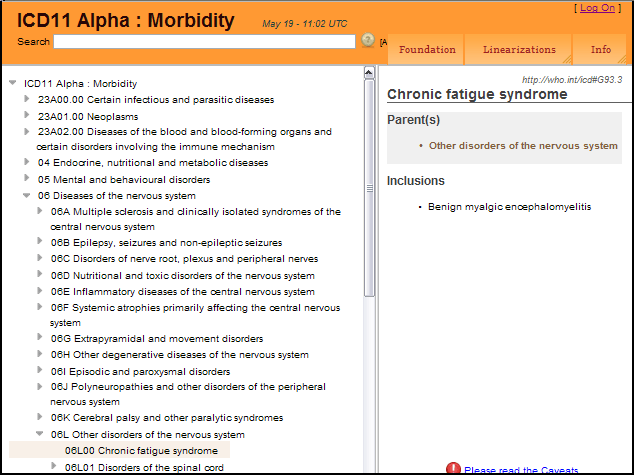
Screenshot from ICD11 Alpha  retrieved May 17 – 11.02 UTC    Chapter 6 Diseases of the nervous system: Foundation Tab selected

ICD11 Alpha Chapter 6

    »  http://apps.who.int/classifications/icd11/browse/f/en#/@_@who_3_int_1_icd_2_G93_3_3
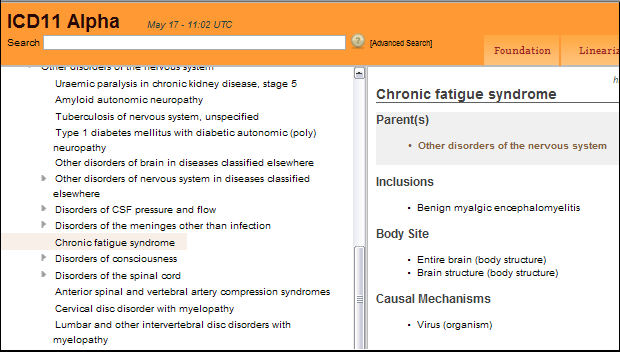
Screenshot from ICD11 Alpha  retrieved May 19 – 11.02 UTC    Chapter 6: Linearizations Tab > Morbidity selected

    »  http://apps.who.int/classifications/icd11/browse/l-m/en#/@_@who_3_int_1_icd_2_G93_3_3
 

Slipping Timeline

In May, I reported that the revision of ICD-10 and development of ICD-11 is running about a year behind targets for the population of content and software development and that the ICD-11 Timeline for Alpha and Beta drafting has been adjusted [1]. In order to meet its revised schedule, the technical work on ICD-11 will need to be completed by 2013, the year the APA’s DSM-5 is slated for publication. 

Drafting platforms

In November 2010, the iCAT platform through which ICD-11 was being drafted was taken out of the public domain. In May, this year, an ICD-11 Alpha browser was released for public viewing [2], with a number of caveats [3].

This most recently published Alpha platform does not include many of the “Content Model” parameters, for example, no draft “Definitions” are included and neither are the  “Discussion Notes” and “Change Histories” that had been viewable in the iCAT, as it stood last June to November. You can see screenshots of the June to November 2010 version of the iCAT in this post [4].

For screenshots from the most recent Alpha Browser for:

Chapter 6: Diseases of the nervous system > 06L Other disorders of the nervous system > 06L00 Chronic fatigue syndrome

see this post [5] or pull up the Alpha Browser pages, here [6].

As you’ll see, ICD-10 Chapter VI (6) is undergoing reorganization and the parent class “G93 Other disorders of brain” under which “Postviral fatigue syndrome”, “Benign myalgic encephalomyelitis” and many other ICD-10 categories had sat is proposed to be removed. A change of hierarchy between “Postviral fatigue syndrome” and “Chronic fatigue sydrome” is recorded in a “Change History” note.

Reorganization of Chapter 6 Diseases of the nervous system

Chapter 6 categories for ICD-11 are currently assigned the codes 06A thru 06L02. It is not known what codes will eventually be assigned to the categories within ICD-11 Chapter 6. As you’ll see from the screenshots, “06L00 Chronic fatigue syndrome” is proposed to be classified under “06L Other disorders of the nervous system”, with “Benign myalgic encephalomyelitis” specified as an Inclusion term to “06L00 Chronic fatigue syndrome”.

Relationships between Inclusion terms are not specified within ICD-10, but they will be specified within ICD-11.

Go here for ICD-11 Chapter 5 “Neurotic, stress-related and somatoform disorders” > Somatoform Disorders and Neurasthenia:

http://apps.who.int/classifications/icd11/browse/f/en#/@_@who_3_int_1_icd_2_F45

http://apps.who.int/classifications/icd11/browse/f/en#/@_@who_3_int_1_icd_2_F48_3_0

Go here for ICD-11 Chapter 18 “Symptoms, signs and abnormal clinical and laboratory findings, not elsewhere classified” > Malaise and fatigue:

http://apps.who.int/classifications/icd11/browse/l-m/en#/@_@who_3_int_1_icd_2_R53


The Revision Steering Group (RSG) and the various ICD Revision Topic Advisory Groups (TAGs) and their external reviewers for content and proposals are using a more layered version of the platform on which they are undertaking the ongoing drafting process; their platform is currently accessible only to WHO, ICD Revision and IT technicians.

The public version of the ICD-11 Alpha Browser, which is being updated daily, is currently open for public viewing only – not for commenting on. But in July, ICD Revision is planning to open up the Alpha Browser for one year for public commenting and consultations.

Extracts from: http://www.who.int/classifications/icd/revision/en/index.html

ICD-11 Timeline

Compiled from the most recent Timelines [1] [7]:

May 2011: Alpha Browser opened up for public viewing [Reached]

July 2011: Alpha Browser opened up for public commenting

+1 year for Commentaries and consultations

May 2012: Beta version opened up to public and Field Trials Version

+2 years for Field trials

2014: Final version for public viewing

May 2015: Presentation of the final version for World Health Assembly (WHA) Approval

Stakeholder participation

The WHO will be engaging with stakeholders who express an interest in participating in the ICD revision process.

Individuals may register to:

Make comments

Make proposals to change ICD categories

Participate in field trials

Assist in translating

The drafting browsers will be open all year round, subject to continuous daily updates and open to all interested stakeholders – Health Care Providers, Information Managers etc. Proposals and feedback will be subject to structured peer review by the Topic Advisory Groups.

For more information on how stakeholder participation is being projected see presentation slides in these reports on my site [8] [9].

Registering for participation

It’s currently unclear which classes of stakeholder might be called upon to participate, and to what extent, during the Alpha drafting stage.

The Stakeholder Registration Form [10] currently appears geared for participation by medical and allied health professionals and administrators. Irrespective of whether the “Yes” or “No” field for the question “Are you a health care professional?” is selected, one is presented with the same options:

Register to become involved

http://www.who.int/classifications/icd/revision/en/index.html

WHO wants to know if you are interested in being involved in the ICD Revision. We will contact you as certain features are opened to the public.

What is your clinical profession?

Medicine

Psychology

Nursing

Counselling

Social Work

Health Information Manager

Coder

Which of the following describes your highest educational attainment? Pre-University; University Degree; Non-doctoral post graduate degree (e.g. Master’s;) Doctoral degree (PhD, post bachelor’s MD, or similar)

Are you interested in participating in:

Making proposals

Peer-reviewing

Field trials

I will check the form again, once the Alpha draft has been opened up for public comment, currently scheduled for July. It is anticipated that an Alpha browser using different software from that currently in use may be released in July. I will update when the browser is opened up for public comment.

The ICD-11 “Content Model”

The WHO’s, Dr Bedhiran Üstün, describes ICD-10 as a “laundry list”. One of the most significant differences between ICD-10 and the forthcoming ICD-11 will be the “Content Model”.

Content Model

http://www.who.int/classifications/icd/revision/contentmodel/en/index.html

The content model is a structured framework that captures the knowledge that underpins the definition of an ICD entity.

Represents ICD entities in a standard way

Allows computerization

Each ICD entity can be seen from different dimensions or “parameters”. E.g. there are currently 13 defined main parameters in the content model to describe a category in ICD (see below).

A parameter is expressed using standard terminologies known as “value sets”

Content Model Parameters

ICD Entity Title

Classification Properties

Textual Definitions

Terms

Body System/Structure Description

Temporal Properties

Severity of Subtypes Properties

Manifestation Properties

Causal Properties

Functioning Properties

Specific Condition Properties

Treatment Properties

Diagnostic Criteria

For more information on the application of the “Content Model” see document [11].

Definitions

There are no definitions inlcuded in any volume of ICD-10 for  “Postviral fatigue syndrome”, “Benign myalgic encephalomyelitis” or “Chronic fatigue syndrome”. WHO has never set out what it understands by these terms nor has it specified what ICD-10 understands the relationships between these three terms to be (see page: https://dxrevisionwatch.wordpress.com/icd-11-me-cfs/) but there will be definitions in ICD-11 and the relationships between Inclusion terms will be specified.

Definitions

http://www.who.int/classifications/icd/revision/def/en/index.html

All ICD entities will have definitions: key descriptions of the meaning of the category in human readable terms – to guide users

Limited definition in Print Version – 100 words

Detailed definitions ONLINE

Definitions will be compatible with:

– the Content Model

– Diagnostic Criteria

– across the whole classification and the versions

Versions of ICD-11 are planned for multiple settings:

Primary Care

Clinical Services

Research

Specialty Adaptations of ICD-11 are being planned for:

Children and Youth

Oncology

Mental Health

Neurology

Musculoskeletal

Dermatology

Dentistry

————————————–

Sources, references and further reading:

ICD-11 Revision on main WHO website

http://www.who.int/classifications/icd/revision/en/

1] ICD-11 Revised Timeline

http://www.who.int/classifications/icd/revision/timeline/en/index.html

2] ICD-11 Alpha Browser Platform

http://apps.who.int/classifications/icd11/browse/f/en

3] ICD-11 Alpha Browser Caveats

http://www.who.int/classifications/icd/revision/caveat/en/index.html

4] Article: iCAT collaborative authoring platform, June to November 2010, screenshots and notes

https://dxrevisionwatch.wordpress.com/2010/06/07/pvfs-me-cfs-and-the-icd-11-alpha-draft-and-icat-collaborative-authoring-platform/

5] Article: ICD-11 Alpha Browser Platform, screenshots and notes for Chapter 6: Diseases of the nervous system > 06L Other disorders of the nervous system > 06L00 Chronic fatigue syndrome

https://dxrevisionwatch.wordpress.com/2011/05/19/icd-11-alpha-drafting-platform-launched-17-may-public-version/

6] ICD-11 Alpha Browser Platform: ICD-11 entity “06L00 Chronic fatigue syndrome”

Foundation:

http://apps.who.int/classifications/icd11/browse/f/en#/@_@who_3_int_1_icd_2_G93_3_3

Linearizations Morbidity:

http://apps.who.int/classifications/icd11/browse/l-m/en#/@_@who_3_int_1_icd_2_G93_3_3

7] ICD-11 Timeline: PowerPoint presentation (in PDF format)

http://unstats.un.org/unsd/class/intercop/expertgroup/2011/AC234-P32.PDF

8] Article: ICD Revision Process Alpha Evaluation Meeting documents and PowerPoint slide presentations

https://dxrevisionwatch.wordpress.com/2011/04/19/icd-revision-process-alpha-evaluation-meeting-presentations/

9] Article: ICD-11 Revision Steering Group struggling to meet targets for release of Beta Draft platform in May

https://dxrevisionwatch.wordpress.com/2011/04/11/icd-11-struggling-to-meet-targets-for-release-of-beta-draft-in-may/

10] Register for participation in ICD-11 Alpha drafting process

http://www.who.int/classifications/icd/revision/en/

Stakeholder Registration form

https://spreadsheets.google.com/spreadsheet/viewform?formkey=dDVabnF1RFpTQkVnVEN2TXhVRm55MGc6MQ

[11] ICD-11 Content Model Reference Guide version January 2011

http://sites.google.com/site/icd11revision/home/documents

https://dxrevisionwatch.com/wp-content/uploads/2011/02/content20model20reference20guide20january2020111.doc