Objectors to insertion of DSM-5’s Somatic symptom disorder into ICD-10-CM

Post #283 Shortlink: http://wp.me/pKrrB-3y8

Michael Munoz, Executive Director, Rocky Mountain CFS/ME & FM Association has organized a joint letter of objection signed by 13 U.S. patient organizations and advocates for submission to NCHS. It can be read here:

http://www.rmcfa.org/index.html > http://www.rm-cfs-fms.citymaker.com/f/NCHS.pdf

or download PDF here: Joint response to NCHS 11.15.13

This joint submission had been signed by the following organizations and advocates:

Michael Munoz, Executive Director, Rocky Mountain CFS/ME & FM Association
Lori Chapo-Kroger, RN, President & CEO, PANDORA Org
Charmian Proskauer, President, Massachusetts CFIDS/ME & FM Association
Tamara Staples, President & Co-Founder, Fibromyalgia – ME/CFS Support Center, Inc.
Donna Pearson, Vice President, Massachusetts CFIDS/ME & FM Association
Jean Harrison, President and Founder, MAME – Mothers Against Myalgic Encephalomyelitis
Denise Lopez-Majano, Founder, Speak Up About ME
Rik Carlson, President, Immunedysfunction.org
Jennifer M. Spotila, JD., Occupy CFS blog, Patient Advocate
Billie Moore, Patient Advocate
Charlotte von Salis, JD, Patient Advocate
Mary Schweitzer, Ph.D., Patient Advocate
Mary Dimmock, Patient Advocate

I’d like to thank all those who have submitted objections to NCHS in opposition to the September 2013 C & M Committee meeting proposal to insert Somatic symptom disorder as an inclusion term in ICD-10-CM.

My submission can be read here PDF: Submission NCHS

Some additional organizations and individuals have advised me of their own submissions. If you have submitted a response on behalf of your organization or as a patient, advocate or professional and you would like your name or your organization’s name added to the list of responders below please shoot me an email or contact me via the Contact form with a link to your submission (if it has been placed in the public domain) and a couple of lines of credentials or stakeholder interest, if desired.

Bridget Mildon, Patient advocate and Founder of FND Hope, Inc. FND Hope is the only state registered non profit patient advocacy organization specifically for those assigned a diagnosed of Functional Neurological Disorder. Bridget was misdiagnosed with FND and continues to advocate for those with a FND diagnosis to receive appropriate patient care fndhope.org Submission
Mark Thompson, patient. Submission
Diane O’Leary, Ph.D. is a philosopher focused on the rights of medical patients denied medical care because of mistaken somatoform diagnoses. She is author of the book, Patient, Executive Director of the Sneddon’s Foundation, and author of numerous web and print entries on Sneddon’s Syndrome, a highly threatening cerebrovascular disease generally mistaken for somatoform disorders. Dr. O’Leary is author of “Peculiar Silence: The Problem of Error in Diagnosis of SSD” (a reply piece at BMJ). Dr O’Leary has coauthored several blogs, published and forthcoming, with Prof. Allen Frances at Huffington Post, Psychology Today and Psychiatric Times. New work is forthcoming for the National Organization for Rare Disorders and Ben’s Friends. An audio interview with Dr. O’Leary is available here. PDF Submission also Submission [On LinkedIn]
Suzy Chapman, DipAD, UK carer/advocate for young adult with long-term illness. Owner of website Dx Revision Watch, Monitoring the revision of DSM-5 and ICD-11. Co-author of journal papers and commentaries on the Somatic symptom disorder construct (with Professor Allen Frances). PDF Submission
Richard A. Lawhern, Ph.D. is an 18-year patient advocate. He writes content and moderates for “Living With TN,” a social networking site that supports nearly 5,000 chronic face pain patients in 117 countries – many of whom have been substantively harmed by mis-application of psychosomatic diagnoses. Submission
Angela Kennedy, M.A. (also retired R.G.N.), social science lecturer and researcher. Author of the book Authors of our own misfortune?: The problems with psychogenic explanations for physical illnesses (2012) Village Digital Press. Carer and parent of disabled woman who became ill at 12 years of age.
Gail Kansky, President, National CFIDS Foundation, Inc. Needham, MA http://www.ncf-net.org Submission
Jack Carney, Ph.D., DSW, Brooklyn, NY, Committee to Boycott the DSM-5, contributor to Mad in America. A social worker, Dr Carney writes on the contradictions and hypocrisies of the public mental health system and promotes and applauds acts of resistance to it.
Jennifer Brauer, BA, Women’s Studies, University of Massachusetts. Former certified paramedic, Emergency Medical Technician BLS, Bureau of The Emergency Medical Services, NY City Fire Dept. (1996-2005).
Samuel Wales, author, The Kafka Pandemic

Next meeting of ICD-10-CM Coordination and Maintenance Committee is March 19-20, 2014

Post #282 Shortlink: http://wp.me/pKrrB-3xE

The deadline for receipt of public submissions in response to proposals for updates and changes to ICD-10-CM diagnosis and procedure codes presented at the September 18-19, 2013 meeting of the ICD-9-CM Coordination and Maintenance Committee has now closed.

In 2014, this advisory Committee, which is co-chaired by NCHS and CMS, will be known as the ICD-10-CM Coordination and Maintenance Committee, as there will be no further updates of ICD-9-CM.

A done deal?

Proposals submitted on behalf of the American Psychiatric Association (APA) and presented at the meeting by APA’s Research Director, Darrel Regier, MD, can be found from Page 32 of the Diagnosis Agenda. Additional proposals for inclusion of new DSM-5 disorder terms within ICD-10-CM Chapter 5 Mental and behavioral disorders can be found on Pages 45-46.

The Summary of the September meeting diagnosis presentations can be found here. Links for the four videocasts of the meeting’s two day proceedings are listed in this Dx Revision Watch post and the Meeting Materials are here.

The Timeline for ICD-9-CM (for the remainder of its life) and for ICD-10-CM is set out from Page 3 of the Diagnosis Agenda.

Some diagnosis proposals at the September 18-19, 2013 meeting were requested for October 2014 implementation and some for 2015 implementation. I shall update this site when the outcomes of the various proposals are published, next year.

There is a lack of clarity over which body has requested the addition of Somatic symptom disorder (SSD) and Illness anxiety disorder as inclusion terms to existing ICD-10-CM codes. It isn’t clear whether these two additional DSM-5 constructs have been proposed for inclusion in ICD-10-CM by the APA or by the NCHS/CMS Committee – if the latter, should we assume these two proposals already have the support of NCHS?

Given APA’s determination to achieve harmonization between the two systems, the outcome of its proposals to insert a handful of new DSM-5 disorders into ICD-10-CM may already be a done deal between APA and NCHS: the Director of NCHS may not need much persuasion to ratify their retrofitting into ICD-10-CM.

Loss of public trust and confidence

If NCHS is planning to rubber stamp insertion into ICD-10-CM of DSM-5’s poorly validated Somatic symptom disorder in response to APA diktat, having conducted no field testing and in the absence of a body of supportive evidence for SSD’s clinical relevance, safety and utility, and with disregard for a high level of public concern, what confidence can the public have that this federal agency is meeting its duty of care towards patient populations and towards the clinicians and allied health professionals who may deploy this proposed new ICD term, in its ethics, integrity and methods and for upholding standards of scientific rigour?

APA may re-present proposals next year

If APA is unsuccessful with any of the additions requested via the September meeting, it is possible that the organization may re-present proposals or modified proposals at the next C & M Committee meeting, scheduled for March 19-20, 2014. There are also other new DSM-5 disorders or changes that APA might potentially propose for incorporation into ICD-10-CM at the March 2014 or the September 2014 meeting, or at some later point.

Only a brief public submission period for March 2014 meeting

March 19-20, 2014 meeting

The deadline for Requestors to submit proposals for consideration for the March meeting agenda is January 17, 2014.

The draft agenda will be posted in February 2014.

Registration is required for those wishing to attend the meeting. Register online between on February 14 – March 14.

The two day meeting is scheduled for March 19 – 20.

Note: the deadline for receipt of comments on the March 19-20, 2014 meeting proposals for both procedure and diagnosis codes and changes is given as April 18. So instead of a couple of months for stakeholder responses, it appears there will only be four weeks or so in which to prepare and submit comments or objections.

I will post the Diagnosis Agenda for the March 2014 meeting as soon as it becomes available and links for the videocasts of the proceedings after the meeting has taken place. (Videocasts now substitute for written transcripts of meeting proceedings.)

Extracts from the Timeline that relate to the publication of additions and changes for ICD-10-CM:

April 2014 Notice of Proposed Rulemaking to be published in the Federal Register as mandated by Public Law 99-509. This notice will include references to the complete and finalized FY 2015 ICD-10-CM diagnosis and ICD-10-PCS procedure codes. It will also include proposed revisions to the MS-DRG system based on ICD-10-CM/PCS codes on which the public may comment. The proposed rule can be accessed here.

June 2014 Final addendum posted on web pages as follows:

Diagnosis addendum – http://www.cdc.gov/nchs/icd/icd10cm.htm
Procedure addendum – http://cms.hhs.gov/Medicare/Coding/ICD10/index.html

October 1, 2014 New and revised ICD-10-CM and ICD-10-PCS codes go into effect along with DRG changes. Final addendum posted on web pages as follows:

Diagnosis addendum – http://www.cdc.gov/nchs/icd/icd9cm_addenda_guidelines.htm
Procedure addendum – http://www.cms.gov/Medicare/Coding/ICD9ProviderDiagnosticCodes/addendum.html

November 2014 Any new ICD-10 codes required to capture new technology that will be implemented on the following April 1 will be announced. Information on any new codes to be implemented April 1, 2015 will be posted on the following websites:

http://www.cms.gov/Medicare/Coding/ICD9ProviderDiagnosticCodes/addendum.html

http://www.cdc.gov/nchs/icd/icd9cm_addenda_guidelines.htm

Submission: Objection to proposal to insert DSM-5’s Somatic symptom disorder into ICD-10-CM

Post #281 Shortlink: http://wp.me/pKrrB-3×1

Information in this post relates to proposals submitted via the September ICD-9-CM Coordination and Maintenance Committee meeting for inclusion of additional codes and changes to the forthcoming US specific ICD-10-CM/PCS.

There are just five days is just one day left in which to submit objections to NCHS to the proposal to insert DSM-5’s Somatic symptom disorder into ICD-10-CM.

Submit objections via email by November 15 to Donna Pickett, CDC: nchsicd9CM@cdc.gov

Further information here: Keep SSD out of ICD-10-CM – November 15 deadline for objections

Please let me know if you or your organization or professional body has submitted comment or objections, with a link if your submission is being placed in the public domain.

We need to keep SSD out of ICD-10-CM

Please consider submitting an objection before the November 15 deadline.

If you submitted comment during any of the three DSM-5 public review periods or you are an advocate or clinician signatory to the Institute of Medicine (IOM) definition issue letters campaign please also consider submitting an objection to NCHS.

I have submitted the following:

PDF: Submission NCHS

Text:

To: Ms Donna Pickett, CDC

Re: Comment on proposals, September 18-19, 2013 meeting of the ICD-9-CM Coordination and Maintenance Committee

Diagnostic Agenda, Page 45: Additional Tabular List Inclusion Terms for ICD-10-CM

Add Somatic symptom disorder to ICD-10-CM Tabular List under F45 Somatoform Disorders as inclusion term to F45.1 Undifferentiated somatoform disorder.

Add Somatic symptom disorder to ICD-10-CM Alphabetical Index.

Requestor for proposal: Unspecified

——————————————————–

I am writing to object to the proposed insertion of Somatic symptom disorder into the ICD-10-CM Tabular List and Alphabetical Index.

Somatic symptom disorder is a new construct created by the American Psychiatric Association (APA) for DSM-5.

For DSM-5, the Somatoform Disorders have been dismantled. Four DSM-IV categories: somatization disorder [300.81], some presentations of hypochondriasis [300.7], pain disorder, and undifferentiated somatoform disorder [300.82] are eliminated and replaced with a single new construct, Somatic Symptom Disorder (SSD), cross-walked in DSM-5 to ICD 300.82 (F45.1).

The Somatic Symptom Disorder construct de-emphasizes “medically unexplained” as the central defining feature of this disorder group. The diagnosis does not require that the somatic symptoms are medically unexplained, instead, the focus shifts away from somatic symptoms to emotional, cognitive and behavioral disturbances and “maladaptive” responses: high levels of health anxiety; disproportionate and persistent concerns about the medical seriousness of the symptom(s); or an excessive amount of time and energy devoted to symptoms and health concerns.

Symptoms may or may not be associated with another medical condition: SSD allows for the application of a mental health diagnosis in patients with “established general medical conditions or disorders” like diabetes, heart disease and cancer or presenting with “somatic symptoms of unclear etiology” if the clinician considers the patient otherwise meets the new criteria.

To meet the requirements for DSM-IV Somatization Disorder, a rigorous criteria set needed to be fulfilled: a history of many medically unexplained symptoms before the age of thirty, resulting in treatment sought or psychosocial impairment. And a high diagnostic threshold: a total of eight or more medically unexplained symptoms from four, specified symptom groups, with at least four pain, two gastrointestinal, one psychosexual and one pseudoneurological symptom.

In DSM-5, the requirement for eight symptoms has been dropped to just one or more persistent, non specific, distressing somatic symptoms and the clinician’s perception of “excessive” or “maladaptive” response to the symptom or symptoms.

• These changes for DSM-5 represent a radical restructuring of the DSM-IV Somatoform Disorder categories and a new construct for which much remains to be determined.

On Day Two of the September ICD-9-CM Coordination and Maintenance Committee meeting, Dr Darrel Regier presented and discussed rationales, coding proposals and timings for six new DSM-5 disorders that the APA has proposed for insertion into ICD-10-CM. But the proposal to add the new DSM-5 Somatic symptom disorder and Illness anxiety disorder category terms to ICD-10-CM did not form part of Dr Regier’s presentation on behalf of the APA.

As it is unspecified within the Diagnosis Agenda and during the meeting presentations, it is unclear whether these two proposals are being requested by the APA, by NCHS/CMS, or by other parties or individuals.

• My first concern is that no description of Somatic symptom disorder, no rationale for why this ICD-10-CM change is needed (including clinical relevancy) and no supporting clinical and literature references for the validity of Somatic symptom disorder as a new disorder term were published in the Diagnosis Agenda.

At the public meeting, no presentation had been made on behalf of APA, or by representatives of NCHS or CMS, or by anyone else for the specific proposal to add Somatic symptom disorder as an inclusion term under the ICD-10-CM Somatoform disorders and there was no discussion of this proposal during the course of the meeting [1][2].

There is an expectation that the committees overseeing the development and revision of the draft for the ICD-10-CM will give due consideration to the applicability, clinical utility and reliability of any proposal for the inclusion of a new disorder construct before granting approval for addition to the Tabular List and Index, and that the comments and objections received during the public response period will also be considered.

The lack of rationales and references for supportive evidence provided by the requestors hinders public participation in the response process.

• The absence from both the Diagnosis Agenda document and the meeting presentations of rationales, clinical relevancy and supporting clinical and literature references to enable public scrutiny, consideration and informed responses to this proposal should disqualify SSD from consideration for implementation during a partial code freeze or for consideration for implementation in October 2015.

The burden of proof before introducing any new diagnosis into a classification system is that it has a favourable risk to benefit ratio. This new construct created by the APA for its DSM-5 merits the same level of scrutiny and risk to benefit evaluation as would be expected to be applied to any proposed new disorder/disease under consideration for inclusion in any chapter of ICD, whether this is for the updating of the ICD-10-CM draft, the international ICD-10, the several clinical modifications of ICD-10 or the drafting of ICD-11.

A number of papers have remarked on the paucity of rigorous evidence for the validity, reliability, acceptability, safety and utility of the SSD construct applied to adults and children in diverse clinical settings and across a spectrum of health and allied professionals.

There is no significant body of published research on the epidemiology, clinical characteristics or treatment of the Somatic symptom disorder construct [3][4][5].

In a paper published in the Journal of Psychosomatic Research, September 2013, the SSD work group concedes the lack of clinical evidence for its new construct and acknowledges the “small amount of validity data concerning SSD”; “that much remains to be determined” about the utility and reliability of the specific SSD criteria and its thresholds when applied in busy, general clinical practice, and there are “vital questions that must be answered” as they go forward [6].

• As an under researched, poorly validated disorder construct, Somatic symptom disorder does not meet NCHS/CMS criteria for “new diseases/new technology procedures, and any minor revisions to correct reported errors in these classifications” and should be rejected for consideration for implementation during a partial code freeze but also rejected for consideration for implementation in October 2015.

Concerns for the looseness of the SSD definition and the ease with which these new criteria can be met have been discussed in a number of published papers and commentaries [7][8][9].

The over-inclusiveness of the SSD diagnosis is borne out by the results of the DSM-5 field trial study reported by the chair of the Somatic symptom disorder work group at the 2012 annual meeting of the American Psychiatric Association.

15% of the ‘diagnosed illness’ study group, comprising patients with cancer or coronary disease, were caught by SSD and would meet the criteria for application of an additional mental disorder diagnosis.

26% of the ‘functional somatic’ study group, patients with irritable bowel syndrome or chronic widespread pain, met the SSD criteria.

SSD has a high false positive rate – capturing 7% of the ‘healthy’ field trial control group.

It is also disturbing that the SSD work group (which included no primary care physicians) appears not to have undertaken any field trials into the safety of application of the SSD criteria in children and adolescents.

NCHS/CMS provides no references for data for the application of SSD in children within the Diagnosis Agenda, although the DSM-5 text clearly indicates APA’s intention that SSD is a diagnosis that may also be applied to children with persistent, distressing somatic symptoms.

Potential implications for the application of a diagnosis of SSD:

I am not persuaded that the new SSD construct and criteria can be safely applied outside the optimal conditions of field trials, in settings where practitioners may not necessarily have adequate time for, or instruction in the administration of diagnostic assessment tools, and where decisions to code or not to code may hang on the arbitrary and subjective perceptions of a wide range of end-users who may lack clinical training in the application of mental disorder criteria.

Misapplication of highly subjective and loose, easily met criteria, especially in busy primary care practice, may result in inappropriate diagnoses of mental disorder and inappropriate medical decision making [10], with considerable implications for patients (see Appendix).

A mental disorder diagnosis of SSD can be applied as a “bolt-on” to any chronic medical diagnosis, eg patients with diabetes, angina, cancer, MS, cardiovascular disease, ME and CFS, IBS, chronic widespread pain (aka fibromyalgia) or to patients with a chronic pain condition or with persistent symptoms of unclear etiology.

Patients with chronic, multiple bodily symptoms due to rare diseases, difficult to diagnoses diseases, or multi-system diseases like Behçet’s disease, which can take several years to arrive at a diagnosis, may be especially vulnerable to missed diagnosis or to misdiagnosis with a mental disorder, which may impede access to further testing, investigations, interventions and effective treatments (and result in increased claims against practitioners for medical negligence).

Patients with chronic fatigue syndrome (CFS), “almost a poster child for medically unexplained symptoms as a diagnosis,” according to SSD work group chair, Joel E Dimsdale, or chronic Lyme disease, Gulf War illness, chemical injury and chemical sensitivity; women with potential symptoms of gynecological disease, like ovarian cancer, already often late-diagnosed, endometriosis or interstitial cystitis, or patients with vague neurological symptoms may be particularly vulnerable to misapplication or misdiagnosis with a mental health disorder under the SSD criteria.

There has been considerable opposition to the introduction of this new, poorly tested construct into the DSM-5 amongst patients, carers, advocates, consumer organizations, mental health practitioners and clinicians and considerable concern for the implications for diverse patient populations that the Somatic Symptom Disorder category will provide a “dustbin diagnosis” for the so-called “functional somatic syndromes,” for those living with chronic pain and for patients with persistent, but as yet undiagnosed, symptoms of disease.

• NCHS/CMS has published no independent field trial data and provided no rationales or clinical and literature references to inform public responses. Given the lack of published evidence for the validity and safety of SSD as a construct in adults and children, there is insufficient basis for the approval of SSD for inclusion within ICD-10-CM and it would be scientifically unsafe, premature and against the public interest to include this new construct within ICD.

The proposal for addition to the ICD-10-CM as an inclusion term during a partial code freeze should be rejected. There should be no implementation in October 2015 as an inclusion term to F45.1 or to any other existing code, or with a unique code created.

Appendix:

Incautious, inept application of criteria resulting in a “bolt-on” psychiatric diagnosis of Somatic symptom disorder could have far-reaching implications for diverse patient populations:

• Application of highly subjective and difficult to measure criteria could potentially result in misdiagnosis with a mental disorder, misapplication of an additional diagnosis of a mental disorder or missed diagnoses through dismissal and failure to investigate new or worsening somatic symptoms.

• Patients with cancer and life threatening diseases may be reluctant to report new symptoms that might be early indicators of recurrence, metastasis or secondary disease for fear of attracting a diagnosis of SSD or of being labelled as “catastrophisers.”

• Application of an additional diagnosis of SSD may have implications for the types of medical investigations, tests and treatments that clinicians are prepared to consider and which insurers are prepared to fund.

• Application of an additional diagnosis of SSD may impact payment of employment, medical and disability insurance and the length of time for which insurers are prepared to pay out. It may negatively influence the perceptions of agencies involved with the assessment and provision of social care, disability adaptations, education and workplace accommodations, and the perceptions of medical staff during hospital admissions and accident and emergency admissions.

• Patients prescribed psychotropic drugs for perceived unreasonable levels of “illness worry” or “excessive preoccupation with symptoms” may be placed at risk of iatrogenic disease or subjected to inappropriate and costly behavioural therapies.

• For multi-system diseases like Multiple Sclerosis, Behçet’s disease or Systemic lupus it can take several years before a diagnosis is arrived at. In the meantime, patients with chronic, multiple somatic symptoms who are still waiting for a diagnosis would be vulnerable.

• The burden of the DSM-5 changes to Somatoform Disorders will fall particularly heavily upon women who are more likely to be casually dismissed when presenting with physical symptoms and more likely to be prescribed inappropriate antidepressants and anti-anxiety medications for them.

• Proposals allow for the application of a diagnosis of SSD to children and where a parent is considered excessively concerned with a child’s symptoms. Families caring for children with any chronic illness may be placed at increased risk of wrongful accusation of “over-involvement” with a child’s symptomatology.

Where a parent is perceived as encouraging maintenance of “sick role behavior” in a child, this may provoke social services investigation or court intervention for removal of a sick child out of the home environment and into foster care or enforced in-patient rehabilitation. This is already happening in families in the U.S. and Europe with a child or young adult with chronic illness, notably with Chronic fatigue syndrome or ME. It may happen more frequently with a diagnosis of a chronic childhood illness + SSD.

Thank you for your consideration.

References:

1. September 18-19, 2013 meeting of the ICD-9-CM Coordination and Maintenance Committee Diagnosis Agenda.

2. September 18-19, 2013 meeting of the ICD-9-CM Coordination and Maintenance Committee Summary of Diagnosis Presentations.

3. DSM-5 Somatic Symptom Disorders Work Group Disorder Descriptions and Justification of Criteria – Somatic Symptoms, pub. May 2011, for second DSM-5 stakeholder review.

4. Robert L. Woolfolk and Lesley A. Allen (2012). Cognitive Behavioral Therapy for Somatoform Disorders, Standard and Innovative Strategies in Cognitive Behavior Therapy, Dr. Irismar Reis De Oliveira (Ed.), ISBN: 978-953-51-0312-7

5. Ghanizadeh A, Firoozabadi A. A review of somatoform disorders in DSM-IV and somatic symptom disorders in proposed DSM-V. Psychiatr Danub. 2012 Dec;24(4):353-8.

6. Dimsdale JE, Creed F, Escobar J, Sharpe M, Wulsin L, Barsky A, Lee S, Irwin MR, Levenson J. Somatic Symptom Disorder: An important change in DSM. J Psychosom Res. 2013 Sep;75(3):223-8. Epub 2013 Jul 25.

7. Frances A. The new somatic symptom disorder in DSM-5 risks mislabeling many people as mentally ill. BMJ. 2013 Mar 18;346:f1580. doi: 10.1136/bmj.f1580.

8. Frances A. DSM-5 Somatic Symptom Disorder. J Nerv Ment Dis. 2013 Jun;201(6):530-1. doi: 10.1097/NMD.0b013e318294827c.

9. Frances A, Chapman S. DSM-5 somatic symptom disorder mislabels medical illness as mental disorder. Aust N Z J Psychiatry. 2013 May;47(5):483-4. doi: 10.1177/0004867413484525.

10. Dimsdale JE. Medically unexplained symptoms: a treacherous foundation for somatoform disorders? Psychiatr Clin North Am 2011;34:511-3.

Interest:

Carer/advocate for young adult with long-term medical condition. Owner of website Dx Revision Watch, Monitoring the revision of DSM-5 and ICD-11. Co-author, journal papers and commentaries on the SSD construct (with Professor Allen Frances).

[End of submission]

Media coverage: Karina Hansen now detained six months against her will in Hammel Neurocenter, Denmark

Post #273 Shortlink: http://wp.me/pKrrB-3kV

Update at September 9: According to reports linked to by ME Forenginen, Danmark, on Facebook:

The Hansen parents had a court hearing on September 5, 2013, to challenge the legality of Karina’s guardianship. Karina’s removal from her home by the authorities and her continued detention at Hammel Neurocenter was not scheduled to be covered during the court proceedings.

The Danish Aktion Karina/Term group that has been protesting outside Hammel Neurocenter and the Aarhus Research Clinic for Functional Disorders (the clinic that is advising Hammel Neurocenter on Ms Hansen’s treatment), are planning a new demonstration in front of the Ministry of Health. The event is scheduled for September 26, in Copenhagen.

For more information on this event: https://www.facebook.com/events/536076826466062/

Update at August 30: It is understood that a meeting between the Hansen parents and physicians at Hammel Neurocenter took place on Tuesday, August 28; that Dr Gerdes and lawyer, Mr Tørnes, were not permitted to attend this meeting and that the parents were denied access to visit their daughter.* I will post further information if and when an official update is released.

*Source: https://www.facebook.com/meforeningen.dk

There have been further protests staged, this week, at Hammel Neurocenter:

Aktion Karina – Myalgisk Encephalomyelitis (ME) Aktion 2, Dag 1:

http://www.youtube.com/watch?v=lFfilet_upo

Update: According to ME Forenginen, Danmark, on Facebook, the Hansen parents have been called to a meeting in the next couple of weeks with Merete Stubkjær Christensen, chief physician, Regionshospitalet, Hammel Neurocenter. Doctor Stig Gerdes and lawyer, Paul Tørnes, have sent a further letter to the Aarhus Research Clinic for Functional Disorders (that is advising Hammel Neurocenter on Ms Hansen’s treatment), following a telephone conversation with the Clinic. It is understood that Dr Gerdes and Mr Tørnes were hoping to attend this anticipated meeting with Merete Stubkjær Christensen to support the parents.

Update: YouTube: Danish Aktion Karina/Term group protest (Day 5):
http://www.youtube.com/watch?v=0tAAJvJmhH4

Update: YouTube: Danish Aktion Karina/Term group protest Hammel Neurocenter (Day 4): http://www.youtube.com/watch?v=OqDUJworpaY

Update: New article, August 14: Dagbladet Holstebro (Subscription required for access)

http://dagbladet-holstebro-struer.dk/holstebro/beskyldte-mor-for-alvorlige-svigt-af-syg-datter

Beskyldte mor for alvorlige svigt af syg datter (Accused mother of serious failure of sick daughter)

Update: YouTubes: Danish Aktion Karina/Term group protests about Karina Hansen’s treatment (Days 1 to 5):

Aktion Karina Day 1: http://www.youtube.com/watch?v=zDBhlnw6DMo

Aktion Karina Day 2: http://www.youtube.com/watch?v=yAf2fH8qhuQ

Aktion Karina Day 3: http://www.youtube.com/watch?v=vpCd9ZGAEY8

Aktion Karina Day 4: http://www.youtube.com/watch?v=OqDUJworpaY

Aktion Karina Day 5: http://www.youtube.com/watch?v=0tAAJvJmhH4

“Karina er en 24 årig ME-syg kvinde, som er blevet tvangsindlagt på Hammel Sygehus, underkastet regler for psykiatrien og hun er under psykiaterne på Forskning klinikken for de såkaldte funktionelle lidelsers bestemmelser og fulde kontrol.

“Karinas telefon er gået død, og er ikke mere i brug. Karina har ikke adgang til en PC. Familiens advokat har fået at vide, at han ikke er Karinas advokat. Karina må ikke modtage besøg.

“Karinas retssikkerhed er alvorligt truet. Karina udsættes for fysisk træning, hvilket ofte skader Me-patienter. Karina har ikke set sine forældre siden indlæggelsen for over 100 dage siden. Psykiaterne på Forskningsklinikken for de såkaldte funktionelle lidelser har fået ansvaret for ME-syge i DK, selvom udenlandske og indlandske eksperter mener, at ME er en neurologisk eller en immunologisk sygdom og ikke en psykiatrisk sygdom. Psykiaterne har voldsomt brug for en succeshistorie, da de har fået ansvaret for et helt nyt ME-videns-center, som fremover skal have ansvaret for ME-syge i DK. Psykiaterne på Forskningsklinikken vil ikke samarbejde med specialister i ME, men kun med andre psykiatere.”

Aktion Karina/Term site – https://www.facebook.com/events/214896588665066/

Update: New article, August 14: Ekstra Bladet

http://ekstrabladet.dk/nationen/article2066198.ece

Voldsomt: 5 betjente tvangsindlægger 24-årig  (Violently: 5 cops forced hospitalization of 24-year-old)

Lige nu demonstrerer ca. 20 borgere mod tvangsindlæggelsen af 24-årige karina, der blev fjernet fra hjemmet – uden forældrenes accept Af: Thomas Harder

(Right now, around 20 citizens demonstrate against forced admission of 24 year old Karina, who was removed from home – without parental consent By Thomas Harder)

“De har taget hende og har gjort hende til en psykiarisk sygdom – men hun er fysisk syg, og vi er meget bekymrede for hende”

(“They have taken her and assigned her a psychiatric illness – but she is physically ill, and we are very concerned for her”)

As previously posted on August 14

+++

“…They have not seen their adult daughter for almost six months, after she was forcibly hospitalized in Hammel Neurocenter. Against her parents’ wishes. Against her own wishes. Not even their daughter’s lawyer can get an explanation…”

+++

KHBW2On 12 February, 24 year old Karina Hansen of Holstebro, Denmark, was removed from her home by five policemen, two doctors, two social workers and a locksmith, who threatened to break down the door to the family home.
She was taken, against her will, to Hammel Neurocenter. For six months, now, Karina has remained in hospital and is denied visits from her parents, Per and Ketty Hansen.

Karina is unable to access her legal representative because the hospital and health authorities refuse to acknowledge the lawyer whom she engaged to represent her, in 2012.

The authorities have appointed a guardian over the heads of Karina and her parents, who held power of attorney for their daughter, pictured on the left.

Rebecca Hansen, chairman, ME Foreningen, Danmark (ME Association, Denmark), who is not a relative, has been acting as lay advocate to the Hansen family. The most recent update on Karina’s situation was published here on Dx Revision Watch, in June.

For links to translations of Update 2: Human Rights denied: Something rotten in the state of Denmark: Karina Hansen’s story in Danish, German and Dutch go here.

Professor Per Fink, Aarhus Research Clinic for Functional Disorders is advising Hammel Neurocenter on Karina’s treatment – a treatment regime she has made plain she does not wish to receive, in a setting she does not wish to be detained in.

Her rights, as a patient, to determine where and by what means and for how long she is treated, to receive documentation and a treatment plan and access to her family and her lawyer, are being denied by Danish Health authorities.

For information on Aarhus Research Clinic and Per Fink et al’s construct of Bodily Distress Syndrome, see Part Two of Dx Revision Watch Post: ICD-11 Beta draft and Bodily Distress Disorders; Per Fink and Bodily Distress Syndrome

+++

National media coverage of the case

On August 10, four reports were published by the newspaper, BT, Danmark (a Danish national tabloid):

http://www.bt.dk/danmark/foraeldre-naegtet-at-se-syg-datter-mor-hvordan-skal-jeg-komme-vaek-herfra

Forældre nægtet at se syg datter: ’Mor, hvordan skal jeg komme væk herfra?’

(Parents are refused [visits] to see sick daughter: ‘Mom, how do I get out of here?’)

by Morten Eggert

also

http://www.bt.dk/danmark/derfor-blev-24-aarige-k-fjernet-fra-sine-foraeldre

Derfor blev 24-årige K fjernet fra sine forældre

(Why was 24 year old K removed from her parents?)

also

http://www.bt.dk/danmark/24-aarig-patient-i-slaar-mig-ihjel

24-årig patient: I slår mig ihjel

(24 year old patient: “You are killing me”)

(As I don’t speak Danish and since this is a very sensitive case, I prefer not to provide imperfect and potentially inaccurate auto translations or summaries; the gist of these reports can be roughly auto translated via Google, Bing or other translators.)

also

[Image] http://xa.yimg.com/kq/groups/86982676/219750998/name/BT

Politiker: De må ikke tvangsindlægge

(Politician: They don’t forcibly hospitalize)

“Liselott Blixt, health spokesperson for Dansk Folkeparti (The Danish People’s Party) and Chairman of the Folketing § 71-supervision, which keeps an eye on the use of coercion, has now prompted a statement from Region Midtjylland on this deeply unhappy case…”

+++

Local media coverage

A local paper (Dagbladet Holstebro-Struer) also reported on the case, last week, on 10 August, with a four page interview with Per and Ketty Hansen. Subscribers can read the interview with Karina’s parents, in Danish, online, here:

http://dagbladet-holstebro-struer.dk/holstebro/de-tog-vores-datter

They took our daughter

+++
From ME Forenginen, Danmark’s Facebook page: https://www.facebook.com/meforeningen.dk

On August 13, BT published an interview with ME Forenginen, Danmark’s, Vice-Chair, Cathrine Engsig, about the treatment of Karina Hansen and her parents:

[Image] https://fbcdn-sphotos-b-a.akamaihd.net/hphotos-ak-frc3/p480x480/995990_412997052143731_905956157_n.jpg

+++

Demonstrations

According to ME Forenginen, Danmark’s, Facebook page, a non-affiliated Danish group has started a 5 day demonstration in Aarhus and Hammel to raise awareness of Karina’s plight.

A series of demonstrations started on Monday, 12 August, and ends on Friday, 16 August, in the afternoon.

More information here: https://www.facebook.com/events/214896588665066

+++

Initiatives

According to ME Forenginen, Denmark’s Facebook page, doctor Stig Gerdes and lawyer Stig Tornaes have contacted psychiatrist, Professor Per Fink, Aarhus Research Clinic for Functional Disorders, who is advising Hammel Neurocenter on Karina’s treatment. A copy of their letter can be read, in Danish, on ME Forenginen, Danmark’s, Facebook page, here:

https://www.facebook.com/meforeningen.dk

I will update when further official updates or media coverage become available.

Clarification
Reports and updates on Dx Revision Watch site on the Hansen family’s situation are being published as provided by, and in consultation with, Rebecca Hansen, Chairman, ME Foreningen, Danmark (ME Association, Denmark), or edited from reports as provided. Dx Revision Watch site has no connection with any petitions or initiatives, or with any websites, social media platforms or other platforms set up to promote petitions or initiatives, or to otherwise raise awareness of the Hansen family’s situation. All enquiries in relation to any petitions or other initiatives, or platforms associated with them should be addressed directly to the organizers, sponsors or owners responsible for them.

+++

Previous posts

Something rotten in the state of Denmark: Karina Hansen’s story: http://wp.me/pKrrB-2Xc

Human Rights denied: Something rotten in the state of Denmark: Karina Hansen’s story: Update 1: http://wp.me/pKrrB-35o

Update 2: Human Rights denied: Something rotten in the state of Denmark: Karina Hansen’s story: http://wp.me/pKrrB-390

+++

Links

Website for ME Foreningen, Danmark www.me-foreningen.dk

Official petition launched and sponsored by the ME Association of Denmark, and approved by the Hansen family: http://www.ipetitions.com/petition/postcardtokarina/
For more information on the ME Association of Denmark’s postcard campaign go here on Facebook
For information on Bodily Distress Syndrome see Part Two of Dx Revision Watch Post: ICD-11 Beta draft and BDD, Per Fink and Bodily Distress Syndrome
Opdater 2: Menneskerettighederne nægtet: Noget råddent i staten Danmark: Karina Hansen: http://wp.me/pKrrB-390
Update 2: Human Rights denied: Something rotten in the state of Denmark: Karina Hansen’s story: http://wp.me/pKrrB-390
Update 2: Ontkenning van mensenrechten: Iets verrot in de staat van Denemarken: Het verhaal van Karina Hansen: http://wp.me/pKrrB-390
Update 2: Menschenrechtsverstoß: Etwas ist faul in Dänemark: Karina Hansens Geschichte: http://wp.me/pKrrB-390
Update 2: Droits de l’Homme: Il y a quelque chose de pourri au royaume du Danemark: l’histoire de Karina Hansen: http://wp.me/pKrrB-390

Translations for Update 2: Human Rights denied: Something rotten in the state of Denmark: Karina Hansen’s story

Post #269 Shortlink: http://wp.me/pKrrB-3hQ

Translations of June 19, 2013 report by Rebecca Hansen, chairman, ME Foreningen, Danmark (ME Association, Denmark).

KHBW2

Karina Hansen has now been detained in Hammel Neurocenter against her will for 6 months

If there is a Norwegian translation or other languages other than those below, I’d be pleased to have links to add to this page. You can contact me via the Contact form.


English: http://wp.me/pKrrB-390 Update 2: Human Rights denied: Something rotten in the state of Denmark: Karina Hansen’s story

You are killing me.” Experimental treatment forced on a severely ill ME patient


Dansk: http://wp.me/pKrrB-3gj Opdater 2: Menneskerettighederne nægtet: Noget råddent i staten Danmark: Karina Hansen

”I slår mig ihjel.” Svært ME syg patient tvinges til eksperimentel behandling


Deutsch  | UFOCOMES-blog

Ihr bringt mich um.” Schwer an ME erkrankte Patientin wird zu experimenteller Behandlung gezwungen


Nederlandse  |  ME|cvs Vereniging   |  PDF Nederlandse vertaling

“Jullie vermoorden mij.” Ernstig zieke ME-patiënte gedwongen tot een experimentele behandeling


For earlier posts:

May 11, 2013: Something rotten in the state of Denmark: Karina Hansen’s story: http://wp.me/pKrrB-2Xc

May 25, 2013: Human Rights denied: Something rotten in the state of Denmark: Karina Hansen’s story: Update 1: http://wp.me/pKrrB-35o

May 25, 2013: Menneskerettighederne nægtet: Noget råddent i staten Danmark: Karina Hansen: Opdater 1: http://wp.me/pKrrB-36e

Information on ME Foreningen postcard campaign and petition on Facebook or here: www.me-foreningen.dk

For information on Bodily Distress Syndrome see Part Two Dx Revision Watch Post: ICD-11 Beta draft and BDD, Per Fink and Bodily Distress Syndrome

BDS, BDDs, BSS, BDD unscrambled

Post #268 Shortlink: http://wp.me/pKrrB-3fA

BDS, BDDs, BSS, BDD and ICD-11, unscrambled

There are two WHO convened working groups charged with making recommendations for the revision of ICD-10’s Somatoform Disorders: the Primary Care Consultation Group (known as the PCCG) and the Expert Working Group on Somatic Distress and Dissociative Disorders (known as the S3DWG).

The revision of ICD-11 is being promoted as an open and transparent process. But to date, neither working group has published progress reports for stakeholder consumption and neither group has published its emerging proposals in public access journals.

Content populated in the public version of the ICD-11 Beta drafting platform sheds little light on proposals.

Consequently, there is considerable confusion around what is being recommended for the revision of ICD-10’s Somatoform Disorders, whether consensus between the two working groups has been reached, and what proposals will progress to field testing during the next two years.

ICD-11 Revision has been asked to clarify when it intends to define and characterize its current proposals within the Beta drafting platform.

The notes below set out some of what is known about the two working groups’ emerging proposals, how they diverge and how they compare with DSM-5’s Somatic Symptom Disorder and with Fink et al’s Bodily Distress Syndrome.

Caveat: the proposals of the two ICD-11 working groups may have undergone revision and refinement since emerging proposals were published, in July and December, last year; the two groups may or may not have reached consensus over how this proposed new ICD construct should be defined and characterized, its inclusions, exclusions and differential diagnoses, or what name it should be given.

What is Bodily Distress Syndrome (BDS)?

+++

Bodily Distress Syndrome is the name given to a disorder construct developed by Per Fink and colleagues, Aarhus University, that is already in use in Danish research studies and in clinical settings [1].

BDS is described by its authors as “a unifying diagnosis that encompasses a group of closely related conditions such as somatization disorder, fibromyalgia, irritable bowel syndrome and chronic fatigue syndrome.”

Per Fink and colleagues are lobbying for BDS to be integrated into forthcoming classification systems and adopted as a diagnosis by primary care practitioners.

Their proposal is for reclassifying somatoform disorders, pain disorder, neurasthenia and the so-called functional somatic syndromes, including fibromyalgia, irritable bowel syndrome and chronic fatigue syndrome, under a new classification, Bodily Distress Syndrome.

They consider these should be treated and managed as subtypes of the same disorder with CBT, GET, “mindfulness therapy” and in some cases, antidepressants.

The PDF format slide presentation in reference [2] will give an overview of BDS and there is more information and links in an earlier post, in reference [3].

Is Fink et al’s Bodily Distress Syndrome construct the same as DSM-5’s SSD?

+++

No, Bodily Distress Syndrome is a different construct to DSM-5’s Somatic Symptom Disorder.

Psychological or behavioural characteristics, central for the diagnosis of SSD, do not form part of the BDS criteria.

For BDS, physical symptoms are central to the diagnosis, which is based on identification of symptom patterns (not symptom count) from four body systems:

Cardiopulmonary/autonomic arousal; Gastrointestinal arousal; Musculoskeletal tension; General symptoms.

There is a “Modest” BDS (single-organ type) and a “Severe” BDS (multi-organ type).

If the symptoms are better explained by another disease, they cannot be labelled BDS.

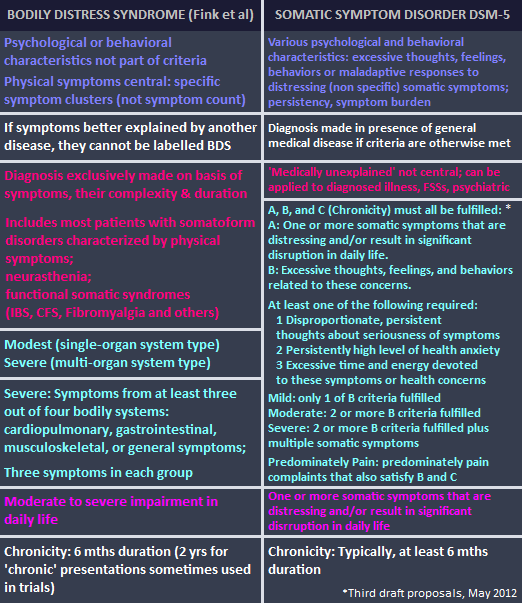
The graphic below compares mutli-organ Bodily Distress Syndrome with Somatic Symptom Disorder, as the DSM-5 draft criteria had stood, in May 2012.

Note the defining characteristics of the DSM-5 SSD construct: the SSD definition calls for positive psychobehavioural characteristics (excessive or maladaptive responses or associated health concerns) in response to persistent distressing somatic symptoms; the requirement that the symptoms are “medically unexplained” is not central to the diagnosis and the symptoms may or may not be associated with a well-recognised medical condition.

The SSD diagnosis can be made in the presence of one or more unspecified, somatic symptoms associated with general medical conditions and diagnosed disease, like multiple sclerosis, cancer, diabetes or angina, or in the so-called “functional somatic syndromes” (for example, IBS, CFS or fibromyalgia) or in complaints with unclear etiology.

Compare Fink et al’s BDS with DSM-5’s SSD, in the table, below:

Depending on screen size/resolution, graphic may not display in full. Click on the image and the image file will load. Graphic: Suzy Chapman

Bodily Distress Syndrome comparison with Somtatic Symptom Disorder

Continued on Page 2