Important changes to DSM-5 Development website: Draft proposals and criteria removed

Important changes to DSM-5 Development website: Draft proposals and criteria removed

Post #208 Shortlink: http://wp.me/pKrrB-2wk

Update: November 16: Webpages on the DSM-5 Development site that were no longer accessible, yesterday, via the home page or a Proposals tab menu but were still accessible via their URLs have today been placed behind a log  in.

Following closure of the third and final DSM-5 stakeholder review, revisions made by the 13 Work Groups and Task Force to proposals and criteria for DSM-5 subsequent to June 15 are subject to embargo.

You can read the DSM-5 Permissions Policy here  (Updated: 5/30/2012).

The DSM-5 Development site Terms and Conditions of Use can be read here (Effective Date: June 21, 20120).

The Terms and Conditions of Use page has not been updated to reflect very recent changes to the website.

+++

Removal of proposals for DSM-5 categories and criteria

I have a webpage change detection service set up for the home page and selected pages of the DSM-5 Development site.

Today, November 15, I was notified that the DSM-5 Development home page text has been recently edited.

The home page text has been revised and the 20 links towards the foot of the home page text to Proposed Revisions have been removed, as has the drop-down tab menu for Proposed Revisions, Rationales, Severity Specifiers for the 20 DSM-5 category sections.

The revised home text can be read here.

The home page text as it had stood prior to recent editing can be reviewed (for a while) on this Google cache page.

[…Google’s cache of http://www.dsm5.org/ . It is a snapshot of the page as it appeared on 4 Nov 2012 21:50:47 GMT…]

The DSM manual and its clinical and research criteria sets are a major cash cow for the publishing arm of the APA.

APA is protecting its intellectual property rights by removing draft criteria as they had stood at June 15, 2012 and in placing an embargo on interim revisions to the texts, prior to publication of the final categories, criteria sets and associated textual content, next year.

Consequently, draft proposals, criteria, rationales, severity specifiers and for some categories, PDF files expanding on proposals and rationales, as they had stood at the time of the third draft, are no longer available for review or for comparison with earlier iterations of the draft directly from links on the site’s home page text or from links in a Proposals tab drop-down menu along the top of the home page.

According to the DSM-5 Development home page and recent commentary from Task Force Chair, David J Kupfer, MD, DSM-5 remains on target for release in May 2013.

No recent projections for the date by which an online version of the DSM-5 is expected to be available, post publication of the print edition, have come to my attention but it is anticipated that access to any online version of the manual would be available via subscription – not as a freely accessible public domain version, as ICD-10-CM and ICD-11 will be when they are published and implemented.

DSM-5 Round up: November #1

DSM-5 Round up: November #1

Post #207 Shortlink: http://wp.me/pKrrB-2vW

Huffington Post Blog

David J. Kupfer, MD | Chair, DSM-5 Task Force | November 7, 2012

Field Trial Results Guide DSM Recommendations

Written with Helena C. Kraemer, Ph.D.

Two years ago this month, APA announced the start of field trials that would subject proposed diagnostic criteria for the future DSM-5 to rigorous, empirically sound evaluation across diverse clinical settings. And now, as the first comprehensive analyses of that effort are published, what’s clear is just how well the field trials did their job…

Full commentary

1 Boring Old Man

OMG!…

1 Boring Old Man | November 9, 2012

Side Effects

From quirky to serious, trends in psychology and psychiatry

by Christopher Lane, Ph.D.

The DSM-5 Field Trials’ Decidedly Mixed Results

Far from being a ringing endorsement, the field trials set off fresh alarm bells

Christopher Lane, Ph.D. | November 11, 2012

“What’s the chance that a second, equally expert diagnosis will agree with the first, making a particular diagnosis reliable?” asks David Kupfer, chair of the DSM-5 task force, of the decidedly mixed results of the DSM-5 field trials. First off, are you sure you really want to know?…

Full commentary

http://www.psychologytoday.com/blog/dsm5-in-distress/201211/you-cant-turn-sows-ear-silk-purse

also here on Psychiatric Times (registration required):

http://www.psychiatrictimes.com/blog/frances/content/article/10168/2113993

You Can’t Turn a Sow’s Ear Into a Silk Purse

By Allen Frances, MD | November 11, 2012

In his recent Huffington Post piece titled Field Trial Results Guide DSM Recommendations,1 DSM-5 Task Force Chair Dr David Kupfer says, “What’s clear is just how well the field trials did their job.” This surprisingly optimistic claim has inspired these telling rejoinders from Mickey Nardo, MD, and Barney Carroll, MD, 2 of the best informed critics of DSM-5.

Dr Nardo first: “The absence of biological tests in psychiatry is unique in medicine and sentences the classification of mental disorders to endless controversy. In the 1970s, Dr Robert Spitzer proposed we use inter-rater reliability as a stand in for objective tests. His statistician colleagues developed a simple measure (called ‘kappa’) to indicate the level of diagnostic agreement corrected for chance. In 1974, Spitzer reported on 5 studies that clearly exposed the unreliability of DSM-II, the official diagnostic system at the time.

“To correct this problem and obtain the diagnostic agreement necessary for research studies, Spitzer then set about constructing sets of diagnostic criteria meant to tap overt signs and symptoms, rather than the more inferential mechanisms that informed DSM-II. He also developed structured clinical interviews that provided a uniform method of assessment. These approaches worked well to improve the poor kappas obtained using the free form approach of DSM-II.

“In 1980, Spitzer took the next big step of introducing the criterion based method of diagnosis into DSM-III. What had originated as a research tool now informed all clinical practice. It was an important milestone for psychiatry when DSM-III field testing showed that the system achieved good kappas. The new manual was an instant success throughout the mental health professions and brought a measure of objectivity to a field previously dominated by warring subjective opinions. Later, in 1994, DSM-IV was also able to demonstrate good kappas in its much more extensive field testing.

“The DSM-5 Task Force originally planned two sets of field trials, the second of which was meant to provide quality control to correct whatever weaknesses would be exposed in the first. But along the way, the field testing got far behind its schedule and the quality control step was quietly cancelled. No explanation was ever offered, but it seemed likely that DSM-5 was being rushed to press so that APA could reap publishing profits.

“Dr David Kupfer now wants us to believe that the recently published results of the DSM-5 field testing somehow serve to justify the inclusion in DSM 5 of extremely controversial and much feared changes. This is a terribly misleading claim. Independent of all the other criticisms of DSM-5 (and there are plenty), the poor results of the field trials must have been a major disappointment to the Task Force. Dr Kupfer is now making a desperate attempt to salvage the failed project by putting an unrealistically positive spin on its results.

“Our forty-year experience in reliability testing for DSM-II, the RDC, DSM-III, and DSM-IV makes clear what are acceptable and what are unacceptable kappa levels. There is no way of avoiding or cloaking the stark and troubling fact that the DSM-5 field trials produced remarkably low kappas—harking back to the bad old days of DSM-II.

[see http://1boringoldman.com/index.php/2012/10/31/humility-2/ ].

“Equally disturbing, three of the eight diagnoses tested at multiple centers had widely divergent kappa values at the different sites—hardly a vote for their reliability. Even worse, two major diagnostic categories [Major Depressive Disorder and Generalized Anxiety Disorder] performed terribly, in a range that is clearly unacceptable by anybody’s standard.

[see http://1boringoldman.com/index.php/2012/10/31/but-this-is-ridiculous/ ].

“Dr Kupfer has been forced to drastically lower our expectations in an effort to somehow justify the remarkably poor and scattered DSM-5 kappa results. There is, in fact, only one possible explanation for the results—the DSM-5 field trials were poorly designed and incompetently administered. Scientific integrity requires owning up to the defects of the study, rather than asking us to deviate from historical standards of what is considered acceptable reliability. It is not cricket to lower the target kappas after the study results fail to meet reasonable expectations.

“Diagnostic agreement is the bedrock of our system—a non-negotiable bottom line. The simple truth is that by historical standards, the DSM-5 field trials did not pass muster. Dr Kupfer can’t expect to turn this sow’s ear into a silk purse.”

Dr Carroll adds this: “The purpose of DSM-5 is to have criteria that can be used reliably across the country and around the world. The puzzling variability of results across the sites in the DSM-5 field trials is a major problem. Let’s take just one of many examples—for Bipolar I Disorder, the Mayo Clinic came in with a very good kappa value of 0.73 whereas the San Antonio site came in with a really lousy kappa of 0.27. You can’t just gloss over this gaping discrepancy by reporting a mean value. The inconsistencies across sites have nothing to do with the criteria tested—they are instead prima facie evidence of unacceptably poor execution of the study protocol. The inconsistent results prove that something clearly wasn’t right in how the study was done.

“The appropriate response is to go back to the drawing board by completing the originally planned quality control second stage of testing—rather than barreling ahead to premature publication and pretending that everything is just fine when it is not. The DSM-5 leaders have lowered the goal posts and are claiming a bogus sophistication for their field trials design as an excuse for its sloppy implementation. But a low kappa is a low kappa no matter how you try to disguise it. Dr Kupfer is putting lipstick on the pig.

“Many people experience a glazing of the eyes when the term kappa appears, but it’s really a simple idea. The kappa value tells us how far we have moved from completely random agreement (a kappa of 0) to completely perfect agreement (a kappa of 1.0). The low end of kappas that DSM-5 wants us to find acceptable are barely better than blind raters throwing random darts. If there is this much slop in the system when tested at academic centers, imagine how bad things will become in the real world of busy and less specialized clinical practice.

“Something isn’t right . . . and when something isn’t right in a matter as serious as psychiatric diagnosis the professional duty is to fix it. Having shirked this responsibility, APA deserves to fail in the business enterprise that it has made of DSM-5. If ever there was a clear conflict of interest, this is it.”

Thanks are due to Drs Nardo and Carroll. There can be no doubt that the DSM-5 Field Trials were a colossal waste of money, time, and effort. First off, they didn’t ask the most obvious and important question—What are the risks that DSM-5 will create millions of misidentified new ‘patients’ who would then be subjected to unnecessary treatment? Second, the results on the question it did ask (about diagnostic reliability) are so all over the map that they are completely uninterpretable. And to top it off, DSM-5 cancelled the quality control stage that might have cleaned up the mess.

It is almost certain that DSM-5 will be a dangerous contributor to our already existing problems of diagnostic inflation and inappropriate prescription of psychotropic drugs. The DSM-5 leadership is trying to put a brave face on its badly failed first stage of field testing and has offered no excuse or explanation for canceling its second and most crucial quality control stage. This field testing fiasco erases whatever was left of the credibility of DSM-5 and APA.

Reference

1. Kupfer DJ. Field trial results guide DSM recommendations. Huffington Post. November 7, 2012. http://www.huffingtonpost.com/david-j-kupfer-md/dsm-5_b_2083092.html . Accessed November 13, 2012.

Nature News Blog

DSM field trials inflame debate over psychiatric testing

05 Nov 2012 | 15:00 GMT | Posted by Heidi Ledford | Category: Health and medicine

As the latest revision of a key psychiatric tome nears completion, field trials of its diagnoses have prompted key changes to controversial diagnoses and sparked questions as to how such trials should be conducted…

Read on

Aging Well – News & Insight for Professionals in Geriatric Medicine

Dementia and DSM-5:

Changes, Cost, and Confusion

James Siberski, MS, CMC

Aging Well, Vol. 5 No. 6 P. 12

DSM-5 changes will require providers to learn the differences between major and minor neurocognitive disorders and to explain the differences and their significance to patients and their families.

The Diagnostic and Statistical Manual of Mental Disorders (DSM), published by the American Psychiatric Association and used for diagnosis by mental health professionals in the United States, describes symptoms for all mental disorders. Its primary components are the diagnostic classifications, diagnostic criteria sets, and descriptive texts. DSM-I was initially approved in 1951 and published the following year. Since then it has been revised several times and resulted in DSM-II in 1968, DSM-III in 1980, DSM-III-R in 1987, DSM-IV in 1994, and the current version, DSM-IV-TR, in 2000. Historically, it has been both praised and criticized…

Full article

Health Care Renewal

DOES AMERICAN PSYCHIATRY MATTER?

Bernard Carroll, MD | November 03, 2012

…What lies ahead? Stakeholders are going to vote with their feet. DSM-5 is likely to be a footnote in the history of psychiatric classification. The APA will become even less relevant than it is today, much like the American Medical Association, which now commands the loyalty of maybe 30% of U.S. physicians….

Full commentary

APA finally posts DSM-5 Field Trials online and DSM-5 Round up

APA finally posts DSM-5 Field Trials online and DSM-5 Round up

Post #206 Shortlink: http://wp.me/pKrrB-2vu

Three papers discussing the results of the DSM-5 field trials were posted online yesterday by the American Journal of Psychiatry. The papers describe the methods and results of the 23 diagnoses assessed during the field trials.

APA failed to publish field trial results during the life of the third and final public review and comment period.

Access to the abstracts is free but you will need subscriber or institution access for the full PDFs or cough up $$ for the papers. ($35 per paper for 24 hours’ access. Why have these reports not been published on the DSM-5 Development website? Many classes of stakeholder will be disenfranchised.)

The article states that criteria were tested in October 2010 through February 2012 by 279 clinicians at 11 U.S. and Canadian academic centers. A second set of data from small group practices and private practices is expected to be reported early next year (that is, after the finalized draft has gone to the publishers).

Proposed criteria are still under review and won’t be finalized until approved by APA Board of Trustees.

DSM-5 draft proposals for criteria and categories as issued for the third and final stakeholder review can be read here on the DSM-5 Development website.

Note that the draft is now frozen and criteria sets and manual texts subject to embargo until publication of the DSM-5 manual. Any revisions made by the Task Force and Work Groups since the third iteration was released in May, this year, won’t be reflected on the DSM-5 Development website.

Published yesterday in the American Journal of Psychiatry and at Psychiatry Online:

Tuesday, October 30, 2012

Full text of article:

DSM-5 Field Trials Posted Online by AJP

http://alert.psychiatricnews.org/2012/10/dsm-5-field-trials-posted-online-by-ajp.html

+++
Article 1 | October 30, 2012

Abstract: http://psychiatryonline.org/article.aspx?articleid=1387935

DSM-5 Field Trials in the United States and Canada, Part I: Study Design, Sampling Strategy, Implementation, and Analytic Approaches

Diana E. Clarke, Ph.D., M.Sc.; William E. Narrow, M.D., M.P.H.; Darrel A. Regier, M.D., M.P.H.; S. Janet Kuramoto, Ph.D., M.H.S.; David J. Kupfer, M.D.; Emily A. Kuhl, Ph.D.; Lisa Greiner, M.S.S.A.; Helena C. Kraemer, Ph.D.

Am J Psychiatry 2012;:. 10.1176/appi.ajp.2012.12070998

PDF for those with subscriber access: http://ajp.psychiatryonline.org/data/Journals/AJP/0/appi.ajp.2012.12070998.pdf

+++
Article 2 | October 30, 2012

Abstract: http://psychiatryonline.org/article.aspx?articleid=1387906

DSM-5 Field Trials in the United States and Canada, Part II: Test-Retest Reliability of Selected Categorical Diagnoses

Darrel A. Regier, M.D., M.P.H.; William E. Narrow, M.D., M.P.H.; Diana E. Clarke, Ph.D., M.Sc.; Helena C. Kraemer, Ph.D.; S. Janet Kuramoto, Ph.D., M.H.S.; Emily A. Kuhl, Ph.D.; David J. Kupfer, M.D.

Am J Psychiatry 2012;:. 10.1176/appi.ajp.2012.12070999

PDF for those with subscriber access:
http://ajp.psychiatryonline.org/data/Journals/AJP/0/appi.ajp.2012.12070999.pdf

+++
Article 3 | October 30, 2012

Abstract: http://psychiatryonline.org/article.aspx?articleid=1387907

DSM-5 Field Trials in the United States and Canada, Part III: Development and Reliability Testing of a Cross-Cutting Symptom Assessment for DSM-5

William E. Narrow, M.D., M.P.H.; Diana E. Clarke, Ph.D., M.Sc.; S. Janet Kuramoto, Ph.D., M.H.S.; Helena C. Kraemer, Ph.D.; David J. Kupfer, M.D.; Lisa Greiner, M.S.S.A.; Darrel A. Regier, M.D., M.P.H.

Am J Psychiatry 2012;:. 10.1176/appi.ajp.2012.12071000

PDF for those with subscriber access:
http://ajp.psychiatryonline.org/data/Journals/AJP/0/appi.ajp.2012.12071000.pdf

Commentaries:

DSM5 in Distress
The DSM’s impact on mental health practice and research.

by Allen Frances, M.D.

DSM 5 Field Trials Discredits APA

You can’t turn a sow’s ear into a silk purse.

…According to the authors, 14 of the 23 disorders had “very good” or “good” reliability; 6 had questionable, but ‘acceptable’ levels; and just three had “unacceptable” rates. Sounds okay until you look at the actual data and discover that the cheerful words used by the DSM 5 leaders simply don’t fit their extremely disappointing results. The paper is a classic example of Orwellian ‘newspeak’…

Allen Frances, M.D. | August 30, 2012

Read full article here

Also on Huffington Post

+++

1 Boring Old Man

finally…

1 Boring Old Man | October 30, 2012

Well, they finally published the results of the DSM-5 Field Trials. Here are the links to the abstracts and the main table of kappa values to look over…


DSM-5 Round up

Public Lecture St Mary’s College of Maryland

http://www.smcm.edu/calendar/events/index.php?com=detail&eID=2317

DSM-V: Social, Political, and Ethical Implications

November 2

3:00 PM – 5:00 PM

Cole Cinema, Campus Center

This presentation will describe the DSM-V, scheduled for publication in May 2013, and the controversy surrounding its development. Dr. Ancis will provide an overview of the newly proposed classification system and diagnoses.

It is imperative that those involved in using the DSM-V, or potentially impacted by the DSM, be duly informed. Questions associated with the DSM-V revision process; the empirical bases of proposed changes; social, legal, and political implications; and ethical and cultural considerations will be addressed.

Dr. Ancis will describe her involvement in a number of initiatives related to DSM-V proposals, including those of the Association of Women in Psychology and Counselors for Social Justice. She will also review concerns of major mental health organizations worldwide, such as the American Psychological Association, the American Counseling Association, and the British Psychological Society, and related divisions.

Dr. Ancis is currently a Professor of Counseling and Psychological Services at Georgia State University. She earned her Bachelors, Masters, and Ph.D from the University at Albany, State University of New York. Her major areas of interest are multicultural competency training, diversity attitudes, race and gender issues, education and career development, and legal system experiences.

Event Contact Info

Janet Kosarych-Coy

Email: jmkosarychcoy@smcm.edu

Phone: 2408954283

Website: Click to Visit

Location: Cole Cinema, Campus Center

18952 E. Fisher Rd

St. Mary’s City, MD 20686

Categories:


Psychology Today

Side Effects

From quirky to serious, trends in psychology and psychiatry

The Tranquilizer Trap The scandal over benzodiazepines gets different emphasis in the UK and U.S.

Published on October 3, 2012 by Christopher Lane, Ph.D. in Side Effects

Anti-DSM Sentiment Rises in France Why French psychiatrists and psychoanalysts are opposed to the diagnostic manual  (French Stop DSM-5 Campaign)

Published on September 28, 2012 by Christopher Lane, Ph.D. in Side Effects

New York Times

Report Sees Less Impact in New Autism Definition

By BENEDICT CAREY | Published: October 2, 2012

Proposed changes to the official diagnosis of autism will not reduce the proportion of children found to have it as steeply as many have feared, scientists reported on Tuesday, in an analysis that contradicts several previous studies…

Medscape

Medscape Medical News > Psychiatry

Controversial New Diagnosis in DSM-5 May Be Faulty

Pam Harrison | October 17, 2012

Attenuated psychosis syndrome (APS), a new and controversial diagnosis for potential inclusion in the upcoming Diagnostic and Statistical Manual of Mental Disorders, Fifth Edition (DSM-5), is questionable, new research suggests…

DSM-5 and Employment Law

In September, Douglas Hass (Franczet Radelet) published an article Could the American Psychiatric Association Cause You Headaches? The Dangerous Interaction between the DSM-5 and Employment Law:

Abstract:

http://papers.ssrn.com/sol3/papers.cfm?abstract_id=2153268

Since its first publication in 1952, the American Psychiatric Association’s Diagnostic and Statistical Manual (DSM) has long served not only as the primary reference for mental health disorders for medical practitioners, but also as a primary authority for the legal community…

Full text in PDF format: Hass

Research Article

http://onlinelibrary.wiley.com/doi/10.1002/da.22012/abstract

Research Article

The Effect of Draft DSM-V Criteria on Posttraumatic Stress Disorder Prevalence

Patrick S. Calhoun Ph.D.1,2,3,*,
Jeffrey S. Hertzberg B.A.3,
Angela C. Kirby M.S.3,
Michelle F. Dennis B.A.2,
Lauren P. Hair M.S.3,
Eric A. Dedert Ph.D.1,2,3,
Jean C. Beckham Ph.D.1,2,3
Article first published online: 26 OCT 2012

DOI: 10.1002/da.22012

© 2012 Wiley Periodicals, Inc.

Journal of Psychosomatic Research

November 2012 Issue, Journal of Psychosomatic Research

http://www.jpsychores.com/current

Issue: Vol 73 | No. 5 | November 2012 | Pages 325-400

http://www.jpsychores.com/article/S0022-3999(12)00225-5/abstract

Predictive validity and clinical utility of DSM-5 Somatic Symptom Disorder – Comparison with DSM-IV somatoform disorders and additional criteria for consideration

Katharina Voigt
Affiliations
Department of Psychosomatic Medicine and Psychotherapy, University Medical Center Hamburg-Eppendorf and Schön Klinik Hamburg-Eilbek, Hamburg, Germany

Corresponding author at: Department of Psychosomatic Medicine and Psychotherapy, University Medical Center Hamburg-Eppendorf, Martinistr. 52, 20246 Hamburg, Germany. Tel.: +49 40 7410 54408; fax: +49 40 7410 54975.

Eileen Wollburg
Affiliations
Schön Klinik Bad Bramstedt, Bad Bramstedt, Germany

Nina Weinmann
Affiliations
Schön Klinik Bad Bramstedt, Bad Bramstedt, Germany

Annabel Herzog
Affiliations
Department of Psychosomatic Medicine and Psychotherapy, University Medical Center Hamburg-Eppendorf and Schön Klinik Hamburg-Eilbek, Hamburg, Germany

Björn Meyer
Affiliations
GAIA AG, Hamburg, Germany

Gernot Langs
Affiliations
Schön Klinik Bad Bramstedt, Bad Bramstedt, Germany

Bernd Löwe
Affiliations
Department of Psychosomatic Medicine and Psychotherapy, University Medical Center Hamburg-Eppendorf and Schön Klinik Hamburg-Eilbek, Hamburg, Germany

Received 3 July 2012; received in revised form 29 August 2012; accepted 30 August 2012; published online 24 September 2012.

Abstract

Objective
Major changes to the diagnostic category of somatoform disorders are being proposed for DSM-5. The effect of e.g. the inclusion of psychological criteria (criterion B) on prevalence, predictive validity, and clinical utility of “Somatic Symptom Disorder” (SSD) remains unclear. A prospective study was conducted to compare current and new diagnostic approaches.

Methods
In a sample of N=456 psychosomatic inpatients (61% female, mean age=44.8±10.4years) diagnosed with somatoform, depressive and anxiety disorders, we investigated the current DSM-5 proposal (SSD) plus potential psychological criteria, somatic symptom severity, and health-related quality of life at admission and discharge.

Results
N=259 patients were diagnosed with DSM-IV somatoform disorder (56.8%). With a threshold of 6 on the Whiteley Index to assess psychological criteria, the diagnosis of SSD was similarly frequent (51.8%, N=230). However, SSD was a more frequent diagnosis when we employed the recommended threshold of one subcriterion of criterion B. Patients diagnosed with only SSD but not with DSM-IV somatoform disorder showed greater psychological impairment. Both diagnoses similarly predicted physical functioning at discharge. Bodily weakness and somatic and psychological attributions at admission were among significant predictors of physical functioning at discharge. Reduction of health anxiety, bodily weakness, and body scanning significantly predicted an improvement of physical functioning.

Conclusions
Psychological symptoms enhance predictive validity and clinical utility of DSM-5 Somatic Symptom Disorder compared to DSM-IV somatoform disorders. The SSD diagnosis identifies more psychologically impaired patients than its DSM-IV precursor. The currently suggested diagnostic threshold for criterion B might increase the disorder’s prevalence.

Keywords: Somatoform disorder, Diagnosis, Diagnostic and Statistical Manual of Mental Disorders, Classification of diseases, Validation studies as topic

Ed: Note: Between publication of the second iteration of the DSM-5 draft proposals for public review and publication of the third set of draft proposals, the SSD “B type criteria” were reduced from the requirement to meet at least two from the “B type” criteria to at least one [1].

1] http://www.dsm5.org/ProposedRevision/Pages/proposedrevision.aspx?rid=368

Somatic Symptom Disorder Criteria

Summary: September 19 ICD-9-CM Coordination and Maintenance Committee Meeting

Summary: September 19 ICD-9-CM Coordination and Maintenance Committee Meeting

Post #205 Shortlink: http://wp.me/pKrrB-2vc  

The September meeting of the ICD-9-CM Coordination and Maintenance Committee, jointly chaired by CMS and CDC, took place on September 19, 2012.

For further information on this public process see the CDC website page:

http://www.cdc.gov/nchs/icd/icd9cm_maintenance.htm

+++

Meeting Summary document

The meeting Summary document has now been published.  The audio is not yet available.

The Summary document can be downloaded here:

September 19, 2012

Summary (10 pages) [PDF – 59 KB]

http://www.cdc.gov/nchs/data/icd9/2012_September_Summary.pdf

or opened in PDF format here:     Summary September 19 2012

+++

The Proposals and Agenda document can be downloaded here:

http://www.cdc.gov/nchs/icd/icd9cm_maintenance.htm#meeting_materials

ICD-9-CM Coordination and Maintenance Committee Meeting

September 19, 2012

Proposals (74 pages) [PDF – 730 KB]

http://www.cdc.gov/nchs/data/icd9/Topic_packet_for_September_19_2012.pdf

or opened in PDF format here:     Topic packet for September 19 2012

According to the Summary document, the deadline for receipt of public comments on proposals submitted at this meeting is November 16, 2012. If there is any change to this date, I will update.

Comments on proposals presented at the ICD-9-CM Coordination and Maintenance Committee meeting should be sent to the following email address: nchsicd9CM@cdc.gov. See Page One of the Summary document for important information on submission of public comment.

Extract, Summary document

Chronic fatigue syndrome

Andreas Kogelnik, MD, representing the Coalition 4 ME/CFS, was available via telephone to address questions and clinical concerns.

Lori Chapo-Kroger, representing the Coalition 4 ME/CFS, expressed that many nations, and the World Health Organization, put CFS at G93 in ICD-10, and that this would include everyone but the U.S.

Mary Dimmock, representing the Coalition 4 ME/CFS, questioned why the change must wait until after 2014 when they feel that this is an error in the classification right now (and has been since 2001).

Dr. Kogelnik indicated that the term myalgic encephalomyelitis is used in Europe while the U.S. continues to use the term chronic fatigue syndrome, and that the Coalition 4 ME/CFS considers these two conditions (CFS and ME) to be the same. That is why they want both terms included in the same code.

Nelly Leon-Chisen, AHA, noted support for a need for a code for chronic fatigue syndrome distinct from chronic fatigue, unspecified. She indicated also that with the cause being unknown it is better that the classification not be locked into placing CFS as a viral code. Also, if there is no consensus for ME and CFS being the same then it makes sense to keep them as two separate codes. If research later develops that says they are the same then the data can be aggregated together. However, if the research does not show this, then you don’t have them lumped into one code that does not allow you to separate out one from the other.

Sue Bowman, AHIMA, questioned counting all CFS as following a virus infection. She expressed a need for clinical consensus on this condition. Also, she stated that she did not see a rationale for an early change (before 2014).

+++

Note: Dx Revision Watch has no connection with the Coalition 4 ME/CFS or with the development of any proposals submitted by this organization. The views and opinions expressed in Coalition 4 ME/CFS submissions to ICD-9-CM  Coordination and Maintenance Committee meetings represent the views of the Coalition 4 ME/CFS and its representatives and not the views of Dx Revision Watch.

All enquiries about proposals submitted to CMS/CDC on behalf of the Coalition 4 ME/CFS should be addressed directly to the Coalition 4 ME/CFS.

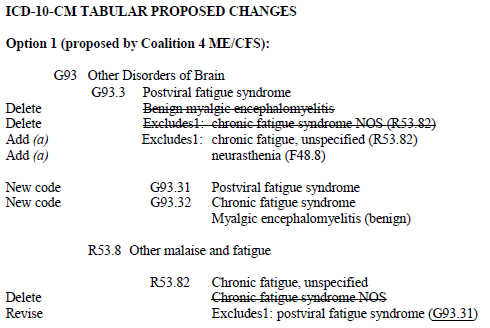
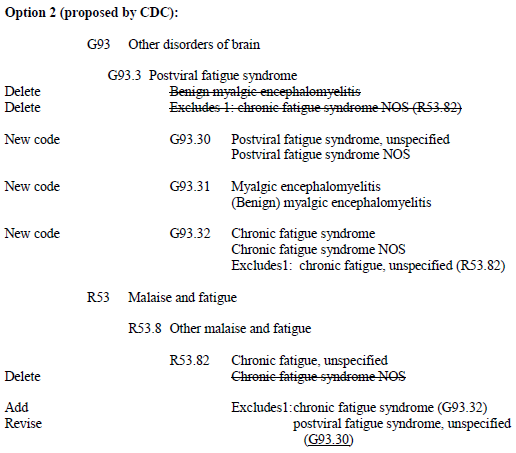
Note also that the proposal from the Coalition 4 ME/CFS (Option 1) and the alternative proposal presented by CMS/CDC (Option 2) at the September meeting are set out in accordance with the requirements of the ICD-9-CM Coordination and Maintenance Committee for the submission of proposals. 

For Options 1 and Option 2 see post Proposals: September 19 ICD-9-CM Coordination and Maintenance Committee Meeting or Proposals document Topic packet for September 19 2012

+++

Related posts:

Proposals: September 19 ICD-9-CM Coordination and Maintenance Committee Meeting

Coding CFS in ICD-10-CM: CFSAC and the Coalition4ME/CFS initiative

Extracts: ICD-9-CM Coordination and Maintenance Committee Meeting Summary document (CFS coding)

Extracts: ICD-9-CM Coordination and Maintenance Committee Meeting September 14, 2011 (Coding of CFS in ICD-10-CM)

Proposals: September 19 ICD-9-CM Coordination and Maintenance Committee Meeting

Proposals: September 19 ICD-9-CM Coordination and Maintenance Committee Meeting

Post #204 Shortlink: http://wp.me/pKrrB-2uL

The next meeting of the ICD-9-CM Coordination and Maintenance Committee, which is jointly chaired by CMS and CDC, takes place on September 19, 2012. 

There is a very full agenda for this meeting. The meeting materials Proposals document has now been published.

For further information on this public process see the CDC website page:

http://www.cdc.gov/nchs/icd/icd9cm_maintenance.htm

+++

The Proposals and Agenda document can be downloaded here:

http://www.cdc.gov/nchs/icd/icd9cm_maintenance.htm#meeting_materials

ICD-9-CM Coordination and Maintenance Committee Meeting

September 19, 2012

Proposals (74 pgs) [PDF – 730 KB]

http://www.cdc.gov/nchs/data/icd9/Topic_packet_for_September_19_2012.pdf

or opened in PDF format here:      Topic packet for September 19 2012

Note: I have no connection with the Coalition 4 ME/CFS or with the development of any proposals submitted by this organization. All enquiries about the proposal submitted to CMS/CDC on behalf of the Coalition 4 ME/CFS should be addressed directly to the Coalition 4 ME/CFS.

Note also that the proposal from the Coalition 4 ME/CFS and the alternative proposal from CMS/CDC are set out in accordance with the requirements of the ICD-9-CM C & M Committee for the submission of proposals.

+++

Coding of CFS in the forthcoming US specific ICD-10-CM

At the ICD-9-CM Coordination and Maintenance Committee’s September 14, 2011 meeting, a presentation had been made on behalf of the Coalition 4 ME/CFS in relation to the formal submission of a proposal.

The proposal requested that consideration be given to moving the classification of Chronic fatigue syndrome from its current proposed location within the ICD-10-CM R code chapter (Chapter 18: Symptoms and signs) to the G code chapter (Chapter 6: Diseases of the nervous system).

This would bring the chapter location of Chronic fatigue syndrome in ICD-10-CM in line with the international version of ICD-10, the Canadian ICD-10-CA and proposals for the forthcoming ICD-11.

No NCHS decision reached in response to the September 2011 proposals and the public comments received in respect of these proposals was conveyed following closure of the public comment period, last November.

However, further discussion of Chronic fatigue syndrome and two additional proposals are tabled on the agenda for discussion at the September 19, meeting, tomorrow.

I am appending the relevant extract from the Diagnosis Agenda and Proposals document which was published on the CDC  website overnight. An official audio and a Summary of the meeting should be available in due course on the CDC website. I will update with these when available.

+++

Extract Topic packet for September 19 2012 (Page 46)

[…]

Chronic fatigue syndrome

Andreas Kogelnik, M.D., Coalition 4 ME/CFS

Chronic fatigue syndrome

A proposal, submitted by the Coalition 4 ME/CFS, to modify codes for chronic fatigue syndrome (CFS) was presented and discussed at the September 2011 ICD Coordination and Maintenance Committee meeting. The National Center for Health Statistics also presented an alternative proposal, Option 2. There were many comments from the audience, and there was general support for the NCHS-proposed Option 2, moving CFS from Chapter 18, Symptoms, signs and abnormal clinical findings, not elsewhere classified, to Chapter 6, Diseases of the Nervous System but retaining separate codes for CFS and myalgic encephalomyelitis (ME). The rationale for retaining separate codes included agreement on the importance of being able to extract data on the two conditions separately or combine, as needed. It was also noted that term ME is not seen in medical record documentation. Written comments received on this issue were inconclusive. There was not agreement that the two conditions are the same. While some comments were from private citizens, others were from advocacy organizations and associations that represent health care providers and other large constituencies that use the classification. The public comment period following the meeting is not meant as a poll or survey. Analysis of public comment focused on the substance of the comments; whether there was a clear scientific consensus regarding the etiology and manifestations of the condition; and an understanding of the classification, its structure and conventions, and its uses by the health care industry.

As noted in the information from the September 2011 presentation, the cause or causes of CFS remain unknown, despite a vigorous search. While a single cause for CFS may yet be identified, another possibility is that CFS represents a spectrum of illnesses resulting from multiple possible pathways. Conditions that have been proposed to trigger the development of CFS include infections, trauma, immune dysfunction, stress, and exposure to toxins. Research in this area is ongoing.

There are several case definitions currently in use, some separating CFS from ME, and others merging the two conditions. The most widely used are the 1994 case definition (http://www.cdc.gov/cfs/case-definition/index.html ), the Canadian and the Oxford definitions. A new case definition for ME was published in the 2011 international consensus criteria that emphasized recent research and clinical experience that strongly point to widespread inflammation and multisystem symptoms and neuropathology. This new definition, which considers ME and CFS as synonymous terms, however, has not been widely vetted by the health care community at large. While there is no consensus on one case definition, there is consensus that this is a serious and complex syndrome, and it is likely that there are multiple subgroups. It has been noted that some providers use the terms interchangeably while others consider one condition a subgroup of the other. There is also some overlap with fibromyalgia and CFS/ME could be considered one of the multiple chronic overlapping pain conditions.

References

1. Fukuda et al. Ann Intern Med (1994) 121:953-959
(http://www.cdc.gov/cfs/case-definition/1994.html )
2. Holmes et al. Ann Intern Med (1988) 108:387-389.
3. Sharpe et al. J Roy Soc Med (1991) 84:118-121
4. Carruthers et al. J CFS (2003) 11:7-97
5. Carruthers et al.. J Intern Med (2011) 270: 327-38.

The Coalition 4 ME/CFS has stated that they do not support Option 2 proposed in September 2011 and have submitted a revised proposal. A revised Option 2 is also being proposed, consistent with comments received supporting Option 2 as noted above. The Coalition is also requesting that their proposal be considered for implementation prior to October 1, 2014 even though the condition is not a new disease and therefore does not meet the criteria for implementation during the partial freeze.

Based on the above, the following proposals for consideration are:

+++

+++
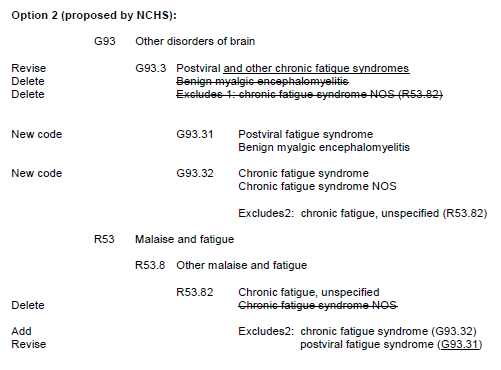
For comparison, the proposal that had been presented by CDC at the September 2011 meeting in counterpoint to an earlier proposal presented by the Coalition 4 ME/CFS at that same meeting was this:


Instead of Title term G93.3 Postviral and other chronic fatigue syndromes (CDC Option 2, September 2011)

CDC suggests retaining the Title term G93.3 Postviral fatigue syndrome (CDC Option 2, September 2012).

+++
Instead of Child category G93.31 Postviral fatigue syndrome, Benign myalgic encephalomyelitis

CDC is now suggesting two categories for Postviral fatigue syndrome, thus:

G93.30 Postviral fatigue syndrome, unspecified, Postviral fatigue syndrome NOS (not otherwise specified)

with a discrete Child category G93.31 Myalgic encephalomyelitis, Benign myalgic encephalomyelitis.

+++
No suggested change to the September 2011 CDC Option 2 suggestion for Child categories:

G93.32 Chronic fatigue syndrome, Chronic fatigue syndrome NOS.

The+++

Related posts:

Coding CFS in ICD-10-CM: CFSAC and the Coalition4ME/CFS initiative

Extracts: ICD-9-CM Coordination and Maintenance Committee Meeting Summary document (CFS coding)

Extracts: ICD-9-CM Coordination and Maintenance Committee Meeting September 14, 2011 (Coding of CFS in ICD-10-CM)

Response to Recommendations from November 2011 CFSAC meeting

Response to Recommendations from November 2011 CFSAC meeting

Post #203 Shortlink: http://wp.me/pKrrB-2ur

The response from the Assistant Secretary for Health to Recommendations from the November 2011 CFSAC meeting is now available on the CFSAC website at: http://1.usa.gov/OghDXF

http://www.hhs.gov/advcomcfs/asst-sect-letter2012.pdf

or open here  asst-sect-letter2012

Text:

DEPARTMENT OF HEALTH & HUMAN SERVICES Office of the Secretary

Office of the Assistant Secretary for Health Washington, D.C. 20201
AUG -3 2012
Gailen Marshall Jr., MD, PhD

Chair, Chronic Fatigue Syndrome Advisory Committee
Professor and Chair Professor of Medicine and Pediatrics
The University of Mississippi Medical Center 2300
North State Street, N416 Jackson, MS 39216-4505

Dear Dr. Marshall:

I have received the recommendations developed by the Chronic Fatigue Syndrome Advisory Committee (CFSAC) during its November 8-9, 2011, meeting. The advice and counsel provided by CFSAC serves as a valuable resource in the Department of Health and Human Services’ (HHS) efforts to properly address the issues and concerns pertaining to chronic fatigue syndrome.

Since the meeting the Department has carefully considered your recommendations. Dr. Nancy Lee, the Designated Federal Officer for CFSAC, has worked collaboratively with the ex officio representatives to the committee to provide responses to the recommendations developed at the meeting. The enclosed document contains information about activities currently undertaken by HHS to work with public health experts and members of the chronic fatigue syndrome community to increase knowledge and provide a better understanding of this debilitating health condition.

I have shared the committee’s recommendations with Secretary Kathleen Sebelius.

The Department is committed to addressing this condition. I commend you and your committee members for the important work you do.

Sincerely yours,
/s/Howard K. Koh
Howard K. Koh, M.D., M.P.H. Assistant Secretary for Health

Enclosure

cc: Dr. Christopher R. Snell
U.S. Public Health Service

RESPONSES TO RECOMMENDATIONS FROM THE CHRONIC FATIGUE SYNDROME ADVISORY COMMITTEE (CFSAC)

REF: November 8-9, 2011 CFSAC Meeting

Recommendation 1: This recommendation addresses the process by which CFSAC transmits recommendations to the Secretary and the Secretary communicates back to CFSAC whether or not a recommendation was acted upon. CFSAC recommends that this process be transparent and clearly articulated to include regular feedback on the status of the Committee’s recommendations. This communication could originate directly from the Office of the Secretary or be transmitted via the relevant agency or agencies.

Procedures are in place to ensure that recommendations made by federal advisory committees are properly handled. The CFSAC charter stipulates that the Committee provides advice and recommendations to the Secretary, through the Assistant Secretary for Health (ASH). Initially, the CFSAC recommendations are sent to the ASH for review. After reviewing the recommendations, the ASH forwards them to appropriate officials within the Office of the Secretary and the Operating and/or Staff Divisions that may be impacted by the Committee’s recommendations. A letter is sent to acknowledge receipt of the recommendations. A response may be prepared to accompany the letter which describes any actions that the Department may take in response to the recommendations made by the Committee. All pertinent information about the recommendations is provided to the designated Federal officer (DFO). The DFO then provides the information to the Chair and the Committee.

Recommendation 2: CFSAC recommends to the Secretary that the NIH or other appropriate agency issue a Request for Application (RFA) for clinical trials research on chronic fatigue syndrome/myalgic encephalomyelitis (ME/CFS).

The National Institutes of Health (NIH) funds research on myalgic encephalomyelitis/chronic fatigue syndrome (ME/CFS); investigators are encouraged to submit proposals for ME/CFS research, including clinical trials, through two funding announcements that are currently open for submission of applications. The next deadline for receipt of applications is October 24, 2012. In fiscal year 2011, NIH funded two applications for clinical trials on ME/CFS. NIH has received few applications proposing ME/CFS research, and even fewer applications proposing ME/CFS clinical trials. It is unclear whether the paucity of ME/CFS clinical trial applications reflects the current status of the field or an acknowledgement that clinical trials are difficult to design for a complex and multi-faceted illness. Clinical trials are challenging to design and conduct for all diseases, with basic requirements of a well-defined patient population, valid measurement instruments, appropriate safeguards for subjects, and generalizability of the clinical trial outcomes to the larger affected patient population. NIH is taking action to stimulate ME/CFS research across NIH through the regular monthly meetings of the Trans-NIH ME/CFS Working Group (WG). The WG discusses the current status of ongoing research on ME/CFS and proposes methods to increase the number and quality of research applications submitted to NIH ranging from preclinical research to clinical trials. In addition, the WG is focusing on the recommendations from the April 2011 State of the Knowledge Workshop on ME/CFS to develop priorities. The outcome from these planning sessions will suggest a range of activities and research.

Recommendation 3: CFSAC would like to encourage and support the creation of the DHHS Interagency Working Group on Chronic Fatigue Syndrome and ask this group to work together to pool resources that would put into place the “Centers of Excellence” concept that has been recommended repeatedly by this advisory committee. Specifically, CFSAC encourages utilizing HHS agency programs and demonstration projects, available through the various agencies, to develop and coordinate an effort supporting innovative platforms that facilitate evaluation and treatment, research, and public and provider education. These could take the form of appropriately staffed physical locations, or be virtual networks comprising groups of qualified individuals who interact through a variety of electronic media. Outreach and availability to underserved populations, including people who do not have access to expert care, should be a priority in this effort.

HHS leadership has identified the need for a Department-wide plan to address ME/CFS. The Department established the HHS Ad Hoc Workgroup on ME/CFS to develop a plan and to identify opportunities for interagency collaboration. The HHS ME/CFS plan will highlight recently initiated programs and future agency-specific and cross-agency activities. In developing the report, the Ad Hoc Workgroup will consider recommendations made by CFSAC. After completion, the ME/CFS plan will be posted on the CFSAC website. The DFO, Nancy C. Lee, M.D. is responsible for providing leadership and coordination for development of the HHS ME/CFS report.

Recommendation 4: This multi-part recommendation pertains to classification of CFS in ICD classification systems:

a) CFSAC considers CFS to be a multi-system disease and rejects any proposal to classify ME/CFS as a psychiatric condition in the U.S. disease classification systems.

b) CFSAC rejects the current classification of ME/CFS in Chapter 18 of ICD-9-CM under R53.82, chronic fatigue unspecified, chronic fatigue syndrome, not otherwise specified.

c) CFSAC continues to recommend that ME/CFS should be classified in ICD-IO-CM in Chapter 6 under Diseases of the Nervous System at G93.3 in line with ICD-IO, the World Health Organization, and ICD-I-CA [sic], the Canadian Clinical Modification and in accordance with CFSAC’s recommendations of August 2005 and May 2011. CFSAC rejects CDC’s National Center for Health Statistics (NCHS) Option 2 and recommends that ME/CFS remain in the same code and the same subcode as myalgic encephalomyelitis because CFS includes both viral and non-viral triggers.

d) CFSAC recommends that an “excludes one”* be added to G93.3 for chronic fatigue, R53.82, and neurasthenia, F48.8. CFSAC recommends that these changes be made in ICD-10-CM prior to its rollout in 2013.**

[*Ed: Should read “Excludes 1”. For definitions for “Excludes1″ and “Excludes2″ see Post #118]

[**Ed: On August 3, HHS announced Final Rule to delay compliance date for ICD-10-CM/PCS to October 1, 2014.]

Development and implementation of the guidelines for the lCD-10 fall within HHS under the purview of the Centers for Disease Control and Prevention (CDC) and the Centers for Medicare and Medicaid Services. Use of the revised codes will provide robust and specific data that will improve patient care and enable the international comparability of health care data. On February 16, 2012, the Department issued a press release announcing that HHS would initiate a process to postpone the date that certain health care entities must comply with the ICD-10.

A proposal to change the classification of ME/CFS in ICD-10-CM was presented at the September 2011 Coordination and Maintenance (C & M) Committee/CDC/NCHS; a subsequent proposal was received on January 12, 2012 and will be presented at the September 19, 2012 C & M meeting for additional discussion.

+++
Related posts

Notice of Meeting of the ICD-9-CM Coordination and Maintenance Committee

Coding CFS in ICD-10-CM: CFSAC and the Coalition4ME/CFS initiative

Extracts: ICD-9-CM Coordination and Maintenance Committee Meeting Summary document (CFS coding)

Extracts: ICD-9-CM Coordination and Maintenance Committee Meeting September 14, 2011 (Coding of CFS in ICD-10-CM)