A proposal for the ICD-10 G93.3 legacy terms for ICD-11: Part One

Post #329 Shortlink: http://wp.me/pKrrB-4dV

Our Proposal and Rationale is set out in Part Two:

A proposal for the ICD-10 G93.3 legacy terms for ICD-11: Part Two

A version of ICD-11 in 2018

It’s been a long time coming and it ain’t finished yet…

The World Health Organization (WHO) has been revising ICD-10 since 2007.

After several shifts in the timeline, WHO plans to present a version of the next edition (ICD-11 MMS) at the World Health Assembly (WHA), in May 2018.

WHO won’t be seeking endorsement of the ICD-11 product in May 2018 because it won’t be ready to implement. Endorsement will be sought at some point in the future. In the meantime, a version of ICD-11 is scheduled for release later in 2018, after the May assembly. The release date has yet to be announced.

https://hscic.kahootz.com/connect.ti/t_c_home/view?objectId=297939

“…The World Health Organization (WHO) is currently developing the 11th revision of ICD. Once endorsed by the World Health Assembly (WHA), WHO Nomenclature regulations stipulate that Member States must use the most current revision for mortality and morbidity purposes. For this reason and to allow member countries to adopt the new revision when they are ready, WHO will brief the WHA on ICD-11 in May 2018 but will not seek endorsement at this time.”

Member states will transition from ICD-10 to the new edition at their own pace. It’s going to be several years before countries have evaluated the ICD-11 product for utility and prepared their health systems to make the transition.

At some point, data using codes from the new edition will be accepted alongside data compiled using ICD-10. WHO will continue to support ICD-10 until the majority of member states have adopted and implemented the new edition.

It will take even longer for countries like the U.S. and Canada, who use a country specific adaptation of ICD, to implement as they will need to modify the new edition to suit their countries’ health systems. The earliest Canada can implement is currently projected as 2023 [1]. The U.S.’s CDC estimate it will take at least 6 years after the codes have been ratified to prepare, field test and implement an ICD-11-CM/PCS.


Proposal deadlines

Some important deadlines for proposals for the ICD-11 Beta draft:

The deadline in order for proposals to be considered for a frozen version in March/April 2017 was 30 December 2016.

In order for proposals to be considered for inclusion in the version of ICD-11 that is scheduled for release in 2018, they needed to be submitted by March 30, 2017. So those two deadlines have been reached.

Comments by member states and improvements arising as a part of the Quality Assurance mechanism will be included with deadlines later in 2017.

According to Slide #12 in this November 2016 WHO presentation, the deadline for member state comments is May 31, 2017; the deadline for Field Testing and Quality Assurance is June 30, 2017 [2]. But these dates are unconfirmed and may have been revised since November, last year.

Proposals received after the end of May will be considered in the context of ICD-11 maintenance after 2018, when the new version will be subject to an annual update and maintenance schedule [3]. The first annual update is anticipated in 2019.

The Joint Task Force is considering naming each year’s iteration in the format: ICD 2018; ICD 2019; ICD 2020 and so on. There may never be a need for an ICD-12, since an electronic system is better able to evolve “gracefully” – as Dr Christopher Chute (Joint Task Force; Chair, Revision Steering Group) puts it – in response to advances in scientific knowledge and classificatory changes.


Deadlines for submitting comments

I have asked Dr Jakob and the Joint Task Force to clarify by what date comments on proposals that met the March 30 deadline will need to be submitted by in order to be considered in the context of the earliest release of ICD-11, in 2018.

No clarification has been forthcoming; so if you are a stakeholder considering submitting a comment on existing proposals in the Beta draft or on outstanding proposals queued in the “Proposals Mechanism” which are still going through the review process, then I would advise that you put this in hand over the next couple of weeks. If any deadline is announced, I will update at the top of this report.


Frozen release

On April 4, ICD Revision is scheduled to release a frozen version of ICD-11 MMS for field testing*. If there are any changes in this April 2017 Frozen Release that are relevant to stakeholders in the G93.3 terms, I will post an update at the top of this report.

*ICD-11 Field Trials, Information and Terms of Engagement, March 17, 2017 https://hscic.kahootz.com/gf2.ti/af/762498/122441/PDF/-/ICD11_FT_Information_and_ToE.pdf


Current status of the ICD-10 G93.3 legacy categories

The ICD-10 G93.3 legacy categories: Postviral fatigue syndrome; Benign myalgic encephalomyelitis and Chronic fatigue syndrome were taken out of the public version of the Beta draft in early 2013, with no explanation for their absence.

ICD Revision has maintained a cephalopodic grip on its intentions for these terms.

Advocates and patient organization stakeholders have been attempting to obtain transparency from ICD Revision around the Topic Advisory Group for Neurology’s proposals for these terms for over four years. During this period, stakeholders have been disenfranchised from participation in the revision process.


Questions raised in the English Parliament

15 international stakeholder organizations wrote to the ICD-11 MMS Joint Task Force, in February, in support of my call that the Joint Task Force place the matter of the continued absence of proposals for these terms on the Agenda of their February 20–22 meeting, in Cologne.

There were asked to expedite the release of proposals for public scrutiny and comment before the March 30 deadline.

This initiative was met with a disturbing level of obfuscation on the part of WHO and the Joint Task Force, especially given that ICD Revision has been promoted as an open, transparent process, inclusive of stakeholder participation.

The Countess of Mar, a long standing advocate for patients with ME and CFS, tabled two Written Questions in the House of Lords. The first is here (February 27), which received a response that raised more questions than it answered and a follow up question, here (March 16), which received an equally opaque reply.

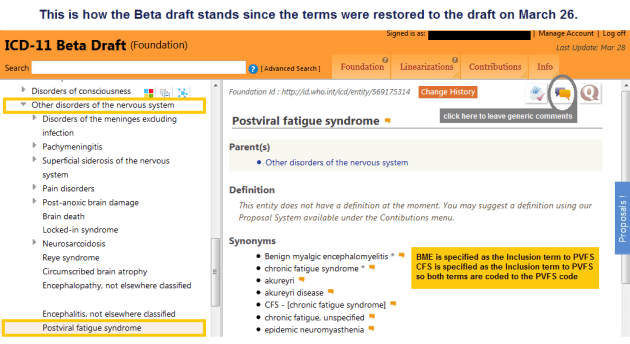
But on March 26, the three terms were finally restored to the Beta draft – but with this caveat:

“While the optimal place in the classification is still being identified, the entity has been put back to its original place in ICD.”

Team WHO 2017-Mar-26 – 12:46 UTC

This suggests that we should view the restoration of the terms as a “placeholder” and that the work group may release revised proposals later this year.


What do we know?

WHO has confirmed that there is no intention to classify the ICD-10 G93.3 legacy terms under the Mental or behavioural disorders chapter or under the Symptoms, signs chapter.

“Team WHO” has also approved some long standing proposals for exclusions for two of these terms under Fatigue (but not yet approved an exclusion for Postviral fatigue syndrome and I have asked “Team WHO” for the rationale for this apparent anomaly, since one would anticipate that if the inclusion terms are excluded under Fatigue, the ICD concept title entity would also be excluded). Possibly, TAG Neurology has other plans for the classification of PVFS in ICD-11.

So, nearly 10 years into the revision process, it’s still unclear what the work group might be considering for these terms, when they will reach consensus, or whether alternative proposals might be released on April 4, when a frozen version of ICD-11 is scheduled for release for field testing.


How do the terms currently stand in ICD-10?

This is how the G93.3 legacy terms were represented in ICD-10:

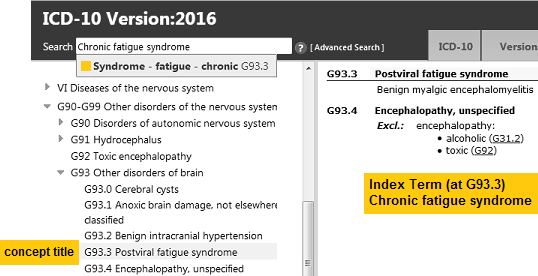
For ICD-10, Postviral fatigue syndrome (PVFS) is the lead (or concept title) term. Benign myalgic encephalomyelitis is the inclusion term under PVFS and takes the G93.3 code. Chronic fatigue syndrome is listed only in the Index, and coded to G93.3.


How do the terms stand in ICD-11 Beta draft, now they have been restored?

Since March 26, 2017, for ICD-11 Beta draft, all three terms are currently back under the Neurology chapter, under parent: Other disorders of the nervous system. PVFS is the lead (or concept title) term. BME and CFS are both specified as inclusion terms to PVFS, in the ICD-11 equivalent of the Tabular List. The terms listed under synonyms and all other “Content Model” descriptive content appear much as the Beta had stood in 2009.

But given the caveat, it is still unknown what the work group might be considering for these terms or whether or when they might release further proposals.

Note that the recommendations of the various external work groups are advisory only. WHO classification experts and the Joint Task Joint can, and sometimes do, overrule work group decisions.

If the Topic Advisory Group for Neurology, that has responsibility for these terms, were to reach consensus and release an alternative set of proposals before 2018, these will not necessarily obtain the approval of WHO/Joint Task Joint.


Suzy Chapman and Mary Dimmock have submitted a proposal

To address this situation, U.S. advocate, Mary Dimmock, and I have collaborated on the preparation of a formal and fully referenced proposal which we submitted on March 27. Our proposal (in the PDF below) recommends that these terms should be retained in the neurological chapter, using separate codes for ME and CFS, and also makes other recommendations.

PDF: Suzy Chapman, Mary Dimmock Proposal for ICD-11


Our Proposal and Rationale is set out in Part Two:

A proposal for the ICD-10 G93.3 legacy terms for ICD-11: Part Two

For a good overview of ICD-11’s structure and functionality by NHS Digital click here

References:

1 International Statistical Classification of Diseases and Related Health Problems, 11th Revision, Canada, Canadian Institute for Health Information (CIHI). https://www.cihi.ca/en/submit-data-and-view-standards/codes-and-classifications/icd-11

2 Presentation, Dr Robert Jakob, WHO/ICD Revision, November 2016. https://t.co/VvtZXVHZoF

3 ICD Revision Quarterly Newsletter, ICD-11 Update: January 2017. http://www.who.int/entity/classifications/ICD11January2017Newsletter.pdf

Save

ICD-11 Beta draft: Rationale for Proposal for Deletion of proposed new category: Bodily distress disorder

Post #328 Shortlink: http://wp.me/pKrrB-4dc

View on ICD-11 Proposal Mechanism: https://tinyurl.com/submissionDeleteBDD

(Registration with the Beta draft required in order to view proposals via the Beta draft Proposal Mechanism.)

PDF: ICD-11 Bodily distress disorder submission

Proposal submitted by Suzy Chapman (Dx Revision Watch) via ICD-11 Beta draft Proposal Mechanism

Submitted: March 1, 2017 (Remains unprocessed)

The author has no affiliations or conflicts of interest to declare.

Rationale for Proposal for Deletion of the Entity: Bodily distress disorder

1: The acronym “BDD” is already in use to indicate Body Dysmorphic Disorder [1].

2: With limited field studies, there is currently no substantial body of evidence for the validity, reliability, utility, prevalence, safety and acceptability of the S3DWG’s proposed disorder construct. However, the focus of this rationale is the proposed nomenclature.

The Somatic Distress and Dissociative Disorders Working Group (S3DWG) proposes to name its construct, “bodily distress disorder (BDD)” – a term that is already used by researchers and in the field interchangeably with the disorder term, “bodily distress syndrome (BDS).”

“Bodily distress syndrome” is a conceptually divergent disorder construct: differently defined and characterized, with different criteria that are already operationalized in Denmark and beyond, in research and clinical settings, and which potentially include a different patient set to that described in the S3DWG’s proposal [2].

As defined for the ICD-11 core version, the S3DWG’s “bodily distress disorder” construct has stronger conceptual and characterization alignment with DSM-5 “somatic symptom disorder (SSD)” than with Fink et al. (2010) “bodily distress syndrome” [3][4].

It is noted that “Somatic symptom disorder” is listed under Synonyms for the BDD entry in the ICD-11 Beta draft.

The defining feature of both the S3DWG’s “bodily distress disorder” and DSM-5 “somatic symptom disorder” is the removal of the distinction between “medically explained” and “medically unexplained” somatic complaints. Rather than define the disorder on the basis of the absence of a known medical cause, instead, specific psychological features are required in order to fulfill the criteria.

The S3DWG’s BDD is characterized by “the presence of bodily symptoms that are distressing to the individual and excessive attention directed toward the symptoms which may be manifest by repeated contact with health care providers.”

“Excessive attention is not alleviated by appropriate clinical examination and investigations and appropriate reassurance.”

“If a medical condition is causing or contributing to the symptoms, the degree of attention is clearly excessive in relation to its nature and progression.”

“Bodily symptoms and associated distress are persistent, being present on most days for at least several months and are associated with significant impairment in personal, family, social, educational, occupational or other important areas of functioning.”

The S3DWG’s “bodily distress disorder” may involve a single unspecified somatic symptom or multiple unspecified symptoms that may vary over time, in association with the disorder’s other defining features.

For DSM-5 “somatic symptom disorder,” the centrality of medically unexplained symptoms in order to meet the criteria is similarly de-emphasized and replaced by psychological responses to distressing, persistent symptoms: “excessive thoughts, behaviours and feelings” or “excessive preoccupation” with the bodily symptom or associated health concerns [5].

As with BDD, for SSD, the symptoms may or may not be associated with another medical condition. Some patients with general medical diagnoses, such as cancer, cardiovascular disease or diabetes, or patients diagnosed with the so-called “functional somatic syndromes” may qualify for a diagnosis of SSD if they are perceived as experiencing disproportionate and excessive thoughts and feelings or using maladaptive coping strategies in response to their illness, despite the reassurance of their clinicians [6].

As with the S3DWG’s defining of BDD, for SSD, there is no requirement for a specific number of complaints from among specified symptom groups to meet the criteria: so no symptoms counts or symptom clusters from body systems required for either.

To meet the SSD criteria: at least one symptom of at least six months duration and at least one of three psychological criteria are required: disproportionate thoughts about the seriousness of the symptom(s); or a high level of health anxiety; or devoting excessive time and energy to symptoms or health concerns; and for the symptoms to be significantly distressing or disruptive to daily life.

Though they differ somewhat in the characterization of their severity specifiers, the S3DWG’s defining of BDD and DSM-5 SSD may be considered essentially similar in conceptualization: no distinction between “medically explained” and “medically unexplained”; a much simplified criteria set to those defining the somatoform disorders, based on “excessive” or “disproportionate” psychological responses to persistent distressing symptoms, and with significant impairment or disruption to functioning.

Whereas, for the Fink et al. (2010) “bodily distress syndrome (BDS),” psychological or behavioural characteristics are not part of the criteria: symptom patterns or clusters from organ/body systems (cardiopulmonary; gastrointestinal; musculoskeletal or general symptoms) are central [2]. The diagnosis is exclusively made on the basis of the somatic symptoms, their complexity and duration, with moderate to severe impairment of daily life. There is a “Moderate: single organ” type and a “Severe: multi-organ” type.

The Fink et al. (2010) BDS construct is considered by its authors to have the ability to capture the somatoform disorders, neurasthenia, “functional symptoms” and the so-called “functional somatic syndromes” under a single, unifying disorder construct which subsumes CFS, ME, fibromyalgia and IBS (which are discretely classified within other chapters of ICD-10), noncardiac chest pain, chronic pain disorder, MCS and some others [7][8][9].

(The various so-called specialty “functional somatic syndromes” are considered by the authors to be an artifact of medical specialization and manifestations of a similar, underlying disorder with a common, hypothesized aetiology.)

Contrast this with the S3DWG’s BDD construct, which makes no assumptions about aetiology and does not exclude symptoms associated with general medical conditions; whereas, for Fink et al. BDS, “If the symptoms are better explained by another disease, they cannot be labelled BDS.”

That DSM-5 SSD and Fink et al. (2010) BDS are differently conceptualized, with different criteria sets, potentially capturing different patient populations has been acknowledged by SSD work group chair, Joel E Dimsdale, and by Fink, Henningsen and Creed [10][11]. In the literature, however, one observes frequent instances where the term “bodily distress disorder” has been used when what is actually being discussed within the paper or editorial is the Fink et al. (2010) “bodily distress syndrome (BDS)” disorder construct.

For example, “bodily distress disorder” is used interchangeably with “bodily distress syndrome” in the editorial (Creed et al. 2010): Is there a better term than “medically unexplained symptoms”? [1].

In this (Rief and Isaac 2014) editorial: The future of somatoform disorders: somatic symptom disorder, bodily distress disorder or functional syndromes? the authors are using the term, “bodily distress disorder” while clearly discussing the Fink et al. (2010) BDS construct [12].

The S3DWG’s proposed term is seen, here, as “Bodily distress disorder (Fink and Schroder 2010)” in Slide #3 of the symposium presentation: An introduction to “medically unexplained” persistent physical symptoms. (Professor Trudie Chalder, Department of Psychological Medicine, King’s Health Partners, 2014) [13].

This recent paper: Medium- and long-term prognostic validity of competing classification proposals for the former somatoform disorders (Schumacher et al. 2017) compares prognostic validity of DSM-5 “somatic symptom disorder (SSD)” with “bodily distress disorder (BDD)” and “polysymptomatic distress disorder (PSDD)” and discusses their potential as alternatives to SSD for the replacement of the somatoform disorders for the forthcoming ICD-11 [14].

The authors state, “the current draft of the WHO group is based on the BDD proposal.” But the authors have confirmed that for their study, they had operationalized “Bodily distress disorder based on Fink et al. 2007” [15].

In the (Fink et al. 2007) paper: Symptoms and syndromes of bodily distress: an exploratory study of 978 internal medical, neurological, and primary care patients, the authors conclude: “We identified a general, distinct, bodily distress syndrome or disorder that seems to encompass the various functional syndromes advanced by different medical specialties as well as somatization disorder and related diagnoses of the psychiatric classification.”

There are other examples in the literature and in the field. But these suffice to demonstrate that the term, “bodily distress disorder” is already used synonymously with disorder term “bodily distress syndrome (BDS)” and that researchers/clinicians, including Fink et al., do not differentiate between the two.

If researchers/clinicians do not differentiate between “bodily distress syndrome” and “bodily distress disorder” (and in some cases, one observes the conflations, “bodily distress syndrome or disorder” and “bodily distress syndrome/disorder”), has the S3DWG considered the difficulties and implications for maintaining the discrete identity of its proposed disorder, once ICD-11 is in the hands of its end users – clinicians, allied health professionals and coders; or considered the implications for patients and the particular vulnerability of those diagnosed with one of the so-called, “functional somatic syndromes”; or the implications for data reporting and analysis?

The S3DWG presented its emerging proposals for subsuming most of the ICD-10 somatoform disorder categories between F45.0 – F45.9, and F48.0 Neurasthenia, under a new single category which it proposes to call “bodily distress disorder (BDD)” in 2012 [3] and again in 2016 [4].

Thus far, the S3DWG has published no rationale for its recommendation to repurpose a disorder term already strongly associated with the Fink et al. (2010) disorder construct.

Neither has the group discussed nor acknowledged within its papers the implications for confusion and conflation between its own SSD- like “BDD” construct and the Fink et al. “bodily distress syndrome (BDS).”

Nor has the group’s output discussed the potential difficulties and implications for maintaining construct integrity within and beyond ICD-11.

There is no justification for introducing a new disorder category into ICD-11 that has greater conceptual alignment with the DSM-5 SSD construct but is proposed to be assigned a disorder name that is closely associated with a divergent (and operationalized) construct/criteria set, that is already in use in research and clinical settings.

This is unsafe and unsound classificatory practice.

This proposed disorder name should be rejected by the Project Lead for the revision of the Mental or behavioural disorders chapter and by the Joint Task Force that is overseeing the finalization of ICD-11 MMS.

If the S3DWG is unprepared or unwilling to reconsider and recommend an alternative disorder name then I submit that the current proposal to replace the somatoform disorders with a single “bodily distress disorder” category should be abandoned.

ICD-11 should proceed with the ICD-10 status quo, or retire or deprecate the somatoform disorder categories for the next edition.

It is perhaps germane that in 2010, three years prior to the finalization of DSM-5, Creed et al. had advanced: “Somatic symptom disorder is not a term that is likely to be embraced enthusiastically by doctors or patients; it has an uncertain core concept, dubious wide acceptability across cultures and does not promote multidisciplinary treatment. In our discussion, the terms which fit most closely the criteria we have set out above were the following: bodily distress (or stress) syndrome/ disorder, psychosomatic or psychophysical disorder, functional (somatic) syndrome or disorder.” [1]

The authors conclude that “bodily distress disorder” best fitted their “Criteria to judge the value of alternative terms for ‘medically unexplained symptoms.'”

It would appear that the term “bodily distress disorder” can mean anything anyone chooses it to mean – which might be admissible for Humpty Dumpty but unsound classificatory practice for ICD-11 [16].

References:

1 Creed F, Guthrie E, Fink P, Henningsen P, Rief W, Sharpe M, White P. Is there a better term than “medically unexplained symptoms”? J Psychosom Res. 2010 Jan;68(1):5-8. doi:10.1016/j.jpsychores.2009.09.004. [PMID: 20004295]

2 Fink P, Schröder A. One single diagnosis, bodily distress syndrome, succeeded to capture 10 diagnostic categories of functional somatic syndromes and somatoform disorders. J Psychosom Res. 2010 May;68(5):415-26. [PMID: 20403500]

3 Creed F, Gureje O. Emerging themes in the revision of the classification of somatoform disorders. Int Rev Psychiatry. 2012 Dec;24(6):556-67. doi: 10.3109/09540261.2012.741063. [PMID: 23244611]

4 Gureje O, Reed GM. Bodily distress disorder in ICD-11: problems and prospects. World Psychiatry. 2016 Oct;15(3):291-292. doi: 10.1002/wps.20353. [PMID: 27717252]

5 American Psychiatric Association. (2013). Somatic Symptom and Related Disorders. In Diagnostic and statistical manual of mental disorders (5th ed.). Washington, DC: Author.

6 Frances A, Chapman S. DSM-5 somatic symptom disorder mislabels medical illness as mental disorder. Aust N Z J Psychiatry. 2013 May;47(5):483-4. [PMID: 23653063]

7 Lam TP, Goldberg DP, Dowell AC, Fortes S, Mbatia JK, Minhas FA, Klinkman MS. Proposed new diagnoses of anxious depression and bodily stress syndrome in ICD-11-PHC: an international focus group study. Fam Pract. 2013 Feb;30(1):76-87. doi: 10.1093/fampra/cms037. Epub 2012 Jul 28. [PMID: 22843638]

8 Ivbijaro G, Goldberg D. Bodily distress syndrome (BDS): the evolution from medically unexplained symptoms (MUS). Ment Health Fam Med. 2013 Jun;10(2):63-4. [PMID: 24427171]

9 Goldberg DP, Reed GM, Robles R, Bobes J, Iglesias C, Fortes S, de Jesus Mari J, Lam TP, Minhas F, Razzaque B et al. Multiple somatic symptoms in primary care: A field study for ICD-11 PHC, WHO’s revised classification of mental disorders in primary care settings. J Psychosom Res. 2016 Dec;91:48-54. doi:10.1016/j.jpsychores.2016.10.002. Epub 2016 Oct 4. [PMID: 27894462]

10 Medically Unexplained Symptoms, Somatisation and Bodily Distress: Developing Better Clinical Services, Francis Creed, Peter Henningsen, Per Fink (Eds), Cambridge University Press, 2011.

11 Frances Creed and Per Fink. Presentations, Research Clinic for Functional Disorders Symposium, Aarhus University Hospital, May 15, 2014.

12 Rief W, Isaac M. The future of somatoform disorders: somatic symptom disorder, bodily distress disorder or functional syndromes? Curr Opin Psychiatry September 2014 – Volume 27 – Issue 5 – p315–319. [PMID: 25023885]

13 Chalder, T. An introduction to “medically unexplained” persistent physical symptoms. Presentation, Department of Psychological Medicine, King’s Health Partners, 2014. [Accessed 27 February 2017]

14 Schumacher S, Rief W, Klaus K, Brähler E, Mewes R. Medium- and long-term prognostic validity of competing classification proposals for the former somatoform disorders. Psychol Med. 2017 Feb 9:1-14. doi: 10.1017/S0033291717000149. [PMID: 28179046]

15 Fink P, Toft T, Hansen MS, Ornbol E, Olesen F. Symptoms and syndromes of bodily distress: an exploratory study of 978 internal medical, neurological, and primary care patients. Psychosom Med. 2007 Jan;69(1):30-9. [PMID: 17244846]

16 Carroll L. Alice’s Adventures in Wonderland. 1885. Macmillan.

Update to Letter to key Revision personnel re Continued absence of the ICD-10 G93.3 terms from the ICD-11 Beta drafting platform

Post #324 Shortlink: http://wp.me/pKrrB-46A

Update at February 23, 2016: Since no proposals and rationales for the ICD-10 G93.3 legacy terms were released in September or December 2015, I contacted ICD’s Dr Robert Jakob, again. Dr Jakob told me on February 2, 2016 that “[ICD-11 Revsion is] still working on the extensive review and the conclusions.”

This report is an update to Post #322:

Continued absence of the ICD-10 G93.3 terms from the ICD-11 Beta drafting platform: Letter to key Revision personnel

Eight years into the revision process and stakeholders still don’t know how ICD Revision proposes to classify the ICD-10 G93.3 legacy terms for ICD-11.

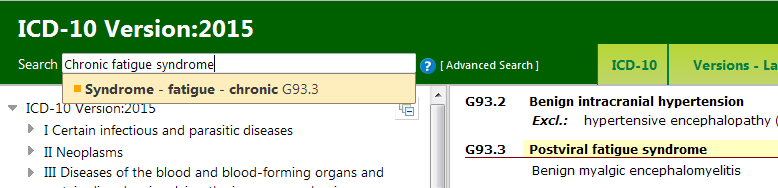
In ICD-10, the (G93.3) Title term is Postviral fatigue syndrome; Benign myalgic encephalomyelitis is the Inclusion term under G93.3; Chronic fatigue syndrome is included in the Index only, and indexed to the G93.3 code [1].

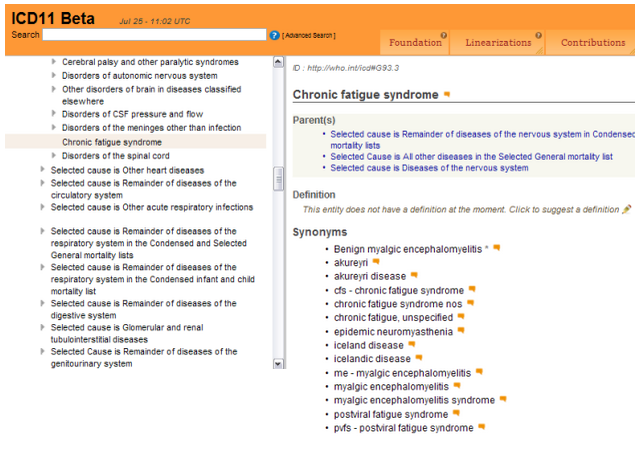
By 2012, the public version of the ICD-11 Beta draft had the three terms listed as in the screenshot, below – still under the Diseases of the nervous system chapter, but with a change of relationship between the three terms.

At that point, Chronic fatigue syndrome was being proposed as a new ICD Title term; Benign myalgic encephalomyelitis* was specified as the Inclusion term (indicated in the draft by hover text over the asterisk which is not displaying in this screenshot).

Postviral fatigue syndrome, previously designated as Title code in ICD-10, was now located under Synonyms, in a list of alternative and historical terms imported from other terminology systems and health informatics sources, including two terms specific to Chapter 18: Symptoms, signs etc. of the U.S. ICD-10-CM clinical modification [4].

Beta12

Source: ICD-11 Beta drafting platform, public version, July 25, 2012.


In early 2013, ICD Revision removed the entry for Chronic fatigue syndrome and its associated terms from the public version of the Beta draft; from that point on, none of the terms were accessible in any Linearization.

(In the version of the Beta that the public sees, there are no holding pens viewable for categories “Needing a decision to be made” and no tab for “Category Notes and Decisions” which might indicate the rationale for the temporary or permanent absence of a category from the draft.)

Although a Change History function was incorporated into the public Beta in March, no Change History is available for these terms. The Topic Advisory Group (TAG) for Neurology has published no progress reports on emerging proposals for scrutiny and discussion.

So for over 2 years, now, stakeholders have been unable to monitor evolving proposals for the classification of these G93.3 legacy entities within ICD-11. The continued absence of these terms hinders submission of comments and suggestions on proposed chapter location(s), parent classes, hierarchies, inclusions, exclusions, definitions or other Content Model descriptive text.


Request for release of information on current status of proposals

On June 8, I sent a letter to Bedirhan Üstün (WHO/ICD Revision Coordinator), Cc’d to key ICD Revision personnel and the recently assembled ICD Revision Project Management Team, requesting an update on the status of proposals for these terms and their restoration to the draft [5]. Read letter here

On Friday, June 19, Anneke Schmider (WHO Technical Officer, ICD Revision Project Manager) facilitated a conference call with myself and Dr Robert Jakob (WHO ICD classifications, ICD Revision Steering Group) in which Dr Jakob responded to my letter, having obtained a progress report from TAG Neurology.

NB: It was not the purpose of this discussion to advance my own views on how these terms should be represented within ICD-11 but to elicit clarifications on the current status of proposals.


Summary of main points from our discussion:

TAG Neurology retains responsibility for these three terms.

None of the sub-working groups that sit under TAG Neurology has specific responsibility for these terms.

TAG Neurology is still reviewing the literature and has yet to reach consensus about where to classify these terms within ICD-11.

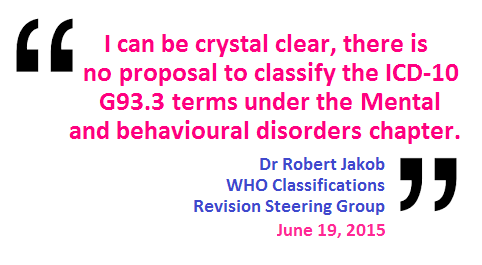
Dr Jakob says he can be “crystal clear” that there is no proposal to classify the ICD-10 G93.3 legacy terms under the Mental and behavioural disorders chapter.

JakobJune155

The ICD-11 principle of multiple parenting was discussed in general terms: multiple parenting allows the same disease to be expressed in two (or more) places in the ICD-11 linearizations. A disease or disorder category will be located under a primary parent class within one chapter but may also be searchable under a secondary (or tertiary) parent within another chapter, whilst retaining the code assigned in the primary location. (See ICD-11 Multiple parenting Slides 42-48)

Because TAG Neurology is still working towards consensus, Dr Jakob would not be drawn on the following:

whether relocating one or more of these terms from the Diseases of the nervous system to an alternative chapter(s) was under consideration;

whether retaining one or more of these terms within the Diseases of the nervous system chapter but secondary parenting under an alternative chapter(s) was under consideration;

what existing parent classes were being considered for locating these terms under;

whether the creation of any new parent classes was being considered for these terms;

whether any changes in the relationship between the three terms, as they had stood in the Beta draft in early 2013, have already been agreed or remain under consideration (ie any changes to which of the terms are identified as ICD Title terms, which are specified as Inclusion terms and which are listed as Synonyms).

which of the terms are proposed to be assigned a Definition and other Content Model descriptive text and where definition(s) would be sourced from.

It remains unclarified, therefore, whether ICD-11 intends to define CFS discretely from BME. Also unclarified: whether exclusions for these terms are proposed to be inserted under categories such as Bodily distress disorder; Fatigue [previously Malaise and fatigue in ICD-10]; and a proposed new Diseases of the nervous system parent term, Functional clinical forms of the nervous system (a proposal that TAG Mental Health opposes).

I have already submitted requests via the Proposal Mechanism that PVFS, BME and CFS are inserted under Exclusions to Bodily distress disorder, and Fatigue.


With regard to a date by which we might anticipate proposals being released:

The Beta draft was frozen on May 31, 2015. The Beta Comment facility is open and stakeholders can register to comment on the draft or submit formal proposals for changes and enhancements to proposals via the Proposals Mechanism. Another frozen release is expected in August. (But while TAG Neurology’s proposals remain absent from the Beta and unpublished elsewhere, stakeholders are in no position to comment on the TAG proposals or submit suggestions for modifications to TAG proposals.)

Dr Jakob says that in September 2015, ICD Revision plans to post various materials relating to the development process on the WHO/ICD website for public scrutiny, this to possibly include rationales, and documents relating to the abridged Primary Care version of ICD-11.

If TAG Neurology’s proposals for the G93.3 legacy terms are not ready for September release, then Dr Jakob projected their release towards the end of December 2015.

The target date for presentation of ICD-11 for World Health Assembly (WHA) approval is currently proposed for May 2018. There would be a period for public review and comment prior to presentation for adoption.

I will update on the status of proposals for these terms as soon as further information becomes available.

It is regrettable that stakeholders are little better informed than they were two years ago.


Bodily stress syndrome (S3DWG); Bodily stress syndrome (PCCG)

My longstanding concerns regarding the proposals of the WHO Working Group on Somatic Distress and Dissociative Disorders (S3DWG) for the revision of the ICD-10 Somatoform disorders and the alternative proposals of the ICD-11 Primary Care Consultation Group (PCCG) were beyond the scope of my letter to Dr Üstün and my discussions with Dr Jakob in response to that letter.

However, I advised Dr Jakob that my concerns around proposals for the S3DWG’s “Bodily distress disorder” and the Primary Care Consultation Group’s “Bodily stress syndrome” have been discussed with ICD Revision’s, Dr Geoffrey Reed, and in formal submissions via the Proposals Mechanism and Beta Comment facility for the consideration of TAG Mental Health [6][7].


References and related posts

1 ICD-10 Version: 2015 Chapter VI Diseases of the nervous system, G93.3

2 ICD-11 Beta drafting platform (Public version)

Frozen release at May 31, 2015

3 ICD-11 Beta Proposal Mechanism (Registration required for access)

4 Briefing paper on ICD-11 and PVFS, ME and CFS: Part 2, Dx Revision Watch

5 Continued absence of the ICD-10 G93.3 terms from the ICD-11 Beta drafting platform: Letter to key Revision personnel, Dx Revision Watch

6 Personal correspondence; ICD-11 Beta Proposal Mechanism.

7 Comment submitted to ICD-11 Topic Advisory Group for Mental Health re: Bodily distress disorder, Suzy Chapman


Save

Comment submitted to ICD-11 Topic Advisory Group for Mental Health re: Bodily distress disorder

Post #323 Shortlink: http://wp.me/pKrrB-465

There are two ways in which stakeholders can submit comments on proposals in the ICD-11 Beta draft or make formal suggestions for changes or additions to the draft:

by selecting a disorder or disease term and submitting a comment on the proposed ICD-11 Title term, on the proposed Definition text (if a Definition has already been populated), or commenting on the lists of Synonyms, Inclusions, Exclusions or on any other Content Model descriptors. Users may also leave replies to comments submitted by other users or invite others to participate in threads;

by selecting a disorder or disease term and suggesting changes to the classification or enhancement of existing content by proposing Definition texts, additional Synonyms or Exclusions, additional child entities, changes to existing parent/child hierarchies or deletions of existing entities – ideally supported with rationales and references. Proposals for changes or suggestions for modifications are submitted via the Proposals Mechanism platform. This platform also supports user comments. Once submitted, the progress of a proposal can be tracked.

To register for interaction with the Beta draft see User Guide: Information on registering and signing in

To comment on existing proposals see User Guide: Commenting on the category

To suggest changes or submit new proposals see User Guide: Proposals

At the time of writing, the Beta draft is subject to a frozen release (frozen May 31, 2015) but this does not prevent registered users from continuing to commenting on the ICD-11 Beta draft or from submitting proposals via the Proposals Mechanism.

Comment submitted to TAG Mental Health in May re: Bodily distress disorder

On May 2, 2015, I posted a commentary via the ICD-11 Beta platform Comment facility. As one needs to be registered in order to read/make comments and submit proposals, I have pasted a copy, below.

Once uploaded, Comments and Proposals are screened and forwarded to the appropriate Topic Advisory Group (TAG) Managing Editors for their consideration. In this case, my comment will have been forwarded to the Topic Advisory Group for Mental Health.

Some of the points raised, below, had already been raised by me, either via the Beta platform or directly with ICD Revision personnel. But it may be advantageous to consolidate these points within the one comment for two reasons:

Firstly, the level of global concern around ICD-11 proposals by the WHO ICD-11 Working Group on Somatic Distress and Dissociative Disorders for a new disorder construct, currently proposed to be called “Bodily distress disorder (BDD),” and also for the alternative proposals of the ICD-11 Primary Care Consultation Group.

Secondly, the unsoundness of introducing into ICD a new disorder category that proposes to use terminology which is already closely associated with a conceptually divergent disorder construct isn’t being given due attention in journal papers or editorials and has yet to be acknowledged or addressed by the ICD-11 subworking group responsible for this recommendation.


Click link for PDF document   Chapman BDD Submission May 2015

Comment, Bodily distress disorder

http://apps.who.int/classifications/icd11/browse/f/en#/http://id.who.int/icd/entity/767044268?showcomment=_4_id_3_who_3_int_1_icd_1_entity_1_767044268 [Log in required]

Suzy Chapman 2015-May-02 – 20:43 UTC

It should be noted that earlier this year, TAG Mental Health added the new DSM-5 disorder term “Somatic symptom disorder” under Synonyms to “Bodily distress disorder (BDD).”

I welcome affirmation that BDD, as defined by ICD-11 Beta, shares common conceptual features with DSM-5’s SSD.

However, as with “Somatic symptom disorder”, the proposed “Bodily distress disorder” diagnosis is unsupported by any substantial body of evidence for its likely validity, safety and acceptability. We [Allen Frances and Suzy Chapman, 2012-13] have called for a higher standard of evidence and risk-benefit analysis for ICD Revision [1][2][3].

BDD’s characterization, as entered into the Beta draft and as described by Gureje and Creed (2012), is far looser than the (rarely used) definitions of Somatization disorder in DSM-IV and in ICD-10 [4].

BDD broadens the diagnosis to include those where a diagnosed general medical condition is causing or contributing to the symptom(s) if the degree of attention is considered excessive in relation to the condition’s nature and progression. Like SSD, the diagnosis does not require symptoms to be “medically unexplained” but instead refers to any persistent and clinically significant somatic complaint(s) with associated psychobehavioural responses: excessive thoughts, feelings and behaviours. There were long-standing concerns for the over-inclusiveness of DSM-IV’s Undifferentiated somatoform disorder.

BDD’s three severity specifiers rely on highly subjective clinical decision making around loose and difficult to measure cognitions; as with SSD, there are considerable concerns that lack of specificity will expose patients to risk of misdiagnosis, missed or delayed diagnosis, misapplication of a mental disorder, iatrogenic disease and stigma.

Whether the term “Bodily distress disorder” (or “Body distress disorder,” as Sudhir Hebbar [a psychiatrist who had left an earlier comment on the Beta draft in respect of the proposed BDD name and disorder construct] has suggested) is used for this proposed replacement for the Somatoform disorder categories, F45.0 – F45.9, plus F48.0 Neurasthenia, both the disorder conceptualization and the terminology remain problematic.

The terms “Bodily distress disorder” and “Bodily distress syndrome” (Fink et al, 2010) are already being used synonymously in the literature.

The terms are used interchangeably in papers by Fink and colleagues from around 2007 onwards [5] and by Creed, Guthrie et al, in 2010 [6]. They are used interchangeably by Professor Creed in symposia presentations.

In a September 2014 editorial by Rief and Isaac [7] the term “Bodily distress disorder” has been employed throughout, whereas the construct that Rief and Isaac are actually discussing is the Fink et al (2010) BDS disorder construct – not the “BDD” construct, as defined in the Beta draft – which the authors do not discuss, at all.

According to the Beta draft Definition and BDD’s three severity characterizations (Mild; Moderate; Severe), the WHO ICD-11 Working Group on Somatic Distress and Dissociative Disorders (the S3DWG) defines “Bodily distress disorder” as having strong construct congruency and characterization alignment with DSM-5’s “Somatic Symptom Disorder” and poor conceptual alignment with Fink et al’s, already operationalized, “Bodily distress syndrome” [8].

If, in the context of ICD-11 usage, the S3DWG’s proposal for a replacement for the Somatoform disorders remains for a disorder model with greater conceptual concordance with the DSM-5 SSD construct there can be no rationale for proposing to name this disorder “Bodily distress disorder.”

There is significant potential for confusion over disorder conceptualization and for disorder conflation if the S3DWG’s proposed replacement for the Somatoform disorders has greater conceptual alignment with the SSD construct but is assigned a disorder name that sounds very similar to, and is already being used interchangeably with an operationalized, but divergent construct and criteria set.

Additionally, the acronym “BDD” is already in use to indicate Body Dysmorphic Disorder.

If ICD-11 intends to proceed with the BDD construct following field test evaluation, and despite the lack of a body of evidence for validity, safety and acceptability, then an alternative disorder term needs to be assigned.

In a 2010 paper, Creed and co-authors advanced that “Somatic symptom disorder is not a term that is likely to be embraced enthusiastically by doctors or patients; it has an uncertain core concept, dubious wide acceptability across cultures and does not promote multidisciplinary treatment” and they expressed a preference for the term, “bodily distress syndrome/disorder” [6].

I have no evidence that Prof Creed has changed his opinions about SSD since the publication of DSM-5 and perhaps he remains wedded to the “Bodily distress disorder” term (and wedded to the BDS construct) and is reluctant to relinquish the term.

Creed, Henningsen and Fink acknowledge that Fink et al’s (2010) BDS construct is very different to DSM-5’s SSD; that BDS and SSD have very different criteria and that they capture, or potentially capture, different patient populations [9].

Budtz-Lilly, Fink et al (In Press) outline some of the conceptual differences between SSD and BDS:

“The newly introduced DSM-5 diagnosis, somatic symptom disorder (SSD), has replaced most of the DSM-IV somatoform disorder subcategories [10]. The diagnosis requires the presence of one or more bothering somatic symptoms of any aetiology and is not based on exclusion of any medical condition (…) BDS and SSD represent two very conceptually different diagnoses. BDS is based on symptom pattern recognition only, and symptoms are thought to be caused by hyperactivity in the central nervous system, whereas SSD criteria are based on prominent positive psycho-behavioural symptoms or characteristics, but no hypothesis of aetiology. BDS is assessed without asking patients about psychological symptoms.” [10]

In order to fulfill the clinical criteria of BDS, the symptom pattern may not be better explained by another disease. Whereas the SSD diagnosis may be applied to a heterogeneous group of patients: as a “bolt-on” mental health diagnosis for patients with, for example, cancer, cardiovascular disease, diabetes and chronic pain conditions, or to patients with so-called specialty-specific functional somatic syndromes, or to patients with “functional symptoms”, if the criteria are otherwise met.

SSD, then, clearly cannot be BDS. And if the S3DWG’s BDD is close in conceptualization and criteria to SSD, then the S3DWG’s BDD cannot be BDS, either. But the terms BDD and BDS are already used interchangeably outside ICD-11.

What is the S3DWG rationale for proposing to use this disorder term when the group is aware that outside the context of ICD-11 Beta proposals, the term is synonymously used with an already operationalized, but divergent disorder construct?

Whatever the group’s justification, the term is clearly inappropriate; it needs urgent scrutiny beyond the S3DWG group and I call on TAG Mental Health and the Revision Steering Group to review the BDD disorder descriptions in the context of the group’s current choice of terminology.

But the waters get even muddier:

Possibly Sudhir Hebbar and other users of the Beta platform are unaware that in addition to the 17 member S3DWG subworking group’s proposals, the 12 member Primary Care Consultation Group (PCCG) is also charged with advising ICD-11 on the revision of the ICD-10 Somatoform disorders framework and disorder categories.

The 28 mental disorders approved for inclusion in the abridged ICD-11 primary care version will require an equivalent category within the core edition.

The Primary Care Consultation Group [chair, Prof, Sir David Goldberg] has proposed an alternative construct which it proposes to name, “Bodily stress syndrome (BSS)”. The PCCG’s “BSS” draws heavily on the Fink et al (2010) “Bodily distress syndrome” disorder construct and criteria [8][11].

(NB: Rief and Isaac [7] question the justification of the BDS construct for inclusion within a mental disorder classification due to the absence of requirement for positive psychobehavioural features. In 2012, the PCCG’s proposed “BSS” had included some psychobehavioural features to meet the criteria, tacked onto an essentially BDS-like model. Whether this modification was intended as a nod towards DSM-5’s SSD or to legitimise inclusion of a BDS-like model/criteria set within a mental disorder classification is not discussed within the group’s 2012 paper. With no recent update on proposals available, I cannot confirm whether the PCCG’s adapted BDS retains these additional psychobehavioural features.)

Budtz-Lilly, Fink et al (In Press) write:

“In the current draft, the ICD-11 primary care work group has included these [BDS] criteria in their suggestion for a definition of bodily (di)stress syndrome with minor adaptations.” [10] (The paper does not specify what these “minor adaptations” are.)

The authors go on to state:

“Furthermore the ICD-11 somatoform disorder psychiatry work group has announced that the term ‘bodily distress disorder’ will be used for the diagnosis.”

Here, one assumes the authors are referring to the S3DWG subworking group. It is disingenuous of the authors to imply that the S3DWG is onside with the PCCG’s proposals, whilst omitting any discussion of the core differences between the two groups’ proposed disorder constructs and criteria.

According to Ivbijaro and Goldberg (2013) the Primary Care Consultation Group’s (adapted “BDS”) construct has been progressed to field tests [12].

In his September 2014 presentation at the XVI World Congress of Psychiatry, in Madrid, Prof Oye Gureje confirmed that the S3DWG’s “Bodily Distress Disorder” is also currently a subject of tests of its utility and reliability in internet- and clinic-based studies.

So both sets of proposals are undergoing field testing. But since the proposed full disorder descriptions, criteria, differential diagnoses, exclusions etc have not been public domain published and because no progress reports have been issued by either work group since 2012, stakeholders are still unable to scrutinize and compare the two sets of current proposals, side by side.

Significant concerns remain around the deliberations of these two working groups:

a) their lack of transparency: there have been no papers or progress reports published on behalf of either group since 2012; the key Gureje and Creed 2012 paper remains behind a paywall;

b) no rationale has been published for the S3DWG’s proposal to call its proposed construct “BDD” when it evidently has greater conceptual concordance with SSD and poor concordance with Fink et al’s BDS, for which the “BDD” term is already in use, synonymously; there has been no discussion by either group for the implications for construct integrity;

c) it remains unclear whether the S3DWG’s “BDD” will incorporate Exclusions for CFS, ME, Fibromyalgia and IBS, which are currently discretely coded for within ICD-10, and which are considered may be especially vulnerable to misdiagnosis or misapplication of a diagnosis of “BDD”, under the construct as it is currently proposed;

[Dr Geoffrey Reed has said that he cannot request Exclusions until the missing G93.3 legacy terms have been added back into the Beta draft, but at such time, he would be happy to do so.]

d) the PCCG’s “BSS” proposed diagnosis appears to be inclusive of children [11] but there is currently no information from the S3DWG on whether their proposed “BDD” diagnosis is also intended to be applied in children and young people;

e) there is no body of independent evidence for the validity, reliability and safety of the application of “SSD”, “BDD”, “BSS” or Fink et al’s (2010) BDS in children and young people;

f) because of the lack of recent progress reports setting out current iterations for disorder descriptions and criteria, it cannot be determined what modifications and adaptations have been made by the PCCG to the Fink et al (2010) BDS disorder description/criteria for specific ICD-11 field test use. Likewise, the only information to which we have access for the criteria that are being field tested for BDD is what little information appears in the Beta draft.

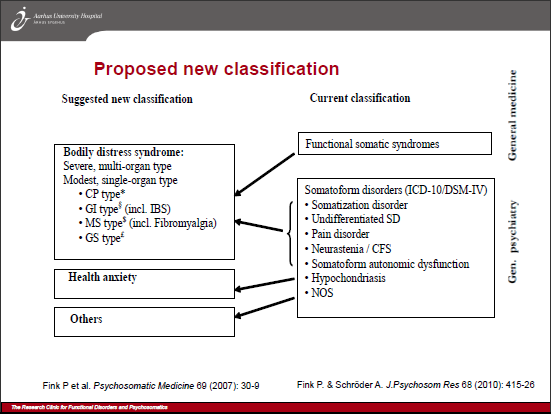
Fink et al’s BDS construct is considered by its authors to have the ability to capture the somatoform disorders, neurasthenia, noncardiac chest pain and other pain syndromes, “functional symptoms”, and the so-called “FSSs”, including CFS, ME, Fibromyalgia and IBS [8][13].

[Under the Fink et al disorder construct, the various so-called specialty “functional somatic syndromes” are considered to be manifestations of a similar, underlying disorder.]

In Lam et al (2012) the PCCG list a number of diseases and conditions for consideration under Differential diagnosis, vis: “Consider physical disease with multiple symptoms, e.g. multiple sclerosis, hyperparathyroidism, acute intermittent porphyria, myasthenia gravis, AIDS, systemic lupus erythematosus, Lyme disease, connective tissues disease.”

Notably, Chronic fatigue syndrome, ME, IBS and Fibromyalgia are omitted from the Differential diagnosis list. The authors are silent about whether their adapted BDS is intended to capture these discretely coded for ICD-10 diagnoses and if not, how these disorder groups could be reliably excluded [11].

ICD Revision has said that it does not intend to classify CFS, ME and Fibromyalgia under Mental and behavioural disorders. However, it has not clarified what measures would be taken to safeguard these patient groups if BSS were to be approved by the RSG for use in the ICD-11-PHC version.

There have been considerable concerns, globally, amongst patients, patient advocacy groups and the clinicians who advise them for the introduction in Denmark of the BDS disorder construct: these concerns apply equally to “BSS”.

It should also be noted that since early 2013, the ICD-10 G93.3 legacy entities, Postviral fatigue syndrome; Benign myalgic encephalomyelitis; Chronic fatigue syndrome, have been absent from the public version of the Beta draft. For over two years, now, and despite numerous requests (including requests by UK health directorates, parliamentarians and registered advocacy organizations) proposals for the chapter location and parent classes for these three terms (and their proposed Definitions and other Content Model parameters) have not been released.

Again, I request that these terms are restored to the Beta draft, with a “Change History”, in order that professional and lay stakeholders are able to monitor and participate fully in the revision process, a process from which they are currently disenfranchised.

If any clinicians attempting to follow the revision of the Somatoform disorders share concerns for any of the issues raised in these comments and wish to discuss further, they are most welcome to contact me via “Dx Revision Watch.”


References

1 Frances A. The new somatic symptom disorder in DSM-5 risks mislabeling many people as mentally ill. BMJ. 2013 Mar 18;346:f1580.

2 Allen Frances, Suzy Chapman. DSM-5 somatic symptom disorder mislabels medical illness as mental disorder. Aust N Z J Psychiatry. 2013 May;47(5):483-4.

3 Frances A. DSM-5 Somatic Symptom Disorder. J Nerv Ment Dis. 2013 Jun;201(6):530-1.

4 Creed F, Gureje O. Emerging themes in the revision of the classification of somatoform disorders. Int Rev Psychiatry 2012;24:556-67.

5 Fink P, Toft T, Hansen MS, Ornbol E, Olesen F. Symptoms and syndromes of bodily distress: an exploratory study of 978 internal medical, neurological, and primary care patients. Psychosom Med. 2007 Jan;69(1):30-9.

6 Creed F, Guthrie E, Fink P et al, Is there a better term than ‘medically unexplained symptoms’?. J Psychosom Res. 2010;68:5-8

7 Rief W, Isaac M. The future of somatoform disorders: somatic symptom disorder, bodily distress disorder or functional syndromes? Curr Opin Psychiatry 2014 Sep;27(5):315-9.

8 Fink P, Schroder A. One single diagnosis, bodily distress syndrome, succeeded to capture 10 diagnostic categories of functional somatic syndromes and somatoform disorders. J Psychosom Res. 2010 May;68(5):415-26.

9 Medically Unexplained Symptoms, Somatisation and Bodily Distress: Developing Better Clinical Services, Francis Creed, Peter Henningsen, Per Fink (Eds), Cambridge University Press, 2011.

10 In Press: Anna Budtz-Lilly, Per Fink, Eva Ornbol, Mogens Vestergaard, Grete Moth, Kaj Sparle Christensen, Marianne Rosendal. A new questionnaire to identify bodily distress in primary care: The ‘BDS checklist’. J Psychosom Res. [Published J Psychosom Res. June 2015 Volume 78, Issue 6, Pages 536–545]

11 Lam TP, Goldberg DP, Dowell AC, Fortes S, Mbatia JK, Minhas FA, Klinkman MS: Proposed new diagnoses of anxious depression and bodily stress syndrome in ICD-11-PHC: an international focus group study. Family Practice (2013) 30 (1): 76-87.

12 Ivbijaro G, Goldberg D. Bodily distress syndrome (BDS): the evolution from medically unexplained symptoms (MUS). Ment Health Fam Med. 2013 Jun;10(2):63-4.

13 Fink et al: Proposed new classification: https://dxrevisionwatch.com/wp-content/uploads/2013/01/finkproposednewclass1.png


Caveats: The ICD-11 Beta drafting platform is not a static document: it is a work in progress, subject to daily edits and revisions, to field test evaluation and to approval by ICD Revision Steering Group and WHO classification experts. Not all new proposals may survive ICD-11 field testing. Chapter numbering, codes and Sorting codes currently assigned to ICD categories may change as chapters and parent/child hierarchies are reorganized. The public version of the Beta draft is incomplete; not all “Content Model” parameters display or are populated; the draft may contain errors and category omissions.
Continued absence of the ICD-10 G93.3 terms from the ICD-11 Beta drafting platform: Letter to key Revision personnel

Post #322 Shortlink: http://wp.me/pKrrB-45z

Update: June 12, 2015: This situation is now being looked into by a member of the recently assembled ICD-11 Project Management team.

As previously posted:

Although the development process for ICD-11 has been in progress for eight years, it’s still not known how ICD Revision proposes to classify the ICD-10 G93.3 legacy terms.

On June 8, I sent a letter, via email, to WHO/ICD Revision, requesting a prompt resolution to this situation:

For the attention of Bedirhan Üstün (WHO/ICD Revision Coordinator, Project Management Team)

CC:

Dr Margaret Chan (Director-General, WHO)
Robert Jakob (Medical Officer, WHO ICD classifications)
Christopher Chute (Chair, ICD-11 Revision Steering Group)
Tarun Dua (lead WHO Secretariat for Topic Advisory Group for Neurology)
Raad Shakir (Chair, Topic Advisory Group for Neurology)
Marjorie S. Greenberg (ex-officio NCHS, WHO-FIC, ICD-11 Revision Steering Group member, team member external assessors for ICD revision process)
Anneke Schmider (WHO Technical Officer, ICD Revision Project Manager)
J Ties Boerma (ICD Revision Project Management team)
Ségolène Aymé (founder Orphanet, chair of ICD-11 Topic Advisory Group for Rare Diseases)
Stefanie Weber (DIMDI German Institute of Medical Documentation and Information, WHO-FIC)


Re: Continued absence of the ICD-10 G93.3 legacy entities from the public version of the Beta drafting platform


Monday, June 8, 2015

Dear Dr Üstün,

At the end of May, a frozen release was posted for the ICD-11 Beta draft.

I remain extremely concerned that there are still no entries in the public Beta, within any linearization, for the three ICD-10 G93.3 legacy entities:

Postviral fatigue syndrome
Benign myalgic encephalomyelitis
Chronic fatigue syndrome

As you are aware, these three entities (plus a dozen or so synonym terms) were removed without explanation from the Diseases of the nervous system chapter of the public version of the Beta draft, in early 2013.

Consequently, for over 2 years, stakeholders throughout the world have been unable to view evolving proposals for the classification of these entities within ICD-11 or to scrutinise proposed chapter location, proposed hierarchies, proposed Definitions and other Content Model parameters.

It is very difficult to monitor, make comments or suggestions where terms are not represented within the draft.

A request submitted by me, in February, via the Proposal Mechanism, to restore these entities to the public Beta has produced no response.

While these three entities remain absent from the Beta draft, stakeholders are effectively disenfranchised from participating in the revision process.

Since the start of the revision process, in 2007, no progress reports, editorials or journal papers have been published on behalf of TAG Neurology discussing the work group’s deliberations for these specific entities.

Since early 2013, when the three entities were removed from the public Beta, there has been no information available, at all.

I am aware that in March 2014, enquiries had been made by English and Scottish Health Directorates and that WHO was jointly approached by several UK registered ME/CFS patient organizations and English parliamentarians. The WHO’s response, at that point, was that proposals for the classification of these terms was unresolved and that more time and more input from the work groups was required [1].

A year later, the need for clarification for current proposals remains unmet.

Given the level of concern amongst stakeholders, globally, would you please look into this matter?

Could you please expedite the restoring of these terms to the Beta draft, with a Change History, in order that the ICD-11 development process can be inclusive of the thousands of clinicians, researchers, allied health professionals, advocacy organizations and patients with a stakeholder interest in the classification of these terms.

If it is not possible to restore terms to the Beta while a freeze is in operation, could TAG Neurology be instructed to issue an immediate statement of intention for these terms, in the interim?

Many thanks in anticipation of a swift resolution.

Sincerely,

Suzy Chapman

1 Correspondence, Scottish Health Directorate and WHO, March 2014, obtained under FOI.

Background to this letter:

In ICD-10 Version 2015:

Postviral fatigue syndrome is coded in Chapter VI: Diseases of the nervous system (the Neurology chapter), at code G93.3, under parent class G93 Other disorders of brain (view here).

Benign myalgic encephalomyelitis is the inclusion term to Postviral fatigue syndrome and assigned the G93.3 code.

Chronic fatigue syndrome is not included in ICD-10 Volume 1: The Tabular List but is indexed to G93.3 in ICD-10: Volume 3: The Alphabetical Index.

(The orange symbol denotes an Index term)

ICD102015

Proposals for ICD-11

In May 2010, a change to the hierarchical relationship between the three terms had been proposed. Whereas Postviral fatigue syndrome had been the Title category term for ICD-10, Chronic fatigue syndrome was proposed as the Title category term for ICD-11.

As part of a substantive reorganization of the Neurology chapter, the parent class, G93 Other disorders of brain (under which the ICD-10 categories G93.0 thru G93.9 were located), is proposed to be retired for ICD-11.

This has meant that the terms that sat under the G93 parent class for ICD-10 would need to be relocated under alternative parent classes for ICD-11 or have new parent classes created for them.

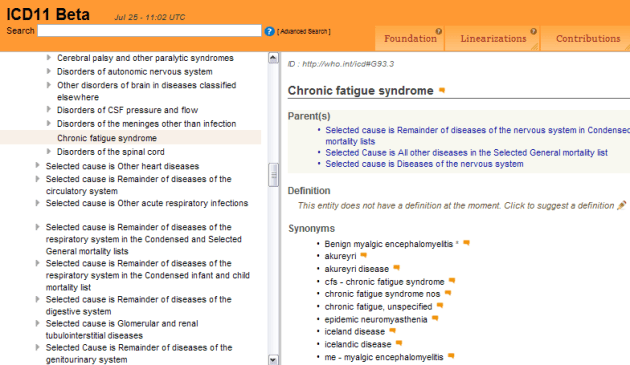
In July 2012, the public version of the ICD-11 Beta drafting platform had stood as in my screenshot, below.

It’s not evident in my screenshot, but the asterisk at the end of Benign myalgic encephalomyelitis displayed a hover text denoting its specification as the Inclusion term to ICD Title term, Chronic fatigue syndrome.

Also not evident in this cropped screenshot is the listing of Postviral fatigue syndrome under Synonyms.

At this point, around 14 historical or alternative terms were listed under Synonyms. These additional uncoded for terms, which had included the ICD-10-CM R53.82 terms, chronic fatigue, unspecified and chronic fatigue syndrome nos, had been scraped from other classification and EMR systems as part of the Beta drafting process :

July2512

Source: ICD-11 Beta drafting platform, July 25, 2012.

In November 2012, ICD Revision inserted a scrappy Definition for Chronic fatigue syndrome (this replaced an earlier draft ICD-11 Beta Definition). I have sourced this draft Definition to an internal ICD Revision/Stanford Protege document (line 1983):

Chronic fatigue syndrome is characterized by extreme chronic fatigue of an indeterminate cause, which is disabling andt [sic] does not improve with rest and that is exacerbated by physical or mental activity.

The “Selected Cause” sub linearization was later removed from the public Beta draft and some of the terms that had been listed under it were restored to the Neurology chapter and to other chapters. But Title term, Chronic fatigue syndrome, its Inclusion term and its list of Synonyms were not restored to any chapter.

Since February 2013, no listing can be found in any chapter of the public version of the Beta draft, under any linearization, for any of the terms, Postviral fatigue syndrome, Benign myalgic encephalomyelitis or Chronic fatigue syndrome, either as uniquely coded for ICD Title terms, or as Inclusion terms or as Synonyms to Title terms, or listed in the ICD-11 Beta Index.

So currently, there is no information within the Beta draft for proposals for these three terms.

The public version of the Beta drafting platform displays no editing “Change History” or “Category Notes” for these terms and their continued absence from the draft is hampering professional and public stakeholder scrutiny, discourse and comment.

This is not acceptable for any disease category, given that ICD Revision is promoted by WHO’s, Bedirhan Üstün, as an open and transparent process that is inclusive of all classes of stakeholder. The recent external review of the revision process has called for greater transparency [1].

Since June 2013, my repeated requests for an explanation for the absence of these three terms from the Beta draft and for ICD Revision’s intentions for these terms were ignored by ICD Revision until July 2014, when a response was forthcoming from ICD Revision’s, Dr Geoffrey Reed.

It is understood that Annette Brooke MP also received a response, in July 2014, from WHO’s, Dr Robert Jakob, in respect of the joint organizations’ letter of March 18, for which Ms Brooke had been a co-signatory [2].

What clarifications have been given?

WHO and ICD Revision’s, Dr Geoffrey Reed (Senior Project Officer, Revision of Mental and behavioural disorders), have said that there has been no proposal and no intention to include ME or other conditions such as fibromyalgia or chronic fatigue syndrome in the classification of mental disorders.

Dr Reed has said that the easiest way to make this absolutely clear will be through the use of exclusion terms. However, he has said that he would be unable to request that exclusion terms are added to relevant Mental and behavioural disorders categories (e.g. Bodily distress disorder) until the conditions that are being excluded exist in the classification; that at such time, he would be happy to do so.

In August 2014, I submitted two FOI requests, one to the Scottish Health Directorate, one to the English Department of Health. The latter was not deemed specific enough in terms of named health agencies for a response to be generated, but I did receive information regarding the former.

Extract from FOI Response: September 24, 2014: FOI request fulfilled by (SCOTLAND) ACT 2002 (FOISA),

Information held covering the time period indicated relates to an email exchange on 11 and 12 March 2014 as part of a request for advice in answering Ministerial correspondence.

On 11 March the World Health Organisation WHO were asked “I would be very grateful for your help in confirming the status of an element within the WHO’s ICD 11 regarding ME/CFS. On 25th February in the UK parliament, the Under-Secretary of State for Health informed the UK parliament that the WHO had publicy stated that there was no proposal  to reclassify ME/CFS in ICD-11…I would be very grateful if you can confirm that this is the case and if possible, provide a web link to the original wording so I can include this within the correspondence I am preparing”.

The WHO responded on 12 March; “The question regarding MS/CFS [sic] and ICD-11 has been asked recently by several different parties. At this point in time, the ICD-11 is still under development, and to handle this classification issue we will need more time and input from the relevant working groups. It would be premature to make any statement on the subject below.

The general information on ICD Revision can be accessed here: http://www.who.int/classifications/icd/revision/. The current state of development of ICD-11 (draft) can be viewed here (and comments can be made, after self registration): http://www.who.int/classifications/icd11 ”.

A further email on 12 March to the WHO asked; “It would be fair to say then …that work will continue on the draft with an expected publication in 2015?”.

WHO responded on 12 March; “Work on the draft will continue until presentation at the World Health Assembly in 2017**. Before, reviews and field testing will provide input to a version that is available for commenting, as much as possible and proposals can be submitted online* with the mechanisms provided already.”

*Since the three terms are currently not accounted for within the Beta draft this impedes the submission of comments.

**Rescheduled in May, this year; the proposed target for presentation for WHA approval is currently May 2018.

This is all that has been disclosed by WHO/ICD Revision in respect of current proposals for the classification of the three ICD-10 G93.3 terms, despite the fact that ICD-11 has now been under development for 8 years, and prior to the timeline extension in January 2014, the new edition had been scheduled for WHA approval and dissemination in 2015.

There remain 6 important questions to be answered by WHO/ICD Revision:

• under which chapter(s) are PVFS, BME and CFS proposed to be located?
• under which parent classes?
• what hierarchies are proposed, in terms of coded for Title terms, Inclusions, Synonyms?
• which of the terms are to be assigned definitions?
• where will definitions be sourced from?
• when will the terms be restored to the draft to enable scrutiny and comment?

Important caveats: The public Beta platform is not a static document, it is a work in progress, subject to daily editing and revision, to field test evaluation and to approval by the RSG and WHO classification experts. Not all new proposals may survive the ICD-11 field tests. Chapter numbering, codes and “sorting codes” currently assigned to ICD categories are not stable and will change as chapters and parent/child hierarchies are reorganized. The public version of the Beta is incomplete; not all “Content Model” parameters display or are populated; the draft may contain errors and omissions.

References and related posts

1 ICD-11 Revision releases External review and Response: shifts projected WHA adoption to 2018

2 Joint Open letter to WHO/ICD Revision over classification of absent G93.3 terms for ICD-11 Beta draft

3 ICD-11 Revision releases External review and Response: shifts projected WHA adoption to 2018

4 Briefing paper on ICD-11 and PVFS, ME and CFS: Part 1

5 Briefing paper on ICD-11 and PVFS, ME and CFS: Part 2

6 Summary of responses from WHO re: Bodily distress disorder, Bodily stress syndrome, Bodily Distress Syndrome

Abstract: WPA Congress 2014: ICD-11 Symposia: Proposals and evidence for the ICD-11 classification of bodily distress disorders

Post #320 Shortlink: http://wp.me/pKrrB-43v

Edited version of the text published on 13.01.15.

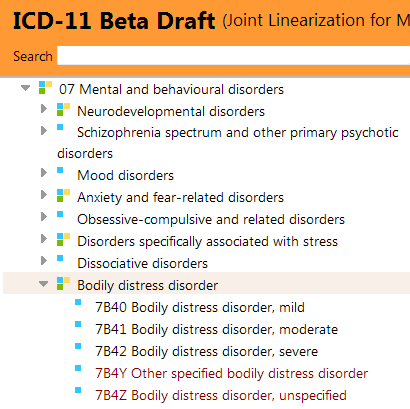
Screenshot: ICD-11 Beta drafting platform, public version, 13.01.15; Chapter 07 Mental and behavioural disorders: Bodily distress disorder. Joint Linerarization for Mortality and Morbidity Statistics (JLMMS) view selected.

+++
BDD130115

“Show availability in main linearizations” view selected. Hover text for categories designated with three coloured key reads: “In Mortality and Morbidity, Primary Care High Resource, Primary Care Low Resource.” Hover text for categories designated with single blue key reads: “In Mortality and Morbidity.”

Two working groups, two sets of recommendations

The Expert Working Group on Somatic Distress and Dissociative Disorders (S3DWG) is one of two working groups advising the Mental Health Topic Advisory Group (TAG) on the potential revision of the ICD-10 Somatoform disorders categories for ICD-11.

The other group tasked with making recommendations on the revision of the Somatoform disorders is the Primary Care Consultation Group (PCCG), led by Prof Sir David Goldberg [1].

The S3DWG’s disorder construct is the construct that has been entered into the ICD-11 Beta drafting platform since 2012 [2].

Perversely, the S3DWG is proposing to call its disorder construct, “Bodily distress disorder” (BDD) – a term already being used outside ICD Revision, interchangeably, with Bodily Distress Syndrome (BDS), which is conceptually different.

To further muddy the waters, the PCCG has proposed calling its construct (which in 2012 had drawn heavily on the Fink et al BDS concept but with some DSM-5 SSD-like psychobehavioural features tacked on), “Bodily stress syndrome” (BSS).

So four very similar terms in play:

Bodily distress disorder (S3DWG, the construct entered into the Beta draft)

Body distress disorders (PCCG primary care disorder group heading*)

Bodily stress syndrome (PCCG disorder category sitting under Body distress disorders*)

Bodily Distress Syndrome (Fink et al, 2010)

*As proposals of the Primary Care Consultation Group had stood in mid 2012 [1].

The co-chair of the Mental Health TAG agrees that the S3DWG’s BDD and Fink et al’s (2010) BDS construct [3] are conceptually different; that there is potential for confusion between the two constructs and he will be discussing the issue of BDD terminology with the working group.

I shall be reporting on some recently proposed revisions to the definition text for BDD and its three Severities in my next post.

ICD-11 Symposia, XVI World Congress of Psychiatry, Madrid 2014

The have been no progress reports from either the S3DWG or the PCCG since emerging proposals for both working groups were published in 2012.

In September, Professor Oye Gureje, who chairs the ICD-11 Expert Working Group on Somatic Distress and Dissociative Disorders, presented on “Proposals and evidence for the ICD-11 classification of Bodily Distress Disorders” as part of series of symposia on the development of the ICD-11 chapter for mental and behavioural disorders, at the World Psychiatric Association XVI World Congress, in Madrid.

In the absence of progress reports, I have requested that WHO/WPA make a transcript, slides or summary of this presentation publicly available.

In the meantime, the Abstracts for these ICD-11 symposia presentations can be found here:

http://www.tilesa.es/wpamadrid2014/abstracts/volume8/files/assets/basic-html/page352.html

also: http://www.tilesa.es/wpamadrid2014/abstracts/volume8/index.html#/352/zoomed

XVI World Congress of Psychiatry. Madrid 2014
Volume 2. Abstracts Regular Symposia

[…]

http://www.tilesa.es/wpamadrid2014/abstracts/volume8/files/assets/basic-html/page354.html

Session: Regular Symposium SPEAKER 3 Code SY469

Title: Proposals and evidence for the ICD-11 classification of bodily distress disorders

Speaker O. Gureje University of Ibadan, Ibadan, Nigeria Abstract Objectives:

The disorder categories currently classified in the group of Somatoform Disorders in ICD-10 have been the subject of controversy relating to their names, utility, reliability and acceptability.

The ongoing development of ICD-11 presents an opportunity to revise these categories so as to enhance their utility and overall acceptability.

Methods: The WHO ICD-11 Working Group on Somatic Distress and Dissociative Disorders has conducted a comprehensive review of the current status of Somatoform Disorders, drawing on literature from across the world and considered within diverse clinical experiences of experts who were consulted for the revision exercise. Proposals for DSM-5 and their suitability for global application were also considered.

Results: Important areas for improving the utility and reliability of disorders grouped under Somatoform Disorders were identified. These areas encompass name, content, structure and clarity of the phenomenology. A simplified category of Bodily Distress Disorder with an improved set of guidelines for making the diagnosis has been proposed to replace current Somatoform Disorders categories.

Bodily Distress Disorder may be described as Mild, Moderate, or Severe based on the extent of focus on bodily symptoms and their interference with personal functioning. Bodily Distress Disorder is currently a subject of tests of its utility and reliability in internet- and clinic-based studies via the extensive network that WHO has developed.

Conclusions: Bodily Distress Disorder holds the promise of addressing the various concerns that have been expressed in regard to the utility and applicability of categories currently classified under Somatoform Disorders. The overarching goal of the new category is to enhance the clinical care of patients presenting with these common and disabling conditions. Bodily Distress Disorder is currently a subject of tests of its utility and reliability in internet- and clinic-based studies, including in primary care settings, via the extensive network that WHO has developed.

References Creed F, Gureje O. Emerging themes in the revision of the classification of somatoform disorders. International Review of Psychiatry 2012; 24:556-567

Further reading:

1 Lam TP, Goldberg DP, Dowell AC, Fortes S, Mbatia JK, Minhas FA, Klinkman MS: Proposed new diagnoses of anxious depression and bodily stress syndrome in ICD-11-PHC: an international focus group study. Family Practice (2013) 30 (1): 76-87. Full free text: http://fampra.oxfordjournals.org/content/30/1/76.long

2 Creed F, Gureje O. Emerging themes in the revision of the classification of somatoform disorders. Int Rev Psychiatry 2012;24:556-67. [Abstract: PMID: 23244611]

3 Fink P, Schröder A. One single diagnosis, bodily distress syndrome, succeeded to capture 10 diagnostic categories of functional somatic syndromes and somatoform disorders. J Psychosom Res. 2010 May; 68(5):415-26.  [Abstract: PMID: 20403500].

Caveats: The ICD-11 Beta drafting platform is not a static document: it is a work in progress, subject to daily edits and revisions, to field test evaluation and to approval by ICD Revision Steering Group and WHO classification experts. Not all new proposals may survive ICD-11 field testing. Chapter numbering, codes and sorting codes currently assigned to ICD categories may change as chapters and parent/child hierarchies are reorganized. The public version of the Beta draft is incomplete; not all “Content Model” parameters display or are populated; the draft may contain errors and category omissions.