Trouble with timelines (2) Might APA hold back DSM-5 in response to an October 2014 ICD-10-CM compliance date?

Trouble with timelines (2): Might APA hold back publication of DSM-5 in response to a firm October 2014 ICD-10-CM compliance date?

Post #200 Shortlink: http://wp.me/pKrrB-2sW

Update at August 17: Commentary on DSM-5 from One Boring Old Man: didn’t need to happen…

Update at August 16: Commentary on DSM-5 from One Boring Old Man: all quiet on the western front…

+++

In Trouble with timelines (1): DSM-5, ICD-10-CM, ICD-11 and ICD-11-CM, on August 10, I wrote

With no changes to the published Timeline and no intimation of further delays, I’m assuming DSM-5 remains on target.

But it’s not necessarily a given that DSM-5 will be on the bookshelves for May 2013.

Roger Peele, M.D., D.L.F.A.P.A, has been a member of the DSM-5 Task Force since 2006. From 2007- 2010, Dr Peele was APA Trustee-At-Large; since 2010, Secretary to the APA Board of Trustees.

Dr Peele maintains a website at http://rogerpeele.com/index.asp providing clinical information for Montgomery County clinicians, resources for County residents and listing some of the initiatives taken relative to the American Psychiatric Association:

http://rogerpeele.com/

Writing just a few days after HHS Secretary’s announcement of intent to postpone the compliance date for adoption of ICD-10-CM/PCS codes sets for a further year, to October 1, 2014, Dr Peele informed his readers that the proposal to delay the compliance deadline

“…reduces some of the pressures to publish DSM-5 in 2013.”

In his post of February 23, Dr Peele goes on to say that a more certain answer was expected on February 28, but that remarks at the previous day’s American College of Psychiatrists meeting suggested the timing of DSM-5 for early 2013 was still on.

This suggests to me that if HHS decides not to take forward its proposal to delay ICD-10-CM compliance until October 1, 2014 but to stick with the original compliance date of October 1, 2013, that APA will still want to get its manual out several months ahead of the ICD-10-CM compliance deadline.

In order to meet a publication date of May 2013, APA says the final manual text will need to be with the publishers by December, this year. So unless HHS announces a decision within the next few weeks, APA isn’t going to have very much time left in which to dither over potentially shifting publication to 2014.

ICD-10-CM will be freely available online and is already accessible for pre implementation viewing. It’s the policy of WHO, Geneva, to make print versions of ICD publications globally available at reasonable cost. Although ICD-10-CM has been developed by US committees for US specific use, it’s not expected that print versions of ICD-10-CM will be as expensive as DSM-5.

DSM manuals are expensive; they are a commercial product generating substantial income for the APA’s publishing arm. APA will be looking to maximize sales and publication revenue and retain market share with this forthcoming edition.

There are already groups and petitions calling for the boycotting of DSM-5 in favour of using Chapter 5 of ICD-10-CM, when its code sets are operationalized.

So if ICD-10-CM is to be adopted by October 1, 2013, I cannot see APA and American Psychiatric Publishing not aiming to steal a march.

If, on the other hand, HHS were to announce shortly a firm rule that compliance for ICD-10-CM is being pushed back to October 2014, if DSM-5 Task Force and work groups are struggling to finalize the manual or having problems obtaining approval for some of their more contentious proposals from the various panels that are scrutinizing the near final draft, then delaying publication of DSM-5 to late 2013 or spring 2014 would provide APA with a window in which to complete its manual but still push it out ahead of ICD-10-CM.

Its PR firm can sell a publication delay to end-users as the APA’s taking the opportunity of postponement of ICD-10-CM compliance to allow more time for evaluation of DSM-5 field trial results, refinement of criteria or honing disorder description texts, and that a delay will better facilitate harmonization efforts with ICD-10-CM and ICD-11.

(ICD-10-CM is a modification of the WHO’s ICD-10 and has closer correspondence with DSM-IV than with DSM-5. Since 2003, ICD-9-CM diagnostic codes have been mandated by HIPAA for all electronic reporting and transactions for third-party billing and reimbursement and DSM-5 codes will need to be crosswalked to ICD-9-CM codes, for the remaining life of the ICD-9-CM. DSM-5 codes will also need to be convertible to ICD-10-CM codes for all electronic transactions.)

In a June 2011 presentation to the International Congress of the Royal College of Psychiatrists, APA President, John M. Oldham, MD, MS, spoke of “Negotiations in progress to ‘harmonize’ DSM-5 with ICD-11 and to ‘retro-fit’ these codes into ICD-10-CM” and that DSM-5 would need “to include ICD-10-CM ‘F-codes’ in order to process all insurance claims beginning October 1, 2011.”

With the drafting timelines for the three systems now so out of whack and a partial code freeze on ICD-10-CM, and with ICD-11 still at the Beta drafting stage, I can no longer be bothered to attempt to unscramble how alignment of the three systems [or best fit where no corresponding category exists] is going to dovetail, in practice, pre and post publication, or what the implications might be for the medical billing and coding industry, for clinicians and for patients.

Dr Peele then says

“Since ICD-11-CM is due in 2016, it may become appealing to the Feds to skip ICD-10-CM, and wait until 2016”

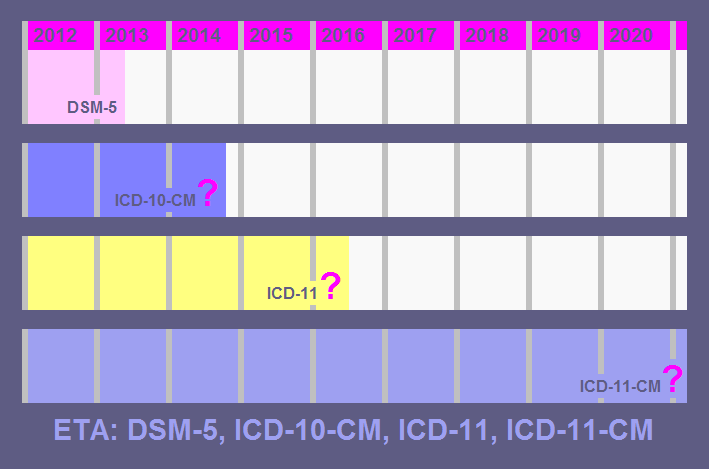
ICD-11-CM due in 2016?

Not so. It is the WHO’s ICD-11 that is aiming for readiness by 2016.

A misconception on the part of Dr Peele or wishful thinking?

It might suit the interests of APA and American Psychiatric Publishing, financially and politically, if ICD-10-CM were to be thrown overboard and instead, the US skip to a Clinical Modification of ICD-11, two or three years after a copy of its shiny new DSM-5 is sitting on every psychiatrist’s desk.

But that is not going to happen in 2016.

There is strong federal opposition, in any case, against leapfrogging over ICD-10-CM to a US modification of ICD-11:

Federal Register, January 16, 2009:

…We [ICD-9-CM Coordination and Maintenance Committee] discussed waiting to adopt the ICD-11 code set in the August 22, 2008 proposed rule (73 FR 49805)…

…However, work cannot begin on developing the necessary U.S. clinical modification to the ICD–11 diagnosis codes or the ICD–11 companion procedure codes until ICD–11 is officially released. Development and testing of a clinical modification to ICD–11 to make it usable in the United States will take an estimated additional 5 to 6 years. We estimated that the earliest projected date to begin rulemaking for implementation of a U.S. clinical modification of ICD–11 would be the year 2020.

The suggestion that we wait and adopt ICD–11 instead of ICD–10–CM and ICD–10–PCS does not consider that the alpha-numeric structural format of ICD–11 is based on that of ICD–10, making a transition directly from ICD–9 to ICD–11 more complex and potentially more costly. Nor would waiting until we could adopt ICD–11 in place of the adopted standards address the more pressing problem of running out of space in ICD–9–CM Volume 3 to accommodate new procedure codes…

And from a more recent Federal Register document:

Federal Register, April 17, 2012:

3. Option 3: Forgo ICD-10 and Wait for ICD-11

…The option of foregoing a transition from ICD-9 to ICD-10, and instead waiting for ICD-11, was another alternative that was considered. This option was eliminated from consideration because the World Health Organization, which creates the basic version of the medical code set from which all countries create their own specialized versions, is not expected to release the basic ICD-11 medical code set until 2015 at the earliest.

From the time of that release, subject matter experts state that the transition from ICD-9 directly to ICD-11 would be more difficult for industry and it would take anywhere from 5 to 7 years for the United States to develop its own ICD-11 CM and ICD-11-PCS versions.


From an interview with Christopher Chute, MD, Making the Case for the ICD-10 Compliance Delay April 4, 2012, by Gabriel Perna for Healthcare Informatics:

“…Chute is also adamant that there is no possible reason or possibility that the U.S. could just skip over ICD-10 right into ICD-11. Even with his ties to ICD-11, Chute says there it’s not realistic, nor is it plausible, to have seven-to-nine more years of ICD-9 codes, while the medical industry waits for the World Health Organization to finish drafting ICD-11 and then waits for the U.S. to adapt it for its own use.”

A recent article in the JOURNAL OF AHIMA/July 2012/Volume 83, Number 7 in response to Chute et al [1] suggests the earliest the US could move onto a CM of ICD-11 might be 2025, or 13 years from now.

So, if HHS were to announce, soonish, a final rule for an October 1, 2014 ICD-10-CM compliance date, it’s not totally out of the question, in my view, that APA (who might be struggling to complete the manual for December) may extend its publication date for a second time.


References

1] There are important reasons for delaying implementation of the new ICD-10 coding system. Chute CG, Huff SM, Ferguson JA, Walker JM, Halamka JD. Health Aff (Millwood). 2012 Apr;31(4):836-42. Epub 2012 Mar 21 http://www.ncbi.nlm.nih.gov/pubmed/22442180  (Abstract free; Subscription or payment required for full text)
New domain for Dx Revision Watch and new Twitter address

New domain for Dx Revision Watch and new Twitter address

Post #199 Shortlink: http://wp.me/pKrrB-2rE

Please note the domain for this site has changed to

http://dxrevisionwatch.com

Previous links to posts and pages are being mapped across to this domain but you may like to update Bookmarks and update links to the Home Page on websites and blogs.

The Twitter page associated with this site has also changed from

http://twitter.com/meagenda

to

http://twitter.com/dxrevisionwatch

@dxrevisionwatch

These are voluntary changes and not related to the threats of legal action issued on behalf of American Psychiatric Publishing, A Division of American Psychiatric Association, which forced a domain and site name change, last December [1].

1] Media coverage: American Psychiatric Association (APA) “cease and desist” v DSM-5 Watch website; Legal information and resources for bloggers and site owners

Trouble with timelines (1) DSM-5, ICD-10-CM, ICD-11 and ICD-11-CM

Trouble with timelines (1): DSM-5, ICD-10-CM, ICD-11 and ICD-11-CM

Post #198 Shortlink: http://wp.me/pKrrB-2qr

Update at March 7, 2014: ICD-11 has been postponed by two years. It is now scheduled for presentation for World Health Assembly approval in 2017.

Update at August 15, 2012: On Page 3, I stated that Steven Hyman, MD, is a DSM-5 Task Force Member and that Dr Hyman chairs the meetings of the  International Advisory Group for the Revision of ICD-10 Mental and Behavioural Disorders. According to the DSM-5 Development site, Dr Hyman is no longer a member of the DSM-5 Task Force, having served from 2007-2012. I cannot confirm whether Dr Hyman continues involvement with the International Advisory Group for the Revision of ICD-10 Mental and Behavioural Disorders though his name remains listed on the WHO site page, or on what date or for what reason Dr Hyman stood down from the DSM-5 Task Force.

+++

While the US health care industry, professional bodies and clinical practices sweat on the announcement of a final rule for ICD-10-CM compliance and speculation continues over the feasibility of leapfrogging from ICD-9-CM to ICD-11, I thought I’d run through the timelines.

+++

DSM-5: ETA: May 18-22, 2013

Originally slated for publication in May 2012.

In December 2009, the American Psychiatric Association shifted release of DSM-5 to May 2013, in response to slipping targets. With no changes to the published Timeline and no intimation of further delays, I’m assuming DSM-5 remains on target.

The final manual is scheduled for submission to American Psychiatric Publishing by December 31, 2012, for official release, next May, during APA’s 2013 Annual Meeting in San Francisco.

Following closure of the third and final public review on June 15, 2012, draft proposals for disorder descriptions and criteria sets as published on the DSM-5 Development website were frozen. The DSM-5 website will not be updated with any further revisions made by the work groups between June 15 and going to print. Final criteria sets and manual content are under strict embargo until publication [1].

+++

ICD-10-CM: ETA: Compliance mandatory by October 1, 2013; Final Rule to be announced on CMS’s proposal to delay compliance date to October 1, 2014

The development process for ICD-10-CM is as old as God’s dog.

WHO published ICD-10 in 1992. Twenty years on, while the rest of the world has long since migrated to ICD-10, the US is still waiting to transition from ICD-9-CM to a US specific clinical modification of ICD-10. The US is still using a modification based on WHO’s long since retired, ICD-9, and a code set that is now over 35 years old.

The Tabular List and preliminary crosswalk between ICD-9-CM and ICD-10-CM were posted on the NCHS website for public comment in December 1997. Field testing took place nearly ten years ago, in the summer of 2003.

The proposed rule for the adoption of ICD-10-CM/PCS was published in August 2008 with a proposed compliance date of October 1, 2011. In January 2009, the Department of Health and Human Services (HHS) published a final rule adopting ICD-10-CM/PCS to replace ICD-9-CM in HIPAA transactions, with an effective compliance date of October 1, 2013.

On February 16, 2012, HHS Secretary Kathleen Sibelius announced intent to postpone the compliance date for adoption of ICD-10-CM/PCS codes sets for a further year, to October 1, 2014 to allow more time for providers, payers and vendors to prepare for transition.

Public comment on the proposed rule closed in June. An imminent decision on a final compliance rule is anticipated but no date by which a decision would be announced has been issued.

Annual updated releases of ICD-10-CM and associated documentation have been posted on the CDC website for public viewing since January 2009.

CMS has issued the 2013 release of ICD-10-CM and General Equivalence Mappings (GEMs) which replace the December 2011 release. Until an implementation date is reached, codes in the 2013 release of ICD-10-CM are not currently valid for any purpose or use but are available for public viewing on the CDC website.

+++
Partial Code freeze for ICD-9-CM and ICD-10-CM

At the September 15, 2010 public ICD-9-CM Coordination and Maintenance Committee Meeting it was announced that the committee had finalized its recommendation to impose a partial code freeze for ICD-9-CM and ICD-10-CM/PCS codes prior to implementation of ICD-10-CM. Partial Code Freeze Announcement [PDF]

October 1, 2011 was the last major update of ICD-10-CM/PCS until October 1, 2014. Between October 1, 2011 and October 1, 2014 proposals for revisions to ICD-10-CM/PCS will be considered only for new diseases/new technology procedures and minor revisions to correct reported errors. Regular (at least annual) updates to ICD-10-CM/PCS will resume on October 1, 2014.

These Partial Code Freeze dates are based on the original compliance date of October 1, 2013. It’s reported that postponement of the requirement for compliance until October 1, 2014 would also push back scheduled ICD-10-CM coding updates.

If the proposed compliance date of October 1, 2014 is instituted, adoption of ICD-10-CM would become mandatory around 18 months after publication of DSM-5. The first regular updates to ICD-10-CM would resume one year post compliance date, that is, from October 1, 2015.

Continued on Page 2

Two resign from DSM-5 Personality Disorders Work Group over “seriously flawed” proposals

Two resign from DSM-5 Personality Disorders Work Group over “seriously flawed” proposals

Post #191 Shortlink: http://wp.me/pKrrB-2kN

Update at July 24, 2012: Additional reporting from Straight.com, Vancouver, on the resignations of two members of the DSM-5 Personality Disorders Work Group:

UBC prof emeritus John Livesley and Dutch expert quit DSM-V committee defining personality disorders

Charlie Smith | July 23, 2012

Update at July 16, 2012:

In the July issue of Clinical Psychology & Psychology there is an Editorial and two Commentaries around DSM-5 proposals for Personality and Personality Disorders.

Clinical Psychology & Psychotherapy

http://onlinelibrary.wiley.com/journal/10.1002/(ISSN)1099-0879/earlyview

Commentary

No abstract is available for this article.

Personality Disorder Proposal for DSM-5: A Heroic and Innovative but Nevertheless Fundamentally Flawed Attempt to Improve DSM-IV

Roel Verheul

Article first published online: 12 JUL 2012 | DOI: 10.1002/cpp.1809

Editorials

No abstract is available for this article.

DSM-5 Personality Disorders: Stop Before it is Too Late

Paul Emmelkamp and Mick Power

Article first published online: 3 JUL 2012 | DOI: 10.1002/cpp.1807

Commentary

No abstract is available for this article.

Disorder in the Proposed DSM-5 Classification of Personality Disorders

W. John Livesley

Article first published online: 3 JUL 2012 | DOI: 10.1002/cpp.1808

Roel Verheul, Ph.D. and W. John Livesley, M.D., Ph.D. resigned as members of the DSM-5 Personality and Personality Disorders Work Group in April.

Dr Roel Verheul is CEO of de Viersprong, Netherlands Institute for Personality Disorders.

Dr. John Livesley is Professor Emeritus at the University of British Columbia.

Allen Frances, M.D. who chaired the DSM-IV Task Force blogs at DSM 5 in Distress. Drs Verheul and Livesley have written to Dr Frances setting out their concerns for what they believe to be “seriously flawed proposals” and “a truly stunning disregard for evidence.”

DSM5 in Distress
The DSM’s impact on mental health practice and research.

by Allen Frances, M.D.

Two Who Resigned From DSM-5 Explain Why
They spell out the defects in the personality section

Allen Frances, M.D. | July 11, 2012

Roel Verheul and John Livesley both felt compelled to resign from the DSM-5 Personality Disorders Work Group. Here is an email from them describing what went wrong in the preparation of this section:

“…Regrettably, the Work Group has been unable to capitalize on the opportunity and has advanced a proposal that is seriously flawed. It has also demonstrated an inability to respond to constructive feedback both from within the Work Group and from the many experts in the field who have communicated their concerns directly and indirectly. We also regret the need to resign because we were the only International members of the Work Group which is now without representation from outside the US…”

“…Early on in the DSM-5 process, we developed major concerns about the Work Group’s mode of working and its emerging recommendations that we communicated to the Work Group and Task Force… We considered the current proposal to be fundamentally flawed and decided that it would be wrong of us to appear to collude with it any longer…As we see it, there are two major problems with the proposal…”

Read full article here

Proposals for the DSM-5 Personality Disorders as issued for the third and final stakeholder review can be read here on the DSM-5 Development site.

Changes to content on DSM-5 Development site (1)

Changes to content on DSM-5 Development site (1)

Post #189 Shortlink: http://wp.me/pKrrB-2jn


Content embargo

According to American Psychiatric Association’s recently published, highly restrictive DSM-5 Permissions Policy – following closure of the third and final public review, the content of DSM-5 will be under strict embargo until the manual is published.

DSM-5 is expected to be finalized by December 31 for publication in May 2013.

APA closed its third stakeholder review of draft proposals for DSM-5 categories and criteria on June 15 and issued a Press Release on June 26 – write-up from Deborah Brauser for Medscape Medical News, below.

Between closure of the final review and Wednesday, June 27, the DSM-5 Development site stated that although comments on proposals could no longer be submitted through the website the site would remain viewable with the draft proposals until DSM-5’s publication.

That line of text was deleted from the DSM-5 Development site home page yesterday, Thursday, June 28.

It remains unconfirmed whether it is now APA’s intention to remove the draft as it stood at the third review from the DSM-5 Development site at some point between now and the slated publication date.


Categories and criteria text frozen during final revisions

According to DSM-5 Development home page text, revisions to categories and criteria will continue to be made between now and the end of 2012 in response to stakeholder feedback; continued analysis of DSM-5 Field Trial results; scrutiny by the DSM-5 Scientific Review Committee which will review scientific validating evidence for revisions; an extensive peer review process; review by an Assembly DSM-5 committee and an overall final review by the DSM-5 Task Force.

Disorder categories and criteria texts as they currently stand on the website are now frozen and the site content will not be updated to reflect any further revisions and edits made between June 15 and submission of final texts, later this year, for approval by APA Board of Trustees.

None of the manual’s extensive textual content that will accompany the new categories has been out on public review.

The remainder of the development process is set out on the Home Page under “Next Steps” and in the APA Board Materials Packet – December 10-11, 2011. This document sets out the DSM-5 Development program from December 2011 until May 2013:

Open here: Item 11.A – DSM Task Force Report


From Medscape Medical News > Psychiatry

Last DSM-5 Public Review Period Ends With 2000 Comments

Deborah Brauser | June 26, 2012

June 26, 2012 — The latest and final public comment period for the upcoming Diagnostic and Statistical Manual of Mental Disorders, Fifth Edition (DSM-5) ended on June 15 — but not before logging 2298 responses from around the world, the American Psychiatric Association (APA) reports.

This was the third public comment period that has been opened for online feedback regarding the manual’s proposed criteria changes. To date, there have been a total of 15,000 public comments posted…

Read full report

Ed: Free registration required for access to most parts of Medscape site.


Comment on closure of third and final draft review from 1 Boring Old Man

1 Boring Old Man

missed opportunity…

Wednesday, June 27, 2012


Related material

1] APA News Release June 26, 2012

2] DSM-5 Development Timeline

3] DSM-5 Development Permissions Policy

4] DSM-5 Terms and Conditions of Use

NAPPP launches Petition to Endorse ICD-10-CM for Diagnosis of Mental Disorders

National Alliance of Professional Psychology Providers (NAPPP) launches Petition to Endorse ICD-10-CM for Diagnosis of Mental Disorders

Post #188 Shortlink: http://wp.me/pKrrB-2jf

The National Alliance of Professional Psychology Providers (NAPPP) has launched a petition for psychologists to endorse the forthcoming ICD-10-CM for Diagnosis of Mental Disorders.

The NAPPP mission is “to promote and advocate for the clinical practice of psychology. NAPPP welcomes licensed, doctoral level psychologists who provide healthcare related services. Retired psychologists, and students also are eligible for membership.”

Professionals can sign the Petition here:

http://www.nappp.org/ICD.html

Petition to Endorse ICD-10-CM for Diagnosis of Mental Disorders

The purpose of this petition is to establish a national policy for psychological practitioners to use the standards of the World Health Organization (WHO) for the diagnosis and treatment of mental disorders. The International Statistical Classification of Diseases and Related Health Problems 10th Revision (ICD-10) Version 10 presents worldwide standards for the diagnosis and treatment of mental and physical disorders as adopted by WHO. The advantages for psychology of using ICD-10 include ensuring that psychologists and all other doctoral healthcare providers will use the same diagnostic system. Consistent use of ICD-10 will simplify both establishment of consistent diagnosis and reimbursement for services. Workload counting of practitioners will also be better standardized for organization use.

Use of ICD-10 will also eliminate the political controversies that encumber frequent revisions to the Diagnostic and Statistical Manual (DSM). Finally, psychologists, using the ICD-10-CM to diagnose and treat mental conditions, will advance collaboration and integration of psychological and medical practices. Use of the same ICD-10 system by all health professions could also facilitate a comprehensive understanding of patients and their needs. Failure to use ICD-10-CM by psychologists would marginalize their services in the health care reform movement. All the advantages listed above will aid in implementation of the Affordable Care Act (ACA). Cooperative integration of the various health care professions is a prime goal of the Affordable Care Act (ACA). The US Department of Health and Human Services adopted a Rule April 17, 2012 that postponed compliance with ICD-10 codes until October 1, 2014.* This prime goal had originally been set for January 1, 2012. This delay will allow the Center for Medicare and Medicaid (CMS) to amend its 5010-CM coding system to comply with the ICD-10 Edition of diagnostic and procedure codes. This delay allows psychological practitioners to integrate their coding for reimbursement during the transitions of health care reform. This delay also provides psychology an opportunity to point out deficiencies in the present reimbursement system and to recommend corrective modifications to CMS as it amends its 5010-CM diagnostic and procedure coding system.

To read a comprensive statement on the rationale for the advantages to psychologists to support this petition, go HERE    (http://www.nappp.org/pdf/ICD.pdf  )

Petitioners strongly urge American Psychological Association Practice Organization and the APA Practice Directorate to expend all possible efforts to implement use of ICD-10 by all practicing psychologists. This action is petitioned and asked to receive priority attention because the clear advantages listed above. Expediting this request needs to be done to achieve these advantages and to circumvent unacceptable developments in the proposed edition of DSM-V**.

*Ed: This is a proposed postponement. No final rule to postpone compliance to October 1, 2014 has yet been issued by CMS.

**Ed: The forthcoming revision of the DSM will be known as “DSM-5” not “DSM-V.”

DSM; DSM-IV; DSM-IV-TR; DSM-IV-PC; DSM-V; DSM V; DSM-5; DSM 5 are registered trademarks of the American Psychiatric Association.