ICD-11 Revision Beta drafting process: stakeholder participation

ICD-11 Revision Beta drafting process: stakeholder participation

Post #194 Shortlink: http://wp.me/pKrrB-2nw

Information in this report relates to the World Health Organization’s ICD-11, currently under development. It does not apply to the existing ICD-10 or to the forthcoming US specific “clinical modification” of ICD-10, known as ICD-10-CM.

Update at August 2, 2012:

ICD-11 Slide Presentation:     Harrison Slides 2011 PDF 3MB

+++
Update at August 2, 2012:

Dr Robert J.G. Chalmers, co-chair and managing editor of ICD Revision Dermatology Topic Advisory Group put out a call, yesterday, on the website of the American Academy of Dermatology Association (AAD) for input into the Beta draft for Chapter 12 Diseases of the skin:

An invitation to contribute to the future of dermatology

ICD-11 Update

By Robert J.G. Chalmers

ICD-11 draft is ready for comments and criticism

By Robert J.G. Chalmers, MB, FRCP, August 01, 2012

+++

When will ICD-11 be ready for dissemination?

Slipping targets

The revision of ICD-10 and development of the structure for ICD-11 began in 2007.

ICD-11 was originally planned to be ready for dissemination by 2012, with the timelines for the revisions of ICD-10 and DSM-IV running more or less in parallel. Source: Archive documents, References [1] [2].

Very early on in the revision process, the ICD-11 dissemination date was extended from 2012 to 2015. In 2009, launch of the Beta draft was timelined for May 2011, with the final draft scheduled for submission to World Health Assembly (WPA) for approval in 2014.

In order to be ready for global implementation in 2015, the technical work on ICD-11 would need to be completed by 2012. Source: Dr Geoffrey Reed, Ph.D., May 2009, via personal correspondence.

+++

ICD-11 still at the Beta drafting stage

In early 2011, in response to slipping targets for content population and software development, ICD Revision and WHO-FIC were discussing the pros and cons of postponing the launch of a Beta drafting platform until later that year or until May 2012, and whether an interim solution might be to launch “a hybrid model of opening the revision process to public comment and suggestions at the same time not a full scale beta phase with field trials…”

Sources: Slide presentation: ICD Revision Paediatrics Meeting, Ankara, Turkey, February 28 – March 1, 2011;
Report: WHO-FIC Council conference call, February 16, 2011: Page 6: 
PDF for Report [3]

+++

Launch of the Beta delayed

The decision was made to delay launching the Beta draft until May 2012. With the Alpha and Beta stages already running a year or more behind 2009 targets, it’s not clear how much time can be allocated for completing the Beta phase and two year field trials period – if the target for a final version for public viewing in 2014 is going to be reached.

According to the ICD-11 Timeline, presentation for World Health Assembly approval has been shifted to May 2015 and in this paper, published in March 2012 by Christopher Chute, MD, (Chair, ICD-11 Revision Steering Group) et al, publication of ICD-11 is now expected “around 2016.”

+++
“…And just a small detail: who will do all this work?” [4]

ICD-11 is a very ambitious project.

The burden of drafting and liaison is being carried out largely via electronic means between individuals scattered across the globe and in addition to their clinical and academic responsibilities.

Given the scale of the undertaking, its technical complexity, limited funding and human resources, lack of an overall project manager, reported communication problems between WHO, Revision Steering Group, Topic Advisory Group managing editors and members and the amount of work that remains to be completed, I cannot see this vision of WHO’s Bedirhan Üstün reaching fruition by 2016.

There are some interesting comments in this Agenda Appendix (Page 6 of 10) on project funding, lack of resources, project management and lines of communication: ICD-11 April 11 Meeting Agenda

For make-up of the Revision Steering Group (RSG) and the various Topic Advisory Groups (TAGs) see links at end of post. Membership of the various sub working groups to Topic Advisory Groups and the names of external peer reviewers of proposals and content have not been published by ICD-11 Revision.

+++

Where can the Beta drafting platform be viewed?

ICD Revision Steering Group and the various Topic Advisory Groups that are developing the Beta draft are working on an electronic collaborative authoring platform, called the iCAT, on a password protected server accessible only by WHO classification experts, Revision Steering Group, Topic Advisory Group Managing Editors and revision process IT personnel and software developers. It looks similar to this:
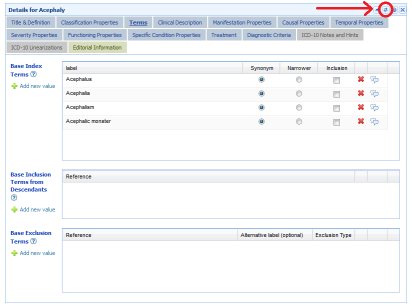
For more views of the iCAT see Slides 20-25 and Slide 39 of this 2011 slide presentation:

ICD-11 Slide Presentation:     Harrison Slides 2011 PDF 3MB

The iCAT platform is more complex than the publicly viewable version of the Beta platform and has a mechanism for recording change histories which tracks additions, deletions and revisions to the draft as ICD chapters are reorganized and new content generated and populated.

Population of content is managed by the Topic Advisory Group (TAG) Managing Editors following review by the Revision Steering Group. Structural changes to the classification, eg changing parent/child relationships and editing the linearizations can only be done by TAG Managing Editors in liaison with WHO classification experts. Source: Drafting Workflow text and chart [MS Word]; Swim Lane Workflow chart [PDF].

The publicly viewable version of the Beta drafting platform, which was launched in May 2012, looks like this:

With no change histories displaying in the public version of the Beta it is difficult for stakeholders to track proposed hierarchical changes to existing categories, changes to the names of parent classes or child categories, proposed introduction of new category terms (and the rationales for these) or proposed retirement of ICD-10 categories.

In the absence of rationales, it cannot be determined whether the disappearance of a category or group of categories is due to error or oversight by Advisory Group Managing Editors or others with editor level access, a temporary absence while a specific chapter section is being reorganized or whether these no longer displaying categories are intended to be subsumed under existing or new categories.

For example, a number of ICD-10 F45 and F48 Somatoform Disorder categories were removed from the Beta draft in early July with no explanation of intention.

Whilst ICD Revision invites interaction with the drafting process, the lack of clear intent on the part of Advisory Group editors and lack of response to requests for clarifications hinder submission of meaningful stakeholder comment and productive interaction with the process.

Caveats

When viewing the Beta draft, be mindful of the Caveats published by ICD Revision; the draft is in a state of flux.

The ICD-11 Beta drafting process is a work in progress over the next two to three years. The Beta draft is updated on a daily basis to reflect the work being carried out on the iCAT platform. Parent terms, category terms and sorting codes assigned to categories are subject to change as chapter reorganization progresses.

The Beta draft can be accessed here:

Beta draft Foundation Component (FC) view:

http://apps.who.int/classifications/icd11/browse/f/en

Beta draft Linearization Morbity (LM) view:

http://apps.who.int/classifications/icd11/browse/l-m/en

For definitions of Synonyms, Inclusions, Exclusions and ICD-11 terminology see the iCAT Glossary.

+++

Who are the stakeholders in ICD?

government service providers
policy makers and policy implementation agencies
health care professionals and practitioners
physician groups, especially primary care physicians
psychiatrists
psychologists
nurses
researchers and clinician academics
lay health care workers (who deliver most of the primary and mental health care in some developing countries)
social workers
patients (aka service users/consumers of health services), their families and carers
advocacy and disability rights organizations
health information managers and coders
health information technology workers
insurers

On its Facebook page, in June, ICD Revision put out a specific call for professionals with backgrounds in the following fields:

http://www.facebook.com/ICD11

Do you have a background in any of the following areas?

Medicine
Nursing
Midwifery
Dentistry
Pharmacy
Health information management (coding, medical records)
Environmental and occupational health and hygiene
Physiotherapy or Physical therapy
Nutrition
Social Sciences
Psychology
Social work and counseling
Epidemiology
Health Policy
Traditional and complementary medicine

WHO is asking experts from all over the world to sign up today to participate in the ICD revision.

www.who.int/classifications/icd11 

+++

How can stakeholders participate in the Beta process?

The public version of the Beta platform can be viewed without registration.

Professional stakeholders and others who register an interest are able to interact with the drafting process and have access to additional content.

Interested stakeholders can register here

Registered stakeholders are permitted to:

• Add comments on and read other stakeholder comments on concepts; title terms; synonyms; inclusion terms, exclusions and other Content Model parameter terms;
• Comment on whether a category is in the right place;
• Comment on whether the category is useful for Primary Care; Research; Clinical;
• Suggest definitions (with source for definition) for a disease or disorder and comment on already populated draft definitions;
• Make proposals to change ICD categories;
• Offer to participate in field trials (for professionals);
• Offer to assist in translating ICD into other languages

Comments left by registered stakeholders are not visible to non registered viewers. Comments cannot be edited or deleted and appear immediately.

Recent comments get aggregated here:

http://apps.who.int/classifications/icd11/browse/Contributions/RecentComments

+++
PDFs of Print Versions for the ICD-11 Beta Morbidity Linearization

Registered users can download individual chapters or the full linearization using the links on this page. These PDF files are updated every few days to reflect the daily revisions to the drafting platform:

http://apps.who.int/classifications/icd11/browse/l-m/en/Printables
 

For more information on how it is envisaged professional and lay stakeholders will interact with the drafting process see:

PowerPoint presentation slides in Posts #70 and #71:

ICD Revision Process Alpha Evaluation Meeting 11 – 14 April 2011: The Way Forward?

ICD Revision Process Alpha Evaluation Meeting documents and PowerPoint slide presentations

ICD-11 Revision Video invitation to participate here: Video invitation to participate

Press Release here announcing launch of Beta drafting platform. Further media coverage here

Specific call for comments from neurology professionals on The Lancet Neurology site here:

http://www.thelancet.com/journals/laneur/article/PIIS1474-4422(12)70125-4/fulltext

+++

Recently issued documents around the Beta drafting process

Frequently Asked Questions About ICD-11

ICD-11 Beta: Expectations, Concerns and Known Issues: Information for Beta Participants

http://www.who.int/classifications/icd/revision/betaexpectations/en/

ICD-11 Known Concerns and Criticisms: Known concerns about the ICD-11 Beta phase

http://www.who.int/classifications/icd/revision/icd11betaknownconcerns.pdf 

     ICD-11 Beta known concerns

ICD-11 Known Problems and Issues: General known issues

http://www.who.int/classifications/icd/revision/icd11knownissues.pdf 

     ICD-11 General known issues

+++

The ICD-11 Content Model

ICD Revision says that the most important difference between ICD-10 and ICD-11 will be the Content Model.

In ICD-10, other than Chapter V Mental and behavioral disorders, there are no definitions or other descriptive content associated with ICD categories – just hierarchical lists of diseases arranged by chapter and their ICD codes.

But content in ICD-11 is being populated in accordance with the Content Model Reference Guide and there will be the potential for considerably more content to be included for diseases, disorders and syndromes in ICD-11 than appears in ICD-10, across all chapters:

“Population of the Content Model and the subsequent review process will serve as the foundation for the creation of the ICD-11. The Content Model identifies the basic characteristics needed to define any ICD category through use of multiple parameters.”

The most recently published version of the Content Model Reference Guide is here:

Content Model Reference Guide January 2011  [MS Word]

There are currently 13 defined parameters in the content model to describe a category in ICD. All categories will have an ICD Entity Title, Classification Properties, Textual Definition, Terms and up to 13 parameters described.

Content Model Parameters

  • ICD Entity Title
  • Classification Properties
  • Textual Definitions
  • Terms
  • Body System/Structure Description
  • Temporal Properties
  • Severity of Subtypes Properties
  • Manifestation Properties
  • Causal Properties
  • Functioning Properties
  • Specific Condition Properties
  • Treatment Properties
  • Diagnostic Criteria

Some ICD-11 chapters are more advanced than others for reorganization of categories and population of proposed definitions and text for other parameters.

In setting itself the task of generating, peer reviewing, populating and approving this amount of detail across the entire ICD, one has to question how realistic a goal this is within current timeframes.

“Populating the Content Model is a critical task for the revision. Failure results in failure of delivery of ICD‑11.” [4]

It would not surprise me if at some point before the end of this year, ICD Revision Steering Group announces further delays for the Beta drafting and field trial stages and an extension to the projected dissemination date, or a scaling back of the project if completion of ICD-11 and its several, planned speciality publications, by 2016, is to be viable.

+++

Will ICD-11 be implemented worldwide from 2015/16?

ICD-10 is used in over 100 countries, worldwide. Assuming ICD-11 does meet it schedules, it may still take several years before countries currently using ICD-10 are ready to adopt ICD-11.

Several countries have been authorized by WHO to develop their own “Clinical Modification (CM)” of ICD. Canada uses an adaptation called ICD-10-CA, with a version published for 2009. Germany uses a version called ICD-10-GM. Australia (ICD-10-AM) and Thailand (ICD-10-TM) also use country specific modifications of ICD-10.

The US lags behind the rest of the world and is still using a CM version of ICD based on the ICD-9, which is long since retired by the WHO.

Instead of moving onto ICD-11, once this is completed, the US had scheduled implementation of a clinical modification of ICD-10 called ICD-10-CM, for October 1, 2013. ICD-10-CM has been in development for a considerable number of years.

On April 17, 2012 the Secretary of HHS issued a proposed rule to delay the compliance date for ICD-10-CM and ICD-10-PCS codes sets from October 1, 2013 to October 1, 2014, in order to allow more time for clinical practices and the coding industry to prepare for transitioning from ICD-9-CM to ICD-10-CM.

The public comment period for the proposed rule to delay the compliance date is now closed and comments are in the process of being reviewed. A final rule has yet to be announced. Until a new compliance date has been ratified and the revised implementation date reached, codes in ICD-10-CM are not valid for any purpose or use but can be viewed for free on the CDC website together with other ICD-10-CM documentation.

The US might not anticipate moving on to a clinical modification of ICD-11 before 2020 and possibly later*.

*Source: DHSS Office of Secretary Final Rule document“We estimated that the earliest projected date to begin rulemaking for implementation of a U.S. clinical modification of ICD–11 would be the year 2020.”

WHO-FIC meeting materials suggest no earlier than 2018 for Canada. Australia is discussing earlier adoption of ICD-11 (or a CM of ICD-11).

Harmonization between ICD-11 and DSM-5

There is already a degree of correspondence between DSM-IV categories and Chapter V of ICD-10. For the next editions, the APA and WHO have committed as far as possible:

“To facilitate the achievement of the highest possible extent of uniformity and harmonization between ICD-11 mental and behavioural disorders and DSM-V disorders and their diagnostic criteria.”

with the objective that

“The WHO and APA should make all attempts to ensure that in their core versions, the category names, glossary descriptions and criteria are identical for ICD and DSM.”

WHO acknowledges that there may be areas where congruency may not be achievable.

With the timelines for DSM-5 and ICD-11 running out of synch (DSM-5 slated for publication in May 2013; ICD-11 still at the Beta drafting stage with a two year period scheduled for completion of its field trials), this may present barriers to harmonization.

In a June 2011 presentation to the International Congress of the Royal College of Psychiatrists, APA President, John M. Oldham, MD, MS, spoke of “Negotiations in progress to ‘harmonize’ DSM-5 with ICD-11 and to ‘retro-fit’ these codes into ICD-10-CM” and that DSM-5 would need “to include ICD-10-CM ‘F-codes’ in order to process all insurance claims beginning October 1, 2011.”

With the three systems: DSM-5 (publication date May 2013), ICD-10-CM (subject to partial code freeze since October 1, 2011 until 2014+ with new compliance date t.b.a.) and ICD-11 (dissemination scheduled for 2015+) set to become potentially more closely aligned, proposals for ICD-11 may have implications for US health care professionals and patient populations who might also consider themselves stakeholders in the ICD-11 development process.

+

References and additional ICD-11 related links and documentation

According to documents [1] and [2], ICD-11 was originally planned for dissemination by 2012, with the timelines for revisions of ICD-10 and DSM-IV running more or less in parallel. By 2008, the completion date for ICD-11 had been extended to 2014. In December 2009, the American Psychiatric Association (APA) announced a shift in the publication date for DSM-5 to May 2013. APA News Release No. 09-65 

1] IUPsyS Mar 08 Agenda Item 25 ICD-10
International Union of Psychological Science COMMITTEE ON INTERNATIONAL RELATIONS ACTION, March 28–30, 2008, Agenda Item No. 25: Revision of the International Classification of Diseases (ICD-10) and Involvement of Psychology

2] Exhibit 1 WHO Letter Aug 07 
Letter Saxena, WHO, to Ritchie, IUPsyS (International Union for Psychological Science), August 2007
Source: http://www.apa.org/international/governance/cirp/s08agenda25-Exhibit1.pdf  

3] Pages 5-6: Report, WHO FIC Council conference call, 16 February 2011, PDF format

4] Closing remarks, PowerPoint presentation: “Proposal for the ICD Beta Platform”, Stanford team, 12.04.11, WHO, Geneva.

5] Key document: ICD Revision Project Plan version 2.1 9 July 2010

Key links

ICD-11 Beta drafting platform  |  Publicly viewable version

WHO ICD Revision  |  Main WHO website: Revision Steering Group and Topic Advisory Groups
ICD-11 Revision site  |  Revision resources [Google site currently unavailable]
ICD-11 Revision site Documents Page  |  Key revision documents and meeting materials  [Google site currently unavailable]

ICD-11 Revision Information  |
ICD-11 Timeline  |

ICD Information Sheet  |

Revision News  |
Steering Group  |
Topic Advisory Groups  |

ICD-11 YouTube Channel  |  Video reports
ICD-11 on Facebook  |
ICD-11 on Twitter  |
ICD-11 Blog  |  Not updated since October 2009

ICD-11 YouTubes collated on Dx Revision Watch ICD-11 YouTubes  |

WHO Publications

ICD-10 Tabular List online Version: 2010  |  International Statistical Classification of Diseases and Related Health Problems 10th Revision Version: 2010, Tabular List of inclusions and Chapter List

ICD-10 Volume 2: Instruction Manual  |  Volume 2 online Version: 2010 PDF Download

ICD-10 for Mental and Behavioural Disorders Diagnostic Criteria for Research  |  PDF download
ICD-10 for Mental and Behavioural Disorders Clinical Descriptions and Diagnostic Guidelines  |  PDF download

ICD-10 Volume 3: The Alphabetical Index  |  WHO does not make ICD-10 Volume 3: The Alphabetical Index available online

About the World Health Organization (WHO)

The WHO Family of International Classifications  

History of ICD

NAPPP launches Petition to Endorse ICD-10-CM for Diagnosis of Mental Disorders

National Alliance of Professional Psychology Providers (NAPPP) launches Petition to Endorse ICD-10-CM for Diagnosis of Mental Disorders

Post #188 Shortlink: http://wp.me/pKrrB-2jf

The National Alliance of Professional Psychology Providers (NAPPP) has launched a petition for psychologists to endorse the forthcoming ICD-10-CM for Diagnosis of Mental Disorders.

The NAPPP mission is “to promote and advocate for the clinical practice of psychology. NAPPP welcomes licensed, doctoral level psychologists who provide healthcare related services. Retired psychologists, and students also are eligible for membership.”

Professionals can sign the Petition here:

http://www.nappp.org/ICD.html

Petition to Endorse ICD-10-CM for Diagnosis of Mental Disorders

The purpose of this petition is to establish a national policy for psychological practitioners to use the standards of the World Health Organization (WHO) for the diagnosis and treatment of mental disorders. The International Statistical Classification of Diseases and Related Health Problems 10th Revision (ICD-10) Version 10 presents worldwide standards for the diagnosis and treatment of mental and physical disorders as adopted by WHO. The advantages for psychology of using ICD-10 include ensuring that psychologists and all other doctoral healthcare providers will use the same diagnostic system. Consistent use of ICD-10 will simplify both establishment of consistent diagnosis and reimbursement for services. Workload counting of practitioners will also be better standardized for organization use.

Use of ICD-10 will also eliminate the political controversies that encumber frequent revisions to the Diagnostic and Statistical Manual (DSM). Finally, psychologists, using the ICD-10-CM to diagnose and treat mental conditions, will advance collaboration and integration of psychological and medical practices. Use of the same ICD-10 system by all health professions could also facilitate a comprehensive understanding of patients and their needs. Failure to use ICD-10-CM by psychologists would marginalize their services in the health care reform movement. All the advantages listed above will aid in implementation of the Affordable Care Act (ACA). Cooperative integration of the various health care professions is a prime goal of the Affordable Care Act (ACA). The US Department of Health and Human Services adopted a Rule April 17, 2012 that postponed compliance with ICD-10 codes until October 1, 2014.* This prime goal had originally been set for January 1, 2012. This delay will allow the Center for Medicare and Medicaid (CMS) to amend its 5010-CM coding system to comply with the ICD-10 Edition of diagnostic and procedure codes. This delay allows psychological practitioners to integrate their coding for reimbursement during the transitions of health care reform. This delay also provides psychology an opportunity to point out deficiencies in the present reimbursement system and to recommend corrective modifications to CMS as it amends its 5010-CM diagnostic and procedure coding system.

To read a comprensive statement on the rationale for the advantages to psychologists to support this petition, go HERE    (http://www.nappp.org/pdf/ICD.pdf  )

Petitioners strongly urge American Psychological Association Practice Organization and the APA Practice Directorate to expend all possible efforts to implement use of ICD-10 by all practicing psychologists. This action is petitioned and asked to receive priority attention because the clear advantages listed above. Expediting this request needs to be done to achieve these advantages and to circumvent unacceptable developments in the proposed edition of DSM-V**.

*Ed: This is a proposed postponement. No final rule to postpone compliance to October 1, 2014 has yet been issued by CMS.

**Ed: The forthcoming revision of the DSM will be known as “DSM-5” not “DSM-V.”

DSM; DSM-IV; DSM-IV-TR; DSM-IV-PC; DSM-V; DSM V; DSM-5; DSM 5 are registered trademarks of the American Psychiatric Association.

WHO releases ICD-11 Beta drafting platform

WHO releases ICD-11 Beta drafting platform

Post #170 Shortlink: http://wp.me/pKrrB-28K

Yesterday, May 14, the World Health Organization (WHO) announced the launch of the ICD-11 Beta drafting platform.

Press Release here and below.

This publicly viewable platform replaces the Alpha drafting platform that has been viewable since mid 2011. ICD-11 Revision Topic Advisory Groups are using a separate drafting platform with greater functionality than the platform launched yesterday.

Interested stakeholders can register for increased access and to interact with the Beta drafting platform.

In terms of functionality, the Beta platform does not appear to incorporate any additional features over the Alpha. 

In terms of population of content, some entities have text populated for Definitions, others are still waiting for provisional definitions. Some entities have very few “Content Model” parameters listed, others have the following: Parents; Definition; Synonyms; Exclusions; Narrower Terms; Causal Mechanisms; Body Site.

It’s not evident how many of the proposed 13 “Content Model” parameters that describe an ICD-11 entity term will eventually be populated for any given entity. The original list of 13 “Content Model” parameters has been modified since early 2011, but no new documentation has been publicly released that sets out the new parameters.

More information on the Beta drafting platform here:

http://www.who.int/classifications/icd/revision/en/

The International Classification of Diseases 11th Revision is due by 2015

Participate in the ICD Revision

Beta phase participants will have the opportunity to:

• Make Comments
• Make Proposals
• Propose definitions of diseases in a structured way
• Participate in Field Trials
• Assist in translating ICD into other languages

Video invitation to participate
Frequently Asked Questions About ICD-11
ICD Information Sheet

WHO video invitation from Dr Marie-Paule Kieny on ICD-11

For the first time, experts in the public health community who work with patient diagnosis and treatment have an opportunity to contribute to the development of the next version of the ICD. This is WHO’s publication that ensures all aspects of the health community refer to diseases and health conditions in a consistent way.

WHO is calling on experts, health providers and stakeholders from around the world to participate in the 11th revision process. The final ICD-11 will be released in 2015.

With your help, this classification will be more comprehensive than ever before.


The Beta drafting platform can be found here:

Linearizations:

http://apps.who.int/classifications/icd11/browse/l-m/en

Foundation Component:

http://apps.who.int/classifications/icd11/browse/f/en#

User Guide:

http://apps.who.int/classifications/icd11/browse/Help/en

Listing for Chronic fatigue syndrome:

http://apps.who.int/classifications/icd11/browse/f/en#/http%3a%2f%2fwho.int%2ficd%23G93.3

WHO Press Release

May 2102

http://www.who.int/features/2012/international_classification_disease/en/

WHO seeks health experts’ input for 11th International Classification of Diseases

For the first time, experts in the public health community who work with patient diagnosis and treatment have an opportunity to contribute to the development of the next version of the International Classification of Diseases (ICD), which is WHO’s publication that ensures all members of the health community refer to diseases and health conditions in a consistent way.

WHO/Jim Holmes

WHO is releasing the beta version of what will be ICD-11 on a wiki-type platform that allows stakeholder comments to be added after peer review. The final ICD-11 will be released in 2015.

WHO encourages anyone interested to comment to develop a more comprehensive classification.

Foundation for reliable health data

The ICD is the foundation for the identification of health trends and statistics globally. Receiving input from health experts will greatly improve the representation from current medical practice and create insight from a broader diversity of medicine.

“Literally this is what doctors use to diagnose a patient,” says Tevfik Bedirhan Ustun, coordinator in the Department of Health Statistics and Information Systems. “It is how we define the cause of death when a person dies. In research, it is how we classify health problems based on evidence.”

The ICD is the gold standard for defining and reporting diseases and health conditions. It allows the world to compare and share health information using a common language.

In addition to health providers, the ICD is a key tool used by epidemiologists to study disease patterns, insurers, national health programme managers, data collection specialists, and others who track global health progress and how health resources are spent.

ICD-11 innovations

Using advances in information technology, this ICD revision will allow users to collect data on cause of death, advances in science and medicine, emerging diseases and health conditions, and compare information across the globe with more ease and diversity in the service of public health and clinical reporting.

Some of the key new features of the 11th version will include:

• a new chapter on traditional medicine, which constitutes a significant part of health care in many parts of the world;
• it will be ready to use with electronic health records and applications;
• it will updated through the development phase to reflect new knowledge as it is added to the classification; and
• it will be produced in multiple languages through the development phase.

Further coverage:

http://www.dailypioneer.com/nation/65415-who-seeks-inputs-for-key-disease-database.html

WHO seeks inputs for key disease database

Tuesday, 15 May 2012 00:29
Pioneer News Service | New Delhi

The World Health Organisation (WHO) in a maiden initiative has invited experts and users to contribute online to the development of its next version of the International Classification of Diseases (ICD) capturing mortality and morbidity data.

The world’s standard tool provides a picture of the general health of countries and populations and its 11th version is now being developed through an innovative, collaborative process to be released in 2015.

“This is for the first time WHO is calling on experts and users to participate in the revision process through a web-based platform. The outcome will be a classification that is based on user input and needs,” a WHO official said.

Users include physicians, nurses, other providers, researchers, health information managers and coders, health information technology workers, policy-makers, insurers and patient organisations.

WHO will soon be releasing the beta version of what will be ICD-11 on a wiki-type platform that allows stakeholder comments to be added after peer review.

All Member States are expected to use the most current version of the ICD for reporting death and disease statistics (according to the WHO Nomenclature Regulations adopted by the World Health Assembly in 1967), the official added.

Regarding the steps for participating, he elaborated that experts and stakeholders will have to register for a participant account on the web portal which will be open for comments over the next three years and accepted changes will be reflected immediately.

Some of the key new features of the 11th version will include a new chapter on traditional medicine, which constitutes a significant part of health care in many parts of the world and ready to use with electronic health records and applications.

The ICD is translated into 43 languages and is used by all 117 member countries. The ICD holds importance as it provides a common language for reporting and monitoring diseases. This allows the world to compare and share data in a consistent and standard way – between hospitals, regions and countries and over periods of time. It facilitates the collection and storage of data for analysis and evidence-based decision-making, the official said.

AHIMA: Ten Reasons to Not Delay ICD-10 (ICD-10-CM)

AHIMA: Ten Reasons to Not Delay ICD-10 (ICD-10-CM)

Post #147 Shortlink: http://wp.me/pKrrB-1Xw

This material relates to the forthcoming US specific “clinical modification” of the WHO ICD-10, known as “ICD-10-CM.” It does not relate to other country specific clinical modifications of ICD-10.

Update @ February 27: There has been considerable coverage of HHS’s announcement to delay the compliance date for ICD-10-CM.

Further coverage:

Press release

HCPro

Industry Experts Respond to Announcement of ICD-10 Deadline Delay

February 27, 2012

Industry experts respond as HHS has confirmed its intent to delay the ICD-10 compliance deadline, according to its latest press release. HCPro contacted numerous industry experts for their thoughts on the recent announcement by CMS. Although reactions are mixed, experts agree that forward progress on ICD-10 readiness for providers is essential…

ICD-10 may not be postponed for everyone

Ken Kerry | February 20, 2012

One school of thought is that it will be delayed for a year or two; but CMS’ announcement mentioned that only “certain healthcare entities” would be granted a reprieve. Which entities? We don’t know yet.


On January 16, 2009, Department of Health and Human Services (HHS) published a Final Rule in the Federal Register mandating adoption of ICD-10-CM and ICD-10-PCS to replace ICD-9-CM in HIPAA transactions, with a compliance date of October 1, 2013.

Until implementation, codes in ICD-10-CM are not valid for any purpose or use. ICD-10-CM has been subject to partial code freeze since October 1, 2011.

The 2012 release of ICD-10-CM is now available from the CDC site and replaces the December 2011 release:

International Classification of Diseases, Tenth Revision, Clinical Modification (ICD-10-CM)


HHS announces delay for compliance

On February 16, HHS Secretary Kathleen Sebelius issued a press release announcing that HHS will initiate a process to postpone the date by which certain health care entities are required to comply with International Classification of Diseases, 10th Edition diagnosis and procedure codes.

HHS Secretary Kathleen Sebelius said, “We have heard from many in the provider community who have concerns about the administrative burdens they face in the years ahead.  We are committing to work with the provider community to reexamine the pace at which HHS and the nation implement these important improvements to our health care system.”

HHS has yet to announce a new compliance date but it is speculated that the delay would be for at least one year, rather than for a few months.

Related content:

Post #142 | February 16, 2012

HHS Secretary Sebelius announces intent to delay ICD-10-CM compliance date

For background see: 

Could the U.S skip ICD-10 and leapfrog directly to ICD-11?

February 16, 2012 | Tom Sullivan, Government Health IT

HIMSS statement, February 17, 2012

HIMSS Calls for Maintaining October 1, 2013 ICD-10 Implementation Deadline for Most Healthcare Entities

Information Week report

ICD-10 Delay Worries Health IT Leaders

The train’s already left the station for organizations that have been prepping for an October 2013 ICD-10 deadline, say health IT organizations and CIOs.

Nicole Lewis | InformationWeek |February 22, 2012

Practice Fusion

HHS Asks for a Delay to the Start of ICD-10

Robert Rowley, MD | February 21, 2012

AHIMA issues statement and press release

Yesterday, American Health Information Management Association (AHIMA) issued a statement and press release in response to HHS Sebelius’ February 16 announcement to delay the ICD-10-CM compliance date.

AHIMA represents more than 64,000 Health Information Management professionals in the United States and around the world. www.ahima.org

American Health Information Management Association statement and press release

http://journal.ahima.org/2012/02/22/ten-reasons-to-not-delay-icd-10/

     AHIMA statement IDC-10 Delay 02.17.12

Ten Reasons to Not Delay ICD-10

Feb 22, 2012 01:12 pm | posted by Kevin Heubusch | ICD-10

This week AHIMA announced it will reach out to leaders at the Department of Health and Human Services and urge there be no delay in the implementation of ICD-10-CM and ICD-10-PCS.

“We recommend that HHS reach out to the full healthcare community and gather more information about the great strides many have achieved— in good faith—since the ICD-10 deadline was set in January 2009,” said AHIMA CEO Lynne Thomas Gordon, quoted in a statement.

Further, AHIMA encouraged the healthcare community to continue its implementation planning and not let up its efforts.

In a statement released today, AHIMA offered 10 reasons not to delay ICD-10 implementation.

Ten Reasons We Need ICD-10 Now

  1. It Enhances Quality Measures. Without ICD-10 data, serious gaps will remain in the healthcare community’s ability to extract important patient health information needed for physicians and others to measure quality care.
  2. Research Capabilities Will Improve Patient Care. Data could be used in a more meaningful way to enable better understanding of complications, better design of clinically robust algorithms, and better tracking of the outcomes of care. Greater detail offers the ability to discover previously-unrecognized relationships or uncover phenomenon such as incipient epidemics early.
  3. Significant Progress Has Already Been Made. For several years, hospitals and healthcare systems, health plans, vendors and academic institutions have been preparing in good faith to put systems in place to transition to ICD-10. A delay would cause an unnecessary setback.
  4. Education Programs Are Underway. To ready the next generation of HIM professionals, academic institutions have set their curriculum for two-year, four-year, and graduate programs to include ICD-10.
  5. Other Healthcare Initiatives Need ICD-10. ICD-10 is the foundation needed to support other national healthcare initiatives such as meaningful use, value-based purchasing, payment reform, quality reporting and accountable care organizations. Electronic health record systems being adopted today are ICD-10 compatible. Without ICD-10, the value of these other efforts is greatly diminished.
  6. It Reduces Fraud. With ICD-10, the detail of health procedures will be easier to track, reducing opportunities for unscrupulous practitioners to cheat the system.
  7. It Promotes Cost Effectiveness. More accurate information will reduce waste, lead to more accurate reimbursement and help ensure that healthcare dollars are used efficiently.

If ICD-10 Is Delayed:

  1. Resources Will Be Lost. For the last three years, the healthcare community has invested millions of dollars analyzing their systems, aligning resources and training staff for the ICD-10 transition.
  2. Costs Will Increase. A delay will cause increased implementation costs, as many healthcare providers and health plans will need to maintain two systems (ICD-9 and ICD-10). Delaying ICD-10 increases the cost of keeping personnel trained and prepared for the transition. Other systems, business processes, and operational elements also will need upgrading. More resources will be needed to repeat some implementation activities if ICD-10 is delayed.
  3. Jobs Will Be Lost.To prepare for the transition, many hospitals and healthcare providers have hired additional staff whose jobs will be affected if ICD-10 is delayed.

And Finally…

We Can’t Wait for ICD-11. The foundations of ICD-11 rest on ICD-10 and the foundation must be laid before a solid structure can be built. ICD-11 will require the development and integration of a new clinical modification system. Even under ideal circumstances, ICD-11 is still several years away from being ready for implementation in the United States.*

In the report by Tom Sullivan (Health Care Finance News, February 16, 2012), Christopher Chute, MD, who chairs the ICD-11 Revision Steering Group, warned of a possible further delay for completion of ICD-11, from 2015 to 2016.

Implementation of ICD-11 has already been shifted from 2012 to 2014, then last year, to 2015+. These are projections for pilot, then global implementation for ICD-11.

The DHHS Office of the Secretary Final Rule document, February 2009, stated:

“We estimated that the earliest projected date to begin rulemaking for implementation of a U.S. clinical modification of ICD–11 would be the year 2020.”

Canada uses a clinical modification of ICD-10 called ICD-10-CA. WHO-FIC meeting materials suggest that Canada might not move onto ICD-11 (or a modification of ICD-11) until 2018+.  Australia, which uses a clinical modification of ICD-10 called ICD-10-AM, is discussing potentially earlier adoption of ICD-11.

Practice Central on ICD-10-CM transition; APA Monitor and WHO Reed on ICD-11

Two articles on forthcoming classification systems: the first on ICD-10-CM from Practice Central; the second on ICD-11 from the February 2012 edition of the American Psychological Association’s “Monitor on Psychology”

Post #140 Shortlink: http://wp.me/pKrrB-1Tt

Update: Medicare could delay burdensome rules on doctors | Julian Pecquet, for The Hill, February 14, 2012

“The acting head of the Medicare agency said Tuesday that she is considering giving the nation’s doctors more time to switch to a new insurance coding system that critics say would cost millions of dollars for little gain to patients.

“Marilyn Tavenner, the acting administrator of the Centers for Medicare and Medicaid Services, told a conference of the American Medical Association (AMA) that her agency could delay adoption of the so-called ICD-10 system. Current law calls for physicians to adopt the new codes next year…

“…Speaking to reporters after her prepared remarks, Tavenner said her office would formally announce its intention to craft new regulations “within the next few days.”

ICD-10 Deadline Review Update | Andrea Kraynak, for HealthLeaders Media, February 15, 2012

“Big news regarding the ICD-10-CM/PCS implementation timeline came Tuesday morning during the American Medical Association (AMA) National Advocacy Conference in Washington, DC.”

“Per CMS acting administrator Marilyn Tavenner, CMS plans to revisit the current implementation deadline of October 1, 2013. Tavenner said CMS wants to reexamine the pace of implementing ICD-10 and reduce physicians’ administrative burden, according to an AMA tweet…”

Practice Central: Resources for Practicing Psychologists

Practice Central, a service of the APA Practice Organization (APAPO), supports practicing psychologists in all settings and at all stages of their career. APAPO is a companion organization to the American Psychological Association. Our mission is to advance and protect your ability to practice psychology.

http://www.apapracticecentral.org/update/2012/02-09/transition.aspx

Practice Update | February 2012

Transition to the ICD-10-CM: What does it mean for psychologists?

Psychologists should be aware of and prepare for the mandatory shift to ICD-10-CM diagnosis codes in October 2013

By Practice Research and Policy staff

February 9, 2012—Beginning October 1, 2013 all entities, including health care providers, covered by the Health Insurance Portability and Accountability Act (HIPAA) must convert to using the ICD-10-CM diagnosis code sets. The mandate represents a fundamental shift for many psychologists and other mental health professionals who are far more attuned to the American Psychiatric Association’s Diagnostic and Statistical Manual of Mental Disorders (DSM).

Most psychologists were trained using some version of DSM. For other health care providers, the World Health Organization’s International Classification of Diseases and Related Health Problems (ICD) – which contains a chapter on mental disorders – is the classification standard.

Over the years, efforts to harmonize these two classifications have resulted in systems with similar (often identical) codes and diagnostic names. In fact, even if psychologists record DSM diagnostic codes for billing purposes, payers recognize the codes as ICD-9-CM – the official version of ICD currently used in the United States. Since 2003, the ICD-9-CM diagnostic codes have been mandated for third-party billing and reporting by HIPAA for all…

Read full article here


Dr Geoffrey M. Reed, PhD, Senior Project Officer, WHO Department of Mental Health and Substance Abuse, is seconded to WHO through IUPsyS (International Union for Psychological Science). Dr Reed co-ordinates the International Advisory Group for the Revision of ICD-10 Mental and Behavioural Disorders.

Meetings of the International Advisory Group are chaired by Steven Hyman, MD, Harvard University, Cambridge, MA, a former Director of the National Institute of Mental Health (NIMH) and DSM-5 Task Force Member.

The Department of Mental Health and Substance Abuse will also be managing the technical part of the revision of Diseases of the Nervous System (currently Chapter VI), as it is doing for Chapter V.

February 2012 edition of the American Psychological Association’s “Monitor on Psychology”:

http://www.apa.org/monitor/2012/02/disorder-classification.aspx

Feature

Improving disorder classification, worldwide

With the help of psychologists, the next version of the International Classification of Diseases will have a more behavioral perspective.

By Rebecca A. Clay

February 2012, Vol 43, No. 2

Print version: page 40

What’s the world’s most widely used classification system for mental disorders? If you guessed the Diagnostic and Statistical Manual of Mental Disorders (DSM), you would be wrong.

According to a study of nearly 5,000 psychiatrists in 44 countries sponsored by the World Health Organization (WHO) and the World Psychiatric Association, more than 70 percent of the world’s psychiatrists use WHO’s International Classification of Diseases (ICD) most in day-to-day practice while just 23 percent turn to the DSM. The same pattern is found among psychologists globally, according to preliminary results from a similar survey of international psychologists conducted by WHO and the International Union of Psychological Science.

“The ICD is the global standard for health information,” says psychologist Geoffrey M. Reed, PhD, senior project officer in WHO’s Department of Mental Health and Substance Abuse. “It’s developed as a tool for the public good; it’s not the property of a particular profession or particular professional organization.”

Now WHO is revising the ICD, with the ICD-11 due to be approved in 2015. With unprecedented input from psychologists, the revised version’s section on mental and behavioral disorders is expected to be more psychologist-friendly than ever—something that’s especially welcome given concerns being raised about the DSM’s own ongoing revision process. (See “Protesting proposed changes to the DSM” .) And coming changes in the United States will mean that psychologists will soon need to get as familiar with the ICD as their colleagues around the world…

Read full article here

For more information about the ICD revision, visit the World Health Organization.

Rebecca A. Clay is a writer in Washington, D.C

ICD-11 Beta drafting platform for release in May 2012

ICD-11 Beta drafting platform for release in May 2012

Post #139 Shortlink: http://wp.me/pKrrB-1SE

ICD-11 Beta drafting platform

ICD Revision on Facebook has announced that a ‎4th Face to Face meeting of the ICD Revision Topic Advisory Group for Internal Medicine (TAG IM) was held recently, in Tokyo.

No agenda, meeting materials or documents have been posted on the ICD-11 Revision Google site but a PowerPoint presentation prepared by WHO’s, Dr Bedirhan Üstün, is viewable here on the “Slideshare” platform.

Dr Bedirhan Üstün is Coordinator, Classifications, Terminology and Standards, Department of Health Statistics and Information, WHO, Geneva.

You won’t need a PowerPoint .pptx format viewer to view this presentation on the Slideshare site, but you will need a .pptx viewer if you want to download and view the file. (A free .pptx viewer can be downloaded for free from the Microsoft site.)

In order to download the file, you will first need to register with Slideshare or use a Facebook membership as Sign in. If you do agree to download through a Facebook membership, please read and digest the T & C before you agree to Slideshare accessing your Facebook profile data.

View the presentation here:

http://www.slideshare.net/ustunb/tokyo-2012-ustun-show

Tokyo 2012 ustun (show) by Bedirhan Ustun on Feb 10, 2012

for which it states:

“WHO is revising the ICD to be completed by 2015. It is going to enter into a Beta phase by 2012 May during which all stakeholders could see and comment on the ICD as well as propose changes, test in practice.”

Slide #7 states:

2011  : Alpha version (ICD 11 alpha draft)

– + 1 YR  : Commentaries and consultations

2012  : Beta version & Field Trials Version

– + 2 YR Field Trials

2014   : Final version for public viewing

– 2015  : WHA Approval

2015+  implementation

Slides #11 and #12, set out the thirteen parameters of the ICD-11 “Content Model”.


The “Content Model”

ICD Revision says that the most important difference between ICD-10 and ICD-11 will be the Content Model.

Content in ICD-11 will be populated in accordance with the ICD-11 Content Model Reference Guide. There is the potential for considerably more content to be included for diseases, disorders and syndromes in ICD-11 than appears in ICD-10, across all chapters:

“Population of the Content Model and the subsequent review process will serve as the foundation for the creation of the ICD-11. The Content Model identifies the basic characteristics needed to define any ICD category through use of multiple parameters (e.g. Body Systems, Body Parts, Signs and Symptoms, Diagnostic Findings, Causal Agents, Mechanisms, Temporal Patterns, Severity, Functional Impact, Treatment interventions, Diagnostic Rules).”

This is the most recent available version of the Content Model Reference Guide January 2011

This iCAT Glossary page gives an overview of the 13 Content Model parameters.

See also Post #62: ICD-11 Content Model Reference Guide: version for December 2010


New Beta drafting browser

In May 2011, a publicly viewable ICD-11 Alpha Browser platform was launched.

In July 2011, this platform was opened up to professionals and other interested stakeholders who can register via the site for fuller access and for reading and submitting comments. See the ICD-11 Alpha Browser User Guide for information on how the Browser functions and how to register for increased access. (This is the Alpha/Beta “hybrid” referred to in the WHO-FIC Council conference call report, February 16, 2011: Page 6: PDF for Report)

ICD-11 Revision and Topic Advisory Groups are continuing to use a separate platform for drafting purposes.

Stakeholder participation at the Beta stage

In preparation for the Beta drafting stage, another publicly viewable platform is being developed. According to ICD Revision presentations, this platform will invite and support a higher level of professional and public interaction with the drafting process, with various levels of input and editing authority for interested stakeholders who register for participation. According to editing status, registered stakeholders would be permitted to:

Make comments
Make proposals to change ICD categories
Participate in field trials
Assist in translating

See presentation slides in Dx Revision Watch Posts #70 and #71:

ICD Revision Process Alpha Evaluation Meeting 11 – 14 April 2011: The Way Forward?

ICD Revision Process Alpha Evaluation Meeting documents and PowerPoint slide presentations


Slides #15 and #16 of Dr Üstün’s presentation show the methods via which interested stakeholders will be able to register for interaction with the platform.

I will update when more information becomes available on the launch of the Beta platform.