ICD-11 Beta drafting platform: Update (2)

ICD-11 Beta drafting platform: Update (2): Neurasthenia, Postviral fatigue syndrome (PVFS), Benign myalgic encephalomyelitis (ME), Chronic fatigue syndrome (CFS), Fibromyalgia (FM), Irritable bowel syndrome (IBS)

Post #193 Shortlink: http://wp.me/pKrrB-2mC

The information in this report relates to proposals for the World Health Organization’s forthcoming ICD-11, currently scheduled for pilot dissemination in 2015+; it does not apply to the existing ICD-10 or to the forthcoming US specific “clinical modification” of ICD-10, known as ICD-10-CM.

Caveat: The ICD-11 Beta drafting process is a work in progress over the next two to three years. The Beta draft is updated on a daily basis. Parent terms, category terms and sorting codes assigned to categories are subject to change as chapter reorganization progresses. Images and text in this posting may not reflect the most recently assigned categories and codes. This post reflects the Beta draft as it stood at July 25, 2012. Please also read the ICD-11 Beta Draft Caveats.

Post #190 Changes to ICD-11 Beta drafting platform: Bodily Distress Disorders (1) reported on proposals for including three Bodily distress disorder categories in the Somatoform Disorders section of the ICD-11 Beta drafting platform which appear potentially to replace or subsume a number of existing ICD-10 Somatoform Disorder categories.

That post has been revised to reflect clarifications from Professor, Sir David Goldberg, M.D., around the Primary care version of ICD-11 and to include additional material.

The report in this post updates on current proposals for the ICD-11 Beta drafting platform for revision of the following ICD-10 categories: Neurasthenia, Postviral fatigue syndrome (PVFS), Benign myalgic encephalomyelitis (ME), Chronic fatigue syndrome (CFS), Fibromyalgia (FM) and Irritable bowel syndrome (IBS) for the full version of ICD-11.

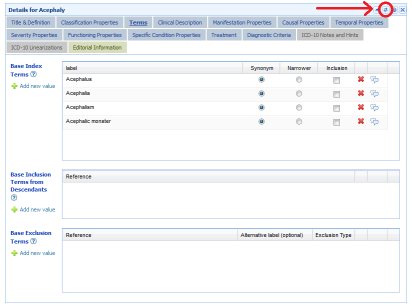
ICD Revision Steering Group and the various Topic Advisory Groups are developing the ICD-11 Beta draft on a non public access collaborative authoring platform where change histories can be tracked, which looks similar to this:
The publicly viewable version of the Beta drafting platform looks like this:

and displays less information. It can be accessed here:

Beta draft Foundation Component (FC) view:

http://apps.who.int/classifications/icd11/browse/f/en

Beta draft Linearization Morbity (LM) view:

http://apps.who.int/classifications/icd11/browse/l-m/en

Increased access to content and interaction with the drafting process can be obtained by registering.
+++
+++
Neurasthenia:

Neurasthenia is not classified in DSM-IV and is not proposed to be classified in DSM-5.

In ICD-10, Neurasthenia is classified in Chapter V Mental and behavioural disorders under parents:

F40-F48 Neurotic, stress-related and somatoform disorders

    F48 Other neurotic disorders
        ›  F48.0 Neurasthenia

+++
For ICD-11 Beta, up until July 3, Neurasthenia was also classified under:

Neurotic, stress-related and somatoform disorders

    9S1 Other neurotic disorders
        ›  9S1.1 Neurasthenia

Inclusions: Fatigue syndrome

Exclusions: psychasthenia
postviral fatigue syndrome
malaise and fatigue
asthenia NOS
burn-out

    9S1.2 Other specified neurotic disorders

Inclusions: Dhat syndrome
Occupational neurosis, including writer’s cramp
Psychasthenia
Psychasthenic neurosis
Psychogenic syncope

     9S1.3 Neurotic disorder, unspecified

Neurosis NOS

+++

On July 4, all child categories classified under parent class, 9S1 Other neurotic disorders, including Neurasthenia and its Inclusion, Fatigue syndrome, were removed from both the FC and LM view and from the PDF for the Chapter 5 Print version and there is currently no listing for any of these categories and child categories under any parent.

As no “Change history” records display in the public version of the Beta draft, it cannot be determined from what information is available whether these categories are temporarily omitted while this section of Chapter 5 is being reorganized, or whether all or selected of these ICD-10 categories are proposed to be retired for ICD-11 or are destined to be subsumed under the proposed Bodily distress disorders categories that ICD Revision has yet to define.

According to the Goldberg February 2011 report, terms included in the ICD11-PHC version of ICD-11 must have an equivalent disorder in the main classification. In February 2011, it was proposed not to include Neurasthenia in the ICD11-PHC version but to subsume under 13 Distress disorder. (It isn’t clear under which disorder group or subcategory Neurasthenia is proposed to be subsumed for the most recently published iteration for ICD11-PHC.)

Neurasthenia remains listed as an Exclusion to Chapter 5 Generalized anxiety disorder and Chapter 18 Malaise and fatigue but these Exclusions may be awaiting attention, if the intention is to retire a number of ICD-10 terms.

I will update when it becomes apparent what the intention is for these currently missing categories.

+++
ICD-11 Chapter 06: Diseases of the nervous system

Postviral fatigue syndrome, Benign myalgic encephalomyelitis, Chronic fatigue syndrome:

In ICD-10, Postviral fatigue syndrome is classified as a Title term within Volume 1: The Tabular List in Chapter VI: Diseases of the nervous system under G00-G99 Other disorders of the nervous system > G93 Other disorders of brain, and coded at G93.3. See: http://apps.who.int/classifications/icd10/browse/2010/en#/G93.3

Benign myalgic encephalomyelitis is also coded in the Tabular List to G93.3 Postviral fatigue syndrome.

Chronic fatigue syndrome is not classified within the Tabular List but is indexed to G93.3 in Volume 3: The Alphabetical Index.

An unauthorised copy of Volume 3: The Alphabetical Index Version for 2006 can be accessed here: (See Page 528)
http://www.scribd.com/doc/7350978/ICD10-2006-Alphabetical-Index-Volume-3 

In indexing Chronic fatigue syndrome to G93.3, ICD-10 does not specify whether it views the term as a synonym, subclass or “best coding guess” to Title term, Postviral fatigue syndrome or to Benign myalgic encephalomyelitis.

Nor does ICD-10 specify the relationship between Postviral fatigue syndrome and Benign myalgic encephalomyelitis.

(For ICD-11, a mechanism will be provided to identify whether an inclusion term is a synonym or a subclass.)

In June 2010, I reported that in May 2010, a change of hierarchy had been recorded in the ICD-11 iCAT Alpha drafting platform “Change History” and “Category Discussion Notes” for class: G93.3 Postviral fatigue syndrome.

See these two screenshots from the original iCAT Alpha drafting platform:

Image 1:

Image 2:

+++
From current information in the Beta draft, it would appear that for ICD-11, the proposal is for a change of hierarchy between Postviral fatigue syndrome and Chronic fatigue syndrome with Chronic fatigue syndrome elevated to an ICD-11 Title term, with a Definition (not currently populated) and with potentially up to 12 other descriptive parameters, populated in accordance with the ICD-11 “Content Model.”

There are a number of terms listed under Synonyms to Title term Chronic fatigue syndrome including Benign myalgic encephalomyelitis and Postviral fatigue syndrome.

Mouse hover over the asterisk at the end of Benign myalgic encephalomyelitis and the following hover text displays, “This term is an inclusion term in the linearizations.”

Also listed under “Synonyms” are “chronic fatigue syndrome nos” and “chronic fatigue, unspecified” (both imported from current proposals for locating Chronic fatigue syndrome in Chapter 18: Symptoms and Signs in the forthcoming US specific, ICD-10-CM).

See this Beta drafting platform page:

http://apps.who.int/classifications/icd11/browse/f/en#/http%3a%2f%2fwho.int%2ficd%23G93
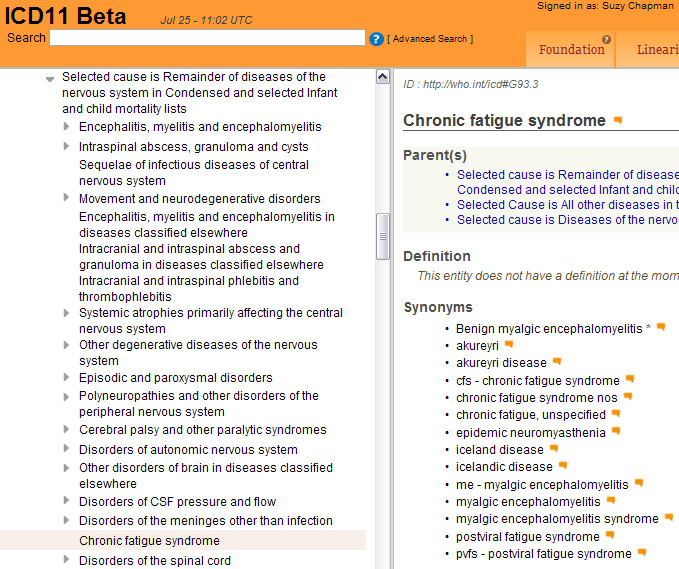
 

There is currently no discrete ICD Title term listed for Postviral fatigue syndrome in either the Foundation Component or Linearization Morbidity view and no discrete ICD Title term for Benign myalgic encephalomyelitis.

It remains unconfirmed, but from the Beta draft as it currently stands, it suggests that for ICD-11:

  • Chronic fatigue syndrome is proposed to become the Chapter 06 Title term
  • Benign myalgic encephalomyelitis is specified as an Inclusion term to CFS under “Synonyms”
  • Postviral fatigue syndrome and a number of other terms are listed under “Synonyms” to CFS

ICD-11 terminology:

For definitions of Synonyms, Inclusions, Exclusions and other ICD-11 terminology see the iCAT Glossary:

http://apps.who.int/classifications/apps/icd/icatfiles/iCAT_Glossary.html

+++
Fibromyalgia (FM):

In ICD-10, Fibromyalgia is classified under:

Chapter XIII: Diseases of the musculoskeletal system and connective tissue > M79 Other soft tissue disorders > M79 Other soft tissue disorders, not elsewhere classified > M79.7 Fibromyalgia 

ICD-10 Version: 2010: http://apps.who.int/classifications/icd10/browse/2010/en#/M79.7

For ICD-11 Beta draft, Fibromyalgia is currently classified under:

Chapter 13: Diseases of the musculoskeletal system and connective tissue > Soft tissue disorders > Other soft tissue disorders > QG6 Other soft tissue disorders, not elsewhere classified > QG6.7 Fibromyalgia

FC: http://apps.who.int/classifications/icd11/browse/f/en#/http%3a%2f%2fwho.int%2ficd%23M79.7
LM: http://apps.who.int/classifications/icd11/browse/l-m/en#/http%3a%2f%2fwho.int%2ficd%23M79.7

+++
Irritable bowel syndrome (IBS):

In ICD-10, Irritable bowel syndrome is classified under:

Chapter XI: Diseases of the digestive system > K55-K63 Other diseases of intestines > K58.0 Irritable bowel syndrome with diarrhoea > K58.9 Irritable bowel syndrome without diarrhoea > Irritable bowel syndrome NOS

ICD-10 Version: 2010: http://apps.who.int/classifications/icd10/browse/2010/en#/K58

For ICD-11 Beta draft, Irritable bowel syndrome is currently classified under:

Chapter 11: Diseases of the digestive system > Functional gastrointestinal disorders > FS6 Irritable bowel syndrome and other functional bowel disorders > FS6.1 Irritable bowel syndrome 

FC: http://apps.who.int/classifications/icd11/browse/f/en#/http%3a%2f%2fwho.int%2ficd%23K58
LM: http://apps.who.int/classifications/icd11/browse/l-m/en#/http%3a%2f%2fwho.int%2ficd%23K58

+++
I shall continue to monitor the Beta drafting process and update on any significant developments for both ICD-11 Chapter 5 and Chapter 6 and for ICD11-PHC for the categories that are the focus of this post and post #190.
+++
+++
References and related material:

1] ICD-10 Version: 2010 Volume 1 Tabular List online:
http://apps.who.int/classifications/icd10/browse/2010/en

2] ICD-11 Beta drafting platform:
http://apps.who.int/classifications/icd11/browse/f/en

3] Goldberg, D. Guest editorial. A revised mental health classification for use in general medical settings: the ICD11–PHC 1. International Psychiatry, Page 1, February 2011.
http://www.rcpsych.ac.uk/pdf/IPv8n1.pdf

4] 21st Century Global Mental Health by Dr Eliot Sorel, Professor, George Washington University, Washington D.C.
Publication date: August, 2012: http://www.jblearning.com/catalog/9781449627874/
Page 51, Sample Chapter 2: http://samples.jbpub.com/9781449627874/Chapter2.pdf

Changes to ICD-11 Beta drafting platform: Bodily Distress Disorders (1)

Changes to ICD-11 Beta drafting platform: Bodily Distress Disorders (1)

Post #190 Shortlink: http://wp.me/pKrrB-2jB


+++

This four page post is a revised version of content first published on July 2, 2012.

Information in this report relates to proposals for the World Health Organization’s forthcoming ICD-11, currently scheduled for pilot dissemination in 2015+; it does not relate to the existing ICD-10 or to the forthcoming US specific “clinical modification” of ICD-10, known as ICD-10-CM.

Caveat: The ICD-11 Beta drafting process is a work in progress over the next two to three years. The Beta draft is updated on a daily basis. Parent terms, category terms and sorting codes assigned to categories are subject to change as work on chapter reorganization progresses. Images and text in this posting may not reflect the most recently assigned categories and codes. This post reflects the Beta draft as it stood at July 24, 2012. Please also read the ICD-11 Beta Draft Caveats.

This report updates on recent changes to the Somatoform Disorders section of the ICD-11 Beta drafting platform. The Beta drafting platform can be accessed here:

Beta draft Foundation view:

http://apps.who.int/classifications/icd11/browse/f/en

Beta draft Linearization view:

http://apps.who.int/classifications/icd11/browse/l-m/en
+++

How do the Somatoform Disorders categories currently stand in ICD-10?

ICD-10 Tabular List Version: 2010 can be accessed here: http://apps.who.int/classifications/icd10/browse/2010/en

ICD-10 Chapter V “Somatoform Disorders”

This is the section of ICD-10 that corresponds with the Somatoform Disorders section in DSM-IV. There is a degree of correspondence between current categories for this section of ICD-10 and for DSM-IV, as set out in the (simplified) table, below.

For clinical descriptions and diagnostic guidelines for ICD-10 Somatoform Disorders see Page 129 of the “Blue book”:

ICD-10 Classification of Mental and Behavioural Disorders: Clinical descriptions and diagnostic guidelines: http://www.who.int/classifications/icd/en/bluebook.pdf

Current DSM-IV Codes and Categories for Somatoform Disorders and ICD-10 Chapter V Equivalents

[Ed: Neurasthenia is not categorized within DSM-IV.]

Source: Mayou R, Kirmayer LJ, Simon G, Kroenke K, Sharpe M: Somatoform disorders: time for a new approach in DSM-V. Am J Psychiat. 2005;162:847–855.
+++
+++
This screenshot shows how the ICD-11 Beta draft had stood at June 24, 2012:

ICD-11 Beta Draft: Morbidity Linearization view


+++

For ICD-11 Beta draft, the proposal in June 2012 had been to rename ICD-10’s F45 Somatoform Disorders parent category to Bodily Distress Disorders.

Three new proposed terms: 9R0 Mild bodily distress disorder; 9R1 Moderate bodily distress disorder; 9R2 Severe bodily distress disorder were inserted above the 9R3 thru 9R8 legacy categories imported from ICD-10.

ID : http://who.int/icd#F45

05 Mental and behavioural disorders [Chapter V in ICD-10]

[…]

BODILY DISTRESS DISORDERS  [F45 Somatoform Disorders > F40-F48 Neurotic, stress-related and somatoform disorders in ICD-10]

9R0 Mild bodily distress disorder  [New term to ICD]
9R1 Moderate bodily distress disorder   [New term to ICD]
9R2 Severe bodily distress disorder  [New term to ICD]
9R3 Somatization disorder  [F45.0 in ICD-10]
9R4 Undifferentiated somatoform disorder  [F45.1 in ICD-10]
9R5 Somatoform autonomic dysfunction   [F45.3 in ICD-10]
9R6 Persistent somatoform pain disorder  [F45.4 in ICD-10] 
    ›  9R6.1 Persistent somatoform pain disorder
      9R6.2 Chronic pain disorder with somatic and psychological factors  [Not in ICD-10]
9R7 Other somatoform disorders  [F45.8 in ICD-10]
9R8 Somatoform disorder, unspecified  [F45.9 in ICD-10]

+++

Hypochondriacal disorder, coded at F45.2 in ICD-10, is currently renamed to Illness Anxiety Disorder for ICD-11 Beta draft and relocated under ANXIETY AND FEAR-RELATED DISORDERS:

http://apps.who.int/classifications/icd11/browse/l-m/en#/http%3a%2f%2fwho.int%2ficd%23F45.2

ID : http://who.int/icd#F45.2

9C5  ANXIETY AND FEAR-RELATED DISORDERS

      ›  9C5.6 Illness Anxiety Disorder

Continued on Page Two

NAPPP launches Petition to Endorse ICD-10-CM for Diagnosis of Mental Disorders

National Alliance of Professional Psychology Providers (NAPPP) launches Petition to Endorse ICD-10-CM for Diagnosis of Mental Disorders

Post #188 Shortlink: http://wp.me/pKrrB-2jf

The National Alliance of Professional Psychology Providers (NAPPP) has launched a petition for psychologists to endorse the forthcoming ICD-10-CM for Diagnosis of Mental Disorders.

The NAPPP mission is “to promote and advocate for the clinical practice of psychology. NAPPP welcomes licensed, doctoral level psychologists who provide healthcare related services. Retired psychologists, and students also are eligible for membership.”

Professionals can sign the Petition here:

http://www.nappp.org/ICD.html

Petition to Endorse ICD-10-CM for Diagnosis of Mental Disorders

The purpose of this petition is to establish a national policy for psychological practitioners to use the standards of the World Health Organization (WHO) for the diagnosis and treatment of mental disorders. The International Statistical Classification of Diseases and Related Health Problems 10th Revision (ICD-10) Version 10 presents worldwide standards for the diagnosis and treatment of mental and physical disorders as adopted by WHO. The advantages for psychology of using ICD-10 include ensuring that psychologists and all other doctoral healthcare providers will use the same diagnostic system. Consistent use of ICD-10 will simplify both establishment of consistent diagnosis and reimbursement for services. Workload counting of practitioners will also be better standardized for organization use.

Use of ICD-10 will also eliminate the political controversies that encumber frequent revisions to the Diagnostic and Statistical Manual (DSM). Finally, psychologists, using the ICD-10-CM to diagnose and treat mental conditions, will advance collaboration and integration of psychological and medical practices. Use of the same ICD-10 system by all health professions could also facilitate a comprehensive understanding of patients and their needs. Failure to use ICD-10-CM by psychologists would marginalize their services in the health care reform movement. All the advantages listed above will aid in implementation of the Affordable Care Act (ACA). Cooperative integration of the various health care professions is a prime goal of the Affordable Care Act (ACA). The US Department of Health and Human Services adopted a Rule April 17, 2012 that postponed compliance with ICD-10 codes until October 1, 2014.* This prime goal had originally been set for January 1, 2012. This delay will allow the Center for Medicare and Medicaid (CMS) to amend its 5010-CM coding system to comply with the ICD-10 Edition of diagnostic and procedure codes. This delay allows psychological practitioners to integrate their coding for reimbursement during the transitions of health care reform. This delay also provides psychology an opportunity to point out deficiencies in the present reimbursement system and to recommend corrective modifications to CMS as it amends its 5010-CM diagnostic and procedure coding system.

To read a comprensive statement on the rationale for the advantages to psychologists to support this petition, go HERE    (http://www.nappp.org/pdf/ICD.pdf  )

Petitioners strongly urge American Psychological Association Practice Organization and the APA Practice Directorate to expend all possible efforts to implement use of ICD-10 by all practicing psychologists. This action is petitioned and asked to receive priority attention because the clear advantages listed above. Expediting this request needs to be done to achieve these advantages and to circumvent unacceptable developments in the proposed edition of DSM-V**.

*Ed: This is a proposed postponement. No final rule to postpone compliance to October 1, 2014 has yet been issued by CMS.

**Ed: The forthcoming revision of the DSM will be known as “DSM-5” not “DSM-V.”

DSM; DSM-IV; DSM-IV-TR; DSM-IV-PC; DSM-V; DSM V; DSM-5; DSM 5 are registered trademarks of the American Psychiatric Association.

Reminder: Comment period on ICD-10-CM proposed delay ends May 17

Reminder: Comment period on ICD-10-CM proposed delay ends May 17

Post #159 Shortlink: http://wp.me/pKrrB-23H

On April 9, the US Department of Health and Human Services issued a proposed rule calling for a one year delay in the ICD-10-CM/PCS compliance deadline.

The proposed rule would postpone the compliance date by which providers and industry have to adopt ICD-10-CM by one year, from October 1, 2013 to October 1, 2014. 

The proposed rule was published in the Federal Register on April 17, followed by a 30 day period during which CMS will take comments.

Comments should be submitted to HHS no later than 5:00 pm ET on May 17, 2012.


Proposed Rule

The Proposed Rule documentation can be found on this page in PDF and HTML formats:

http://www.regulations.gov/#!documentDetail;D=CMS-2012-0043-0001

Administrative Simplification: Adoption of a Standard for a Unique Health Plan Identifier; Addition to the National Provider Identifier Requirements; and a Change to the Compliance Date for ICD-10-CM and ICD-10-PCS Medical Data Code Sets

Document ID: CMS-2012-0043-0001 Document Type: Proposed Rule
Docket ID: CMS-2012-0043 RIN:

More information on the proposed rule is available from this CMS fact sheet

HHS PROPOSES ONE-YEAR DELAY OF ICD-10 COMPLIANCE DATE (CMS-0040-P)

Submitting comment

Submitting comment by post:

Centers for Medicare & Medicaid Services
Department of Health and Human Services
Attention: CMS–0040–P
P.O. Box 8013
Baltimore, MD 21244–8013

Submitting comment online:

Go to the Federal Regulations website, here:

http://www.regulations.gov/#!documentDetail;D=CMS-2012-0043-0001

Hit the Submit a Comment button, top right of web page

http://www.regulations.gov/#!submitComment;D=CMS-2012-0043-0001

For delivery by hand see the Alternate Ways to Comment pop up, top right of Submit a Comment page.

Related material

Press release: April 9, 2012

Summary Proposal Rule

This proposed rule would implement section 1104 of the Patient Protection and Affordable Care Act (hereinafter referred to as the Affordable Care Act) by establishing new requirements for administrative transactions that would improve the utility of the existing Health Insurance Portability and Accountability Act of 1996 (HIPAA) transactions and reduce administrative burden and costs. It proposes the adoption of the standard for a national unique health plan identifier (HPID) and requirements or provisions for the implementation of the HPID. This rule also proposes the adoption of a data element that will serve as an other entity identifier (OEID), an identifier for entities that are not health plans, health care providers, or “individuals,” that need to be identified in standard transactions. This proposed rule would also specify the circumstances under which an organization covered health care provider must require certain noncovered individual health care providers who are prescribers to obtain and disclose an NPI. Finally, this rule proposes to change the compliance date for the International Classification of Diseases, 10th Revision, Clinical Modification (ICD-10-CM) for diagnosis coding, including the Official ICD-10-CM Guidelines for Coding and Reporting, and the International Classification of Diseases, 10th Revision, Procedure Coding System (ICD-10-PCS) for inpatient hospital procedure coding, including the Official ICD-10-PCS Guidelines for Coding and Reporting, from October 1, 2013 to October 1, 2014. 

What’s new in the ICD-11 Alpha drafting platform? (CFS, PVFS, ME)

What’s new in the ICD-11 Alpha drafting platform? (CFS, PVFS, ME)

Post #157 Shortlink: http://wp.me/pKrrB-22h


Screenshot: ICD-11 Alpha Browser Foundation view selected, logged in at April 10, 2012:

Chapter 6: Diseases of the nervous system

http://apps.who.int/classifications/icd11/browse/f/en#/http%3a%2f%2fwho.int%2ficd%23G93.3

Apr 09 – 11:02 UTC


ICD-11 Beta drafting platform to launch in May?

As reported in previous posts, according to the timeline, the ICD-11 Beta drafting platform is supposed to be launching this May.

ICD-11 Revision Steering Group has yet to announce whether the Beta platform remains on target for a May release and if so, on what date it will be launched – so I cannot give you a date yet.

Like the Alpha Drafting Browser, the Beta drafting platform will be a work in progress – not a final Beta draft. The final Beta isn’t scheduled until 2014, after the ICD-11 field trials have been undertaken.

When it does launch, the Beta platform is intended to be accessible to professionals and the public for viewing.

Registered or logged in users will have greater access to content and will be able to interact with the platform to read comments, comment on proposals and make suggestions, as part of the ongoing drafting process.  

In the meantime, the publicly viewable version of the Alpha drafting platform (known as the ICD-11 Alpha Browser) can still be accessed here:

http://apps.who.int/classifications/icd11/browse/f/en

The various ICD-11 Revision Topic Advisory Groups are carrying out their draft preparation work on a separate, more complex multi-author drafting platform that is accessible only to WHO and ICD Revision personnel.


Alpha drafting platform

As before, the publicly viewable version of the Alpha Browser should be viewed with the following caveats in mind:

the Alpha draft is a work in progress; it is incomplete; it may contain errors and omissions; it is in a state of flux and updated daily; textual content, codes and “Sorting labels” are subject to change as chapters are reorganized and content populated; the content has not been approved by Topic Advisory Groups, Revision Steering Group or WHO.

It is possible to register, or sign into the platform using existing accounts with several third party account providers such as Google, Yahoo and myOpenID, for increased access and functionality. Once signed in, Comments and Questions can be read and PDFs of the drafts of the top level linearizations can be downloaded from the Linearization tab.

See the Alpha Browser User Guide for information on how the Alpha Browser functions:

http://apps.who.int/classifications/icd11/browse/Help/en


The ICD-11 “Content Model”

ICD-11 will be available in both print and online versions and unlike most chapters of ICD-10, will include descriptive content for ICD terms.

For the online version of ICD-11, all ICD entities will include a definition and a number of additional key descriptive fields – between 7 and 13 pre-defined parameters, populated according to a common “Content Model” (Content Model Reference Guide January 2011).

For example, ICD entity Title, Definition, Synonyms, Narrower Terms, Exclusions, Body Site, Body System, Signs and Symptoms, Causal Mechanisms, and possibly Diagnostic Criteria for some entities.*

*According to the iCAT User Google Group message board, these fields may have been revised since the January 2011 Content Model Reference Guide was published; Content Model parameters in the Beta draft may therefore differ from those currently displaying in the public Alpha drafting platform.

The print version will use a concise version of Definition due to space constraints.

In the Alpha Browser, not all these Content Model parameters display in the Foundation and Linearization views and not all of the parameters that have been listed for individual entities have had their draft text added yet, as some chapters are more advanced for the population of proposed content than others.

So the Alpha draft is still very patchy and many entities have no Definition and little or no other proposed content filled in.

With no “Category Discussion Notes” or “Change history” pop-up windows visible in the public version of the Alpha, the viewer cannot determine the rationales behind the reorganization of terms and hierarchies within the various chapters.


Chapter location and hierarchy for CFS, PVFS and (Benign) ME in ICD-11

I have been reporting since June 2010 that the proposals for ICD-11 Alpha Draft, as far as one could determine, appeared to be:

1] That a change of hierarchy had been recorded in a “Category Discussion Note”, dated May 1, 2010, between ICD-10 Title term “Postviral fatigue syndrome” and “Chronic fatigue syndrome”. (“Category Discussion Notes” and “Change History” pop-ups did display in the earlier iCAT version of the Alpha drafting platform.)

You can view a screenshot from June 2010 of that “Change history” record here:

https://dxrevisionwatch.com/wp-content/uploads/2010/06/change-history-gj92-cfs.png

The Definition field on the “Chronic fatigue syndrome” description panel in the current Alpha Browser is currently blank but in June 2010, the Definition had stood as in this contemporaneous screenshot:

https://dxrevisionwatch.com/wp-content/uploads/2010/05/2icatgj92cfsdef.png

2] That “Chronic fatigue syndrome” had been designated as an ICD-11 Title term within ICD-11 Chapter 6: Diseases of the nervous system, with the capacity for a Definition and up to 10 additional descriptive parameters.

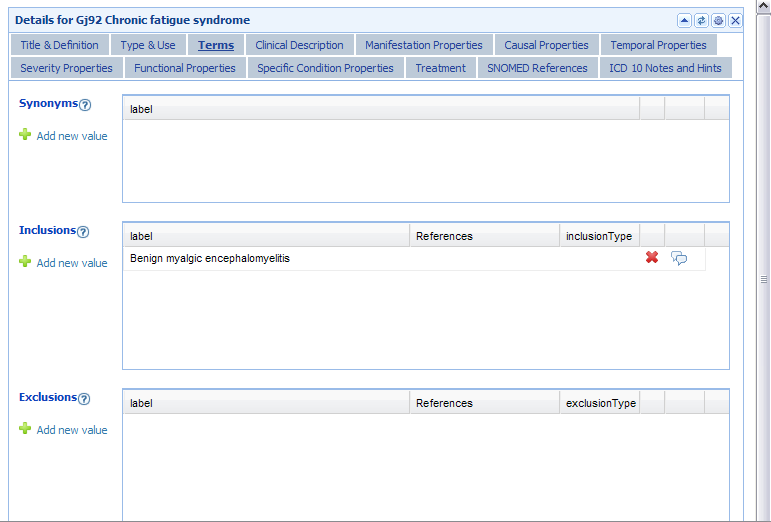
3] That “Benign myalgic encephalomyelitis” had been specified as an Inclusion term to ICD-11 Title term “Chronic fatigue syndrome” but that the relationships between the three terms, PVFS, (B) ME and CFS had yet to be specified, as in this screenshot from June 2010:

https://dxrevisionwatch.com/wp-content/uploads/2010/05/2icatgj92cfsterms.png


What is currently showing in the Chapter 6 Foundation Component?

It isn’t possible to bring up a discrete ICD Title listing for either “Benign myalgic encephalomyelitis” or “Postviral fatigue syndrome” in either the Foundation Component or the Linearization.

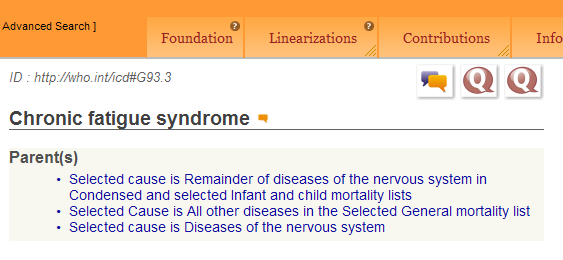
In the Foundation view only, for Chapter 6: Diseases of the nervous system, “Chronic fatigue syndrome” is listed as a Title term with the ICD-10 legacy ID “ID:http://who.int/icd#G93.3”;

the Definition field is currently blank;

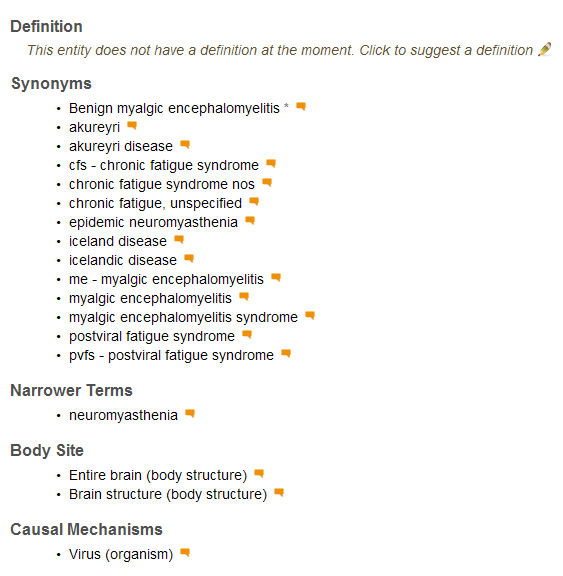
a list of terms has recently been added under “Synonyms”;

one term has recently been added under “Narrower Terms”.

(Note: there is a small asterisk at the end of term “Benign myalgic encephalomyelitis” which is listed at the top of the “Synonyms” list. The asterisk “Hover text” reads “This term is an inclusion term in the linearizations.”)

If you want to view the listing directly on the Browser site (note the “Comment” and “Questions” icons which open up pop-up windows next to terms for reading/commenting won’t display unless you have already registered and logged in) go here:

ICD-11 Alpha Browser Foundation view:

http://apps.who.int/classifications/icd11/browse/f/en#/http%3a%2f%2fwho.int%2ficd%23G93.3

ID:http://who.int/icd#G93.3

Chronic fatigue syndrome

Parent(s)

Selected cause is Remainder of diseases of the nervous system in Condensed and selected Infant and child mortality lists
Selected Cause is All other diseases in the Selected General mortality list
Selected cause is Diseases of the nervous system

Definition

This entity does not have a definition at the moment.

Synonyms

Benign myalgic encephalomyelitis *  [Ed: Hover text over asterisk reads: “This term is an inclusion term in the linearizations.”]
akureyri
akureyri disease
cfs – chronic fatigue syndrome
chronic fatigue syndrome nos   [Ed: from current proposals for ICD-10-CM, Chapter 18, R53.82]
chronic fatigue, unspecified   [Ed: from current proposals for ICD-10-CM, Chapter 18, R53.82]
epidemic neuromyasthenia
iceland disease
icelandic disease
me – myalgic encephalomyelitis
myalgic encephalomyelitis
myalgic encephalomyelitis syndrome
postviral fatigue syndrome
pvfs – postviral fatigue syndrome

Narrower Terms

neuromyasthenia

Body Site

Entire brain (body structure)
Brain structure (body structure)

Causal Mechanisms

Virus (organism)


What’s new in Chapter 5: Mental and behavioural disorders?

As reported in Dx Revision Watch post: http://wp.me/pKrrB-1Vx,  the category “Somatoform Disorders” in Chapter 5, Mental and behavioural disorders is currently renamed to “BODILY DISTRESS DISORDERS”, under which currently sit three new child categories:

5M0 Mild bodily distress disorder
5M1 Moderate bodily distress disorder
5M2 Severe bodily distress disorder.

Chapter 5 Linearization view:

http://apps.who.int/classifications/icd11/browse/l-m/en#/http%3a%2f%2fwho.int%2ficd%23F45

Chapter 5 Foundation view:

http://apps.who.int/classifications/icd11/browse/f/en#/http%3a%2f%2fwho.int%2ficd%23F45

(Click on the little grey arrows to display the child categories):

Child categories to parent “BODILY DISTRESS DISORDERS”:

http://apps.who.int/classifications/icd11/browse/f/en#/http%3a%2f%2fwho.int%2ficd%231905_dd0250d2_e8cd_4c48_a93f_7997cc1c8b07

BODILY DISTRESS DISORDERS

5M0 Mild bodily distress disorder
5M1 Moderate bodily distress disorder
5M2 Severe bodily distress disorder
5M3 Somatization disorder
5M4 Undifferentiated somatoform disorder
5M5 Somatoform autonomic dysfunction
5M6 Persistent somatoform pain disorder
      > 5M6.0 Persistent somatoform pain disorder
      > 5M6.1 Chronic pain disorder with somatic and psycological [sic] factors
5M7 Other somatoform disorders
5M8 Somatoform disorder, unspecified

None of these three new (proposed) categories have had any Definitions or other textual content added to the description panels on the right hand side of the Alpha Browser page since I first reported this change in February.

It is still not possible to determine what disorders ICD-11 intends might be captured by these three new (proposed) terms, should ICD-11 Revision Steering Group and WHO classification experts consider these terms to be valid constructs and approve their progression through to the Beta draft.

Because no “Change Notes” or “Change history” pop-up windows display in this version of the Alpha Drafting browser, it is not possible to determine:

whether ICD-11 is proposing to introduce three new terms – 5M0 Mild bodily distress disorder; 5M1 Moderate bodily distress disorder; 5M2 Severe bodily distress disorder, in addition to retaining existing ICD-10 terms, 5M3 thru 5M8;

how ICD Revision intends to define these (proposed) new terms at 5M0, 5M1, 5M2;

how these three (proposed) new terms would relate to the existing ICD-10 “Somatoform Disorders” categories which remain listed as child categories to “BODILY DISTRESS DISORDERS” (apart from “Hypochondriacal disorder” [ICD-10: F45.2], which is now listed as “5H0.5 Illness Anxiety Disorder” in the ICD-11 Alpha Draft).

(See Page 1 and 2 of my report: “Bodily Distress Disorders” to replace “Somatoform Disorders” for ICD-11?: http://wp.me/pKrrB-1Vx  )


References:

ICD-11 Revision: http://www.who.int/classifications/icd/revision/en/

ICD-11 Alpha Browser User Guide: http://www.who.int/classifications/icd/revision/caveat/en/index.html
Alpha Browser Foundation view: http://apps.who.int/classifications/icd11/browse/f/en#
Alpha Browser Linearization view: http://apps.who.int/classifications/icd11/browse/l-m/en#
“Bodily Distress Disorders” to replace “Somatoform Disorders” for ICD-11?: http://wp.me/pKrrB-1Vx

HHS proposes one year delay for ICD-10-CM compliance

HHS proposes one year delay for ICD-10-CM compliance

Post #156 Shortlink: http://wp.me/pKrrB-22q

Yesterday, April 9, the US Department of Health and Human Services issued a proposed rule calling for a one year delay in the ICD-10-CM/PCS compliance deadline.

According to a Centers for Medicare and Medicaid Services (CMS) press release, the proposed rule would postpone the compliance date by which providers and industry have to adopt ICD-10-CM by one year, from October 1, 2013 to October 1, 2014. 

Official publication of the proposed rule is expected to be published in the Federal Register on April 17, followed by a 30 day period during which CMS will take comments.

Full proposal document (pre-publication PDF version)

      http://www.ofr.gov/OFRUpload/OFRData/2012-08718_PI.pdf

or at:

https://s3.amazonaws.com/public-inspection.federalregister.gov/2012-08718.pdf

This document is scheduled to be published in the
Federal Register on 04/17/2012 and available online at
http://federalregister.gov/a/2012-08718 , and on FDsys.gov

Press release issued April 9, 2012:

http://www.hhs.gov/news/press/2012pres/04/20120409a.html

Details for: NEW HEALTH CARE LAW PROVISIONS CUT RED TAPE, SAVE UP TO $4.6 BILLION

For Immediate Release: Monday, April 09, 2012
Contact: CMS Office of Public Affairs
202-690-6145

NEW HEALTH CARE LAW PROVISIONS CUT RED TAPE, SAVE UP TO $4.6 BILLION

Department of Health and Human Services (HHS) Secretary Kathleen Sebelius today announced a proposed rule that would establish a unique health plan identifier under the Health Insurance Portability and Accountability Act of 1996 (HIPAA). The proposed rule would implement several administrative simplification provisions of the Affordable Care Act.

The proposed changes would save health care providers and health plans up to $4.6 billion over the next ten years, according to estimates released by the HHS today. The estimates were included in a proposed rule that cuts red tape and simplifies administrative processes for doctors, hospitals and health insurance plans.

“The new health care law is cutting red tape, making our health care system more efficient and saving money,” Secretary Sebelius said. “These important simplifications will mean doctors can spend less time filling out forms and more time seeing patients.”

Currently, when health plans and entities like third party administrators bill providers, they are identified using a wide range of different identifiers that do not have a standard length or format. As a result, health care providers run into a number of time-consuming problems, such as misrouting of transactions, rejection of transactions due to insurance identification errors, and difficulty determining patient eligibility.

The rule simplifies the administrative process for providers by proposing that health plans have a unique identifier of a standard length and format to facilitate routine use in computer systems. This will allow provider offices to automate and simplify their processes, particularly when processing bills and other transactions.

The proposed rule also delays required compliance by one year– from Oct. 1, 2013, to Oct. 1, 2014– for new codes used to classify diseases and health problems. These codes, known as the International Classification of Diseases, 10th Edition diagnosis and procedure codes, or ICD-10, will include new procedures and diagnoses and improve the quality of information available for quality improvement and payment purposes.

Many provider groups have expressed serious concerns about their ability to meet the Oct. 1, 2013, compliance date. The proposed change in the compliance date for ICD-10 would give providers and other covered entities more time to prepare and fully test their systems to ensure a smooth and coordinated transition to these new code sets.

The proposed rule announced today is the third in a series of administrative simplification rules in the new health care law. HHS released the first in July of 2011 and the second in January of 2012, and plans to announce more in the coming months.

More information on the proposed rule is available on fact sheets at

http://www.cms.gov/apps/media/fact_sheets.asp

The proposed rule may be viewed at www.ofr.gov/inspection.aspx . Comments are due 30 days after publication in the Federal Register.

Media coverage:

MedPage Today

HHS Announces ICD-10 Delay

Joyce Frieden, News Editor, MedPage Today | April 09, 2012


ICD10 Watch

Breaking News: HHS proposes 1-year delay in ICD-10 implementation deadline

Carl Natale | April 09, 2012


Healthcare Finance News

HHS proposes one-year ICD-10 delay

Tom Sullivan, Government Health IT | April 10, 2012