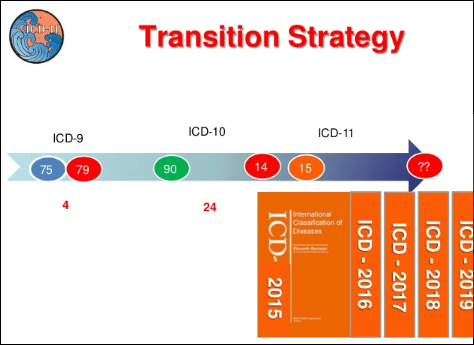
WHO considers further extension to ICD-11 development timeline

Post #275 Shortlink: http://wp.me/pKrrB-3sc

Information in this report relates to the World Health Organization’s ICD-11, currently under development. It does not apply to the current ICD version (ICD-10) or to the forthcoming US specific “clinical modification” of ICD-10, known as ICD-10-CM.

Timeline slippage

Documents posted recently by the World Health Organization (WHO) indicate that ICD Revision is failing to meet development targets and a further extension to the ICD-11 timeline is under consideration.

ICD serves as the international health information standard for the collection, classification, processing and presentation of disease-related data in national and global health statistics.

The 10th edition (ICD-10) was adopted by the World Health Assembly in 1990.

The development process for the next edition (ICD-11) began in April 2007, with ICD-11 scheduled for dissemination by 2012 and the timelines for the development of ICD-11 and DSM-5 running more or less in parallel [1] [2].

Early on in the revision process, the ICD-11 dissemination date was extended. By 2009, the final draft was scheduled for World Health Assembly (WHA) approval in 2014. In order to be ready for global implementation in 2015, the technical work on ICD-11 would need to be completed by 2012 [3].

The WHA approval date was subsequently shunted from 2014 to 2015 – four years later than originally planned and the current, projected implementation date is 2016+.
+++

“…And just a small detail: who will do all this work?” [4]

ICD-11 is a very ambitious and under-resourced project. Given the scale of the undertaking, the technical complexity, the limited funding and human resources, the feasibility of the project reaching its targets by May 2015 has proved unrealistic.

I have written a number of times on this site that I did not envisage dissemination of ICD-11 by 2016 without some scaling back of the project’s scope – or an announcement, at some point this year, of a further extension to the timeline.

ICD-11 Revision Steering Group considers its options

WHO has recently posted a meeting materials document [5] and a slide presentation [6] which summarize, inter alia, ICD-11’s progress, current development status and timelines for finalization date and approval by WHO Governing Bodies.

ICD Revision is considering extending the timeline by up to a couple of years.

This 14 page document Committee for the Coordination of Statistical Activities, Twenty-second Session 4-6 September 2013, Items for discussion and decision: Item 8 of the provisional agenda can be downloaded here

or opened on Dx Revision WatchPDF: SA-2013-12-Add1-Health-WHO

It summarizes the status of the ICD Revision process under section headings:

1. Background: need and mandate
2. General organization structure of the multiple streams of work
3. Progress and current status
4. The remaining steps
5. Further maintenance of ICD after finalization
6. Timelines for the finalization date and approval by WHO Governing Bodies

Extracts from the document setting out the rationale and options for postponement of WHA Approval:

[…]

3. Progress and Current Status of ICD Revision:

[…]

BETA PHASE:

At this point in time, 1 September 2013, an ICD2013 Beta version has been produced for review purposes and field trials after 6 years of drafting phases.

The current ICD 2013 Beta version has relatively stable classification lists (i.e. linearizations) for Mortality and Morbidity recording. It will be reviewed by the specific Mortality Reference Group and the Morbidity Reference Group to see how well it fits the purpose and proposed transition from ICD‐10.

In addition, the Beta version has planned processes for:

(i) Systematic international scientific peer review
(ii) Submission of additional proposals from public groups and scientists
(iii) Conducting field trials for its applicability and reliability
(iv) Production support in multiple languages (translations) starting with WHO official languages
(v) Preparations for transitions from ICD‐10 to ICD‐11.

[…]

6. Timelines

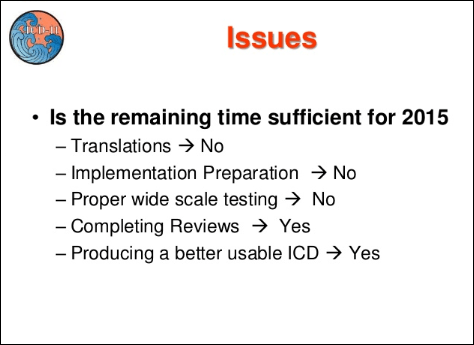
The current ICD Revision Process timeline foresees that the ICD is submitted to the WHA in 2015 May and could then be implemented. Between now and 2015, there remains 20 months to conduct the remaining tasks summarized above as: 1. Reviews, 2. Additional Proposals, 3. Field Trials, 4. Translations, and 5. Transition Preparations.

Given the technical requirements these steps could be expedited in the next 20 months. The experience obtained thus far, however, suggests that this timeframe will be extremely tight for paying due diligence to the work especially in terms of: appropriate consultations with expert groups; communication and dissemination with stakeholders; and sufficient time for field testing in multiple countries and settings, and carrying out the resulting edits.

WHO Secretariat would like to discuss this with all stakeholders and evaluate the possible options:

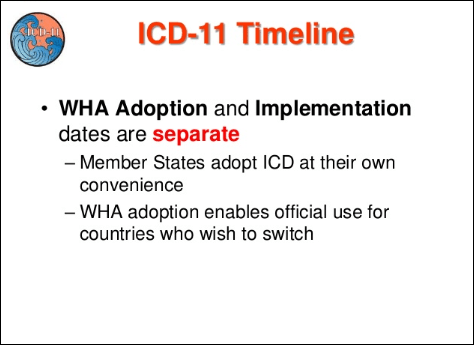
a. Keep ICD submission to WHA to 2015 as originally planned and implementation / adoption date may be free by any Member State (current position – no change).

b. Postpone submission to WHA to a later year to allow longer time for field trials and other transition preparations.

[…]

In conclusion:

(a) WHO Secretariat could produce an ICD 2015 ready including Mortality and Morbidity Linearizations, Reference Guide and Index with the appropriate resolution to go to the World Health Assembly. This timeframe, however, is extremely tight for paying due diligence to the work especially in terms of: appropriate consultations with expert groups; and sufficient time for field testing in multiple countries and settings, and carrying out the resulting edits

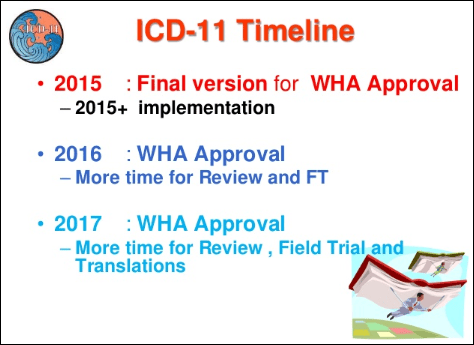
(b) If the timeline is advanced to 2016, there will be more time to have ICD 2016 version with more translations and incorporations of some field tests results.

(c) If the timeline is advanced to 2017, ICD 2017 will be ready with most Field Test results incorporated and maintenance scheme tested.

[…]

If WHO/ICD-11 Revision Steering Group does elect to postpone submission for WHA approval until May 2017, dissemination of ICD-11 may not be scheduled before 2018.

Once approved and released, adoption of ICD-11 won’t happen overnight. It may take several years before WHO Member States adopt ICD-11. Low resource and developing countries may also take longer to prepare for and transition to the new edition.

Note for US readers: According to Page 3332 of DHSS Office of Secretary Final Rule document (Federal Register / Vol. 74, No. 11 / Friday, January 16, 2009 / Rules and Regulations):

“…We [ICD-9-CM Coordination and Maintenance Committee] discussed waiting to adopt the ICD-11 code set in the August 22, 2008 proposed rule (73 FR 49805)…

“…However, work cannot begin on developing the necessary U.S. clinical modification to the ICD-11 diagnosis codes or the ICD-11 companion procedure codes until ICD-11 is officially released. Development and testing of a clinical modification to ICD-11 to make it usable in the United States will take an estimated additional 5 to 6 years. We estimated that the earliest projected date to begin rulemaking for implementation of a U.S. clinical modification of ICD-11 would be the year 2020.” [7]

This projection, in early 2009, would have been based on the assumption that ICD-11 was anticipated to be finalized and submitted for WHA Approval by 2014 (now potentially shifting to 2017).

An additional two year delay in the finalization of the ICD-11 code sets would likely impact on the development process for a clinical modification of ICD-11 for US specific use, kicking adaptation and implementation of an ICD-11-CM even further down the road.

+++
This slide presentation, below, was uploaded to Slideshare on September 9 by Dr Bedirhan Üstün, Coordinator, Classification, Terminology and Standards, World Health Organization, and also sets out the postponement options now under consideration:

Slide presentation: World Health Organization Classifications, Terminologies, Standards

ICD Revision: Quality Safety Meeting 2013 September 9-10

Where are we? What remains to be done? Shall we have ICD WHA submission in 2015 or later?

http://www.slideshare.net/ustunb/icd-2013-qs-tag-26027668

Slide 29:
Ustun 29rule

Slide 30:

Ustun 30rule

Slide 34:

Ustun 34rule

Slide 35: [WHA Approval – options under consideration]
Ustun 35rule
+++

References

1. Agenda Item No. 25: Revision of the International Classification of Diseases (ICD-10) and Involvement of Psychology International Union of Psychological Science Committee on International Relations Action, March 28–30, 2008 IUPsyS Mar 08 Agenda Item 25 ICD-10

2. Letter Saxena, WHO, to Ritchie, IUPsyS (International Union for Psychological Science), August 2007 Exhibit 1 WHO Letter Aug 07

3. Dr Geoffrey Reed, Ph.D., May 2009, personal correspondence.

4. Closing remarks, PowerPoint presentation: “Proposal for the ICD Beta Platform”, Stanford team, 12.04.11, WHO, Geneva.

5. Committee for the Coordination of Statistical Activities, Twenty-second Session 4-6 September 2013, Items for discussion and decision: Item 8 of the provisional agenda, 3 September 2013 Full document in PDF format

6. Slide presentation: ICD Revision: Where are we? Bedirhan Ustun, World Health Organization Classifications, Terminologies, Standards, ICD Revision: Quality Safety Meeting 2013, September 9-10, 2013 http://www.slideshare.net/ustunb/icd-2013-qs-tag-26027668

7. DHSS Office of Secretary Final Rule document (Federal Register / Vol. 74, No. 11 / Friday, January 16, 2009 / Rules and Regulations), Page 3332.

ICD-11 Round up: April #1

ICD-11 Round up: April #1

Post #239 Shortlink: http://wp.me/pKrrB-2Qy

[PMID 23583019]

The Lancet, Early Online Publication, 11 April 2013
doi:10.1016/S0140-6736(12)62191-6

Proposals for mental disorders specifically associated with stress in the International Classification of Diseases-11

Maercker A, Brewin CR, Bryant RA, Cloitre M, Reed GM, Ommeren MV, Humayun A, Jones LM, Kagee SA, Llosa AE, Rousseau C, Somasundaram DJ, Souza R, Suzuki Y, Weissbecker I, Wessely SC, First MB, Saxena S.

Mental disorders specifically associated with stress are exceptional in needing external events to have caused psychiatric symptoms for a diagnosis to be made. The specialty of stress-associated disorders is characterised by lively debates, including about the extent to which human suffering should be medicalised, 1 and the purported overuse of the diagnosis of post-traumatic stress disorder (PTSD). 2 Most common mental disorders are potentiated or exacerbated by stress and childhood adversity…

Contributors
AM, CRB, RAB, MC, GMR, MvO, SW, MBF, and SS were the core writing group. AH, LJ, SAK, AEL, CR, DS, RS, YS, and IW discussed the text and gave feedback to the core writing group.
Conflicts of interest
AM, CRB, RAB, MC, AH, LJ, SAK, CR, DS, SCW, and YS are members of the WHO ICD-11 Working Group on the Classification of Disorders Specifically Associated with Stress, reporting to the WHO International Advisory Group for the Revision of ICD-10 Mental and Behavioural Disorders. GMR, MvO, and SS are members of the WHO Secretariat, Department of Mental Health and Substance Abuse. AEL, RS, IW, and MBF are special invitees to Working Group meetings. However, the views expressed in this article are those of the authors and, except as specifically noted, do not represent the official policies or positions of the International Advisory Group or WHO.
[Subscription required for full paper. A PDF may be available on authors’ personal websites or academic websites.]

+++

According to CDC’s, Donna Picket, as reported by AHIMA (American Health Information Management Association), “ICD-11 would likely not be ready for implementation in the US until after 2020.”

AHIMA

Update: ICD-11 on Track For 2015

Melanie Endicott | AHIMA & ICD-10 & ICD-10/CAC Summit | April 23, 2013

While the United States is preparing to implement ICD-10-CM/PCS on October 1, 2014, the World Health Organization (WHO) is anticipating a 2015 release of ICD-11. Taking into account the need to then clinically modify the WHO version, ICD-11 would likely not be ready for implementation in the US until after 2020. Donna Pickett, MPH, RHIA, medical systems administrator at Centers for Disease Control and Prevention/National Center for Health Statistics, delivered an update on the progress of ICD-11 development in Monday’s presentation “ICD-11 Update” at the 2013 AHIMA ICD-10-CM/PCS and Computer-Assisted Coding Summit, taking place in Baltimore, MD this week...  Read on

+++

Go here to view ICD-11 Beta drafting platform public version

http://www.who.int/classifications/icd/revision/betaexpectations/en/

ICD-11 Beta: Expectations, Concerns and Known Issues

Information for Beta Participants

ICD-11 Beta Phase started on 14 May 2012. The objective is to have a final ICD-11 version by 2015. This announcement clarifies that ICD-11 Beta version is not final, and will be enhanced by input from multiple stakeholders during the beta phase, which will last 3 years.

Caveats
Problems and Issues
Concerns and Criticisms etc

http://www.who.int/classifications/icd/revision/en/index.html

Revision

Participate in ICD Revision
Video invitation to participate
Frequently Asked Questions About ICD-11
ICD Information Sheet
ICD Revision Information Notes
Register to become involved
Timelines
Content Model
Definitions etc

+++

Presentation | T Bedirhan Üstün

ICD Revision Summary presentation: Quality and Safety Topic Advisory Group meeting, New York, April 2-3, 2013.

ICD11 Quality and Safety TAG 2013 Presentation | Slideshare

According to this presentation, by WHO’s Bedirhan Üstün, all ICD-11 Topic Advisory Groups (TAGs) have finished their editing of the structure. A good deal of work remains for the population of content, in accordance with the ICD-11 Content Model, across all chapters and on compatibility of linearizations across primary care, specialty and detailed research versions.

+++

Presentation [PDF Format, no PP viewer required]

Revising the ICD Definition of Intellectual Disability: Implications and Recommendations | March 19, 2013

Intellectual Disability’s Long Journey: George Jesien, Ph.D., Executive Director, Association for University Centers on Disabilities (AUCD)
Intellectual Disability and the Revision of ICD-10 Mental and Behavioural Disorders: Geoffrey M. Reed, Department of Mental Health and Substance Abuse, WHO
AAIDD Proposed Recommendations for ICD-11: Marc J. Tassé, Nisonger Center – UCEDD, The Ohio State University, Webinar

On Slides 17 and 18, Classification System Most Used and Classification Most Used by Country, graphics for data from WPA-WHO Survey of Practicing Psychiatrists* on global use of ICD-10, ICD-8/9, DSM-IV and Other diagnostic system(s).

*World Psychiatry. 2011 Jun;10(2):118-31.

The WPA-WHO Global Survey of Psychiatrists’ Attitudes Towards Mental Disorders Classification.

Reed GM, Mendonça Correia J, Esparza P, Saxena S, Maj M.

Abstract

Full free paper

+++

Medscape

Schizophrenia Bulletin

Schizophr Bull.2012;38(5):895-898.

Status of Psychotic Disorders in ICD-11

Wolfgang Gaebel

Abstract and full report

+++

ICD-11 Beta draft and Bodily Distress Disorders; Per Fink and Bodily Distress Syndrome: Parts One and Two

ICD-11 Beta draft and Bodily Distress Disorders; Per Fink and Bodily Distress Syndrome Parts One and Two

Post #222 Shortlink: http://wp.me/pKrrB-2Dz

Caveats: The ICD-11 Beta drafting platform is not a static document: it is a work in progress, subject to daily edits and revisions, to field test evaluation and to approval by Topic Advisory Group Managing Editors, the ICD Revision Steering Group and WHO classification experts. The current draft may differ to the information in this report.

Part One

On January 6, I posted a brief update on proposals for the revision of ICD-10’s Somatoform Disorders based on what can be seen in the public version of the ICD-11 Beta drafting platform and on a book chapter by Professor, Sir David Goldberg. [1]

Professor Goldberg chairs the working group for revision of the mental health chapter of ICD-1o-PHC, the abridged, primary care version of ICD-10.

For the revision of ICD-10’s Somatoform Disorders sections for ICD-11, a WHO Expert Working Group on Somatic Distress and Dissociative Disorders has been assembled.

Professor Francis Creed (also a member of the DSM-5 Somatic Symptom and Related Disorders Work Group) is a member of this WHO working group, which is chaired by Professor Oye Gureje.

An April 2011 announcement by Stony Brook Medical Center states that Dr Joan E. Broderick, PhD had been appointed to the WHO Expert Working Group on Somatic Distress and Dissociative Disorders and that the first meeting of the group (said to consist of 17 international behavioral health professionals) was expected to be held in June 2011, in Madrid.

WHO has not published a list of  members of this working group or any progress reports and the names and affiliations of the 14 other members are unknown, so I am unable to confirm whether Professor Per Fink is a member of the group, which reports to the International Advisory Group for the Revision of ICD-10 Mental and Behavioural Disorders.

ICD-11 and Bodily Distress Disorders

ICD-11 is currently scheduled for completion in 2015/16. When viewing the public version of the Beta drafting platform please bear in mind the ICD-11 Revision Caveats: that the Beta draft is a work in progress, updated daily, is incomplete, may contain errors and is subject to change; not all proposals may be approved by the ICD-11 Revision Steering Committee or WHO classification experts, or retained following analysis of ICD-11 and ICD-11-PHC field trials.

The Bodily Distress Disorders section of ICD-11 Beta draft Chapter 5 can be found here:

Foundation View: http://apps.who.int/classifications/icd11/browse/f/en#/http%3a%2f%2fid.who.int%2ficd%2fentity%2f1472866636
Linearization View: http://apps.who.int/classifications/icd11/browse/l-m/en#/http%3a%2f%2fid.who.int%2ficd%2fentity%2f1472866636

As the ICD-11 Beta drafting platform stands at the time of compiling this report, the existing ICD-10 Somatoform Disorders are proposed to be subsumed under or replaced by Bodily Distress Disorders, and Psychological and behavioural factors associated with disorders or diseases classified elsewhere.

The following proposed ICD-11 categories are listed as child categories under parent term, Bodily Distress Disorders, and Psychological and behavioural factors associated with disorders or diseases classified elsewhere:

EC5 Mild bodily distress disorder
EC6 Moderate bodily distress disorder
EC7 Severe bodily distress disorder
EC8 Psychological and behavioural factors associated with disorders or diseases classified elsewhere

No Definition or any other Content Model parameters have been populated for the proposed categories EC5, EC6 and EC7, which are new entities to ICD. (EC8 is a legacy category from ICD-10.)

Note that the sorting codes assigned to categories are subject to frequent change as chapters are reorganized.

From the information currently displaying in the Beta draft, it is not possible to determine:

• how ICD-11 proposes to define Bodily Distress Disorders;

• what diagnostic criteria are being proposed;

whether diagnostic criteria would be based on a requirement for excessive or disproportionate psychological and behavioral characteristics in response to distressing somatic symptoms, such as illness anxiety, symptom focusing, catastrophising, maladaptive coping strategies, avoidance behavior or misattribution; or based on somatic symptom counts, or specific symptom clusters, or number of bodily systems affected, or a combination of these;

how the three Severity Specifiers: Mild, Moderate and Severe would be categorized;

• how the three Severities would be assessed for within primary and secondary care;

whether ICD-11’s proposed Bodily Distress Disorder construct is intended to mirror or incorporate DSM-5’s Somatic Symptom Disorder (SSD) construct, in line with ICD-11/DSM-5 harmonization, or

whether it is intended to mirror or incorporate Per Fink’s Bodily Distress Syndrome (BDS) construct, or to combine elements from both;

whether the Bodily Distress Disorder construct is proposed only to be applied to patients with distressing ‘medically unexplained somatic symptoms’ (MUS), or the so-called ‘Functional somatic syndromes’ (FSS), if the patient is considered to also meet the BDD criteria, or

whether it is proposed to be inclusive of patients with distressing somatic symptoms in the presence of diagnosed illness and general medical conditions, if the patient is considered to also meet the criteria;

• whether the Bodily Distress Disorder construct is proposed to be inclusive of parents or caregivers perceived as encouraging maintenance of sick role behavior or over-involved.

whether the Bodily Distress Disorder construct is proposed to be inclusive of children;

whether it is proposed that all or selected of the following: Neurasthenia and Fatigue syndrome (F48.0), Chronic fatigue syndrome (indexed to G93.3 in ICD-10; classified in ICD-11 Beta draft as an ICD Title term in Chapter 6: Diseases of the nervous system), IBS (K58), and Fibromyalgia (M79.7) should be reclassified under Bodily Distress Disorders;

• whether the Bodily Distress Disorder construct is proposed to subsume ICD-10’s Hypochondriacal disorder with somatic symptoms or incorporate this entity under Illness Anxiety Disorder for ICD-11.

(For ICD-11, ICD-10’s Hypochondriacal disorder [F45.2] is currently proposed to be renamed to Illness Anxiety Disorder and located underANXIETY AND FEAR-RELATED DISORDERS.)

 • what ICD-11 proposes to do with ICD-10’s Neurasthenia;

(ICD-10’s Chapter V Neurasthenia [F48.0] is no longer listed in the public version of the ICD-11 Beta draft. For ICD-11-PHC, the primary care version of ICD-11, the proposal is for the term Neurasthenia to be eliminated. Since terms used in ICD-11-PHC require corresponding terms in the main classification, the intention may be to eliminate Neurasthenia from the main version, or subsume under another term.) [2]

All that can be determined from the Beta draft is that these earlier ICD-11 Beta draft Somatoform Disorders categories appear proposed to be subsumed under or replaced with the new BDD categories, EC5, EC6 and EC7, set out above:

Somatization disorder [F45.0 in ICD-10]
Undifferentiated somatoform disorder [F45.1 in ICD-10]
Somatoform autonomic dysfunction [F45.3 in ICD-10]
Persistent somatoform pain disorder [F45.4 in ICD-10]
    > Persistent somatoform pain disorder
    > Chronic pain disorder with somatic and psychological factors [Not in ICD-10]
Other somatoform disorders [F45.8 in ICD-10]
Somatoform disorder, unspecified [F45.9 in ICD-10]

I have previously reported that for ICD-11-PHC, the proposal, last year, was for a new disorder section called Bodily distress disorders, under which would sit new category Bodily stress [sic] syndrome.

This category is proposed for the ICD-11 primary care version to include “milder somatic symptom disorders” as well as “DSM-5’s Complex somatic symptom disorder” and would replace “medically unexplained somatic symptoms.” [2]

In a future post (Part Three of this report), I shall be discussing emerging proposals for the ICD-11 construct, Bodily Distress Disorders, which may serve to fill in some of the gaps.

In the meantime, since it is unclear whether and to what extent the ICD-11 Bodily Distress Disorders category is proposed to mirror or incorporate the Bodily Distress Syndrome construct developed by Per Fink et al, Aarhus, Denmark, I am providing some material on Bodily Distress Syndrome in Part Two

New domain for Dx Revision Watch and new Twitter address

New domain for Dx Revision Watch and new Twitter address

Post #199 Shortlink: http://wp.me/pKrrB-2rE

Please note the domain for this site has changed to

http://dxrevisionwatch.com

Previous links to posts and pages are being mapped across to this domain but you may like to update Bookmarks and update links to the Home Page on websites and blogs.

The Twitter page associated with this site has also changed from

http://twitter.com/meagenda

to

http://twitter.com/dxrevisionwatch

@dxrevisionwatch

These are voluntary changes and not related to the threats of legal action issued on behalf of American Psychiatric Publishing, A Division of American Psychiatric Association, which forced a domain and site name change, last December [1].

1] Media coverage: American Psychiatric Association (APA) “cease and desist” v DSM-5 Watch website; Legal information and resources for bloggers and site owners

Slide presentation: Per Fink: Somatoform disorders – functional somatic syndromes – Bodily distress syndrome (EACLPP lecture, June 2012)

Slide presentation: Per Fink: Somatoform disorders – functional somatic syndromes – Bodily distress syndrome (EACLPP lecture, June 2012)

Post #197 Shortlink: http://wp.me/pKrrB-2pN

Slide presentation: Per Fink: Somatoform disorders – functional somatic syndromes – Bodily distress syndrome (EACLPP lecture, June 2012)

23 slides in PDF format (i.e. no PowerPoint viewer required)

       EACLPP Per Fink Somatoform Disorders

Aarhus University Hospital

The Research Clinic for Functional Disorders and Psychosomatics

Somatoform disorders – functional somatic syndromes – Bodily distress syndrome.

Need for care and organisation of care in an international perspective – EACLPP Lecture

Prof. Per Fink

MD, Ph.D, Dr.Med.Sc.

www.functionaldisorders.dk

+++

June 2012 EACLPP Annual Conference*

*The European Association of Consultation-Liaison Psychiatry and Psychosomatics (EACLPP) and the European Network of Psychosomatic Medicine (ECPR) have recently merged the two associations to create a new society – the European Association of Psychosomatic Medicine (EAPM).

The Annual Scientific Meeting of the European Association for Consultation-Liaison Psychiatry and Psychosomatics (EACLPP) and the European Conference on Psychosomatic Research (ECPR) was entitled

“Towards a New Agenda: Cross-disciplinary Approach to Psychosomatic Medicine”

The conference was held in the city of Aarhus, Denmark, on 27 – 30 June 2012.

For last year’s conference, a report was published. I will post any report coming out of this year’s conference.

A Conference Abstract document be accessed here:

http://www.eaclpp-ecpr2012.dk/Home/DownloadOral

Selected Extracts:

Page 61 Nagel A

Department of Psychosomatic Medicine and Psychotherapy, University Medical Center Hamburg-Eppendorf & Schön Klinik Hamburg-Eilbek, Germany, Voigt K Department of Psychosomatic Medicine and Psychotherapy, University Medical Center Hamburg- Eppendorf & Schön Klinik Hamburg-Eilbek, Germany

Diagnostic validity of Complex Somatic Symptom Disorder: Which combination of psychological criteria is best suited for DSM-5?

Page 17 Budtz-Lilly A

The Research Unit for General Practice, School of Public Health, Aarhus University, Denmark

Bodily Distress Syndrome: A new diagnosis for functional disorders in primary care

Page 19 Escobar J

Robert Wood Johnson Medical School, New Brunswick, NJ, USA

An Update on DSM-5

Page 32 Fjorback L

Aarhus University Hospital, Research Clinic for Functional Disorders and Psychosomatics

Mindfulness Therapy for Bodily Distress Syndrome – randomized trial, one-year follow-up, active control

+++

Notes on Fink et al and Bodily Distress Syndrome (BDS)

According to Fink and colleagues, Bodily Distress Syndrome is a unifying diagnosis that encompasses somatization disorder, so-called “medically unexplained symptoms” (MUS), fibromyalgia, irritable bowel syndrome and chronic fatigue syndrome and some other conditions which they consider to be closely related, with a likely shared underlying aetiology.

See paper: Fink P, Schröder A. One single diagnosis, bodily distress syndrome, succeeded to capture 10 diagnostic categories of functional somatic syndromes and somatoform disorders J Psychosom Res. 2010 May;68(5):415-26.

See article: Per Fink,a Marianne Rosendal b Understanding and Management of Functional Somatic Symptoms in Primary Care: The Concept of Functional Somatic Symptoms

aResearch Clinic for Functional Disorders and Psychosomatics, Aarhus University Hospital, Denmark
bResearch Unit for General Practice, University of Aarhus, Denmark

See Per Fink’s clinical trial for BDS: http://clinicaltrials.gov/ct2/show/NCT01518647

See BDS clinician/patient manual: Specialised Treatment for Severe Bodily Distress Syndromes (STreSS)

According to a June 2012 EACLPP Conference Abstract, the concept of Bodily Distress Syndrome (BDS) “is expected to be integrated into the upcoming versions of classification systems.”

The potential for inclusion of Bodily Distress Disorder/Syndrome within ICD-11 could have significant implications for patients, globally, who are diagnosed with one of the so-called “functional somatic syndromes.” These proposals require very close monitoring by patient organizations in those countries that will be implementing ICD-11, post 2015.

Research and clinical professionals, patient organizations and their professional advisors can register now with ICD Revision for input into the ongoing drafting process and urge organizations and professionals to engage in this process.

Abstracts, oral presentations, EACLPP Conference: 27 – 30 June 2012, Aarhus University Campus, Aarhus – Denmark

http://www.eaclpp-ecpr2012.dk/Home/DownloadOral

Extracts

Page 17 Budtz-Lilly A

The Research Unit for General Practice, School of Public Health, Aarhus University, Denmark

Bodily Distress Syndrome: A new diagnosis for functional disorders in primary care

Aim: Medically unexplained or functional symptoms and disorders are common in primary care. Empirical research has proposed specific criteria for a new unifying diagnosis for functional disorders and syndromes: Bodily Distress Syndrome (BDS). This new concept is expected to be integrated into the upcoming versions of classification systems.

And from Page 31 of the Conference Abstracts:

Fjorback L

Aarhus University Hospital, Research Clinic for Functional Disorders and Psychosomatics

Mindfulness Therapy for Bodily Distress Syndrome – randomized trial, one-year follow-up, active control

Objective: To conduct a feasibility and efficacy trial of mindfulness therapy in somatization disorder and functional somatic syndromes such as fibromyalgia, irritable bowel syndrome, and chronic fatigue syndrome, defined as bodily distress syndrome (BDS)…

+++

References and related material:

1] Patients with medically unexplained symptoms and somatisation – a challenge for European health care systems: A white paper of the EACLPP Medically Unexplained Symptoms study group by Peter Henningsen and Francis Creed: http://www.eaclpp.org/working_groups.html
http://www.eaclpp.org/documents/Patientswithmedicallyunexplainedsymptomsandsomatisation_000.doc

2] Creed F, Guthrie E, Fink P, Henningsen P, Rief W, Sharpe M and White. Is there a better term than “Medically unexplained symptoms”? J Psychosom Res: Volume 68, Issue 1, Pages 5-8 January 2010) discusses the deliberations of the EACLPP MUS study group. Editorial also includes references to the DSM and ICD revision processes: http://www.ncbi.nlm.nih.gov/pubmed/20004295

3] Fink P, Schröder A. One single diagnosis, bodily distress syndrome, succeeded to capture 10 diagnostic categories of functional somatic syndromes and somatoform disorders. J Psychosom Res. 2010 May;68(5):415-26. The Research Clinic for Functional Disorders and Psychosomatics, Aarhus University Hospital, 8000 Aarhus, Denmark:
http://www.ncbi.nlm.nih.gov/pubmed/20403500

Fink P, Toft T, Hansen MS, Ørnbøl E, Olesen F. Symptoms and syndromes of bodily distress: an exploratory study of 978 internal medical, neurological, and primary care patients. Psychosom Med. 2007 Jan;69(1):30-9.
http://www.ncbi.nlm.nih.gov/pubmed/17244846
Full text: http://www.psychosomaticmedicine.org/content/69/1/30.full

Fink P, Rosendal, M. Recent developments in the understanding and management of functional somatic symptoms in primary care. Current Opinion in Psychiatry 2008, 21:182–188

Rosendal M, Fink P, Falkoe E, Schou Hansen H, Olesen F. Improving the Classification of Medically Unexplained Symptoms in Primary Care. Eur. J. Psychiat. v.21 n.1 Zaragoza ene.-mar. 2007
Text: http://scielo.isciii.es/scielo.php?script=sci_arttext&pid=S0213-61632007000100004
PDF: http://scielo.isciii.es/pdf/ejpen/v21n1/improv3.pdf

4] EURASMUS  http://eurasmus.net/
The multidisciplinary European Research Association for Somatisation and Medically Unexplained Symptoms(EURASMUS) was formed to study the genetic, psychological and physiological mechanisms underlying bodily distress. Co-convenors: Francis Creed, Peter Henningsen

5] Notes from EACLPP Workgroup meeting in Budapest July 2011

EACLPP_WG_Medically_Unexplained_Symptoms_Budapest_2011

Report from Working group meeting on MUS/somatisation/bodily distress, Budapest July 1st 2011

“…We should find out whether the WHO group for classification of somatic distress and dissociative disorders will provide a better diagnostic system for these disorders.”

6] Article: ‘Heartsinks’ and weird symptoms by Tony Dowell, June 15, 2011.

Article Table: Functional somatic syndromes according to medical speciality:
http://www.nzdoctor.co.nz/media/671495/heartsinks.pdf

Round up: ICD-11 PHC, ICD-11 Classification of Mood and Anxiety Disorders, Monograph: Public Health Aspects of Diagnosis and Classification of Mental and Behavioral Disorders, ASHA DSM-5 comments

Round up: ICD- 11 PHC; ICD-11 Classification of Mood and Anxiety Disorders; Monograph: Public Health Aspects of Diagnosis and Classification of Mental and Behavioral Disorders; ASHA DSM-5 comments

1] Paper: The primary health care version of ICD-11: the detection of common mental disorders in general medical settings By David P. Goldberg, James J. Prisciandaro, Paul Williams

2] The ICD-11 Classification of Mood and Anxiety Disorders: background and options (Guest Editors: Mario Maj, Geoffrey M. Reed), World Psychiatry, Volume 11, Supplement 1, June 2012

3] Monograph: Public Health Aspects of Diagnosis and Classification of Mental and Behavioral Disorders: Refining the Research Agenda for DSM-5 and ICD-11 By Shekhar Saxena, Patricia Esparza, Darrel A. Regier, Norman Sartorius

4] Submissions to DSM-5 public reviews for drafts one, two and three by The American Speech-Language-Hearing Association

Post #195 Shortlink: http://wp.me/pKrrB-2pa

This post relates to the World Health Organization’s ICD-11 and ICD-11 PHC (Primary Care version), both currently under development. It does not apply to the existing ICD-10, ICD-10 PHC or to the forthcoming US specific “clinical modification” of ICD-10, known as ICD-10-CM.

Note on ICD-10 PHC and ICD-11 PHC

ICD-10 PHC (sometimes written as ICD-10-PHC or ICD10-PHC or ICD-10 PC), is a simplified version of the WHO’s ICD-10 chapter for mental and behavioural disorders for use in general practice and primary health care settings. This system has rough but not exact equivalence to mental disorders in the core ICD-10 classification.

The ICD-10 PHC describes 25 disorders commonly managed within primary care as opposed to circa 450 classified within Chapter V of ICD-10.

A chart showing the grouping of categories adapted from the full ICD-10 version for the existing ICD-10 PHC categories can be found here.

The revision of ICD-10 PHC, ICD-11 PHC, is currently under development.

Professor, Sir David Goldberg, M.D., Emeritus Professor, Institute of Psychiatry, King’s College, London, is a member of the DSM-5 Mood Disorders Work Group. Prof Goldberg also chairs the Consultation Group for Classification in Primary Care that is making recommendations for the 28 mental and behavioural disorders proposed for inclusion in ICD-11 PHC.

The majority of patients with mental health problems are diagnosed and managed by general practitioners in primary care – not by psychiatrists and mental health specialists. ICD10-PHC is used in developed and developing countries in general medical settings and also used in the training of medical officers, nurses and multi purpose health workers.

Further information on ICD-10 PHC and the development of the mental health disorders section of ICD-11 PHC can be found in these two documents:

1] Goldberg, D. Guest editorial. A revised mental health classification for use in general medical settings: the ICD11–PHC 1. International Psychiatry, Page 1, February 2011.
http://www.rcpsych.ac.uk/pdf/IPv8n1.pdf

2] 21st Century Global Mental Health by Dr Eliot Sorel, Professor, George Washington University, Washington D.C.
Publication date: August, 2012: http://www.jblearning.com/catalog/9781449627874/
Page 51, Sample Chapter 2: http://samples.jbpub.com/9781449627874/Chapter2.pdf

ICD Revision publishes the names and bios of members of the ICD-11 Revision Steering Group, ICD-11 Topic Advisory Groups, and International Advisory Group for the Revision of ICD-10 Mental and Behavioural Disorders.

But membership of the various sub working groups to the Topic Advisory Groups (TAGs), the names of external peer reviewers recruited by TAG Managing Editors for reviewing proposals and content and the membership of the advisory/consultation groups for the revision of the ICD Primary Care version have not been published by ICD-11 Revision.

The Abstract below lists members of the (WHO) Primary Care Consultation Group for the Revision of ICD-10 Mental and Behavioural Disorders.

1] Paper: The primary health care version of ICD-11: the detection of common mental disorders in general medical settings

http://www.ghpjournal.com/article/S0163-8343(12)00197-1/abstract

The primary health care version of ICD-11: the detection of common mental disorders in general medical settings

26 July 2012

David P. Goldberg, James J. Prisciandaro, Paul Williams

David P. Goldberg
Affiliations Primary Care Consultation Group, World Health Organization; and Institute of Psychiatry, KCL, London, UK

James J. Prisciandaro
Affiliations Department of Psychiatry, Medical University of South Carolina, Charleston SC, USA
Corresponding author.

Paul Williams
Affiliations Health Services & Population Research, Institute of Psychiatry, KCL, London, UK

Received 31 January 2012; accepted 19 June 2012. published online 26 July 2012.
Corrected Proof

Abstract

Background

The primary health care version of the ICD-11 is currently being revised.

Aim
To test two brief sets of symptoms for depression and anxiety in primary care settings, and validate them against diagnoses of major depression and current generalised anxiety made by the CIDI.

Method
The study took place in general medical or primary care clinics in 14 different countries, using the Composite International Diagnostic Interview adapted for primary care (CIDI-PC) in 5,438 patients. The latent structure of common symptoms was explored, and two symptom scales were derived from item response theory (IRT), these were then investigated against research diagnoses.

Results
Correlations between dimensions of anxious, depressive and somatic symptoms were found to be high. For major depression the 5 item depression scale has marked superiority over the usual 2 item scales used by both the ICD and DSM systems, and for anxiety there is some superiority. If the questions are used with patients that the clinician suspects may have a psychological disorder, the positive predictive value of the scale is between 78 and 90%.

Conclusion
The two scales allow clinicians to make diagnostic assessments of depression and anxiety with a high positive predictive value, provided they use them only when they suspect that a psychological disorder is present.

This article is partly based on the work of the World Health Organization (WHO) Primary Care Consultation Group for the Revision of ICD-10 Mental and Behavioural Disorders, of which the first author is Chair. Other members of the group include Michael Klinkman (GP, United States; Vice Chairman); Sally Chan (nurse, Singapore), Tony Dowell (GP, New Zealand) Sandra Fortes (psychiatrist, Brazil), Linda Gask (psychiatrist, UK), KS Jacob (psychiatrist, India), Tai-Pong Lam (GP, Hong Kong), Joseph Mbatia (psychiatrist, Tanzania), Fareed Minhas (psychiatrist, Pakistan), Marianne Rosendal (GP, Denmark), assisted by WHO Secretariat Geoffrey Reed and Shekhar Saxena. The views expressed in this article are those of the authors and, except as specifically noted, are not intended to represent the official policies and positions of the Primary Care Consultation Group or of the WHO.

Competing interests: David Goldberg is a consultant for Ultrasis and advises the World Health Organization and the American Psychiatric Association.

James Prisciandaro and Paul Williams have no competing interests

PII: S0163-8343(12)00197-1

doi:10.1016/j.genhosppsych.2012.06.006

+++
2] The ICD-11 Classification of Mood and Anxiety Disorders: background and options (Guest Editors: Mario Maj, Geoffrey M. Reed), World Psychiatry, Volume 11, Supplement 1, June 2012

The PDF of this publication is free.

Note regarding references within these commentaries to DSM-5 proposals: Some of these commentaries were written prior to the release of the third DSM-5 draft for public review, in May 2012, and quote draft proposals as they had stood for the second draft.

For example, the commentary Hypochondriasis in ICD-11 by D.J. Stein, on Page 100, sets out in narrative form the DSM-5 Somatic Symptom Disorder Work Group proposals and criteria for Complex Somatic Symptom Disorder as they had stood in May 2011 and are not the most recent iteration.

DSM-5 proposals have not been finalized. Proposals as they stood in May 2012 for the third and final public review may be subject to further change before DSM-5 is published in May 2013. Please refer to the DSM-5 Development website for the most recent proposals and criteria sets for the categories and proposed categories that are discussed in these commentaries.

http://www.wpanet.org/uploads/WPA-WHO_Collaborative_Activities/WP_ICD-11%20Supplement.pdf

July 2012

The ICD-11 Classification of Mood and Anxiety Disorders: background and options (Guest Editors: Mario Maj, Geoffrey M. Reed) World Psychiatry, Volume 11, Supplement 1, June 2012

Contents

The development of the ICD-11 classification of mood and anxiety disorders

M. Maj, G.M. Reed Page 3

How global epidemiological evidence can inform the revision of ICD-10 classification of depression and anxiety disorders

L.H. Andrade, Y.-P. Wang Page 6

Specifiers as aids to treatment selection and clinical management in the ICD classification of mood disorders

D.J. Miklowitz, M.B. First Page 11

Challenges in the implementation of diagnostic specifiers for mood disorders in ICD-11

M.B. First Page 17

Cultural issues in the classification and diagnosis of mood and anxiety disorders

S. Chakrabarti, C. Berlanga, F. Njenga Page 26

Bipolar disorders in ICD-11

S.M. Strakowski Page 31

Changes needed in the classification of depressive disorders: options for ICD-11

E. Paykel, L.H. Andrade, F. Njenga, M.R. Phillips Page 37

Differentiating depression from ordinary sadness: contextual, qualitative and pragmatic approaches

M. Maj Page 43

Severity of depressive disorders: considerations for ICD-11

J.L. Ayuso-Mateos, P. Lopez-García Page 48

Dysthymia and cyclothymia in ICD-11

M.R. Phillips Page 53

Psychotic and catatonic presentations in bipolar and depressive disorders

S. Chakrabarti Page 59

Mixed states and rapid cycling: conceptual issues and options for ICD-11

M. Maj Page 65

How should melancholia be incorporated in ICD-11?

D. Moussaoui, M. Agoub, A. Khoubila Page 69

Postpartum depression and premenstrual dysphoric disorder: options for ICD-11

M.L. Figueira, V. Videira Dias Page 73

Disruptive mood dysregulation with dysphoria disorder: a proposal for ICD-11

E. Leibenluft, R. Uher, M. Rutter Page 77

Generalized anxiety disorder in ICD-11

M.K. Shear Page 82

Agoraphobia and panic disorder: options for ICD-11

D.J. Stein Page 89

Specific and social phobias in ICD-11

P.M.G. Emmelkamp Page 94

Hypochondriasis in ICD-11

D.J. Stein Page 100

+++

3] Public Health Aspects of Diagnosis and Classification of Mental and Behavioral Disorders: Refining the Research Agenda for DSM-5 and ICD-11

Note: Substantial extracts from this DSM-5 and ICD-11 monograph can be previewed online on the Amazon site via the “LOOKINSIDE!” function. Greater access to preview content is available to Amazon account holders.  Extracts can also be previewed via Google:

Preview via Amazon “LOOKINSIDE!”:

http://www.amazon.com/Aspects-Diagnosis-Classification-Behavioral-Disorders/dp/0890423490#reader_0890423490

Preview via Google Books:

http://tinyurl.com/DSM5-ICD11-Monograph

Public Health Aspects of Diagnosis and Classification of Mental and Behavioral Disorders: Refining the Research Agenda for Dsm-5 and ICD-11

By Shekhar Saxena, Patricia Esparza, Darrel A. Regier, Norman Sartorius

(c) 2012

Paperback: 303 pages
Publisher: American Psychiatric Publishing; 1 edition (April 30, 2012)

Public Health Aspects of Diagnosis and Classification of Mental and Behavioral Disorders: Refining the Research Agenda for DSM-5 and ICD-11
[Paperback]

Shekhar Saxena (Author), Patricia Esparza (Author), Darrel A. Regier (Author), Benedetto Saraceno (Author), Norman Sartorius (Author)

Shekhar Saxena, M.D.,is Director of the Department of Mental Health and Substance Abuse at the World Health Organization in Geneva, Switzerland.

Patricia Esparza, Ph.D.,is Research Professor and clinical psychologist in the Department of Psychology and Counseling at Webster University in Geneva, Switzerland.

Darrel A. Regier, M.D., M.P.H.,is Director of the American Psychiatric Institute for Research and Education and Director of the Division of Research at the American Psychiatric Association in Arlington, Virginia; and Vice-Chair of the DSM-5 Task Force.

Benedetto Saraceno, M.D.,FRCPsych,is Professor of Psychiatry and Director of the World Health Organization Collaborating Center on Mental Health of the University of Geneva in Geneva, Switzerland.

Norman Sartorius, M.D., Ph.D.,is President of the Association for the Improvement of Mental Health Programs in Geneva, Switzerland.

Book Description
Publication Date: April 30, 2012 | ISBN-10: 0890423490 | ISBN-13:
978-0890423493 | Edition: 1

“Public Health Aspects of Diagnosis and Classification of Mental and Behavioral Disorders: Refining the Research Agenda for DSM-5 and ICD-11” provides a comprehensive summary of the current state of mental health classification in the United States and internationally, fostering a better understanding of primary research and clinical needs and facilitating the efforts of service planners, researchers and trainees to address current use of psychiatric diagnosis in the public health sector. The volume reflects the proceedings of a research planning conference convened by the APA and World Health Organization (WHO) that focused on public health aspects of the diagnosis and classification of mental disorders. Highly relevant to the ongoing development of DSM-5 and ICD-11, the book includes the background papers prepared and presented by the Conference Expert Groups. The resulting collection: – Discusses the current state of mental illness prevention efforts and the role of public health in supporting them–critical topics, given that development of effective strategies to reduce mental illness around the world depends on the accuracy with which risk and protective factors can be identified, defined, and understood. – Features international perspectives on public health implications of psychiatric diagnosis, classification, and service, providing viewpoints that are broad and more globally relevant. – Views mental health education, and awareness on a macro level, including its impact on social and economic policy, forensics and the legal system, and education. This approach facilitates the continued development of a research base in community health and promotes the establishment of programs for monitoring, treating, and preventing mental illness. – Addresses many fascinating and clinically relevant issues, such as those raised by the concept and the definition of mental disorders and how these impact psychiatric services and practice by individual providers.

This collection should prove useful to the advisory groups, task forces, and working groups for the revision of these two classifications, as well as for researchers in the area of diagnosis and classification, and more generally in public health.

+++
4] Submissions to DSM-5 public reviews for drafts one, two and three by The American Speech-Language-Hearing Association (ASHA)

The American Speech-Language-Hearing Association (ASHA) represents people with speech, language, and hearing disorders and advocates for services to help them communicate effectively.

ASHA submitted comments during all three DSM-5 draft comment periods:

ASHA submission April 2010 [PDF]; June 2011 [PDF]; June 2012 [PDF]

ASHA Letter sent June 2012 [PDF]

DSM-V Revisions To Move Forward (ASHA Leader article)

all documents available from this page:

http://www.asha.org/SLP/DSM-5/

+++

Key ICD-11 links and documents

ICD-11 Beta drafting platform  |  Publicly viewable version

WHO ICD Revision  |  Main WHO website: Revision Steering Group and Topic Advisory Groups
ICD-11 Revision site  |  Revision resources [Google site currently unavailable]
ICD-11 Revision site Documents Page  |  Key revision documents and meeting materials  [Google site currently unavailable]

ICD-11 Revision Information  |
ICD-11 Timeline  |

ICD Information Sheet  |

Revision News  |
Steering Group  |
Topic Advisory Groups  |

ICD-11 YouTube Channel  |  Video reports
ICD-11 on Facebook  |
ICD-11 on Twitter  |
ICD-11 Blog  |  Not updated since October 2009

ICD-11 YouTubes collated on Dx Revision Watch ICD-11 YouTubes  |

WHO Publications

ICD-10 Tabular List online Version: 2010  |  International Statistical Classification of Diseases and Related Health Problems 10th Revision Version: 2010, Tabular List of inclusions and Chapter List

ICD-10 Volume 2: Instruction Manual  |  Volume 2 online Version: 2010 PDF Download

ICD-10 for Mental and Behavioural Disorders Diagnostic Criteria for Research  |  PDF download
ICD-10 for Mental and Behavioural Disorders Clinical Descriptions and Diagnostic Guidelines  |  PDF download

ICD-10 Volume 3: The Alphabetical Index  |  WHO does not make ICD-10 Volume 3: The Alphabetical Index available online

About the World Health Organization (WHO)

The WHO Family of International Classifications  

History of ICD