ICD-11 Revision Beta drafting process: stakeholder participation

ICD-11 Revision Beta drafting process: stakeholder participation

Post #194 Shortlink: http://wp.me/pKrrB-2nw

Information in this report relates to the World Health Organization’s ICD-11, currently under development. It does not apply to the existing ICD-10 or to the forthcoming US specific “clinical modification” of ICD-10, known as ICD-10-CM.

Update at August 2, 2012:

ICD-11 Slide Presentation:     Harrison Slides 2011 PDF 3MB

+++
Update at August 2, 2012:

Dr Robert J.G. Chalmers, co-chair and managing editor of ICD Revision Dermatology Topic Advisory Group put out a call, yesterday, on the website of the American Academy of Dermatology Association (AAD) for input into the Beta draft for Chapter 12 Diseases of the skin:

An invitation to contribute to the future of dermatology

ICD-11 Update

By Robert J.G. Chalmers

ICD-11 draft is ready for comments and criticism

By Robert J.G. Chalmers, MB, FRCP, August 01, 2012

+++

When will ICD-11 be ready for dissemination?

Slipping targets

The revision of ICD-10 and development of the structure for ICD-11 began in 2007.

ICD-11 was originally planned to be ready for dissemination by 2012, with the timelines for the revisions of ICD-10 and DSM-IV running more or less in parallel. Source: Archive documents, References [1] [2].

Very early on in the revision process, the ICD-11 dissemination date was extended from 2012 to 2015. In 2009, launch of the Beta draft was timelined for May 2011, with the final draft scheduled for submission to World Health Assembly (WPA) for approval in 2014.

In order to be ready for global implementation in 2015, the technical work on ICD-11 would need to be completed by 2012. Source: Dr Geoffrey Reed, Ph.D., May 2009, via personal correspondence.

+++

ICD-11 still at the Beta drafting stage

In early 2011, in response to slipping targets for content population and software development, ICD Revision and WHO-FIC were discussing the pros and cons of postponing the launch of a Beta drafting platform until later that year or until May 2012, and whether an interim solution might be to launch “a hybrid model of opening the revision process to public comment and suggestions at the same time not a full scale beta phase with field trials…”

Sources: Slide presentation: ICD Revision Paediatrics Meeting, Ankara, Turkey, February 28 – March 1, 2011;
Report: WHO-FIC Council conference call, February 16, 2011: Page 6: 
PDF for Report [3]

+++

Launch of the Beta delayed

The decision was made to delay launching the Beta draft until May 2012. With the Alpha and Beta stages already running a year or more behind 2009 targets, it’s not clear how much time can be allocated for completing the Beta phase and two year field trials period – if the target for a final version for public viewing in 2014 is going to be reached.

According to the ICD-11 Timeline, presentation for World Health Assembly approval has been shifted to May 2015 and in this paper, published in March 2012 by Christopher Chute, MD, (Chair, ICD-11 Revision Steering Group) et al, publication of ICD-11 is now expected “around 2016.”

+++
“…And just a small detail: who will do all this work?” [4]

ICD-11 is a very ambitious project.

The burden of drafting and liaison is being carried out largely via electronic means between individuals scattered across the globe and in addition to their clinical and academic responsibilities.

Given the scale of the undertaking, its technical complexity, limited funding and human resources, lack of an overall project manager, reported communication problems between WHO, Revision Steering Group, Topic Advisory Group managing editors and members and the amount of work that remains to be completed, I cannot see this vision of WHO’s Bedirhan Üstün reaching fruition by 2016.

There are some interesting comments in this Agenda Appendix (Page 6 of 10) on project funding, lack of resources, project management and lines of communication: ICD-11 April 11 Meeting Agenda

For make-up of the Revision Steering Group (RSG) and the various Topic Advisory Groups (TAGs) see links at end of post. Membership of the various sub working groups to Topic Advisory Groups and the names of external peer reviewers of proposals and content have not been published by ICD-11 Revision.

+++

Where can the Beta drafting platform be viewed?

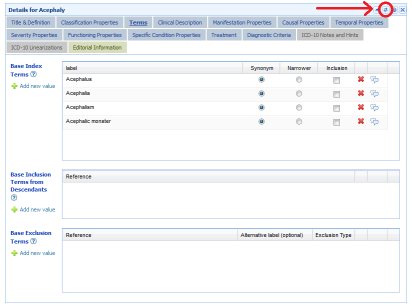
ICD Revision Steering Group and the various Topic Advisory Groups that are developing the Beta draft are working on an electronic collaborative authoring platform, called the iCAT, on a password protected server accessible only by WHO classification experts, Revision Steering Group, Topic Advisory Group Managing Editors and revision process IT personnel and software developers. It looks similar to this:
For more views of the iCAT see Slides 20-25 and Slide 39 of this 2011 slide presentation:

ICD-11 Slide Presentation:     Harrison Slides 2011 PDF 3MB

The iCAT platform is more complex than the publicly viewable version of the Beta platform and has a mechanism for recording change histories which tracks additions, deletions and revisions to the draft as ICD chapters are reorganized and new content generated and populated.

Population of content is managed by the Topic Advisory Group (TAG) Managing Editors following review by the Revision Steering Group. Structural changes to the classification, eg changing parent/child relationships and editing the linearizations can only be done by TAG Managing Editors in liaison with WHO classification experts. Source: Drafting Workflow text and chart [MS Word]; Swim Lane Workflow chart [PDF].

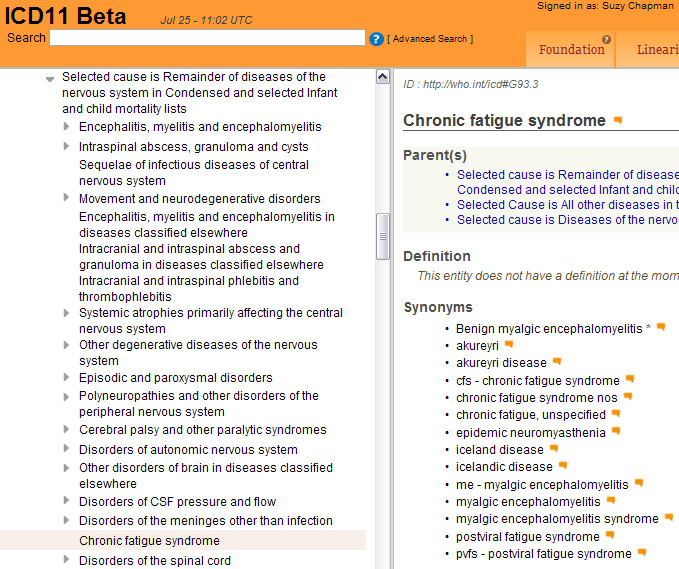
The publicly viewable version of the Beta drafting platform, which was launched in May 2012, looks like this:

With no change histories displaying in the public version of the Beta it is difficult for stakeholders to track proposed hierarchical changes to existing categories, changes to the names of parent classes or child categories, proposed introduction of new category terms (and the rationales for these) or proposed retirement of ICD-10 categories.

In the absence of rationales, it cannot be determined whether the disappearance of a category or group of categories is due to error or oversight by Advisory Group Managing Editors or others with editor level access, a temporary absence while a specific chapter section is being reorganized or whether these no longer displaying categories are intended to be subsumed under existing or new categories.

For example, a number of ICD-10 F45 and F48 Somatoform Disorder categories were removed from the Beta draft in early July with no explanation of intention.

Whilst ICD Revision invites interaction with the drafting process, the lack of clear intent on the part of Advisory Group editors and lack of response to requests for clarifications hinder submission of meaningful stakeholder comment and productive interaction with the process.

Caveats

When viewing the Beta draft, be mindful of the Caveats published by ICD Revision; the draft is in a state of flux.

The ICD-11 Beta drafting process is a work in progress over the next two to three years. The Beta draft is updated on a daily basis to reflect the work being carried out on the iCAT platform. Parent terms, category terms and sorting codes assigned to categories are subject to change as chapter reorganization progresses.

The Beta draft can be accessed here:

Beta draft Foundation Component (FC) view:

http://apps.who.int/classifications/icd11/browse/f/en

Beta draft Linearization Morbity (LM) view:

http://apps.who.int/classifications/icd11/browse/l-m/en

For definitions of Synonyms, Inclusions, Exclusions and ICD-11 terminology see the iCAT Glossary.

+++

Who are the stakeholders in ICD?

government service providers
policy makers and policy implementation agencies
health care professionals and practitioners
physician groups, especially primary care physicians
psychiatrists
psychologists
nurses
researchers and clinician academics
lay health care workers (who deliver most of the primary and mental health care in some developing countries)
social workers
patients (aka service users/consumers of health services), their families and carers
advocacy and disability rights organizations
health information managers and coders
health information technology workers
insurers

On its Facebook page, in June, ICD Revision put out a specific call for professionals with backgrounds in the following fields:

http://www.facebook.com/ICD11

Do you have a background in any of the following areas?

Medicine
Nursing
Midwifery
Dentistry
Pharmacy
Health information management (coding, medical records)
Environmental and occupational health and hygiene
Physiotherapy or Physical therapy
Nutrition
Social Sciences
Psychology
Social work and counseling
Epidemiology
Health Policy
Traditional and complementary medicine

WHO is asking experts from all over the world to sign up today to participate in the ICD revision.

www.who.int/classifications/icd11 

+++

How can stakeholders participate in the Beta process?

The public version of the Beta platform can be viewed without registration.

Professional stakeholders and others who register an interest are able to interact with the drafting process and have access to additional content.

Interested stakeholders can register here

Registered stakeholders are permitted to:

• Add comments on and read other stakeholder comments on concepts; title terms; synonyms; inclusion terms, exclusions and other Content Model parameter terms;
• Comment on whether a category is in the right place;
• Comment on whether the category is useful for Primary Care; Research; Clinical;
• Suggest definitions (with source for definition) for a disease or disorder and comment on already populated draft definitions;
• Make proposals to change ICD categories;
• Offer to participate in field trials (for professionals);
• Offer to assist in translating ICD into other languages

Comments left by registered stakeholders are not visible to non registered viewers. Comments cannot be edited or deleted and appear immediately.

Recent comments get aggregated here:

http://apps.who.int/classifications/icd11/browse/Contributions/RecentComments

+++
PDFs of Print Versions for the ICD-11 Beta Morbidity Linearization

Registered users can download individual chapters or the full linearization using the links on this page. These PDF files are updated every few days to reflect the daily revisions to the drafting platform:

http://apps.who.int/classifications/icd11/browse/l-m/en/Printables
 

For more information on how it is envisaged professional and lay stakeholders will interact with the drafting process see:

PowerPoint presentation slides in Posts #70 and #71:

ICD Revision Process Alpha Evaluation Meeting 11 – 14 April 2011: The Way Forward?

ICD Revision Process Alpha Evaluation Meeting documents and PowerPoint slide presentations

ICD-11 Revision Video invitation to participate here: Video invitation to participate

Press Release here announcing launch of Beta drafting platform. Further media coverage here

Specific call for comments from neurology professionals on The Lancet Neurology site here:

http://www.thelancet.com/journals/laneur/article/PIIS1474-4422(12)70125-4/fulltext

+++

Recently issued documents around the Beta drafting process

Frequently Asked Questions About ICD-11

ICD-11 Beta: Expectations, Concerns and Known Issues: Information for Beta Participants

http://www.who.int/classifications/icd/revision/betaexpectations/en/

ICD-11 Known Concerns and Criticisms: Known concerns about the ICD-11 Beta phase

http://www.who.int/classifications/icd/revision/icd11betaknownconcerns.pdf 

     ICD-11 Beta known concerns

ICD-11 Known Problems and Issues: General known issues

http://www.who.int/classifications/icd/revision/icd11knownissues.pdf 

     ICD-11 General known issues

+++

The ICD-11 Content Model

ICD Revision says that the most important difference between ICD-10 and ICD-11 will be the Content Model.

In ICD-10, other than Chapter V Mental and behavioral disorders, there are no definitions or other descriptive content associated with ICD categories – just hierarchical lists of diseases arranged by chapter and their ICD codes.

But content in ICD-11 is being populated in accordance with the Content Model Reference Guide and there will be the potential for considerably more content to be included for diseases, disorders and syndromes in ICD-11 than appears in ICD-10, across all chapters:

“Population of the Content Model and the subsequent review process will serve as the foundation for the creation of the ICD-11. The Content Model identifies the basic characteristics needed to define any ICD category through use of multiple parameters.”

The most recently published version of the Content Model Reference Guide is here:

Content Model Reference Guide January 2011  [MS Word]

There are currently 13 defined parameters in the content model to describe a category in ICD. All categories will have an ICD Entity Title, Classification Properties, Textual Definition, Terms and up to 13 parameters described.

Content Model Parameters

  • ICD Entity Title
  • Classification Properties
  • Textual Definitions
  • Terms
  • Body System/Structure Description
  • Temporal Properties
  • Severity of Subtypes Properties
  • Manifestation Properties
  • Causal Properties
  • Functioning Properties
  • Specific Condition Properties
  • Treatment Properties
  • Diagnostic Criteria

Some ICD-11 chapters are more advanced than others for reorganization of categories and population of proposed definitions and text for other parameters.

In setting itself the task of generating, peer reviewing, populating and approving this amount of detail across the entire ICD, one has to question how realistic a goal this is within current timeframes.

“Populating the Content Model is a critical task for the revision. Failure results in failure of delivery of ICD‑11.” [4]

It would not surprise me if at some point before the end of this year, ICD Revision Steering Group announces further delays for the Beta drafting and field trial stages and an extension to the projected dissemination date, or a scaling back of the project if completion of ICD-11 and its several, planned speciality publications, by 2016, is to be viable.

+++

Will ICD-11 be implemented worldwide from 2015/16?

ICD-10 is used in over 100 countries, worldwide. Assuming ICD-11 does meet it schedules, it may still take several years before countries currently using ICD-10 are ready to adopt ICD-11.

Several countries have been authorized by WHO to develop their own “Clinical Modification (CM)” of ICD. Canada uses an adaptation called ICD-10-CA, with a version published for 2009. Germany uses a version called ICD-10-GM. Australia (ICD-10-AM) and Thailand (ICD-10-TM) also use country specific modifications of ICD-10.

The US lags behind the rest of the world and is still using a CM version of ICD based on the ICD-9, which is long since retired by the WHO.

Instead of moving onto ICD-11, once this is completed, the US had scheduled implementation of a clinical modification of ICD-10 called ICD-10-CM, for October 1, 2013. ICD-10-CM has been in development for a considerable number of years.

On April 17, 2012 the Secretary of HHS issued a proposed rule to delay the compliance date for ICD-10-CM and ICD-10-PCS codes sets from October 1, 2013 to October 1, 2014, in order to allow more time for clinical practices and the coding industry to prepare for transitioning from ICD-9-CM to ICD-10-CM.

The public comment period for the proposed rule to delay the compliance date is now closed and comments are in the process of being reviewed. A final rule has yet to be announced. Until a new compliance date has been ratified and the revised implementation date reached, codes in ICD-10-CM are not valid for any purpose or use but can be viewed for free on the CDC website together with other ICD-10-CM documentation.

The US might not anticipate moving on to a clinical modification of ICD-11 before 2020 and possibly later*.

*Source: DHSS Office of Secretary Final Rule document“We estimated that the earliest projected date to begin rulemaking for implementation of a U.S. clinical modification of ICD–11 would be the year 2020.”

WHO-FIC meeting materials suggest no earlier than 2018 for Canada. Australia is discussing earlier adoption of ICD-11 (or a CM of ICD-11).

Harmonization between ICD-11 and DSM-5

There is already a degree of correspondence between DSM-IV categories and Chapter V of ICD-10. For the next editions, the APA and WHO have committed as far as possible:

“To facilitate the achievement of the highest possible extent of uniformity and harmonization between ICD-11 mental and behavioural disorders and DSM-V disorders and their diagnostic criteria.”

with the objective that

“The WHO and APA should make all attempts to ensure that in their core versions, the category names, glossary descriptions and criteria are identical for ICD and DSM.”

WHO acknowledges that there may be areas where congruency may not be achievable.

With the timelines for DSM-5 and ICD-11 running out of synch (DSM-5 slated for publication in May 2013; ICD-11 still at the Beta drafting stage with a two year period scheduled for completion of its field trials), this may present barriers to harmonization.

In a June 2011 presentation to the International Congress of the Royal College of Psychiatrists, APA President, John M. Oldham, MD, MS, spoke of “Negotiations in progress to ‘harmonize’ DSM-5 with ICD-11 and to ‘retro-fit’ these codes into ICD-10-CM” and that DSM-5 would need “to include ICD-10-CM ‘F-codes’ in order to process all insurance claims beginning October 1, 2011.”

With the three systems: DSM-5 (publication date May 2013), ICD-10-CM (subject to partial code freeze since October 1, 2011 until 2014+ with new compliance date t.b.a.) and ICD-11 (dissemination scheduled for 2015+) set to become potentially more closely aligned, proposals for ICD-11 may have implications for US health care professionals and patient populations who might also consider themselves stakeholders in the ICD-11 development process.

+

References and additional ICD-11 related links and documentation

According to documents [1] and [2], ICD-11 was originally planned for dissemination by 2012, with the timelines for revisions of ICD-10 and DSM-IV running more or less in parallel. By 2008, the completion date for ICD-11 had been extended to 2014. In December 2009, the American Psychiatric Association (APA) announced a shift in the publication date for DSM-5 to May 2013. APA News Release No. 09-65 

1] IUPsyS Mar 08 Agenda Item 25 ICD-10
International Union of Psychological Science COMMITTEE ON INTERNATIONAL RELATIONS ACTION, March 28–30, 2008, Agenda Item No. 25: Revision of the International Classification of Diseases (ICD-10) and Involvement of Psychology

2] Exhibit 1 WHO Letter Aug 07 
Letter Saxena, WHO, to Ritchie, IUPsyS (International Union for Psychological Science), August 2007
Source: http://www.apa.org/international/governance/cirp/s08agenda25-Exhibit1.pdf  

3] Pages 5-6: Report, WHO FIC Council conference call, 16 February 2011, PDF format

4] Closing remarks, PowerPoint presentation: “Proposal for the ICD Beta Platform”, Stanford team, 12.04.11, WHO, Geneva.

5] Key document: ICD Revision Project Plan version 2.1 9 July 2010

Key links

ICD-11 Beta drafting platform  |  Publicly viewable version

WHO ICD Revision  |  Main WHO website: Revision Steering Group and Topic Advisory Groups
ICD-11 Revision site  |  Revision resources [Google site currently unavailable]
ICD-11 Revision site Documents Page  |  Key revision documents and meeting materials  [Google site currently unavailable]

ICD-11 Revision Information  |
ICD-11 Timeline  |

ICD Information Sheet  |

Revision News  |
Steering Group  |
Topic Advisory Groups  |

ICD-11 YouTube Channel  |  Video reports
ICD-11 on Facebook  |
ICD-11 on Twitter  |
ICD-11 Blog  |  Not updated since October 2009

ICD-11 YouTubes collated on Dx Revision Watch ICD-11 YouTubes  |

WHO Publications

ICD-10 Tabular List online Version: 2010  |  International Statistical Classification of Diseases and Related Health Problems 10th Revision Version: 2010, Tabular List of inclusions and Chapter List

ICD-10 Volume 2: Instruction Manual  |  Volume 2 online Version: 2010 PDF Download

ICD-10 for Mental and Behavioural Disorders Diagnostic Criteria for Research  |  PDF download
ICD-10 for Mental and Behavioural Disorders Clinical Descriptions and Diagnostic Guidelines  |  PDF download

ICD-10 Volume 3: The Alphabetical Index  |  WHO does not make ICD-10 Volume 3: The Alphabetical Index available online

About the World Health Organization (WHO)

The WHO Family of International Classifications  

History of ICD

ICD-11 Beta drafting platform: Update (2)

ICD-11 Beta drafting platform: Update (2): Neurasthenia, Postviral fatigue syndrome (PVFS), Benign myalgic encephalomyelitis (ME), Chronic fatigue syndrome (CFS), Fibromyalgia (FM), Irritable bowel syndrome (IBS)

Post #193 Shortlink: http://wp.me/pKrrB-2mC

The information in this report relates to proposals for the World Health Organization’s forthcoming ICD-11, currently scheduled for pilot dissemination in 2015+; it does not apply to the existing ICD-10 or to the forthcoming US specific “clinical modification” of ICD-10, known as ICD-10-CM.

Caveat: The ICD-11 Beta drafting process is a work in progress over the next two to three years. The Beta draft is updated on a daily basis. Parent terms, category terms and sorting codes assigned to categories are subject to change as chapter reorganization progresses. Images and text in this posting may not reflect the most recently assigned categories and codes. This post reflects the Beta draft as it stood at July 25, 2012. Please also read the ICD-11 Beta Draft Caveats.

Post #190 Changes to ICD-11 Beta drafting platform: Bodily Distress Disorders (1) reported on proposals for including three Bodily distress disorder categories in the Somatoform Disorders section of the ICD-11 Beta drafting platform which appear potentially to replace or subsume a number of existing ICD-10 Somatoform Disorder categories.

That post has been revised to reflect clarifications from Professor, Sir David Goldberg, M.D., around the Primary care version of ICD-11 and to include additional material.

The report in this post updates on current proposals for the ICD-11 Beta drafting platform for revision of the following ICD-10 categories: Neurasthenia, Postviral fatigue syndrome (PVFS), Benign myalgic encephalomyelitis (ME), Chronic fatigue syndrome (CFS), Fibromyalgia (FM) and Irritable bowel syndrome (IBS) for the full version of ICD-11.

ICD Revision Steering Group and the various Topic Advisory Groups are developing the ICD-11 Beta draft on a non public access collaborative authoring platform where change histories can be tracked, which looks similar to this:

The publicly viewable version of the Beta drafting platform looks like this:

and displays less information. It can be accessed here:

Beta draft Foundation Component (FC) view:

http://apps.who.int/classifications/icd11/browse/f/en

Beta draft Linearization Morbity (LM) view:

http://apps.who.int/classifications/icd11/browse/l-m/en

Increased access to content and interaction with the drafting process can be obtained by registering.
+++
+++
Neurasthenia:

Neurasthenia is not classified in DSM-IV and is not proposed to be classified in DSM-5.

In ICD-10, Neurasthenia is classified in Chapter V Mental and behavioural disorders under parents:

F40-F48 Neurotic, stress-related and somatoform disorders

    F48 Other neurotic disorders
        ›  F48.0 Neurasthenia

+++
For ICD-11 Beta, up until July 3, Neurasthenia was also classified under:

Neurotic, stress-related and somatoform disorders

    9S1 Other neurotic disorders
        ›  9S1.1 Neurasthenia

Inclusions: Fatigue syndrome

Exclusions: psychasthenia
postviral fatigue syndrome
malaise and fatigue
asthenia NOS
burn-out

    9S1.2 Other specified neurotic disorders

Inclusions: Dhat syndrome
Occupational neurosis, including writer’s cramp
Psychasthenia
Psychasthenic neurosis
Psychogenic syncope

     9S1.3 Neurotic disorder, unspecified

Neurosis NOS

+++

On July 4, all child categories classified under parent class, 9S1 Other neurotic disorders, including Neurasthenia and its Inclusion, Fatigue syndrome, were removed from both the FC and LM view and from the PDF for the Chapter 5 Print version and there is currently no listing for any of these categories and child categories under any parent.

As no “Change history” records display in the public version of the Beta draft, it cannot be determined from what information is available whether these categories are temporarily omitted while this section of Chapter 5 is being reorganized, or whether all or selected of these ICD-10 categories are proposed to be retired for ICD-11 or are destined to be subsumed under the proposed Bodily distress disorders categories that ICD Revision has yet to define.

According to the Goldberg February 2011 report, terms included in the ICD11-PHC version of ICD-11 must have an equivalent disorder in the main classification. In February 2011, it was proposed not to include Neurasthenia in the ICD11-PHC version but to subsume under 13 Distress disorder. (It isn’t clear under which disorder group or subcategory Neurasthenia is proposed to be subsumed for the most recently published iteration for ICD11-PHC.)

Neurasthenia remains listed as an Exclusion to Chapter 5 Generalized anxiety disorder and Chapter 18 Malaise and fatigue but these Exclusions may be awaiting attention, if the intention is to retire a number of ICD-10 terms.

I will update when it becomes apparent what the intention is for these currently missing categories.

+++
ICD-11 Chapter 06: Diseases of the nervous system

Postviral fatigue syndrome, Benign myalgic encephalomyelitis, Chronic fatigue syndrome:

In ICD-10, Postviral fatigue syndrome is classified as a Title term within Volume 1: The Tabular List in Chapter VI: Diseases of the nervous system under G00-G99 Other disorders of the nervous system > G93 Other disorders of brain, and coded at G93.3. See: http://apps.who.int/classifications/icd10/browse/2010/en#/G93.3

Benign myalgic encephalomyelitis is also coded in the Tabular List to G93.3 Postviral fatigue syndrome.

Chronic fatigue syndrome is not classified within the Tabular List but is indexed to G93.3 in Volume 3: The Alphabetical Index.

An unauthorised copy of Volume 3: The Alphabetical Index Version for 2006 can be accessed here: (See Page 528)
http://www.scribd.com/doc/7350978/ICD10-2006-Alphabetical-Index-Volume-3 

In indexing Chronic fatigue syndrome to G93.3, ICD-10 does not specify whether it views the term as a synonym, subclass or “best coding guess” to Title term, Postviral fatigue syndrome or to Benign myalgic encephalomyelitis.

Nor does ICD-10 specify the relationship between Postviral fatigue syndrome and Benign myalgic encephalomyelitis.

(For ICD-11, a mechanism will be provided to identify whether an inclusion term is a synonym or a subclass.)

In June 2010, I reported that in May 2010, a change of hierarchy had been recorded in the ICD-11 iCAT Alpha drafting platform “Change History” and “Category Discussion Notes” for class: G93.3 Postviral fatigue syndrome.

See these two screenshots from the original iCAT Alpha drafting platform:

Image 1:

Image 2:

+++
From current information in the Beta draft, it would appear that for ICD-11, the proposal is for a change of hierarchy between Postviral fatigue syndrome and Chronic fatigue syndrome with Chronic fatigue syndrome elevated to an ICD-11 Title term, with a Definition (not currently populated) and with potentially up to 12 other descriptive parameters, populated in accordance with the ICD-11 “Content Model.”

There are a number of terms listed under Synonyms to Title term Chronic fatigue syndrome including Benign myalgic encephalomyelitis and Postviral fatigue syndrome.

Mouse hover over the asterisk at the end of Benign myalgic encephalomyelitis and the following hover text displays, “This term is an inclusion term in the linearizations.”

Also listed under “Synonyms” are “chronic fatigue syndrome nos” and “chronic fatigue, unspecified” (both imported from current proposals for locating Chronic fatigue syndrome in Chapter 18: Symptoms and Signs in the forthcoming US specific, ICD-10-CM).

See this Beta drafting platform page:

http://apps.who.int/classifications/icd11/browse/f/en#/http%3a%2f%2fwho.int%2ficd%23G93


There is currently no discrete ICD Title term listed for Postviral fatigue syndrome in either the Foundation Component or Linearization Morbidity view and no discrete ICD Title term for Benign myalgic encephalomyelitis.

It remains unconfirmed, but from the Beta draft as it currently stands, it suggests that for ICD-11:

  • Chronic fatigue syndrome is proposed to become the Chapter 06 Title term
  • Benign myalgic encephalomyelitis is specified as an Inclusion term to CFS under “Synonyms”
  • Postviral fatigue syndrome and a number of other terms are listed under “Synonyms” to CFS

ICD-11 terminology:

For definitions of Synonyms, Inclusions, Exclusions and other ICD-11 terminology see the iCAT Glossary:

http://apps.who.int/classifications/apps/icd/icatfiles/iCAT_Glossary.html

+++
Fibromyalgia (FM):

In ICD-10, Fibromyalgia is classified under:

Chapter XIII: Diseases of the musculoskeletal system and connective tissue > M79 Other soft tissue disorders > M79 Other soft tissue disorders, not elsewhere classified > M79.7 Fibromyalgia 

ICD-10 Version: 2010: http://apps.who.int/classifications/icd10/browse/2010/en#/M79.7

For ICD-11 Beta draft, Fibromyalgia is currently classified under:

Chapter 13: Diseases of the musculoskeletal system and connective tissue > Soft tissue disorders > Other soft tissue disorders > QG6 Other soft tissue disorders, not elsewhere classified > QG6.7 Fibromyalgia

FC: http://apps.who.int/classifications/icd11/browse/f/en#/http%3a%2f%2fwho.int%2ficd%23M79.7
LM: http://apps.who.int/classifications/icd11/browse/l-m/en#/http%3a%2f%2fwho.int%2ficd%23M79.7

+++
Irritable bowel syndrome (IBS):

In ICD-10, Irritable bowel syndrome is classified under:

Chapter XI: Diseases of the digestive system > K55-K63 Other diseases of intestines > K58.0 Irritable bowel syndrome with diarrhoea > K58.9 Irritable bowel syndrome without diarrhoea > Irritable bowel syndrome NOS

ICD-10 Version: 2010: http://apps.who.int/classifications/icd10/browse/2010/en#/K58

For ICD-11 Beta draft, Irritable bowel syndrome is currently classified under:

Chapter 11: Diseases of the digestive system > Functional gastrointestinal disorders > FS6 Irritable bowel syndrome and other functional bowel disorders > FS6.1 Irritable bowel syndrome 

FC: http://apps.who.int/classifications/icd11/browse/f/en#/http%3a%2f%2fwho.int%2ficd%23K58
LM: http://apps.who.int/classifications/icd11/browse/l-m/en#/http%3a%2f%2fwho.int%2ficd%23K58

+++
I shall continue to monitor the Beta drafting process and update on any significant developments for both ICD-11 Chapter 5 and Chapter 6 and for ICD11-PHC for the categories that are the focus of this post and post #190.
+++
+++
References and related material:

1] ICD-10 Version: 2010 Volume 1 Tabular List online:
http://apps.who.int/classifications/icd10/browse/2010/en

2] ICD-11 Beta drafting platform:
http://apps.who.int/classifications/icd11/browse/f/en

3] Goldberg, D. Guest editorial. A revised mental health classification for use in general medical settings: the ICD11–PHC 1. International Psychiatry, Page 1, February 2011.
http://www.rcpsych.ac.uk/pdf/IPv8n1.pdf

4] 21st Century Global Mental Health by Dr Eliot Sorel, Professor, George Washington University, Washington D.C.
Publication date: August, 2012: http://www.jblearning.com/catalog/9781449627874/
Page 51, Sample Chapter 2: http://samples.jbpub.com/9781449627874/Chapter2.pdf

WordPress glitch when viewed in Internet Explorer IE8 and IE9

WordPress glitch when viewed in Internet Explorer IE8 and IE9

Post #192 Shortlink: http://wp.me/pKrrB-2la

Update at July 16: WordPress has now fixed these issues with Garland theme.

This site (and ME agenda site) run on the WordPress theme (template) Garland with the Custom Design upgrade which means I can modify Garland theme’s CSS.

On Thursday or Friday, WordPress implemented changes to some blog templates that enabled “infinite scrolling” – a site wide change being applied to WordPress themes that are suitable for its implementation.

Instead of displaying (in my case) the ten most recent posts, with the need to click for the next ten posts, “infinite scroll” automatically loads more posts.

I have deselected for this feature – I don’t like it and I don’t want it – so you won’t see many changes to the way in which the site functions.

You will see a button at the end of the tenth post for Load more posts and a link for Older posts and Newer posts. You can continue to access archived posts from the monthly Archive links in the right hand column.

There should be no problem when viewing the site in Chrome or Firefox. But there is currently a problem with Internet Explorer 8 and 9 (IE8 and IE9) which may be related to these recent changes or may be a separate issue.

This issue is affecting users of Garland theme and possibly some other themes.

If you are viewing this site in Internet Explorer 8 or 9 you are likely to see the following issues:

The site title Dx Revision Watch may be slow to load, may not load at all or unless the page is refreshed.

You may see no links at the bottom of the tenth post for Older posts and Newer posts though you should see a button for Load more posts.

Down the right hand column, the Search box, Twitter feed, Recent Posts, Links, Archives and Meta are all displaying over in the left side column, and right at the bottom of the page, so you’ll need to scroll right down to locate these.

The default font for posts on this site is Verdana. Occasionally, a post has been uploaded in Georgia and this may display for you in a larger font size than intended, for example this post Somatic Symptom Disorder criteria could capture millions more under mental health diagnosis.

Unfortunately WordPress Support appears to be closed until Monday, July 23, so this may take some time to get sorted. I have moved the Twitter feed over to the left column.

In the meantime, if you have Chrome or Firefox browsers loaded please consider using these.

Links for WordPress users seeking more information

WordPress Support notice about “infinite scroll”:

http://en.forums.wordpress.com/topic/to-infinity?replies=137
http://en.blog.wordpress.com/2012/06/12/to-infinity-and-beyond/

Blogger timethief:

http://onecoolsitebloggingtips.com/2012/03/16/disabling-infinite-scroll-on-your-wordpress-com-blog/

Blogger wordpress tips:

http://wpbtips.wordpress.com/2012/06/05/disabling-infinite-scrolling/

(A very useful site for WordPress.com users on themes, html, formatting, tweaks and workarounds.)

WordPress Forums:

http://en.forums.wordpress.com/topic/problems-with-viewing-blog-in-internet-explorer?replies=19#post-942283

Two resign from DSM-5 Personality Disorders Work Group over “seriously flawed” proposals

Two resign from DSM-5 Personality Disorders Work Group over “seriously flawed” proposals

Post #191 Shortlink: http://wp.me/pKrrB-2kN

Update at July 24, 2012: Additional reporting from Straight.com, Vancouver, on the resignations of two members of the DSM-5 Personality Disorders Work Group:

UBC prof emeritus John Livesley and Dutch expert quit DSM-V committee defining personality disorders

Charlie Smith | July 23, 2012

Update at July 16, 2012:

In the July issue of Clinical Psychology & Psychology there is an Editorial and two Commentaries around DSM-5 proposals for Personality and Personality Disorders.

Clinical Psychology & Psychotherapy

http://onlinelibrary.wiley.com/journal/10.1002/(ISSN)1099-0879/earlyview

Commentary

No abstract is available for this article.

Personality Disorder Proposal for DSM-5: A Heroic and Innovative but Nevertheless Fundamentally Flawed Attempt to Improve DSM-IV

Roel Verheul

Article first published online: 12 JUL 2012 | DOI: 10.1002/cpp.1809

Editorials

No abstract is available for this article.

DSM-5 Personality Disorders: Stop Before it is Too Late

Paul Emmelkamp and Mick Power

Article first published online: 3 JUL 2012 | DOI: 10.1002/cpp.1807

Commentary

No abstract is available for this article.

Disorder in the Proposed DSM-5 Classification of Personality Disorders

W. John Livesley

Article first published online: 3 JUL 2012 | DOI: 10.1002/cpp.1808

Roel Verheul, Ph.D. and W. John Livesley, M.D., Ph.D. resigned as members of the DSM-5 Personality and Personality Disorders Work Group in April.

Dr Roel Verheul is CEO of de Viersprong, Netherlands Institute for Personality Disorders.

Dr. John Livesley is Professor Emeritus at the University of British Columbia.

Allen Frances, M.D. who chaired the DSM-IV Task Force blogs at DSM 5 in Distress. Drs Verheul and Livesley have written to Dr Frances setting out their concerns for what they believe to be “seriously flawed proposals” and “a truly stunning disregard for evidence.”

DSM5 in Distress
The DSM’s impact on mental health practice and research.

by Allen Frances, M.D.

Two Who Resigned From DSM-5 Explain Why
They spell out the defects in the personality section

Allen Frances, M.D. | July 11, 2012

Roel Verheul and John Livesley both felt compelled to resign from the DSM-5 Personality Disorders Work Group. Here is an email from them describing what went wrong in the preparation of this section:

“…Regrettably, the Work Group has been unable to capitalize on the opportunity and has advanced a proposal that is seriously flawed. It has also demonstrated an inability to respond to constructive feedback both from within the Work Group and from the many experts in the field who have communicated their concerns directly and indirectly. We also regret the need to resign because we were the only International members of the Work Group which is now without representation from outside the US…”

“…Early on in the DSM-5 process, we developed major concerns about the Work Group’s mode of working and its emerging recommendations that we communicated to the Work Group and Task Force… We considered the current proposal to be fundamentally flawed and decided that it would be wrong of us to appear to collude with it any longer…As we see it, there are two major problems with the proposal…”

Read full article here

Proposals for the DSM-5 Personality Disorders as issued for the third and final stakeholder review can be read here on the DSM-5 Development site.

Changes to ICD-11 Beta drafting platform: Bodily Distress Disorders (1)

Changes to ICD-11 Beta drafting platform: Bodily Distress Disorders (1)

Post #190 Shortlink: http://wp.me/pKrrB-2jB


+++

This four page post is a revised version of content first published on July 2, 2012.

Information in this report relates to proposals for the World Health Organization’s forthcoming ICD-11, currently scheduled for pilot dissemination in 2015+; it does not relate to the existing ICD-10 or to the forthcoming US specific “clinical modification” of ICD-10, known as ICD-10-CM.

Caveat: The ICD-11 Beta drafting process is a work in progress over the next two to three years. The Beta draft is updated on a daily basis. Parent terms, category terms and sorting codes assigned to categories are subject to change as work on chapter reorganization progresses. Images and text in this posting may not reflect the most recently assigned categories and codes. This post reflects the Beta draft as it stood at July 24, 2012. Please also read the ICD-11 Beta Draft Caveats.

This report updates on recent changes to the Somatoform Disorders section of the ICD-11 Beta drafting platform. The Beta drafting platform can be accessed here:

Beta draft Foundation view:

http://apps.who.int/classifications/icd11/browse/f/en

Beta draft Linearization view:

http://apps.who.int/classifications/icd11/browse/l-m/en
+++

How do the Somatoform Disorders categories currently stand in ICD-10?

ICD-10 Tabular List Version: 2010 can be accessed here: http://apps.who.int/classifications/icd10/browse/2010/en

ICD-10 Chapter V “Somatoform Disorders”

This is the section of ICD-10 that corresponds with the Somatoform Disorders section in DSM-IV. There is a degree of correspondence between current categories for this section of ICD-10 and for DSM-IV, as set out in the (simplified) table, below.

For clinical descriptions and diagnostic guidelines for ICD-10 Somatoform Disorders see Page 129 of the “Blue book”:

ICD-10 Classification of Mental and Behavioural Disorders: Clinical descriptions and diagnostic guidelines: http://www.who.int/classifications/icd/en/bluebook.pdf

Current DSM-IV Codes and Categories for Somatoform Disorders and ICD-10 Chapter V Equivalents

[Ed: Neurasthenia is not categorized within DSM-IV.]

Source: Mayou R, Kirmayer LJ, Simon G, Kroenke K, Sharpe M: Somatoform disorders: time for a new approach in DSM-V. Am J Psychiat. 2005;162:847–855.
+++
+++
This screenshot shows how the ICD-11 Beta draft had stood at June 24, 2012:

ICD-11 Beta Draft: Morbidity Linearization view


+++

For ICD-11 Beta draft, the proposal in June 2012 had been to rename ICD-10’s F45 Somatoform Disorders parent category to Bodily Distress Disorders.

Three new proposed terms: 9R0 Mild bodily distress disorder; 9R1 Moderate bodily distress disorder; 9R2 Severe bodily distress disorder were inserted above the 9R3 thru 9R8 legacy categories imported from ICD-10.

ID : http://who.int/icd#F45

05 Mental and behavioural disorders [Chapter V in ICD-10]

[…]

BODILY DISTRESS DISORDERS  [F45 Somatoform Disorders > F40-F48 Neurotic, stress-related and somatoform disorders in ICD-10]

9R0 Mild bodily distress disorder  [New term to ICD]
9R1 Moderate bodily distress disorder   [New term to ICD]
9R2 Severe bodily distress disorder  [New term to ICD]
9R3 Somatization disorder  [F45.0 in ICD-10]
9R4 Undifferentiated somatoform disorder  [F45.1 in ICD-10]
9R5 Somatoform autonomic dysfunction   [F45.3 in ICD-10]
9R6 Persistent somatoform pain disorder  [F45.4 in ICD-10] 
    ›  9R6.1 Persistent somatoform pain disorder
      9R6.2 Chronic pain disorder with somatic and psychological factors  [Not in ICD-10]
9R7 Other somatoform disorders  [F45.8 in ICD-10]
9R8 Somatoform disorder, unspecified  [F45.9 in ICD-10]

+++

Hypochondriacal disorder, coded at F45.2 in ICD-10, is currently renamed to Illness Anxiety Disorder for ICD-11 Beta draft and relocated under ANXIETY AND FEAR-RELATED DISORDERS:

http://apps.who.int/classifications/icd11/browse/l-m/en#/http%3a%2f%2fwho.int%2ficd%23F45.2

ID : http://who.int/icd#F45.2

9C5  ANXIETY AND FEAR-RELATED DISORDERS

      ›  9C5.6 Illness Anxiety Disorder

Continued on Page Two