Videos and meeting materials: September 18–19 ICD-9-CM Coordination and Maintenance Committee meeting

Post #277 Shortlink: http://wp.me/pKrrB-3tV

Update: Crazy Like Us: How the U.S. Exports Its Models of Illness – DSM-5 is Americanizing the world’s understanding of the mind by Christopher Lane, Ph.D. in Side Effects, October 9, 2013

This report relates to proposals submitted via the September ICD-9-CM/PCS Coordination and Maintenance Committee meeting for the inclusion of additional codes to the forthcoming US specific ICD-10-CM.

The twice yearly ICD-9-CM Coordination and Maintenance Committee meetings provide a public forum to discuss proposed code changes to ICD-9-CM and the ICD-10-CM/PCS. Next year, the committee, which is co-chaired by CMS and CDC, will be renamed to the ICD-10-CM Coordination and Maintenance Committee.

ICD-10-CM/PCS is scheduled for implementation in October 2014 and currently subject to partial code freeze.

The meeting scheduled on September 18, 2013 was devoted to both diagnosis and procedure code topics. The second day of the meeting, September 19, continued discussions related to diagnosis code topics.

Below are links for key meeting materials, four videocasts, and agenda item listings for the diagnosis proposals presented on Day Two (videocast Part 4). This includes the presentation of proposals by American Psychiatric Association (APA) Director of Research, Darrel Regier, MD, for insertion of new DSM-5 diagnoses into the ICD-10-CM.

Meeting materials:

From CDC website: ICD-9-CM Coordination and Maintenance Committee webpage:

http://www.cdc.gov/nchs/icd/icd9cm_maintenance.htm

September 18-19, 2013 meeting Proposals (Timeline, Agenda for Diagnosis Proposals) [PDF – 342 KB]

From CMS.gov website:

September 18-19, 2013 meeting materials page

September 18, 2013 Agenda (Timeline, Agenda for ICD-10-PCS Topics, Procedure presentations) [PDF, 326KB]

September 18, 2013 Meeting Materials [ZIP, 4MB]

Download Zip file from CMS.gov meeting materials page | 4MB Zip file unpacks to:

PDF Presenter Slides: Cerapedics ICD-9 9 18 2013 FINAL [712KB]

PDF Presenter Slides: Respicardia ICD-9 Sept 18 FINAL [670KB]

PDF CMS/CDC Meeting Slides: September-ICD9CM-slides [3033KB]

PDF Text version of CMS/CDC Meeting slides: 508-Compliant-Version-of-September-ICD9CM-slides [282KB]

+++

Videocasts for September 18, 2013 | Day One

Pat Brooks (CMS) Co-Chairperson
9:00 AM – 12:30 PM ICD-10-PCS Procedure presentations with public comment
12:30 PM – 1:30 PM Lunch break
1:30 PM – 5:00 PM Diagnosis presentations with public comment

Part 1 1:43 hours duration

Procedure presentations with public comment


+++
Part 2 1:27 hours duration

Procedure presentations with public comment


+++
Part 3 59 minutes duration

Diagnosis presentations with public comment

+++
Videocast for September 19, 2013 | Day Two

Donna Pickett (CDC) Co-Chairperson
+++
Part 4 1:42 hours duration

Diagnosis presentations with public comment

+++
Diagnosis proposals

4:58 mins in: Presenter Lizabeth (Beth) Fisher (CDC) [on behalf of requestor: The American Society of Anesthesiologists]

Page 47 Diagnosis Agenda: Unintended awareness under general anesthesia

Comment from floor: Robert Adams reads out written statement.

13:56 mins in: DSM-5 and ICD-10-CM Discussions on mental health conditions and harmonization with ICD-10-CM.

Presenter: Darrel Regier, MD (Director of Research, APA; served as DSM-5 Task Force Vice-Chair)

Preamble about DSM and DSM-5.

Page 32 Diagnosis Agenda: Binge eating disorder

No questions or comments from the floor or by phone link.

29 mins in: Page 34 Diagnosis Agenda: Gender identity disorder in adolescence and adulthood

No questions or comments from the floor or by phone link.

37 mins in: Page 35 Diagnosis Agenda: Disruptive mood dysregulation disorder (DMDD)

No questions or comments from the floor or by phone link.

45 mins in: Page 37 Diagnosis Agenda: Social (pragmatic) communication disorder

No questions or comments from the floor or by phone link.

54 mins in: Page 39 Diagnosis Agenda: Hoarding disorder

No questions or comments from the floor or by phone link.

1hr:1 min in: Page 41 Diagnosis Agenda: Excoriation (skin picking) disorder

Some questions raised by DP on behalf of other and comment from the floor.

1hr:14 mins in: Page 43 Diagnosis Agenda: Premenstrual dysphoric disorder (PMDD)

Question raised by DP regarding PMDD and Excludes.
No questions or comments from the floor or by phone link.

Dr Regier concludes his presentation and hands podium back to Donna Pickett (CDC).

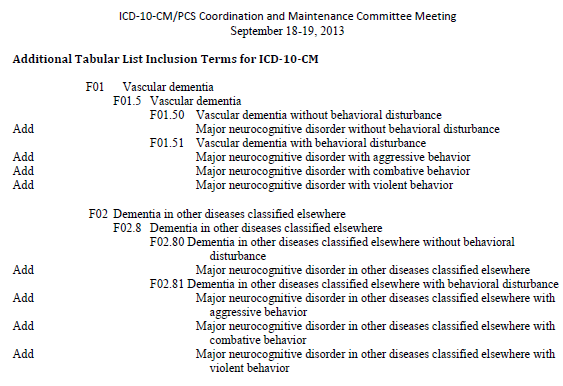
1hr:22 mins in: Page 45-46 Diagnosis Agenda: Additional Tabular List Inclusion Terms for ICD-10-CM

See screenshots at end of Post #276 for Diagnosis Agenda Pages 45-46.

[Unofficial transcription from videocast]

Donna Pickett (CDC): “…And just to complete the package, there are other Tabular List proposals that appear on Page 45 and 46 that we would also invite your comments on. And again, with some of the terminology changes that Dr Regier has described the intent here is to make sure that if those terms are being used, that they do have a home somewhere within ICD-10-CM to facilitate people looking these up. So we invite comments. We’re showing the Tabular List proposed changes; however, there obviously would be associated Alphabetic Index changes with that which we didn’t show just to keep the package a little bit smaller…”

No questions or comments from the floor or by phone link on any of the proposed inclusion terms listed on Pages 45 and 46 under “Additional Tabular List Inclusion Terms for ICD-10-CM”.

Donna Picket moves on to next set of proposals and turns podium over to Beth Fisher (CDC).

1hr:23 mins in: Page 49 Diagnosis Agenda: Intracranial injury (TBI)

Comment from floor at 1hr:32 mins: Luana Ciccarelli from the American Academy of Neurology. Comment from Sue Bowman read out by Beth Fisher.

1hr:34 mins in: Page 53 Diagnosis Agenda: Placenta Previa vs Low Lying Placenta

Presenter Lizabeth (Beth) Fisher (CDC) on behalf of requestor: The American Congress of Obstetricians and Gynecologists (ACOG).

No questions or comments from the floor or by phone link.

This concluded the diagnosis portion of the presentations.

Note that Agenda items from Page 53 onwards were tabled for presentation and discussion in earlier in the meeting proceedings.

1hr:40 mins in: Donna Pickett (CDC) brings meeting to a close.

[Unofficial transcription from videocast]

Donna Pickett (CDC): “…November 15…is in the Topic Package for receipt of comments on all of the proposals. That is the deadline, but we’d love to have them sooner as this does have implications in terms of what does become part of an addenda or not, and that would be specific to the inclusion terms in the Tabular List and Alphabetical Index because, again, unless the proposal meets the criteria established for the partial freeze, no new codes are being entertained except for the ones that were requested. We invite your comments on that as well…”

Submitting public comment:

The deadline for receipt of public and professional stakeholder comment on any of the proposed ICD-10-CM/PCS code revisions discussed at the September 18-19, 2013 ICD-9-CM Coordination and Maintenance Committee meeting is November 15.

Comments should be sent to the following dedicated NCHS/CMS email addresses:

Procedure comments by email to Pat Brooks, CMS: patricia.brooks2@cms.hss.gov

Diagnosis comments by email to Donna Pickett, CDC: nchsicd9CM@cdc.gov

(Full contact details for submission of written comments/objections to NCHS/CMS on Page 8 of the Proposals/Diagnosis Agenda PDF. Electronic submissions are much preferred in order to ensure timely receipt.)

APA petitions CMS for additions to ICD-10-CM: Deadline for public comment and objections November 15

Post #276 Shortlink: http://wp.me/pKrrB-3tq

Information in this report relates to American Psychiatric Association (APA) proposals, submitted via the September ICD-9-CM/PCS Coordination and Maintenance Committee Meeting, for the inclusion of a number of additions to the forthcoming US specific ICD-10-CM.

ICD-9-CM is the official system of assigning codes to medical diagnoses in the United States. Next year, ICD-9-CM will be replaced by ICD-10-CM, scheduled for implementation on October 1, 2014.

The DSM is widely used by CMS contractors, federal and state agencies and medical insurers to indicate eligibility for provision of services.

Since the official codes required in the United States for records and reimbursement purposes are ICD-CM codes, DSM diagnoses are cross-walked to the closest approximation of ICD-CM codes to classify diagnoses for insurance claims, research, data capture and other public health purposes.

APA petitions ICD-9-CM Coordination and Maintenance Committee:

The ICD-9-CM and ICD-10-CM coding systems are subject to annual revisions by NCHS and CMS via public review meetings held twice a year (in March and September), followed by brief public comment periods.

October 1, 2011 saw the last major update of ICD-10-CM/PCS until October 1, 2015. Between October 1, 2011 and October 1, 2015 revisions to ICD-10-CM/PCS will be for new diseases/new technology procedures, and any minor revisions to correct reported errors in these classifications. Regular (at least annual) updates to ICD-10-CM/PCS will resume on October 1, 2015.

The ICD-9-CM Coordination and Maintenance Committee will continue to meet twice a year during this partial code freeze. At these meetings, the public will be asked to comment on whether or not requests for new diagnosis or procedure codes should be created based on the criteria of the need to capture a new technology or disease. Any code requests that do not meet the criteria will be evaluated for implementation within ICD-10-CM on and after October 1, 2015 once the partial code freeze has ended.

At last month’s Coordination and Maintenance Committee meeting, APA presented seven diagnoses that are new to DSM-5, along with proposals for new codes for addition to the ICD-10-CM [1]. APA states that the new codes, if approved [by NCHS/CMS], would probably not be added to ICD-10-CM until 2015.

Yesterday, APA published an article in Psychiatric News (the PR organ of the APA), listing the additions and changes proposed by APA via the September meeting (about two thirds into the article):

ICD Codes for Some DSM-5 Diagnoses Updated, Mark Moran, Psychiatric News, October 07, 2013 DOI: 10.1176/appi.pn.2013.10b30

The following disorders were proposed by APA for inclusion in ICD-10-CM (Pages 32-44, Diagnosis Agenda).

Dr Regier’s presentation starts on Day Two of the meeting, video Part 4, 13:50 mins in from start and concludes after PMDD.

Binge eating disorder (BED);
Disruptive mood dysregulation disorder (DMDD);
Social (pragmatic) communication disorder;
Hoarding disorder;
Excoriation (skin picking) disorder;
Premenstrual dysphoric disorder (PMDD)

Additionally, the APA has petitioned for revisions to the ICD-10-CM listing for gender dysphoria in adolescents and adults, which is not a new disorder. Dr Regier’s presentation concluded with recommendations for PMDD.

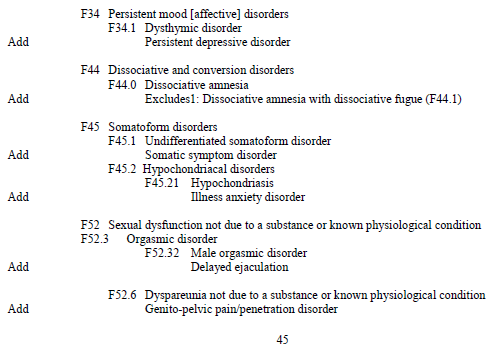
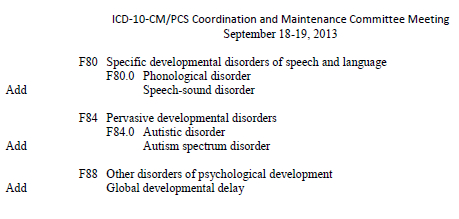
Edit: On Page 45 and 46 of the Agenda, under Additional Tabular List Inclusion Terms for ICD-10-CM a number of other changes to specific Chapter 5 F codes are proposed, including the addition to the ICD-10-CM Chapter 5 codes of the new DSM disorders:

Somatic symptom disorder (proposed as Inclusion term to F45.1 Undifferentiated somatoform disorder)

Illness anxiety disorder (proposed as Inclusion term to F45.21 Hypochondriasis)

None of these 16 proposed additional inclusion terms to the ICD-10-CM Mental and behavioural disorders (Chapter 5) F codes, as listed on Pages 45-46, were presented or discussed by Dr Regier on behalf of the APA but presented briefly and en masse by Donna Pickett.

I have pasted screenshots from the Agenda at the end of this report [Ref 5].

Ms Pickett introduced this section of the Agenda on Day Two, video Part 4, 1 hour 22 mins in from start.

Diagnosis Agenda Item Page 45-46: “Additional Tabular List Inclusion Terms for ICD-10-CM”

Co-Chair Donna Pickett: “…And just to complete the package, there are other Tabular List proposals that appear on Page 45 and 46 that we would also invite your comments on. And again, as with some of the terminology changes that Dr Regier has described the intent here is to make sure that if those terms are being used, that they do have a home somewhere within ICD-10-CM to facilitate people looking these up. So we invite comments. We’re showing the Tabular List proposed changes. However, there obviously would be associated Alphabetic Index changes with that which we didn’t show [in the Agenda] just to keep the package a little bit smaller.”

With no discussion taking place on rationales for individual proposals and no comments or questions being received from the floor or by phone link, Ms Pickett moved swiftly forward to introduce the next Agenda item.

Since these proposals are unattributed in the Agenda, the provenance of these additional 16 code change requests is unclear (that is, whether the requestors are CMS/CDC, Collaborating Centre for the WHO-FIC in North America, WHO ICD-10 Update Committee, WHO ICD-11 Revision, APA or other petitioners).

If the addition of new DSM-5 disorders Somatic symptom disorder and Illness anxiety disorder had been proposed by the APA, it is unclear why these were not included within Dr Regier’s presentation for discussion.

Blink and you might have missed the proposal to incorporate Somatic symptom disorder and Illness anxiety disorder into ICD-10-CM – so little time and attention being devoted to this section of the Agenda.

Note that Hypochondriasis (Illness anxiety disorder) is proposed to be included in the ICD-11 Beta draft under dual parents Obsessive-compulsive and related disorders and Bodily distress disorders, and psychological and behavioural factors associated with disorders or diseases classified elsewhere.

Full proposals from APA and other petitioners can be read in the ICD-9-CM/PCS Coordination and Maintenance Committee Meeting Sept 18–19, 2013: Proposals document at:

http://www.cdc.gov/nchs/icd/icd9cm_maintenance.htm

(Diagnosis Agenda) Proposals document [PDF – 342 KB]:

http://www.cdc.gov/nchs/data/icd/icd_topic_packet_sept_181913.pdf

A Summary report of the Procedure part of the September 18–19, 2013 ICD-9-CM Coordination and Maintenance Committee meeting is not yet available. This is expected to be posted on the CMS webpage in October, at:

http://www.cms.gov/Medicare/Coding/ICD9ProviderDiagnosticCodes/ICD-9-CM-C-and-M-Meeting-Materials.html

and also on the CDC’s website page for the meetings.

Other Meeting materials (Agenda, Proposals and four YouTubes of the two-day September meeting proceedings) are now available from this page [3]:

http://www.cms.gov/Medicare/Coding/ICD9ProviderDiagnosticCodes/ICD-9-CM-C-and-M-Meeting-Materials-Items/2013-09-18-MeetingMaterials.html

There is an ICD-9-CM and ICD-10-CM/PCS revisions Timeline set out on pages 3 thru 7 of the Proposals PDF [2].

Submitting public comment:

The deadline for receipt of public and professional stakeholder comment on any of the proposed ICD-10-CM/PCS code revisions discussed at the September 18-19, 2013 ICD-9-CM Coordination and Maintenance Committee meeting is November 15, 2013.

Comments should be sent to the following NCHS email addresses:

Procedure comments by email to Pat Brooks, CMS: patricia.brooks2@cms.hss.gov

Diagnosis comments by email to Donna Pickett, CDC: nchsicd9CM@cdc.gov

Full contact details for submission of comments/objections to NCHS/CMS are on page 8 of the Proposals PDF. The meeting co-chairs state that electronic submissions are greatly preferred over snail mail in order to ensure timely receipt.

Responders are asked to consider the following:

Whether you agree with a proposal, disagree (and why), or have an alternative proposal to suggest.

But also to comment on the timing of those proposals that are being requested for approval for October 2014.

Does a proposal for a new or changed Index entry and Tabular List entry meet the criteria for implementation in Oct 2014 during a partial code freeze or should consideration for inclusion be deferred to Oct 2015 implementation? And separately, comment on the creation of a specific new code for the condition effective from October 1, 2015.

I shall post reminders before the November 15, 2013 deadline date and also a copy of the September meeting Summary document, once this is available. (Posting of the Summary document may be delayed due to the government shut-down and you may prefer to review the YouTubes of the meeting proceedings rather than wait for the Summary document to appear.)

+++

References for key documents and screenshots:

1. Article: ICD Codes for Some DSM-5 Diagnoses Updated, Mark Moran, Psychiatric News, October 07, 2013:
http://psychnews.psychiatryonline.org/newsarticle.aspx?articleID=1757346

2. ICD-9-CM/PCS Coordination and Maintenance Committee Meeting September 18-19, 2013:
http://www.cdc.gov/nchs/icd/icd9cm_maintenance.htm

September meeting Proposals document [PDF – 342 KB]:
http://www.cdc.gov/nchs/data/icd9/icd9cm_proposals_91819.pdf

3. ICD-9-CM/PCS Coordination and Maintenance Committee Meeting Sept 18-19, 2013 meeting materials and four YouTubes of proceedings:
http://www.cms.gov/Medicare/Coding/ICD9ProviderDiagnosticCodes/ICD-9-CM-C-and-M-Meeting-Materials-Items/2013-09-18-MeetingMaterials.html

4. YouTube Videos from September 18, 2013 Meeting Day One

ICD-9-CM Coordination and Maintenance Committee Meeting (Morning Session) Part 1
http://www.youtube.com/watch?v=Ut3DmV88Dmc

ICD-9-CM Coordination and Maintenance Committee Meeting (Morning Session) Part 2
http://www.youtube.com/watch?v=CAE190sM5AQ

ICD-9-CM Coordination and Maintenance Committee Meeting (Afternoon Session) Part 3
http://www.youtube.com/watch?v=QQOFadq2x6U

September 19, 2013 Meeting Day Two

ICD-9-CM Coordination and Maintenance Committee Meeting Part 4
http://www.youtube.com/watch?v=G-pYdKyr_NE

5. Pages 45-46, Diagnosis Agenda:
ICD10CM 1

ICD10CM 2

ICD10CM 3

WHO considers further extension to ICD-11 development timeline

Post #275 Shortlink: http://wp.me/pKrrB-3sc

Information in this report relates to the World Health Organization’s ICD-11, currently under development. It does not apply to the current ICD version (ICD-10) or to the forthcoming US specific “clinical modification” of ICD-10, known as ICD-10-CM.

Timeline slippage

Documents posted recently by the World Health Organization (WHO) indicate that ICD Revision is failing to meet development targets and a further extension to the ICD-11 timeline is under consideration.

ICD serves as the international health information standard for the collection, classification, processing and presentation of disease-related data in national and global health statistics.

The 10th edition (ICD-10) was adopted by the World Health Assembly in 1990.

The development process for the next edition (ICD-11) began in April 2007, with ICD-11 scheduled for dissemination by 2012 and the timelines for the development of ICD-11 and DSM-5 running more or less in parallel [1] [2].

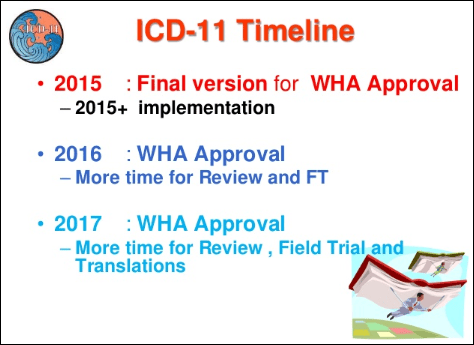
Early on in the revision process, the ICD-11 dissemination date was extended. By 2009, the final draft was scheduled for World Health Assembly (WHA) approval in 2014. In order to be ready for global implementation in 2015, the technical work on ICD-11 would need to be completed by 2012 [3].

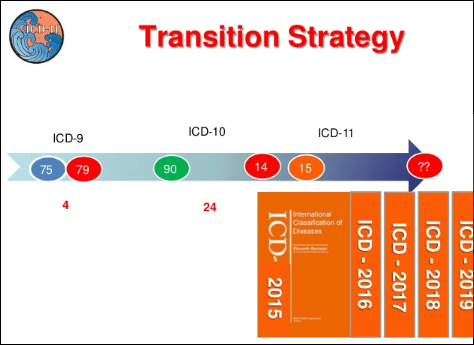
The WHA approval date was subsequently shunted from 2014 to 2015 – four years later than originally planned and the current, projected implementation date is 2016+.
+++

“…And just a small detail: who will do all this work?” [4]

ICD-11 is a very ambitious and under-resourced project. Given the scale of the undertaking, the technical complexity, the limited funding and human resources, the feasibility of the project reaching its targets by May 2015 has proved unrealistic.

I have written a number of times on this site that I did not envisage dissemination of ICD-11 by 2016 without some scaling back of the project’s scope – or an announcement, at some point this year, of a further extension to the timeline.

ICD-11 Revision Steering Group considers its options

WHO has recently posted a meeting materials document [5] and a slide presentation [6] which summarize, inter alia, ICD-11’s progress, current development status and timelines for finalization date and approval by WHO Governing Bodies.

ICD Revision is considering extending the timeline by up to a couple of years.

This 14 page document Committee for the Coordination of Statistical Activities, Twenty-second Session 4-6 September 2013, Items for discussion and decision: Item 8 of the provisional agenda can be downloaded here

or opened on Dx Revision WatchPDF: SA-2013-12-Add1-Health-WHO

It summarizes the status of the ICD Revision process under section headings:

1. Background: need and mandate
2. General organization structure of the multiple streams of work
3. Progress and current status
4. The remaining steps
5. Further maintenance of ICD after finalization
6. Timelines for the finalization date and approval by WHO Governing Bodies

Extracts from the document setting out the rationale and options for postponement of WHA Approval:

[…]

3. Progress and Current Status of ICD Revision:

[…]

BETA PHASE:

At this point in time, 1 September 2013, an ICD2013 Beta version has been produced for review purposes and field trials after 6 years of drafting phases.

The current ICD 2013 Beta version has relatively stable classification lists (i.e. linearizations) for Mortality and Morbidity recording. It will be reviewed by the specific Mortality Reference Group and the Morbidity Reference Group to see how well it fits the purpose and proposed transition from ICD‐10.

In addition, the Beta version has planned processes for:

(i) Systematic international scientific peer review
(ii) Submission of additional proposals from public groups and scientists
(iii) Conducting field trials for its applicability and reliability
(iv) Production support in multiple languages (translations) starting with WHO official languages
(v) Preparations for transitions from ICD‐10 to ICD‐11.

[…]

6. Timelines

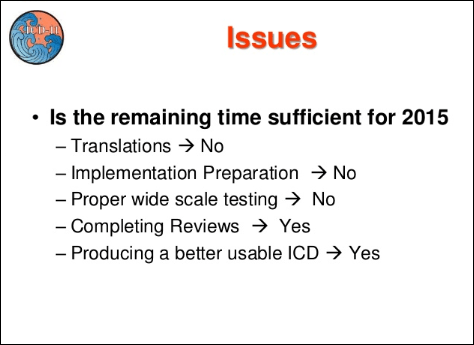
The current ICD Revision Process timeline foresees that the ICD is submitted to the WHA in 2015 May and could then be implemented. Between now and 2015, there remains 20 months to conduct the remaining tasks summarized above as: 1. Reviews, 2. Additional Proposals, 3. Field Trials, 4. Translations, and 5. Transition Preparations.

Given the technical requirements these steps could be expedited in the next 20 months. The experience obtained thus far, however, suggests that this timeframe will be extremely tight for paying due diligence to the work especially in terms of: appropriate consultations with expert groups; communication and dissemination with stakeholders; and sufficient time for field testing in multiple countries and settings, and carrying out the resulting edits.

WHO Secretariat would like to discuss this with all stakeholders and evaluate the possible options:

a. Keep ICD submission to WHA to 2015 as originally planned and implementation / adoption date may be free by any Member State (current position – no change).

b. Postpone submission to WHA to a later year to allow longer time for field trials and other transition preparations.

[…]

In conclusion:

(a) WHO Secretariat could produce an ICD 2015 ready including Mortality and Morbidity Linearizations, Reference Guide and Index with the appropriate resolution to go to the World Health Assembly. This timeframe, however, is extremely tight for paying due diligence to the work especially in terms of: appropriate consultations with expert groups; and sufficient time for field testing in multiple countries and settings, and carrying out the resulting edits

(b) If the timeline is advanced to 2016, there will be more time to have ICD 2016 version with more translations and incorporations of some field tests results.

(c) If the timeline is advanced to 2017, ICD 2017 will be ready with most Field Test results incorporated and maintenance scheme tested.

[…]

If WHO/ICD-11 Revision Steering Group does elect to postpone submission for WHA approval until May 2017, dissemination of ICD-11 may not be scheduled before 2018.

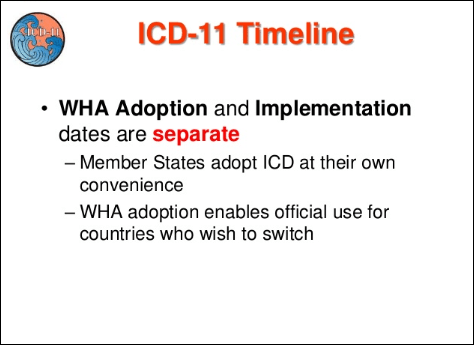
Once approved and released, adoption of ICD-11 won’t happen overnight. It may take several years before WHO Member States adopt ICD-11. Low resource and developing countries may also take longer to prepare for and transition to the new edition.

Note for US readers: According to Page 3332 of DHSS Office of Secretary Final Rule document (Federal Register / Vol. 74, No. 11 / Friday, January 16, 2009 / Rules and Regulations):

“…We [ICD-9-CM Coordination and Maintenance Committee] discussed waiting to adopt the ICD-11 code set in the August 22, 2008 proposed rule (73 FR 49805)…

“…However, work cannot begin on developing the necessary U.S. clinical modification to the ICD-11 diagnosis codes or the ICD-11 companion procedure codes until ICD-11 is officially released. Development and testing of a clinical modification to ICD-11 to make it usable in the United States will take an estimated additional 5 to 6 years. We estimated that the earliest projected date to begin rulemaking for implementation of a U.S. clinical modification of ICD-11 would be the year 2020.” [7]

This projection, in early 2009, would have been based on the assumption that ICD-11 was anticipated to be finalized and submitted for WHA Approval by 2014 (now potentially shifting to 2017).

An additional two year delay in the finalization of the ICD-11 code sets would likely impact on the development process for a clinical modification of ICD-11 for US specific use, kicking adaptation and implementation of an ICD-11-CM even further down the road.

+++
This slide presentation, below, was uploaded to Slideshare on September 9 by Dr Bedirhan Üstün, Coordinator, Classification, Terminology and Standards, World Health Organization, and also sets out the postponement options now under consideration:

Slide presentation: World Health Organization Classifications, Terminologies, Standards

ICD Revision: Quality Safety Meeting 2013 September 9-10

Where are we? What remains to be done? Shall we have ICD WHA submission in 2015 or later?

http://www.slideshare.net/ustunb/icd-2013-qs-tag-26027668

Slide 29:

Ustun 29rule

Slide 30:

Ustun 30rule

Slide 34:

Ustun 34rule

Slide 35: [WHA Approval – options under consideration]

Ustun 35rule
+++

References

1. Agenda Item No. 25: Revision of the International Classification of Diseases (ICD-10) and Involvement of Psychology International Union of Psychological Science Committee on International Relations Action, March 28–30, 2008 IUPsyS Mar 08 Agenda Item 25 ICD-10

2. Letter Saxena, WHO, to Ritchie, IUPsyS (International Union for Psychological Science), August 2007 Exhibit 1 WHO Letter Aug 07

3. Dr Geoffrey Reed, Ph.D., May 2009, personal correspondence.

4. Closing remarks, PowerPoint presentation: “Proposal for the ICD Beta Platform”, Stanford team, 12.04.11, WHO, Geneva.

5. Committee for the Coordination of Statistical Activities, Twenty-second Session 4-6 September 2013, Items for discussion and decision: Item 8 of the provisional agenda, 3 September 2013 Full document in PDF format

6. Slide presentation: ICD Revision: Where are we? Bedirhan Ustun, World Health Organization Classifications, Terminologies, Standards, ICD Revision: Quality Safety Meeting 2013, September 9-10, 2013 http://www.slideshare.net/ustunb/icd-2013-qs-tag-26027668

7. DHSS Office of Secretary Final Rule document (Federal Register / Vol. 74, No. 11 / Friday, January 16, 2009 / Rules and Regulations), Page 3332.

New Theme for Dx Revision Watch: WordPress Enterprise Theme

Post #274 Shortlink: http://wp.me/pKrrB-3qX

Image belgianchocolate Creative Commons

Regular visitors to this site may have noticed a recent change in the WordPress theme from Truly Minimal to WordPress Enterprise Theme.

I have made a number of modifications to the default Enterprise Theme CSS (Cascading Style Sheets). Additional modifications may be effected as I become more acquainted with the CSS for this particular theme.

For WordPress.com users who are running Enterprise Theme and who may be interested in the customization, the current CSS modifications for this site are set out on this page, with examples of further basic CSS modifications to the theme:

About > CSS modifications

image credit | belgianchocolate | creative commons

Media coverage: Karina Hansen now detained six months against her will in Hammel Neurocenter, Denmark

Post #273 Shortlink: http://wp.me/pKrrB-3kV

Update at September 9: According to reports linked to by ME Forenginen, Danmark, on Facebook:

The Hansen parents had a court hearing on September 5, 2013, to challenge the legality of Karina’s guardianship. Karina’s removal from her home by the authorities and her continued detention at Hammel Neurocenter was not scheduled to be covered during the court proceedings.

The Danish Aktion Karina/Term group that has been protesting outside Hammel Neurocenter and the Aarhus Research Clinic for Functional Disorders (the clinic that is advising Hammel Neurocenter on Ms Hansen’s treatment), are planning a new demonstration in front of the Ministry of Health. The event is scheduled for September 26, in Copenhagen.

For more information on this event: https://www.facebook.com/events/536076826466062/

Update at August 30: It is understood that a meeting between the Hansen parents and physicians at Hammel Neurocenter took place on Tuesday, August 28; that Dr Gerdes and lawyer, Mr Tørnes, were not permitted to attend this meeting and that the parents were denied access to visit their daughter.* I will post further information if and when an official update is released.

*Source: https://www.facebook.com/meforeningen.dk

There have been further protests staged, this week, at Hammel Neurocenter:

Aktion Karina – Myalgisk Encephalomyelitis (ME) Aktion 2, Dag 1:

http://www.youtube.com/watch?v=lFfilet_upo

Update: According to ME Forenginen, Danmark, on Facebook, the Hansen parents have been called to a meeting in the next couple of weeks with Merete Stubkjær Christensen, chief physician, Regionshospitalet, Hammel Neurocenter. Doctor Stig Gerdes and lawyer, Paul Tørnes, have sent a further letter to the Aarhus Research Clinic for Functional Disorders (that is advising Hammel Neurocenter on Ms Hansen’s treatment), following a telephone conversation with the Clinic. It is understood that Dr Gerdes and Mr Tørnes were hoping to attend this anticipated meeting with Merete Stubkjær Christensen to support the parents.

Update: YouTube: Danish Aktion Karina/Term group protest (Day 5):
http://www.youtube.com/watch?v=0tAAJvJmhH4

Update: YouTube: Danish Aktion Karina/Term group protest Hammel Neurocenter (Day 4): http://www.youtube.com/watch?v=OqDUJworpaY

Update: New article, August 14: Dagbladet Holstebro (Subscription required for access)

http://dagbladet-holstebro-struer.dk/holstebro/beskyldte-mor-for-alvorlige-svigt-af-syg-datter

Beskyldte mor for alvorlige svigt af syg datter (Accused mother of serious failure of sick daughter)

Update: YouTubes: Danish Aktion Karina/Term group protests about Karina Hansen’s treatment (Days 1 to 5):

Aktion Karina Day 1: http://www.youtube.com/watch?v=zDBhlnw6DMo

Aktion Karina Day 2: http://www.youtube.com/watch?v=yAf2fH8qhuQ

Aktion Karina Day 3: http://www.youtube.com/watch?v=vpCd9ZGAEY8

Aktion Karina Day 4: http://www.youtube.com/watch?v=OqDUJworpaY

Aktion Karina Day 5: http://www.youtube.com/watch?v=0tAAJvJmhH4

“Karina er en 24 årig ME-syg kvinde, som er blevet tvangsindlagt på Hammel Sygehus, underkastet regler for psykiatrien og hun er under psykiaterne på Forskning klinikken for de såkaldte funktionelle lidelsers bestemmelser og fulde kontrol.

“Karinas telefon er gået død, og er ikke mere i brug. Karina har ikke adgang til en PC. Familiens advokat har fået at vide, at han ikke er Karinas advokat. Karina må ikke modtage besøg.

“Karinas retssikkerhed er alvorligt truet. Karina udsættes for fysisk træning, hvilket ofte skader Me-patienter. Karina har ikke set sine forældre siden indlæggelsen for over 100 dage siden. Psykiaterne på Forskningsklinikken for de såkaldte funktionelle lidelser har fået ansvaret for ME-syge i DK, selvom udenlandske og indlandske eksperter mener, at ME er en neurologisk eller en immunologisk sygdom og ikke en psykiatrisk sygdom. Psykiaterne har voldsomt brug for en succeshistorie, da de har fået ansvaret for et helt nyt ME-videns-center, som fremover skal have ansvaret for ME-syge i DK. Psykiaterne på Forskningsklinikken vil ikke samarbejde med specialister i ME, men kun med andre psykiatere.”

Aktion Karina/Term site – https://www.facebook.com/events/214896588665066/

Update: New article, August 14: Ekstra Bladet

http://ekstrabladet.dk/nationen/article2066198.ece

Voldsomt: 5 betjente tvangsindlægger 24-årig  (Violently: 5 cops forced hospitalization of 24-year-old)

Lige nu demonstrerer ca. 20 borgere mod tvangsindlæggelsen af 24-årige karina, der blev fjernet fra hjemmet – uden forældrenes accept Af: Thomas Harder

(Right now, around 20 citizens demonstrate against forced admission of 24 year old Karina, who was removed from home – without parental consent By Thomas Harder)

“De har taget hende og har gjort hende til en psykiarisk sygdom – men hun er fysisk syg, og vi er meget bekymrede for hende”

(“They have taken her and assigned her a psychiatric illness – but she is physically ill, and we are very concerned for her”)

As previously posted on August 14

+++

“…They have not seen their adult daughter for almost six months, after she was forcibly hospitalized in Hammel Neurocenter. Against her parents’ wishes. Against her own wishes. Not even their daughter’s lawyer can get an explanation…”

+++

KHBW2On 12 February, 24 year old Karina Hansen of Holstebro, Denmark, was removed from her home by five policemen, two doctors, two social workers and a locksmith, who threatened to break down the door to the family home.

She was taken, against her will, to Hammel Neurocenter. For six months, now, Karina has remained in hospital and is denied visits from her parents, Per and Ketty Hansen.

Karina is unable to access her legal representative because the hospital and health authorities refuse to acknowledge the lawyer whom she engaged to represent her, in 2012.

The authorities have appointed a guardian over the heads of Karina and her parents, who held power of attorney for their daughter, pictured on the left.

Rebecca Hansen, chairman, ME Foreningen, Danmark (ME Association, Denmark), who is not a relative, has been acting as lay advocate to the Hansen family. The most recent update on Karina’s situation was published here on Dx Revision Watch, in June.

For links to translations of Update 2: Human Rights denied: Something rotten in the state of Denmark: Karina Hansen’s story in Danish, German and Dutch go here.

Professor Per Fink, Aarhus Research Clinic for Functional Disorders is advising Hammel Neurocenter on Karina’s treatment – a treatment regime she has made plain she does not wish to receive, in a setting she does not wish to be detained in.

Her rights, as a patient, to determine where and by what means and for how long she is treated, to receive documentation and a treatment plan and access to her family and her lawyer, are being denied by Danish Health authorities.

For information on Aarhus Research Clinic and Per Fink et al’s construct of Bodily Distress Syndrome, see Part Two of Dx Revision Watch Post: ICD-11 Beta draft and Bodily Distress Disorders; Per Fink and Bodily Distress Syndrome

+++

National media coverage of the case

On August 10, four reports were published by the newspaper, BT, Danmark (a Danish national tabloid):

http://www.bt.dk/danmark/foraeldre-naegtet-at-se-syg-datter-mor-hvordan-skal-jeg-komme-vaek-herfra

Forældre nægtet at se syg datter: ’Mor, hvordan skal jeg komme væk herfra?’

(Parents are refused [visits] to see sick daughter: ‘Mom, how do I get out of here?’)

by Morten Eggert

also

http://www.bt.dk/danmark/derfor-blev-24-aarige-k-fjernet-fra-sine-foraeldre

Derfor blev 24-årige K fjernet fra sine forældre

(Why was 24 year old K removed from her parents?)

also

http://www.bt.dk/danmark/24-aarig-patient-i-slaar-mig-ihjel

24-årig patient: I slår mig ihjel

(24 year old patient: “You are killing me”)

(As I don’t speak Danish and since this is a very sensitive case, I prefer not to provide imperfect and potentially inaccurate auto translations or summaries; the gist of these reports can be roughly auto translated via Google, Bing or other translators.)

also

[Image] http://xa.yimg.com/kq/groups/86982676/219750998/name/BT

Politiker: De må ikke tvangsindlægge

(Politician: They don’t forcibly hospitalize)

“Liselott Blixt, health spokesperson for Dansk Folkeparti (The Danish People’s Party) and Chairman of the Folketing § 71-supervision, which keeps an eye on the use of coercion, has now prompted a statement from Region Midtjylland on this deeply unhappy case…”

+++

Local media coverage

A local paper (Dagbladet Holstebro-Struer) also reported on the case, last week, on 10 August, with a four page interview with Per and Ketty Hansen. Subscribers can read the interview with Karina’s parents, in Danish, online, here:

http://dagbladet-holstebro-struer.dk/holstebro/de-tog-vores-datter

They took our daughter

+++
From ME Forenginen, Danmark’s Facebook page: https://www.facebook.com/meforeningen.dk

On August 13, BT published an interview with ME Forenginen, Danmark’s, Vice-Chair, Cathrine Engsig, about the treatment of Karina Hansen and her parents:

[Image] https://fbcdn-sphotos-b-a.akamaihd.net/hphotos-ak-frc3/p480x480/995990_412997052143731_905956157_n.jpg

+++

Demonstrations

According to ME Forenginen, Danmark’s, Facebook page, a non-affiliated Danish group has started a 5 day demonstration in Aarhus and Hammel to raise awareness of Karina’s plight.

A series of demonstrations started on Monday, 12 August, and ends on Friday, 16 August, in the afternoon.

More information here: https://www.facebook.com/events/214896588665066

+++

Initiatives

According to ME Forenginen, Denmark’s Facebook page, doctor Stig Gerdes and lawyer Stig Tornaes have contacted psychiatrist, Professor Per Fink, Aarhus Research Clinic for Functional Disorders, who is advising Hammel Neurocenter on Karina’s treatment. A copy of their letter can be read, in Danish, on ME Forenginen, Danmark’s, Facebook page, here:

https://www.facebook.com/meforeningen.dk

I will update when further official updates or media coverage become available.

Clarification
Reports and updates on Dx Revision Watch site on the Hansen family’s situation are being published as provided by, and in consultation with, Rebecca Hansen, Chairman, ME Foreningen, Danmark (ME Association, Denmark), or edited from reports as provided. Dx Revision Watch site has no connection with any petitions or initiatives, or with any websites, social media platforms or other platforms set up to promote petitions or initiatives, or to otherwise raise awareness of the Hansen family’s situation. All enquiries in relation to any petitions or other initiatives, or platforms associated with them should be addressed directly to the organizers, sponsors or owners responsible for them.

+++

Previous posts

Something rotten in the state of Denmark: Karina Hansen’s story: http://wp.me/pKrrB-2Xc

Human Rights denied: Something rotten in the state of Denmark: Karina Hansen’s story: Update 1: http://wp.me/pKrrB-35o

Update 2: Human Rights denied: Something rotten in the state of Denmark: Karina Hansen’s story: http://wp.me/pKrrB-390

+++

Links

Website for ME Foreningen, Danmark www.me-foreningen.dk

Official petition launched and sponsored by the ME Association of Denmark, and approved by the Hansen family: http://www.ipetitions.com/petition/postcardtokarina/
For more information on the ME Association of Denmark’s postcard campaign go here on Facebook
For information on Bodily Distress Syndrome see Part Two of Dx Revision Watch Post: ICD-11 Beta draft and BDD, Per Fink and Bodily Distress Syndrome
Opdater 2: Menneskerettighederne nægtet: Noget råddent i staten Danmark: Karina Hansen: http://wp.me/pKrrB-390
Update 2: Human Rights denied: Something rotten in the state of Denmark: Karina Hansen’s story: http://wp.me/pKrrB-390
Update 2: Ontkenning van mensenrechten: Iets verrot in de staat van Denemarken: Het verhaal van Karina Hansen: http://wp.me/pKrrB-390
Update 2: Menschenrechtsverstoß: Etwas ist faul in Dänemark: Karina Hansens Geschichte: http://wp.me/pKrrB-390
Update 2: Droits de l’Homme: Il y a quelque chose de pourri au royaume du Danemark: l’histoire de Karina Hansen: http://wp.me/pKrrB-390

DSM-5 Somatic Symptoms Disorders work group publishes SSD field trial data

Post #272 Shortlink: http://wp.me/pKrrB-3ke

Update: Somatic Symptom Disorder: An important change in DSM. is now published in the September 2013 issue, J Psychosom Res. A subscription or payment is required to access this paper.

http://www.ncbi.nlm.nih.gov/pubmed/23972410

J Psychosom Res. 2013 Sep;75(3):223-8. Epub 2013 Jul 25.
Dimsdale JE, Creed F, Escobar J, Sharpe M, Wulsin L, Barsky A, Lee S, Irwin MR, Levenson J.

DSM-5 Somatic Symptoms Disorders work group publishes SSD field trial data…behind a paywall

Reports on the findings of the DSM-5 field trials have been slow to emerge.

Kappa results trickled out in dribs and drabs; work group chairs presented limited field trial data at the APA’s 2012 Annual Meeting. There remains a paucity of information on field trial study protocols, patient selection, field test results and analysis.

This is of particular concern where radical changes to DSM-IV definitions and criteria were introduced into DSM-5 and are now out there in the field.

A good example is the new DSM-5 “Somatic Symptom Disorder” category, where there is no substantial body of evidence for the reliability, validity, prevalence, safety, acceptability and clinical utility of the implementation of this new disorder construct – though that did not stop them barrelling it through to the final draft.

In its paper, the SSD Work Group acknowledges the “small amount of validity data concerning SSD”; that much “remains to be determined” about the utility and reliability of the specific SSD criteria and its thresholds when applied in busy, general clinical practice and that there are “vital questions that must be answered” as they go forward.

They don’t sound any too confident about what they’ve barrelled through; but neither do they seem overly concerned.

With remarkable insouciance, SSD Work Group Chair, Joel E Dimsdale, told ABC journalist, Susan Donaldson James, “…If it doesn’t work, we’ll fix it in the DSM-5.1 or DSM-6.” (ABC News, February 27, 2013).

Cavia15The implementation of SSD in the DSM-5 is a Beta trial; the public – adults and children – unwitting guinea pigs.

Members of the DSM-5 Somatic Symptoms Disorders Work Group have just published a report – Somatic Symptom Disorder: An important change in DSM.

APA owns the output of the DSM-5 work groups but this report isn’t posted on the APA’s DSM-5 Development site or on the Field Trials or DSM-5 Resources pages.

It’s being published (currently In Press) in the Journal of Psychosomatic Research, for which DSM-5 SSD Work Group member, James Levenson, is a Co-Editor and for which SSD Work Group member, Francis Creed, a past Editor.

Unless you are a subscriber to JPS or have institution access you will need to cough up $30 to access this paper.

DSM-5 Task Force’s Regier and Kupfer have been banging on for years about how transparent the development process for this most recent iteration of the DSM has been. Yet reports on field trial findings and analysis of studies cited in support of the introduction of radical new constructs for DSM are stuffed behind paywalls.

Why are DSM-5 work group reports not being published on the DSM-5 Development website or other APA platforms or published in journals under Creative Commons Licenses, for ease of public accessibility, professional and consumer stakeholder scrutiny and discussion, and for accountability?

The development of ICD-11 is also being promoted by WHO’s Bedirhan Üstün as an open and transparent process.

But emerging proposals from the two working groups charged with making recommendations for revision of ICD-10′s Somatoform Disorders (the Primary Care Consultation Group, chaired by Prof Sir David Goldberg and the WHO Expert Working Group on Somatic Distress and Dissociative Disorders, chaired by Prof Oje Gureje) were also published, last year, in subscription journals and subject to those journals’ respective copyright restrictions [1] [2].

1. Lam TP et al. Proposed new diagnoses of anxious depression and bodily stress syndrome in ICD-11-PHC: an international focus group study. Fam Pract. 2013 Feb;30(1):76-87. [Abstract: PMID:22843638]
2. Creed F, Gureje O. Emerging themes in the revision of the classification of somatoform disorders. Int Rev Psychiatry 2012;24:556-67. [Abstract: PMID: 23244611]

Why are ICD-11 working group progress reports on emerging proposals for potential new ICD disorders and focus group study reports not being published on platforms accessible, without payment, to all classes of ICD stakeholder?

The SSD Work Group paper is authored by Joel E Dimsdale (Chair), Francis Creed, Javier Escobar, Michael Sharpe, Lawson Wulsin, Arthur Barsky, Sing Lee, Michael R. Irwin and James Levenson.

[Although not a member of the SSD Work Group, Javier Escobar is Task Force liaison to the SSD work group and works closely with the group. Francis J Keefe (not included in the paper’s authors) is a member of the SSD Work Group. Nancy Frasure-Smith (not included in the paper’s authors) served as a member of the Work Group from 2007-2011 and was not replaced following withdrawal.]

The paper describes the DSM-5 Work Group’s rationale for the new SSD diagnosis (which replaces four DSM-IV categories); defines the construct, discusses field trial kappa data (inter-rater reliability), presents limited data for validity of SSD, clinical utility and potential prevalence rates, and briefly discusses tasks for future research, education and clinical practice.

http://www.jpsychores.com/

July 2013, Vol. 75, No. 1

In Press

Somatic Symptom Disorder: An important change in DSM

29 July 2013

Joel E. Dimsdale, Francis Creed, Javier Escobar, Michael Sharpe, Lawson Wulsin, Arthur Barsky, Sing Lee, Michael R. Irwin, James Levenson

Received 4 April 2013; received in revised form 27 June 2013; accepted 29 June 2013. published online 29 July 2013.

Corrected Proof

doi:10.1016/j.jpsychores.2013.06.033

Abstract: http://www.jpsychores.com/article/S0022-3999(13)00265-1/abstract [Free]

Full text: http://www.jpsychores.com/article/S0022-3999(13)00265-1/fulltext  [Paywall]

References: http://www.jpsychores.com/article/PIIS0022399913002651/references  [Paywall]


Commentaries on Somatic Symptom Disorder in recent journal papers

In the June 2013 edition of Journal of Nervous and Mental Disorders, Allen Frances, MD, who chaired the Task Force for DSM-IV, discusses his concerns for the loosely defined DSM-5 category, Somatic Symptom Disorder, sets out his suggestions for revising the criteria prior to finalization, as presented to the SSD Work Group chair, in December 2012, and advises clinicians against using the new SSD diagnosis.

http://www.ncbi.nlm.nih.gov/pubmed/23719325

DSM-5 Somatic Symptom Disorder.

Frances A.

Department of Psychiatry, Duke University, Durham, NC.

J Nerv Ment Dis. 2013 Jun;201(6):530-1. doi: 10.1097/NMD.0b013e318294827c. No abstract available.

PMID: 23719325

+++

Commentary by Allen Frances, MD, and Suzy Chapman in the May 2012 issue of Australian and New Zealand Journal of Psychiatry. The paper discusses the over-inclusive DSM-5 Somatic Symptom Disorder criteria and the potential implications for diverse patient groups. The paper concludes by advising clinicians not to use the new SSD diagnosis.

http://www.ncbi.nlm.nih.gov/pubmed/23653063

DSM-5 somatic symptom disorder mislabels medical illness as mental disorder.

Allen Frances¹, Suzy Chapman²

1 Department of Psychiatry, Duke University 2 DxRevisionWatch.com

Aust N Z J Psychiatry. 2013 May;47(5):483-4. doi: 10.1177/0004867413484525. No abstract available.

PMID: 23653063

+++

The April 22, 2013 edition of Current Biology published a feature article on DSM-5 by science writer, Michael Gross, Ph.D. The article includes quotes from Allen Frances, MD, and Suzy Chapman on potential implications for patients for the application of the new DSM-5 Somatic Symptom Disorder. The article includes concerns for the influence of Somatic Symptom Disorder on proposals for a new ICD category – Bodily Distress Disorder – being field tested for ICD-11.

Current Biology 22 April, 2013 Volume 23, Issue 8

Copyright 2013 All rights reserved. Current Biology, Volume  23, Issue  8, R295-R298, 22 April 2013

doi:10.1016/j.cub.2013.04.009

Feature

Has the manual gone mental?

Michael Gross

Full text: http://www.cell.com/current-biology/fulltext/S0960-9822(13)00417-X

PDF: http://download.cell.com/current-biology/pdf/PIIS096098221300417X.pdf

+++

In a BMJ opinion piece, published March 2013, Allen Frances, MD, opposes the new Somatic Symptom Disorder, discusses lack of specificity, data from the field trials, and advises clinicians to ignore this new category.

http://www.ncbi.nlm.nih.gov/pubmed/23511949

The new somatic symptom disorder in DSM-5 risks mislabeling many people as mentally ill.

Frances A.

Allen Frances, chair of the DSM-IV task force

BMJ. 2013 Mar 18;346:f1580. doi: 10.1136/bmj.f1580. No abstract available.

PMID: 23511949

[PubMed – indexed for MEDLINE]

+++
Somatic Symptom Disorder is also included in Saving Normal: An Insider’s Revolt Against Out-Of-Control Psychiatric Diagnosis, DSM-5, Big Pharma, and the Medicalization of Ordinary Life (pp. 193-6): Allen Frances, William Morrow & Company (May 2013).

Also Essentials of Psychiatric Diagnosis: Responding to the Challenge of DSM-5 (Chapter 16): Allen Frances, Guilford Press (June 2013).

+++

Further reading

APA Somatic Symptom Disorder Fact Sheet APA DSM-5 Resources

Somatic Chapter Drops Centrality Of Unexplained Medical Symptoms Psychiatric News, Mark Moran, March 1, 2013

Somatic Symptoms Criteria in DSM-5 Improve Diagnosis, Care David J Kupfer, MD, Chair, DSM-5 Task Force, defends the SSD construct, Huffington Post, February 8, 2013

The new somatic symptom disorder in DSM-5 risks mislabeling many people as mentally ill Allen Frances, MD, BMJ 2013;346:f1580 BMJ Press Release

Somatic Symptom Disorder could capture millions more under mental health diagnosis Suzy Chapman, May 26, 2012

Mislabeling Medical Illness As Mental Disorder Allen Frances, MD, Psychology Today, DSM 5 in Distress, December 8, 2012

Why Did DSM 5 Botch Somatic Symptom Disorder? Allen Frances, MD, Psychology Today, Saving Normal, February 6, 2013

New Psych Disorder Could Mislabel Sick as Mentally Ill Susan Donaldson James, ABC News, February 27, 2013

Dimsdale JE. Medically unexplained symptoms: a treacherous foundation for somatoform disorders? Psychiatr Clin North Am 2011;34:511-3. [PMID: 21889675]