ICD-11 Beta drafting platform: Update (2)

ICD-11 Beta drafting platform: Update (2): Neurasthenia, Postviral fatigue syndrome (PVFS), Benign myalgic encephalomyelitis (ME), Chronic fatigue syndrome (CFS), Fibromyalgia (FM), Irritable bowel syndrome (IBS)

Post #193 Shortlink: http://wp.me/pKrrB-2mC

The information in this report relates to proposals for the World Health Organization’s forthcoming ICD-11, currently scheduled for pilot dissemination in 2015+; it does not apply to the existing ICD-10 or to the forthcoming US specific “clinical modification” of ICD-10, known as ICD-10-CM.

Caveat: The ICD-11 Beta drafting process is a work in progress over the next two to three years. The Beta draft is updated on a daily basis. Parent terms, category terms and sorting codes assigned to categories are subject to change as chapter reorganization progresses. Images and text in this posting may not reflect the most recently assigned categories and codes. This post reflects the Beta draft as it stood at July 25, 2012. Please also read the ICD-11 Beta Draft Caveats.

Post #190 Changes to ICD-11 Beta drafting platform: Bodily Distress Disorders (1) reported on proposals for including three Bodily distress disorder categories in the Somatoform Disorders section of the ICD-11 Beta drafting platform which appear potentially to replace or subsume a number of existing ICD-10 Somatoform Disorder categories.

That post has been revised to reflect clarifications from Professor, Sir David Goldberg, M.D., around the Primary care version of ICD-11 and to include additional material.

The report in this post updates on current proposals for the ICD-11 Beta drafting platform for revision of the following ICD-10 categories: Neurasthenia, Postviral fatigue syndrome (PVFS), Benign myalgic encephalomyelitis (ME), Chronic fatigue syndrome (CFS), Fibromyalgia (FM) and Irritable bowel syndrome (IBS) for the full version of ICD-11.

ICD Revision Steering Group and the various Topic Advisory Groups are developing the ICD-11 Beta draft on a non public access collaborative authoring platform where change histories can be tracked, which looks similar to this:
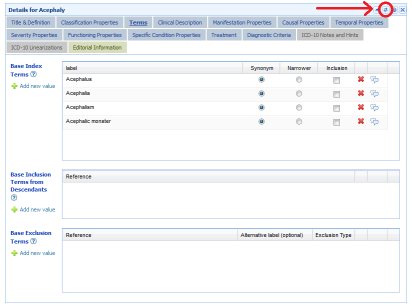
The publicly viewable version of the Beta drafting platform looks like this:

and displays less information. It can be accessed here:

Beta draft Foundation Component (FC) view:

http://apps.who.int/classifications/icd11/browse/f/en

Beta draft Linearization Morbity (LM) view:

http://apps.who.int/classifications/icd11/browse/l-m/en

Increased access to content and interaction with the drafting process can be obtained by registering.
+++
+++
Neurasthenia:

Neurasthenia is not classified in DSM-IV and is not proposed to be classified in DSM-5.

In ICD-10, Neurasthenia is classified in Chapter V Mental and behavioural disorders under parents:

F40-F48 Neurotic, stress-related and somatoform disorders

    F48 Other neurotic disorders
        ›  F48.0 Neurasthenia

+++
For ICD-11 Beta, up until July 3, Neurasthenia was also classified under:

Neurotic, stress-related and somatoform disorders

    9S1 Other neurotic disorders
        ›  9S1.1 Neurasthenia

Inclusions: Fatigue syndrome

Exclusions: psychasthenia
postviral fatigue syndrome
malaise and fatigue
asthenia NOS
burn-out

    9S1.2 Other specified neurotic disorders

Inclusions: Dhat syndrome
Occupational neurosis, including writer’s cramp
Psychasthenia
Psychasthenic neurosis
Psychogenic syncope

     9S1.3 Neurotic disorder, unspecified

Neurosis NOS

+++

On July 4, all child categories classified under parent class, 9S1 Other neurotic disorders, including Neurasthenia and its Inclusion, Fatigue syndrome, were removed from both the FC and LM view and from the PDF for the Chapter 5 Print version and there is currently no listing for any of these categories and child categories under any parent.

As no “Change history” records display in the public version of the Beta draft, it cannot be determined from what information is available whether these categories are temporarily omitted while this section of Chapter 5 is being reorganized, or whether all or selected of these ICD-10 categories are proposed to be retired for ICD-11 or are destined to be subsumed under the proposed Bodily distress disorders categories that ICD Revision has yet to define.

According to the Goldberg February 2011 report, terms included in the ICD11-PHC version of ICD-11 must have an equivalent disorder in the main classification. In February 2011, it was proposed not to include Neurasthenia in the ICD11-PHC version but to subsume under 13 Distress disorder. (It isn’t clear under which disorder group or subcategory Neurasthenia is proposed to be subsumed for the most recently published iteration for ICD11-PHC.)

Neurasthenia remains listed as an Exclusion to Chapter 5 Generalized anxiety disorder and Chapter 18 Malaise and fatigue but these Exclusions may be awaiting attention, if the intention is to retire a number of ICD-10 terms.

I will update when it becomes apparent what the intention is for these currently missing categories.

+++
ICD-11 Chapter 06: Diseases of the nervous system

Postviral fatigue syndrome, Benign myalgic encephalomyelitis, Chronic fatigue syndrome:

In ICD-10, Postviral fatigue syndrome is classified as a Title term within Volume 1: The Tabular List in Chapter VI: Diseases of the nervous system under G00-G99 Other disorders of the nervous system > G93 Other disorders of brain, and coded at G93.3. See: http://apps.who.int/classifications/icd10/browse/2010/en#/G93.3

Benign myalgic encephalomyelitis is also coded in the Tabular List to G93.3 Postviral fatigue syndrome.

Chronic fatigue syndrome is not classified within the Tabular List but is indexed to G93.3 in Volume 3: The Alphabetical Index.

An unauthorised copy of Volume 3: The Alphabetical Index Version for 2006 can be accessed here: (See Page 528)
http://www.scribd.com/doc/7350978/ICD10-2006-Alphabetical-Index-Volume-3 

In indexing Chronic fatigue syndrome to G93.3, ICD-10 does not specify whether it views the term as a synonym, subclass or “best coding guess” to Title term, Postviral fatigue syndrome or to Benign myalgic encephalomyelitis.

Nor does ICD-10 specify the relationship between Postviral fatigue syndrome and Benign myalgic encephalomyelitis.

(For ICD-11, a mechanism will be provided to identify whether an inclusion term is a synonym or a subclass.)

In June 2010, I reported that in May 2010, a change of hierarchy had been recorded in the ICD-11 iCAT Alpha drafting platform “Change History” and “Category Discussion Notes” for class: G93.3 Postviral fatigue syndrome.

See these two screenshots from the original iCAT Alpha drafting platform:

Image 1:

Image 2:

+++
From current information in the Beta draft, it would appear that for ICD-11, the proposal is for a change of hierarchy between Postviral fatigue syndrome and Chronic fatigue syndrome with Chronic fatigue syndrome elevated to an ICD-11 Title term, with a Definition (not currently populated) and with potentially up to 12 other descriptive parameters, populated in accordance with the ICD-11 “Content Model.”

There are a number of terms listed under Synonyms to Title term Chronic fatigue syndrome including Benign myalgic encephalomyelitis and Postviral fatigue syndrome.

Mouse hover over the asterisk at the end of Benign myalgic encephalomyelitis and the following hover text displays, “This term is an inclusion term in the linearizations.”

Also listed under “Synonyms” are “chronic fatigue syndrome nos” and “chronic fatigue, unspecified” (both imported from current proposals for locating Chronic fatigue syndrome in Chapter 18: Symptoms and Signs in the forthcoming US specific, ICD-10-CM).

See this Beta drafting platform page:

http://apps.who.int/classifications/icd11/browse/f/en#/http%3a%2f%2fwho.int%2ficd%23G93
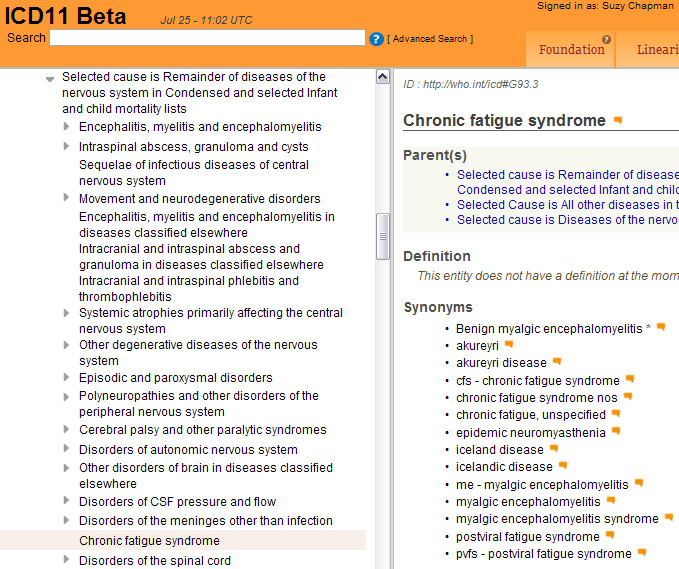
 

There is currently no discrete ICD Title term listed for Postviral fatigue syndrome in either the Foundation Component or Linearization Morbidity view and no discrete ICD Title term for Benign myalgic encephalomyelitis.

It remains unconfirmed, but from the Beta draft as it currently stands, it suggests that for ICD-11:

  • Chronic fatigue syndrome is proposed to become the Chapter 06 Title term
  • Benign myalgic encephalomyelitis is specified as an Inclusion term to CFS under “Synonyms”
  • Postviral fatigue syndrome and a number of other terms are listed under “Synonyms” to CFS

ICD-11 terminology:

For definitions of Synonyms, Inclusions, Exclusions and other ICD-11 terminology see the iCAT Glossary:

http://apps.who.int/classifications/apps/icd/icatfiles/iCAT_Glossary.html

+++
Fibromyalgia (FM):

In ICD-10, Fibromyalgia is classified under:

Chapter XIII: Diseases of the musculoskeletal system and connective tissue > M79 Other soft tissue disorders > M79 Other soft tissue disorders, not elsewhere classified > M79.7 Fibromyalgia 

ICD-10 Version: 2010: http://apps.who.int/classifications/icd10/browse/2010/en#/M79.7

For ICD-11 Beta draft, Fibromyalgia is currently classified under:

Chapter 13: Diseases of the musculoskeletal system and connective tissue > Soft tissue disorders > Other soft tissue disorders > QG6 Other soft tissue disorders, not elsewhere classified > QG6.7 Fibromyalgia

FC: http://apps.who.int/classifications/icd11/browse/f/en#/http%3a%2f%2fwho.int%2ficd%23M79.7
LM: http://apps.who.int/classifications/icd11/browse/l-m/en#/http%3a%2f%2fwho.int%2ficd%23M79.7

+++
Irritable bowel syndrome (IBS):

In ICD-10, Irritable bowel syndrome is classified under:

Chapter XI: Diseases of the digestive system > K55-K63 Other diseases of intestines > K58.0 Irritable bowel syndrome with diarrhoea > K58.9 Irritable bowel syndrome without diarrhoea > Irritable bowel syndrome NOS

ICD-10 Version: 2010: http://apps.who.int/classifications/icd10/browse/2010/en#/K58

For ICD-11 Beta draft, Irritable bowel syndrome is currently classified under:

Chapter 11: Diseases of the digestive system > Functional gastrointestinal disorders > FS6 Irritable bowel syndrome and other functional bowel disorders > FS6.1 Irritable bowel syndrome 

FC: http://apps.who.int/classifications/icd11/browse/f/en#/http%3a%2f%2fwho.int%2ficd%23K58
LM: http://apps.who.int/classifications/icd11/browse/l-m/en#/http%3a%2f%2fwho.int%2ficd%23K58

+++
I shall continue to monitor the Beta drafting process and update on any significant developments for both ICD-11 Chapter 5 and Chapter 6 and for ICD11-PHC for the categories that are the focus of this post and post #190.
+++
+++
References and related material:

1] ICD-10 Version: 2010 Volume 1 Tabular List online:
http://apps.who.int/classifications/icd10/browse/2010/en

2] ICD-11 Beta drafting platform:
http://apps.who.int/classifications/icd11/browse/f/en

3] Goldberg, D. Guest editorial. A revised mental health classification for use in general medical settings: the ICD11–PHC 1. International Psychiatry, Page 1, February 2011.
http://www.rcpsych.ac.uk/pdf/IPv8n1.pdf

4] 21st Century Global Mental Health by Dr Eliot Sorel, Professor, George Washington University, Washington D.C.
Publication date: August, 2012: http://www.jblearning.com/catalog/9781449627874/
Page 51, Sample Chapter 2: http://samples.jbpub.com/9781449627874/Chapter2.pdf

Changes to ICD-11 Beta drafting platform: Bodily Distress Disorders (1)

Changes to ICD-11 Beta drafting platform: Bodily Distress Disorders (1)

Post #190 Shortlink: http://wp.me/pKrrB-2jB


+++

This four page post is a revised version of content first published on July 2, 2012.

Information in this report relates to proposals for the World Health Organization’s forthcoming ICD-11, currently scheduled for pilot dissemination in 2015+; it does not relate to the existing ICD-10 or to the forthcoming US specific “clinical modification” of ICD-10, known as ICD-10-CM.

Caveat: The ICD-11 Beta drafting process is a work in progress over the next two to three years. The Beta draft is updated on a daily basis. Parent terms, category terms and sorting codes assigned to categories are subject to change as work on chapter reorganization progresses. Images and text in this posting may not reflect the most recently assigned categories and codes. This post reflects the Beta draft as it stood at July 24, 2012. Please also read the ICD-11 Beta Draft Caveats.

This report updates on recent changes to the Somatoform Disorders section of the ICD-11 Beta drafting platform. The Beta drafting platform can be accessed here:

Beta draft Foundation view:

http://apps.who.int/classifications/icd11/browse/f/en

Beta draft Linearization view:

http://apps.who.int/classifications/icd11/browse/l-m/en
+++

How do the Somatoform Disorders categories currently stand in ICD-10?

ICD-10 Tabular List Version: 2010 can be accessed here: http://apps.who.int/classifications/icd10/browse/2010/en

ICD-10 Chapter V “Somatoform Disorders”

This is the section of ICD-10 that corresponds with the Somatoform Disorders section in DSM-IV. There is a degree of correspondence between current categories for this section of ICD-10 and for DSM-IV, as set out in the (simplified) table, below.

For clinical descriptions and diagnostic guidelines for ICD-10 Somatoform Disorders see Page 129 of the “Blue book”:

ICD-10 Classification of Mental and Behavioural Disorders: Clinical descriptions and diagnostic guidelines: http://www.who.int/classifications/icd/en/bluebook.pdf

Current DSM-IV Codes and Categories for Somatoform Disorders and ICD-10 Chapter V Equivalents

[Ed: Neurasthenia is not categorized within DSM-IV.]

Source: Mayou R, Kirmayer LJ, Simon G, Kroenke K, Sharpe M: Somatoform disorders: time for a new approach in DSM-V. Am J Psychiat. 2005;162:847–855.
+++
+++
This screenshot shows how the ICD-11 Beta draft had stood at June 24, 2012:

ICD-11 Beta Draft: Morbidity Linearization view


+++

For ICD-11 Beta draft, the proposal in June 2012 had been to rename ICD-10’s F45 Somatoform Disorders parent category to Bodily Distress Disorders.

Three new proposed terms: 9R0 Mild bodily distress disorder; 9R1 Moderate bodily distress disorder; 9R2 Severe bodily distress disorder were inserted above the 9R3 thru 9R8 legacy categories imported from ICD-10.

ID : http://who.int/icd#F45

05 Mental and behavioural disorders [Chapter V in ICD-10]

[…]

BODILY DISTRESS DISORDERS  [F45 Somatoform Disorders > F40-F48 Neurotic, stress-related and somatoform disorders in ICD-10]

9R0 Mild bodily distress disorder  [New term to ICD]
9R1 Moderate bodily distress disorder   [New term to ICD]
9R2 Severe bodily distress disorder  [New term to ICD]
9R3 Somatization disorder  [F45.0 in ICD-10]
9R4 Undifferentiated somatoform disorder  [F45.1 in ICD-10]
9R5 Somatoform autonomic dysfunction   [F45.3 in ICD-10]
9R6 Persistent somatoform pain disorder  [F45.4 in ICD-10] 
    ›  9R6.1 Persistent somatoform pain disorder
      9R6.2 Chronic pain disorder with somatic and psychological factors  [Not in ICD-10]
9R7 Other somatoform disorders  [F45.8 in ICD-10]
9R8 Somatoform disorder, unspecified  [F45.9 in ICD-10]

+++

Hypochondriacal disorder, coded at F45.2 in ICD-10, is currently renamed to Illness Anxiety Disorder for ICD-11 Beta draft and relocated under ANXIETY AND FEAR-RELATED DISORDERS:

http://apps.who.int/classifications/icd11/browse/l-m/en#/http%3a%2f%2fwho.int%2ficd%23F45.2

ID : http://who.int/icd#F45.2

9C5  ANXIETY AND FEAR-RELATED DISORDERS

      ›  9C5.6 Illness Anxiety Disorder

Continued on Page Two

WHO releases ICD-11 Beta drafting platform

WHO releases ICD-11 Beta drafting platform

Post #170 Shortlink: http://wp.me/pKrrB-28K

Yesterday, May 14, the World Health Organization (WHO) announced the launch of the ICD-11 Beta drafting platform.

Press Release here and below.

This publicly viewable platform replaces the Alpha drafting platform that has been viewable since mid 2011. ICD-11 Revision Topic Advisory Groups are using a separate drafting platform with greater functionality than the platform launched yesterday.

Interested stakeholders can register for increased access and to interact with the Beta drafting platform.

In terms of functionality, the Beta platform does not appear to incorporate any additional features over the Alpha. 

In terms of population of content, some entities have text populated for Definitions, others are still waiting for provisional definitions. Some entities have very few “Content Model” parameters listed, others have the following: Parents; Definition; Synonyms; Exclusions; Narrower Terms; Causal Mechanisms; Body Site.

It’s not evident how many of the proposed 13 “Content Model” parameters that describe an ICD-11 entity term will eventually be populated for any given entity. The original list of 13 “Content Model” parameters has been modified since early 2011, but no new documentation has been publicly released that sets out the new parameters.

More information on the Beta drafting platform here:

http://www.who.int/classifications/icd/revision/en/

The International Classification of Diseases 11th Revision is due by 2015

Participate in the ICD Revision

Beta phase participants will have the opportunity to:

• Make Comments
• Make Proposals
• Propose definitions of diseases in a structured way
• Participate in Field Trials
• Assist in translating ICD into other languages

Video invitation to participate
Frequently Asked Questions About ICD-11
ICD Information Sheet

WHO video invitation from Dr Marie-Paule Kieny on ICD-11

For the first time, experts in the public health community who work with patient diagnosis and treatment have an opportunity to contribute to the development of the next version of the ICD. This is WHO’s publication that ensures all aspects of the health community refer to diseases and health conditions in a consistent way.

WHO is calling on experts, health providers and stakeholders from around the world to participate in the 11th revision process. The final ICD-11 will be released in 2015.

With your help, this classification will be more comprehensive than ever before.


The Beta drafting platform can be found here:

Linearizations:

http://apps.who.int/classifications/icd11/browse/l-m/en

Foundation Component:

http://apps.who.int/classifications/icd11/browse/f/en#

User Guide:

http://apps.who.int/classifications/icd11/browse/Help/en

Listing for Chronic fatigue syndrome:

http://apps.who.int/classifications/icd11/browse/f/en#/http%3a%2f%2fwho.int%2ficd%23G93.3

WHO Press Release

May 2102

http://www.who.int/features/2012/international_classification_disease/en/

WHO seeks health experts’ input for 11th International Classification of Diseases

For the first time, experts in the public health community who work with patient diagnosis and treatment have an opportunity to contribute to the development of the next version of the International Classification of Diseases (ICD), which is WHO’s publication that ensures all members of the health community refer to diseases and health conditions in a consistent way.

WHO/Jim Holmes

WHO is releasing the beta version of what will be ICD-11 on a wiki-type platform that allows stakeholder comments to be added after peer review. The final ICD-11 will be released in 2015.

WHO encourages anyone interested to comment to develop a more comprehensive classification.

Foundation for reliable health data

The ICD is the foundation for the identification of health trends and statistics globally. Receiving input from health experts will greatly improve the representation from current medical practice and create insight from a broader diversity of medicine.

“Literally this is what doctors use to diagnose a patient,” says Tevfik Bedirhan Ustun, coordinator in the Department of Health Statistics and Information Systems. “It is how we define the cause of death when a person dies. In research, it is how we classify health problems based on evidence.”

The ICD is the gold standard for defining and reporting diseases and health conditions. It allows the world to compare and share health information using a common language.

In addition to health providers, the ICD is a key tool used by epidemiologists to study disease patterns, insurers, national health programme managers, data collection specialists, and others who track global health progress and how health resources are spent.

ICD-11 innovations

Using advances in information technology, this ICD revision will allow users to collect data on cause of death, advances in science and medicine, emerging diseases and health conditions, and compare information across the globe with more ease and diversity in the service of public health and clinical reporting.

Some of the key new features of the 11th version will include:

• a new chapter on traditional medicine, which constitutes a significant part of health care in many parts of the world;
• it will be ready to use with electronic health records and applications;
• it will updated through the development phase to reflect new knowledge as it is added to the classification; and
• it will be produced in multiple languages through the development phase.

Further coverage:

http://www.dailypioneer.com/nation/65415-who-seeks-inputs-for-key-disease-database.html

WHO seeks inputs for key disease database

Tuesday, 15 May 2012 00:29
Pioneer News Service | New Delhi

The World Health Organisation (WHO) in a maiden initiative has invited experts and users to contribute online to the development of its next version of the International Classification of Diseases (ICD) capturing mortality and morbidity data.

The world’s standard tool provides a picture of the general health of countries and populations and its 11th version is now being developed through an innovative, collaborative process to be released in 2015.

“This is for the first time WHO is calling on experts and users to participate in the revision process through a web-based platform. The outcome will be a classification that is based on user input and needs,” a WHO official said.

Users include physicians, nurses, other providers, researchers, health information managers and coders, health information technology workers, policy-makers, insurers and patient organisations.

WHO will soon be releasing the beta version of what will be ICD-11 on a wiki-type platform that allows stakeholder comments to be added after peer review.

All Member States are expected to use the most current version of the ICD for reporting death and disease statistics (according to the WHO Nomenclature Regulations adopted by the World Health Assembly in 1967), the official added.

Regarding the steps for participating, he elaborated that experts and stakeholders will have to register for a participant account on the web portal which will be open for comments over the next three years and accepted changes will be reflected immediately.

Some of the key new features of the 11th version will include a new chapter on traditional medicine, which constitutes a significant part of health care in many parts of the world and ready to use with electronic health records and applications.

The ICD is translated into 43 languages and is used by all 117 member countries. The ICD holds importance as it provides a common language for reporting and monitoring diseases. This allows the world to compare and share data in a consistent and standard way – between hospitals, regions and countries and over periods of time. It facilitates the collection and storage of data for analysis and evidence-based decision-making, the official said.

CMS expected to announce proposal for new ICD-10 implementation date sometime in April

CMS expected to announce proposal for new ICD-10 implementation date sometime in April

Post #153 Shortlink: http://wp.me/pKrrB-218

In a press release on February 16, Health and Human Services Secretary, Kathleen G. Sebelius, announced HHS’s intent to initiate a process to postpone the date by which certain health care entities have to comply with ICD-10-CM diagnosis and procedure codes.

The final rule adopting ICD-10-CM as a standard was published in January 2009, when a compliance date of October 1, 2013 had been set – a delay of two years from the compliance date initially specified in the 2008 proposed rule.

Several sites covering CMS’s intention to delay implementation are citing April as the month in which a new timeline for ICD-10-CM is expected to be announced:

HC Pro

New ICD-10 implementation date expected in April

ICD-10 Trainer | March 21, 2012

CMS plans to announce a new ICD-10 implementation date sometime in April, according to representatives of CMS and MassHealth, a public health insurance program for low and medium-income residents in Massachusetts.

Renee Washington, director of customer system integration at MassHealth, revealed the time frame for the much anticipated announcement during the Massachusetts Health Data Consortium’s March 9 conference call. Renee Richard from the CMS Regional Office in Boston confirmed this information during the call…

HC Pro Just Coding

Healthcare News: CMS targets April for release of new ICD-10-CM/PCS implementation date

March 20, 2012

CMS expects to release a new ICD-10-CM/PCS implementation date sometime in April. That date will be the same for payers and providers. (Excerpt from a member only article.)

ICD-10 Watch (no connection with this site which was formerly known as “DSM-5 and ICD-11 Watch”)

It’s about time for an ICD-10 delay announcement

Carl Natale | March 30, 2012

It looks like next week is when the Centers for Medicare and Medicaid (CMS) will announce their proposals for a new ICD-10 timeline.

Which should mean they will publish it in the Federal Register and take public comment for 60 days. Then they will consider the feedback and issue a final rule. Who knows when that will be…

Read full round up by Carl Natale


Christopher Chute, MD, (Chair, ICD-11 Revision Steering Group) et al set out the case for delaying implementation, in this paper published at Health Affairs:

Health Affairs

At the Intersection of Health, Health Care, and Policy

There Are Important Reasons For Delaying Implementation Of The New ICD-10 Coding System

Abstract: http://content.healthaffairs.org/content/early/2012/03/21/hlthaff.2011.1258.abstract

Full free text: http://content.healthaffairs.org/content/early/2012/03/21/hlthaff.2011.1258.full

PDF: http://content.healthaffairs.org/content/early/2012/03/21/hlthaff.2011.1258.full.pdf+html

Published online before print March 2012, doi: Health Aff March 2012 10.1377/hlthaff.2011.1258

There Are Important Reasons For Delaying Implementation Of The New ICD-10 Coding System

Christopher G. Chute 1,*, Stanley M. Huff 2, James A. Ferguson 3, James M. Walker 4 and John D. Halamka 5

Author Affiliations

1 Christopher G. Chute (chute@mayo.edu) is a professor of biomedical informatics at Mayo Clinic, in Rochester, Minnesota.
2 Stanley M. Huff is a professor of biomedical informatics at the University of Utah, in [please provide city], and chief medical informatics officer at Intermountain Healthcare, in Murray, Utah.
3 James A. Ferguson is a fellow at the Kaiser Permanente Institute for Health Policy and vice president of health information technology strategy and policy for Kaiser Permanente, in Oakland, California.
4 James M. Walker is chief health information officer of Geisinger Health System, in Danville, Pennsylvania.
5 John D. Halamka is a professor of medicine at Harvard Medical School, chief information officer at Beth Israel Deaconess Medical Center, and chief information officer at Harvard Medical School, in Boston, Massachusetts.
*Corresponding author

Abstract

Federal authorities have recently signaled that they would consider delaying some aspects of implementation of the newest version of the International Classification of Diseases, known as ICD-10-CM, a coding system used to define health care charges and diagnoses. Some industry groups have reacted with dismay, and many providers with relief. We are concerned that adopting this new classification system for reimbursement will be disruptive and costly and will offer no material improvement over the current system. Because the health care community is also working to integrate health information technology and federal meaningful-use specifications that require the adoption of other complex coding standardization systems (such as the system called SNOMED CT), we recommend that the Centers for Medicare and Medicaid Services consider delaying the adoption of ICD-10-CM. Policy makers should also begin planning now for ways to make the coming transition to ICD-11 as tolerable as possible for the health care and payment community.

Full free text

Tom Sullivan, for Health Care IT News, asks Chute, “Why not just skip right to ICD-11?”

Why not just skip right to ICD-11?

Tom Sullivan, Government Health IT| March 13, 2012

…While industry associations battle over the code set’s future, and HHS figures out when the new compliance deadline will be, the World Health Organization (WHO) is already moving toward ICD-11, promising a beta in 2014 to be followed by the final version in 2015. Should that slip until 2016, U.S. health entities will still be settling into ICD-10 when ICD-11 arrives – meaning that shortly thereafter, we will be right back where we are now: Behind the times, on the previous ICD incarnation.

Are we repeating our own faulty history?

“That almost assuredly will be the case,” said Chris Chute, MD, DrPH, who spearheads the Mayo Clinic’s bioinformatics division and chairs the WHO’s ICD-11 Revision Steering Group…

Read full article by Tom Sullivan

Rhonda Butler argues why US health care providers and industry can’t just ditch ICD-10-CM and wait for ICD-11 in 2015/16:

3M Health Information

We Can’t Skip ICD-10 and Go Straight to ICD-11

Rhonda Butler | March 26, 2012

Since the recent announcement by CMS that ICD-10 implementation will be delayed for certain healthcare entities, some industry pundits have argued, “Let’s just skip ICD-10 and go straight to ICD-11.”

Skipping ICD-10 assumes that we haven’t started implementing ICD-10. Well, the U.S. did start—19 years ago.

What have we been doing for the last 19 years…

Read full article

Letter from Justine M. Carr, MD, Chairperson, National Committee on Vital and Health Statistics to The Honorable Kathleen Sebelius, Secretary, Department of Health and Human Services, March 2, 2012

Contains ICD-10-CM timeline

    Re: Possible Delay of Deadline for Implementation of ICD-10 Code Sets

James Phillips asks Michael First (Editor of DSM-IV-TR, Consultant to WHO ICD-11 Revision) how DSM-5 relates to ICD:

Psychiatric Times

DSM-5 In the Homestretch—1. Integrating the Coding Systems

James Phillips, MD | 07 March 2012

With DSM-5 scheduled for publication a little more than a year from now, we may safely assume that, barring unannounced surprises from, say, the APA Scientific Review Committee, what we will see on the DSM-5 Web site is what we will get. With that in mind it’s time to review what we will indeed get. But before moving to significant changes in the major disorder categories, we should remind ourselves where DSM-5 fits into the larger picture of coding mental illnesses.

There are, in case you have forgotten, two classificatory systems of mental disorders—the International Classification of Diseases (ICD), produced by the World Health Organization (WHO), and the Diagnostic and Statistical Manual (DSM), produced by the American Psychiatric Association. How are they related? It is a question that has confused me, and I assume, some of my psychiatric colleagues as well as others—other mental health professionals, and still others. For an answer to this question I asked Michael First, MD, Editor of DSM-IV-TR, Consultant on the WHO ICD-11 revision…

Read full commentary


Related posts:

HHS Secretary Sebelius announces intent to delay ICD-10-CM compliance date  February 16, 2012

AHIMA: Ten Reasons to Not Delay ICD-10 (ICD-10-CM)  February 23, 2012

AHIMA: Ten Reasons to Not Delay ICD-10 (ICD-10-CM)

AHIMA: Ten Reasons to Not Delay ICD-10 (ICD-10-CM)

Post #147 Shortlink: http://wp.me/pKrrB-1Xw

This material relates to the forthcoming US specific “clinical modification” of the WHO ICD-10, known as “ICD-10-CM.” It does not relate to other country specific clinical modifications of ICD-10.

Update @ February 27: There has been considerable coverage of HHS’s announcement to delay the compliance date for ICD-10-CM.

Further coverage:

Press release

HCPro

Industry Experts Respond to Announcement of ICD-10 Deadline Delay

February 27, 2012

Industry experts respond as HHS has confirmed its intent to delay the ICD-10 compliance deadline, according to its latest press release. HCPro contacted numerous industry experts for their thoughts on the recent announcement by CMS. Although reactions are mixed, experts agree that forward progress on ICD-10 readiness for providers is essential…

ICD-10 may not be postponed for everyone

Ken Kerry | February 20, 2012

One school of thought is that it will be delayed for a year or two; but CMS’ announcement mentioned that only “certain healthcare entities” would be granted a reprieve. Which entities? We don’t know yet.


On January 16, 2009, Department of Health and Human Services (HHS) published a Final Rule in the Federal Register mandating adoption of ICD-10-CM and ICD-10-PCS to replace ICD-9-CM in HIPAA transactions, with a compliance date of October 1, 2013.

Until implementation, codes in ICD-10-CM are not valid for any purpose or use. ICD-10-CM has been subject to partial code freeze since October 1, 2011.

The 2012 release of ICD-10-CM is now available from the CDC site and replaces the December 2011 release:

International Classification of Diseases, Tenth Revision, Clinical Modification (ICD-10-CM)


HHS announces delay for compliance

On February 16, HHS Secretary Kathleen Sebelius issued a press release announcing that HHS will initiate a process to postpone the date by which certain health care entities are required to comply with International Classification of Diseases, 10th Edition diagnosis and procedure codes.

HHS Secretary Kathleen Sebelius said, “We have heard from many in the provider community who have concerns about the administrative burdens they face in the years ahead.  We are committing to work with the provider community to reexamine the pace at which HHS and the nation implement these important improvements to our health care system.”

HHS has yet to announce a new compliance date but it is speculated that the delay would be for at least one year, rather than for a few months.

Related content:

Post #142 | February 16, 2012

HHS Secretary Sebelius announces intent to delay ICD-10-CM compliance date

For background see: 

Could the U.S skip ICD-10 and leapfrog directly to ICD-11?

February 16, 2012 | Tom Sullivan, Government Health IT

HIMSS statement, February 17, 2012

HIMSS Calls for Maintaining October 1, 2013 ICD-10 Implementation Deadline for Most Healthcare Entities

Information Week report

ICD-10 Delay Worries Health IT Leaders

The train’s already left the station for organizations that have been prepping for an October 2013 ICD-10 deadline, say health IT organizations and CIOs.

Nicole Lewis | InformationWeek |February 22, 2012

Practice Fusion

HHS Asks for a Delay to the Start of ICD-10

Robert Rowley, MD | February 21, 2012

AHIMA issues statement and press release

Yesterday, American Health Information Management Association (AHIMA) issued a statement and press release in response to HHS Sebelius’ February 16 announcement to delay the ICD-10-CM compliance date.

AHIMA represents more than 64,000 Health Information Management professionals in the United States and around the world. www.ahima.org

American Health Information Management Association statement and press release

http://journal.ahima.org/2012/02/22/ten-reasons-to-not-delay-icd-10/

     AHIMA statement IDC-10 Delay 02.17.12

Ten Reasons to Not Delay ICD-10

Feb 22, 2012 01:12 pm | posted by Kevin Heubusch | ICD-10

This week AHIMA announced it will reach out to leaders at the Department of Health and Human Services and urge there be no delay in the implementation of ICD-10-CM and ICD-10-PCS.

“We recommend that HHS reach out to the full healthcare community and gather more information about the great strides many have achieved— in good faith—since the ICD-10 deadline was set in January 2009,” said AHIMA CEO Lynne Thomas Gordon, quoted in a statement.

Further, AHIMA encouraged the healthcare community to continue its implementation planning and not let up its efforts.

In a statement released today, AHIMA offered 10 reasons not to delay ICD-10 implementation.

Ten Reasons We Need ICD-10 Now

  1. It Enhances Quality Measures. Without ICD-10 data, serious gaps will remain in the healthcare community’s ability to extract important patient health information needed for physicians and others to measure quality care.
  2. Research Capabilities Will Improve Patient Care. Data could be used in a more meaningful way to enable better understanding of complications, better design of clinically robust algorithms, and better tracking of the outcomes of care. Greater detail offers the ability to discover previously-unrecognized relationships or uncover phenomenon such as incipient epidemics early.
  3. Significant Progress Has Already Been Made. For several years, hospitals and healthcare systems, health plans, vendors and academic institutions have been preparing in good faith to put systems in place to transition to ICD-10. A delay would cause an unnecessary setback.
  4. Education Programs Are Underway. To ready the next generation of HIM professionals, academic institutions have set their curriculum for two-year, four-year, and graduate programs to include ICD-10.
  5. Other Healthcare Initiatives Need ICD-10. ICD-10 is the foundation needed to support other national healthcare initiatives such as meaningful use, value-based purchasing, payment reform, quality reporting and accountable care organizations. Electronic health record systems being adopted today are ICD-10 compatible. Without ICD-10, the value of these other efforts is greatly diminished.
  6. It Reduces Fraud. With ICD-10, the detail of health procedures will be easier to track, reducing opportunities for unscrupulous practitioners to cheat the system.
  7. It Promotes Cost Effectiveness. More accurate information will reduce waste, lead to more accurate reimbursement and help ensure that healthcare dollars are used efficiently.

If ICD-10 Is Delayed:

  1. Resources Will Be Lost. For the last three years, the healthcare community has invested millions of dollars analyzing their systems, aligning resources and training staff for the ICD-10 transition.
  2. Costs Will Increase. A delay will cause increased implementation costs, as many healthcare providers and health plans will need to maintain two systems (ICD-9 and ICD-10). Delaying ICD-10 increases the cost of keeping personnel trained and prepared for the transition. Other systems, business processes, and operational elements also will need upgrading. More resources will be needed to repeat some implementation activities if ICD-10 is delayed.
  3. Jobs Will Be Lost.To prepare for the transition, many hospitals and healthcare providers have hired additional staff whose jobs will be affected if ICD-10 is delayed.

And Finally…

We Can’t Wait for ICD-11. The foundations of ICD-11 rest on ICD-10 and the foundation must be laid before a solid structure can be built. ICD-11 will require the development and integration of a new clinical modification system. Even under ideal circumstances, ICD-11 is still several years away from being ready for implementation in the United States.*

In the report by Tom Sullivan (Health Care Finance News, February 16, 2012), Christopher Chute, MD, who chairs the ICD-11 Revision Steering Group, warned of a possible further delay for completion of ICD-11, from 2015 to 2016.

Implementation of ICD-11 has already been shifted from 2012 to 2014, then last year, to 2015+. These are projections for pilot, then global implementation for ICD-11.

The DHHS Office of the Secretary Final Rule document, February 2009, stated:

“We estimated that the earliest projected date to begin rulemaking for implementation of a U.S. clinical modification of ICD–11 would be the year 2020.”

Canada uses a clinical modification of ICD-10 called ICD-10-CA. WHO-FIC meeting materials suggest that Canada might not move onto ICD-11 (or a modification of ICD-11) until 2018+.  Australia, which uses a clinical modification of ICD-10 called ICD-10-AM, is discussing potentially earlier adoption of ICD-11.

“Bodily Distress Disorders” to replace “Somatoform Disorders” for ICD-11?

“Bodily Distress Disorders” to replace “Somatoform Disorders” for ICD-11?

Post #145 Shortlink: http://wp.me/pKrrB-1Vx

The information in this report relates only to proposals for the WHO’s forthcoming ICD-11; it does not relate to ICD-10 or to the forthcoming US specific “clinical modification” of ICD-10, known as ICD-10-CM.

Codes assigned to ICD-11 Beta draft categories are subject to change as chapter reorganization progresses. Images and text in this posting may not reflect the most recently assigned codes. This post has been updated to reflect the launch of the Beta drafting platform and revisions to codes assigned during the drafting process as they stand at June 24, 2012.

Part One


This report contains an important update on proposals for ICD-11 Chapter 5: Mental and behavioural disorders.

In a February 16, 2012 report by Tom Sullivan for Health Care Finance News, Christopher Chute, MD, who chairs the ICD Revision Steering Group, warned of a possible delay for completion of ICD-11 from 2015 to 2016.

The ICD-11 Beta drafting platform was launched in May 2012.

The Beta drafting platform is a publicly viewable browser similar to the Alpha drafting platform that had been in the public domain since May, 2011.

You can view the Beta Drafting Browser here:

Foundation Component view:

http://apps.who.int/classifications/icd11/browse/f/en

Morbidity Linearization view:

http://apps.who.int/classifications/icd11/browse/l-m/en

The Morbidity Linearization is the view that includes (what may be temporarily assigned) sorting codes. These codes are likely to change as chapter organization progresses. Click on the small grey arrows next to the chapters and categories to display parent > child > grandchildren hierarchies. Click on individual terms to display descriptive content in the right hand frame of the Beta Browser.

Textual content for ICD-11 is in the process of being drafted and the population of content for some chapters is more advanced than others. Content for some of the “ICD-11 Content Model” parameters may display: ID legacy code from ICD-10 (where applicable); Parent(s); Definition; Synonyms; Inclusions; Narrower Terms; Exclusions; Body Site; Causal Mechanism; Signs and Symptoms.

(For ICD-11, entities will be defined across all chapters through up to 13 “Content Model” parameters – considerably more descriptive content than in ICD-10 and a significant workload for the Topic Advisory Group members and managers who are generating the content for ICD-11.)

The Beta Browser User Guide is here:

http://apps.who.int/classifications/icd11/browse/Help/en

This page of the User Guide sets out differences between Foundation view and Morbidity Linearization view.

The various ICD Revision Topic Advisory Groups (TAGs) are carrying out their work on a separate, more complex, multi-author drafting platform. On their platform, editing histories and “Category and Discussion Notes” are recorded so the progress of proposals and reorganization of ICD entities can be tracked, as the draft evolves.

For the Beta drafting platform, interested stakeholders may register for increased access and interaction with the drafting process by submitting comments and suggestions on draft content and proposals.

For those registered for increased access, it is possible to download PDFs of drafts for the “Print Versions for the ICD-11 Beta Morbidity Linearization” for all 25 chapters of ICD-11. These are obtainable, once registered and logged in, from the Linearization > Print Versions tab.

Caveats

I’m going to reiterate the ICD-11 Alpha Browser Caveats because it’s important to understand that the ICD-11 Beta draft is a work in progress – not a static document – and is subject to change.

The draft is updated on a (usually) daily basis; when you view the Beta Browser, you are viewing a “snapshot” of how the publicly viewable draft stood at the end of the previous day; not all chapters are as advanced as others for reorganization or population of content; the draft is incomplete and may contain errors and omissions.

The codes and “sorting labels” assigned to ICD parent classes, child and grandchildren terms are subject to change as reorganization of the chapters progresses. The Beta draft has not yet been approved by the Topic Advisory Groups, Revision Steering Group or WHO and proposals for, and content in the draft may not progress to the Beta drafting stage; field trials have not yet been completed – so be mindful of the fact that the draft is in a state of flux.

As it currently stands, the Beta draft lacks clarity; not all textual content will have been generated and uploaded for terms imported from ICD-10 and there may be no definitions or other textual content displaying for proposed new terms.

Two chapters that are a focus of this site are Chapter 5: Mental and behavioural disorders and Chapter 6: Disorders of the nervous system (the Neurology chapter). (ICD-11 is dropping the use of Roman numerals.)

I won’t be reporting on specific categories in Chapter 6 in this post but will do a follow up post for Chapter 6 in a forthcoming post; again, there is a lack of clarity for Chapter 6 and requests for specific clarifications, last year, from the chair of Topic Advisory Group Neurology and the lead WHO Secretariat for TAG Neurology have met with no response.

Continued on Page 2: Somatoform Disorders in ICD-10; Somatoform Disorders to Bodily Distress Disorders for ICD-11?