Notice of Meeting of the ICD-9-CM Coordination and Maintenance Committee

Notice of Meeting of the ICD-9-CM Coordination and Maintenance Committee

Post #201 Shortlink: http://wp.me/pKrrB-2tv

Update at August 18:

CMS meeting to address more ICD-10 issues  Round up from Carl Natale for ICD10 Watch

September ICD-9-CM C & M meeting announced

The next meeting of the ICD-9-CM Coordination and Maintenance Committee has been announced for September 19, 2012 and a tentative agenda published.

For further information on this public process see the CDC website page:

The 2013 release of ICD-10-CM is available to download from the CDC site: International Classification of Diseases, Tenth Revision, Clinical Modification (ICD-10-CM)

ICD-9-CM Coordination and Maintenance Committee

Upcoming meeting: September 19, 2012

    Tentative Agenda

Html: Federal Register Notice of Meeting of ICD-9-CM Coordination and Maintenance Committee

A Notice by the Centers for Disease Control and Prevention

Notice of Meeting of the ICD-9-CM Coordination and Maintenance Committee

The National Center for Health Statistics (NCHS), Classifications and Public Health Data Standards Staff announces the following meeting:

Name: ICD-9-CM Coordination and Maintenance (C&M) Committee meeting.

Time and Date: 9 a.m.-5 p.m., September 19, 2012.

Place: Centers for Medicare and Medicaid Services (CMS) Auditorium, 7500 Security Boulevard, Baltimore, Maryland 21244.

Status: Open to the public, limited only by the space available. The meeting room accommodates approximately 240 people.

Security Considerations: Due to increased security requirements CMS has instituted stringent procedures for entrance into the building by non-government employees. Attendees will need to present valid government-issued picture identification, and sign-in at the security desk upon entering the building. Attendees who wish to attend a specific ICD-9-CM C&M meeting on September 19, 2012, must submit their name and organization by September 10, 2012, for inclusion on the visitor list. This visitor list will be maintained at the front desk of the CMS building and used by the guards to admit visitors to the meeting.

Participants who attended previous ICD-9-CM C&M meetings will no longer be automatically added to the visitor list. You must request inclusion of your name prior to each meeting you attend.

Please register to attend the meeting on-line at: http://www.cms.hhs.gov/apps/events/.Show citation box

Please contact Mady Hue (410-786-4510 or Marilu.hue@cms.hhs.gov ), for questions about the registration process.

Matters To Be Discussed: Tentative agenda items include: September 19, 2012.

ICD-10 Topics:
ICD-10 Implementation Announcements
Expansion of Thoracic Aorta Body Part Under Heart and Great Vessels System
Addendum Issues (Temporary Therapeutic Endovascular Occlusion of Vessel, changing body part from thoracic aorta to abdominal aorta)
ICD-10MS-DRGs
ICD-10HAC Translations
ICD-10MCE Translations

ICD-10-CM Diagnosis Topics:
Age related macular degeneration
Bilateral mononeuropathy
Bilateral option for cerebrovascular codes
Chronic Fatigue Syndrome
Complications of urinary devices
Diabetic macular edema
Food Protein Induced Enterocolitis Syndrome (FPIES)
Maternal care for previous Cesarean section/previous uterine incision
Metatarsus varus (congenital metatarsus adductus)
Microscopic colitis
Mid-cervical region and coding of spinal cord injuries
Multifocal motor neuropathy
Parity to supervision of pregnancy codes
Proliferative diabetic retinopathy
Retinal vascular occlusions
Salter Harris fractures
Sesamoiditis
Shin splints
Spontaneous rupture/disruption of tendon

Agenda items are subject to change as priorities dictate.

Note:

CMS and NCHS will no longer provide paper copies of handouts for the meeting. Electronic copies of all meeting materials will be posted on the CMS and NCHS Web sites prior to the meeting at http://www.cms.hhs.gov/ICD9ProviderDiagnosticCodes/03_meetings.asp#  and http://www.cdc.gov/nchs/icd/icd9cm_maintenance.htm

Contact Persons for Additional Information: Donna Pickett, Medical Systems Administrator, Classifications and Public Health Data Standards Staff, NCHS, 3311 Toledo Road, Room 2337, Hyattsville, Maryland 20782, email dfp4@cdc.gov :, telephone 301-458-4434 (diagnosis); Mady Hue, Health Insurance Specialist, Division of Acute Care, CMS, 7500 Security Boulevard, Baltimore, Maryland 21244, email marilu.hue@cms.hhs.gov , telephone 410-786-4510 (procedures).

The Director, Management Analysis and Services Office, has been delegated the authority to sign Federal Register notices pertaining to announcements of meetings and other committee management activities, for both the Centers for Disease Control and Prevention, and the Agency for Toxic Substances and Disease Registry.

Dated: August 9, 2012.

Catherine Ramadei,

Acting Director, Management Analysis and Services Office, Centers for Disease Control and Prevention.

[FR Doc. 2012-20019 Filed 8-14-12; 8:45 am]

BILLING CODE 4160-18-P

(c) 2012 US Federal Register

+++
Related posts:

At the ICD-9-CM Coordination and Maintenance Committee’s September 14, 2011 meeting, a presentation was made on behalf of the Coalition 4 ME/CFS in relation to the formal submission of a proposal that consideration be given to moving the classification of Chronic fatigue syndrome from its current proposed location within the ICD-10-CM R code chapter (Chapter 18: Symptoms and signs) to the G code chapter (Chapter 6: Diseases of the nervous system).

This would bring chapter location and parent class coding of Chronic fatigue syndrome in line with the international version of ICD-10, published in 1990, the Canadian ICD-10-CA and proposals for the forthcoming ICD-11.

No decision in response to the proposal, meeting discussions and public comment received has been conveyed following closure of the public comment period. Further discussion of Chronic fatigue syndrome has been tabled on the tentative agenda for the September 19, 2012 meeting.

I will post Summary documents and other relevant meeting materials as these become available. There are three posts on Dx Revision Watch that relate to and report on the presentation at the September 14, 2011 meeting:

Coding CFS in ICD-10-CM: CFSAC and the Coalition4ME/CFS initiative

Extracts: ICD-9-CM Coordination and Maintenance Committee Meeting Summary document (CFS coding)

Extracts: ICD-9-CM Coordination and Maintenance Committee Meeting September 14, 2011 (Coding of CFS in ICD-10-CM)

Trouble with timelines (2) Might APA hold back DSM-5 in response to an October 2014 ICD-10-CM compliance date?

Trouble with timelines (2): Might APA hold back publication of DSM-5 in response to a firm October 2014 ICD-10-CM compliance date?

Post #200 Shortlink: http://wp.me/pKrrB-2sW

Update at August 17: Commentary on DSM-5 from One Boring Old Man: didn’t need to happen…

Update at August 16: Commentary on DSM-5 from One Boring Old Man: all quiet on the western front…

+++

In Trouble with timelines (1): DSM-5, ICD-10-CM, ICD-11 and ICD-11-CM, on August 10, I wrote

With no changes to the published Timeline and no intimation of further delays, I’m assuming DSM-5 remains on target.

But it’s not necessarily a given that DSM-5 will be on the bookshelves for May 2013.

Roger Peele, M.D., D.L.F.A.P.A, has been a member of the DSM-5 Task Force since 2006. From 2007- 2010, Dr Peele was APA Trustee-At-Large; since 2010, Secretary to the APA Board of Trustees.

Dr Peele maintains a website at http://rogerpeele.com/index.asp providing clinical information for Montgomery County clinicians, resources for County residents and listing some of the initiatives taken relative to the American Psychiatric Association:

http://rogerpeele.com/

Writing just a few days after HHS Secretary’s announcement of intent to postpone the compliance date for adoption of ICD-10-CM/PCS codes sets for a further year, to October 1, 2014, Dr Peele informed his readers that the proposal to delay the compliance deadline

“…reduces some of the pressures to publish DSM-5 in 2013.”

In his post of February 23, Dr Peele goes on to say that a more certain answer was expected on February 28, but that remarks at the previous day’s American College of Psychiatrists meeting suggested the timing of DSM-5 for early 2013 was still on.

This suggests to me that if HHS decides not to take forward its proposal to delay ICD-10-CM compliance until October 1, 2014 but to stick with the original compliance date of October 1, 2013, that APA will still want to get its manual out several months ahead of the ICD-10-CM compliance deadline.

In order to meet a publication date of May 2013, APA says the final manual text will need to be with the publishers by December, this year. So unless HHS announces a decision within the next few weeks, APA isn’t going to have very much time left in which to dither over potentially shifting publication to 2014.

ICD-10-CM will be freely available online and is already accessible for pre implementation viewing. It’s the policy of WHO, Geneva, to make print versions of ICD publications globally available at reasonable cost. Although ICD-10-CM has been developed by US committees for US specific use, it’s not expected that print versions of ICD-10-CM will be as expensive as DSM-5.

DSM manuals are expensive; they are a commercial product generating substantial income for the APA’s publishing arm. APA will be looking to maximize sales and publication revenue and retain market share with this forthcoming edition.

There are already groups and petitions calling for the boycotting of DSM-5 in favour of using Chapter 5 of ICD-10-CM, when its code sets are operationalized.

So if ICD-10-CM is to be adopted by October 1, 2013, I cannot see APA and American Psychiatric Publishing not aiming to steal a march.

If, on the other hand, HHS were to announce shortly a firm rule that compliance for ICD-10-CM is being pushed back to October 2014, if DSM-5 Task Force and work groups are struggling to finalize the manual or having problems obtaining approval for some of their more contentious proposals from the various panels that are scrutinizing the near final draft, then delaying publication of DSM-5 to late 2013 or spring 2014 would provide APA with a window in which to complete its manual but still push it out ahead of ICD-10-CM.

Its PR firm can sell a publication delay to end-users as the APA’s taking the opportunity of postponement of ICD-10-CM compliance to allow more time for evaluation of DSM-5 field trial results, refinement of criteria or honing disorder description texts, and that a delay will better facilitate harmonization efforts with ICD-10-CM and ICD-11.

(ICD-10-CM is a modification of the WHO’s ICD-10 and has closer correspondence with DSM-IV than with DSM-5. Since 2003, ICD-9-CM diagnostic codes have been mandated by HIPAA for all electronic reporting and transactions for third-party billing and reimbursement and DSM-5 codes will need to be crosswalked to ICD-9-CM codes, for the remaining life of the ICD-9-CM. DSM-5 codes will also need to be convertible to ICD-10-CM codes for all electronic transactions.)

In a June 2011 presentation to the International Congress of the Royal College of Psychiatrists, APA President, John M. Oldham, MD, MS, spoke of “Negotiations in progress to ‘harmonize’ DSM-5 with ICD-11 and to ‘retro-fit’ these codes into ICD-10-CM” and that DSM-5 would need “to include ICD-10-CM ‘F-codes’ in order to process all insurance claims beginning October 1, 2011.”

With the drafting timelines for the three systems now so out of whack and a partial code freeze on ICD-10-CM, and with ICD-11 still at the Beta drafting stage, I can no longer be bothered to attempt to unscramble how alignment of the three systems [or best fit where no corresponding category exists] is going to dovetail, in practice, pre and post publication, or what the implications might be for the medical billing and coding industry, for clinicians and for patients.

Dr Peele then says

“Since ICD-11-CM is due in 2016, it may become appealing to the Feds to skip ICD-10-CM, and wait until 2016”

ICD-11-CM due in 2016?

Not so. It is the WHO’s ICD-11 that is aiming for readiness by 2016.

A misconception on the part of Dr Peele or wishful thinking?

It might suit the interests of APA and American Psychiatric Publishing, financially and politically, if ICD-10-CM were to be thrown overboard and instead, the US skip to a Clinical Modification of ICD-11, two or three years after a copy of its shiny new DSM-5 is sitting on every psychiatrist’s desk.

But that is not going to happen in 2016.

There is strong federal opposition, in any case, against leapfrogging over ICD-10-CM to a US modification of ICD-11:

Federal Register, January 16, 2009:

…We [ICD-9-CM Coordination and Maintenance Committee] discussed waiting to adopt the ICD-11 code set in the August 22, 2008 proposed rule (73 FR 49805)…

…However, work cannot begin on developing the necessary U.S. clinical modification to the ICD–11 diagnosis codes or the ICD–11 companion procedure codes until ICD–11 is officially released. Development and testing of a clinical modification to ICD–11 to make it usable in the United States will take an estimated additional 5 to 6 years. We estimated that the earliest projected date to begin rulemaking for implementation of a U.S. clinical modification of ICD–11 would be the year 2020.

The suggestion that we wait and adopt ICD–11 instead of ICD–10–CM and ICD–10–PCS does not consider that the alpha-numeric structural format of ICD–11 is based on that of ICD–10, making a transition directly from ICD–9 to ICD–11 more complex and potentially more costly. Nor would waiting until we could adopt ICD–11 in place of the adopted standards address the more pressing problem of running out of space in ICD–9–CM Volume 3 to accommodate new procedure codes…

And from a more recent Federal Register document:

Federal Register, April 17, 2012:

3. Option 3: Forgo ICD-10 and Wait for ICD-11

…The option of foregoing a transition from ICD-9 to ICD-10, and instead waiting for ICD-11, was another alternative that was considered. This option was eliminated from consideration because the World Health Organization, which creates the basic version of the medical code set from which all countries create their own specialized versions, is not expected to release the basic ICD-11 medical code set until 2015 at the earliest.

From the time of that release, subject matter experts state that the transition from ICD-9 directly to ICD-11 would be more difficult for industry and it would take anywhere from 5 to 7 years for the United States to develop its own ICD-11 CM and ICD-11-PCS versions.


From an interview with Christopher Chute, MD, Making the Case for the ICD-10 Compliance Delay April 4, 2012, by Gabriel Perna for Healthcare Informatics:

“…Chute is also adamant that there is no possible reason or possibility that the U.S. could just skip over ICD-10 right into ICD-11. Even with his ties to ICD-11, Chute says there it’s not realistic, nor is it plausible, to have seven-to-nine more years of ICD-9 codes, while the medical industry waits for the World Health Organization to finish drafting ICD-11 and then waits for the U.S. to adapt it for its own use.”

A recent article in the JOURNAL OF AHIMA/July 2012/Volume 83, Number 7 in response to Chute et al [1] suggests the earliest the US could move onto a CM of ICD-11 might be 2025, or 13 years from now.

So, if HHS were to announce, soonish, a final rule for an October 1, 2014 ICD-10-CM compliance date, it’s not totally out of the question, in my view, that APA (who might be struggling to complete the manual for December) may extend its publication date for a second time.


References

1] There are important reasons for delaying implementation of the new ICD-10 coding system. Chute CG, Huff SM, Ferguson JA, Walker JM, Halamka JD. Health Aff (Millwood). 2012 Apr;31(4):836-42. Epub 2012 Mar 21 http://www.ncbi.nlm.nih.gov/pubmed/22442180  (Abstract free; Subscription or payment required for full text)

Trouble with timelines (1) DSM-5, ICD-10-CM, ICD-11 and ICD-11-CM

Trouble with timelines (1): DSM-5, ICD-10-CM, ICD-11 and ICD-11-CM

Post #198 Shortlink: http://wp.me/pKrrB-2qr

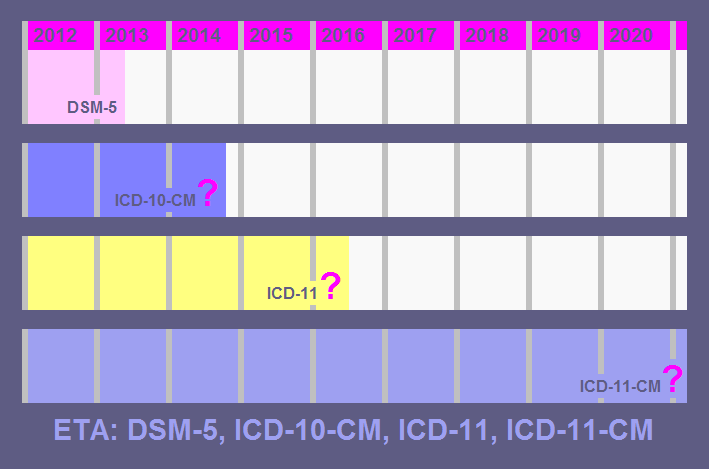
Update at March 7, 2014: ICD-11 has been postponed by two years. It is now scheduled for presentation for World Health Assembly approval in 2017.

Update at August 15, 2012: On Page 3, I stated that Steven Hyman, MD, is a DSM-5 Task Force Member and that Dr Hyman chairs the meetings of the  International Advisory Group for the Revision of ICD-10 Mental and Behavioural Disorders. According to the DSM-5 Development site, Dr Hyman is no longer a member of the DSM-5 Task Force, having served from 2007-2012. I cannot confirm whether Dr Hyman continues involvement with the International Advisory Group for the Revision of ICD-10 Mental and Behavioural Disorders though his name remains listed on the WHO site page, or on what date or for what reason Dr Hyman stood down from the DSM-5 Task Force.

+++

While the US health care industry, professional bodies and clinical practices sweat on the announcement of a final rule for ICD-10-CM compliance and speculation continues over the feasibility of leapfrogging from ICD-9-CM to ICD-11, I thought I’d run through the timelines.

+++

DSM-5: ETA: May 18-22, 2013

Originally slated for publication in May 2012.

In December 2009, the American Psychiatric Association shifted release of DSM-5 to May 2013, in response to slipping targets. With no changes to the published Timeline and no intimation of further delays, I’m assuming DSM-5 remains on target.

The final manual is scheduled for submission to American Psychiatric Publishing by December 31, 2012, for official release, next May, during APA’s 2013 Annual Meeting in San Francisco.

Following closure of the third and final public review on June 15, 2012, draft proposals for disorder descriptions and criteria sets as published on the DSM-5 Development website were frozen. The DSM-5 website will not be updated with any further revisions made by the work groups between June 15 and going to print. Final criteria sets and manual content are under strict embargo until publication [1].

+++

ICD-10-CM: ETA: Compliance mandatory by October 1, 2013; Final Rule to be announced on CMS’s proposal to delay compliance date to October 1, 2014

The development process for ICD-10-CM is as old as God’s dog.

WHO published ICD-10 in 1992. Twenty years on, while the rest of the world has long since migrated to ICD-10, the US is still waiting to transition from ICD-9-CM to a US specific clinical modification of ICD-10. The US is still using a modification based on WHO’s long since retired, ICD-9, and a code set that is now over 35 years old.

The Tabular List and preliminary crosswalk between ICD-9-CM and ICD-10-CM were posted on the NCHS website for public comment in December 1997. Field testing took place nearly ten years ago, in the summer of 2003.

The proposed rule for the adoption of ICD-10-CM/PCS was published in August 2008 with a proposed compliance date of October 1, 2011. In January 2009, the Department of Health and Human Services (HHS) published a final rule adopting ICD-10-CM/PCS to replace ICD-9-CM in HIPAA transactions, with an effective compliance date of October 1, 2013.

On February 16, 2012, HHS Secretary Kathleen Sibelius announced intent to postpone the compliance date for adoption of ICD-10-CM/PCS codes sets for a further year, to October 1, 2014 to allow more time for providers, payers and vendors to prepare for transition.

Public comment on the proposed rule closed in June. An imminent decision on a final compliance rule is anticipated but no date by which a decision would be announced has been issued.

Annual updated releases of ICD-10-CM and associated documentation have been posted on the CDC website for public viewing since January 2009.

CMS has issued the 2013 release of ICD-10-CM and General Equivalence Mappings (GEMs) which replace the December 2011 release. Until an implementation date is reached, codes in the 2013 release of ICD-10-CM are not currently valid for any purpose or use but are available for public viewing on the CDC website.

+++
Partial Code freeze for ICD-9-CM and ICD-10-CM

At the September 15, 2010 public ICD-9-CM Coordination and Maintenance Committee Meeting it was announced that the committee had finalized its recommendation to impose a partial code freeze for ICD-9-CM and ICD-10-CM/PCS codes prior to implementation of ICD-10-CM. Partial Code Freeze Announcement [PDF]

October 1, 2011 was the last major update of ICD-10-CM/PCS until October 1, 2014. Between October 1, 2011 and October 1, 2014 proposals for revisions to ICD-10-CM/PCS will be considered only for new diseases/new technology procedures and minor revisions to correct reported errors. Regular (at least annual) updates to ICD-10-CM/PCS will resume on October 1, 2014.

These Partial Code Freeze dates are based on the original compliance date of October 1, 2013. It’s reported that postponement of the requirement for compliance until October 1, 2014 would also push back scheduled ICD-10-CM coding updates.

If the proposed compliance date of October 1, 2014 is instituted, adoption of ICD-10-CM would become mandatory around 18 months after publication of DSM-5. The first regular updates to ICD-10-CM would resume one year post compliance date, that is, from October 1, 2015.

Continued on Page 2

Slide presentation: Per Fink: Somatoform disorders – functional somatic syndromes – Bodily distress syndrome (EACLPP lecture, June 2012)

Slide presentation: Per Fink: Somatoform disorders – functional somatic syndromes – Bodily distress syndrome (EACLPP lecture, June 2012)

Post #197 Shortlink: http://wp.me/pKrrB-2pN

Slide presentation: Per Fink: Somatoform disorders – functional somatic syndromes – Bodily distress syndrome (EACLPP lecture, June 2012)

23 slides in PDF format (i.e. no PowerPoint viewer required)

       EACLPP Per Fink Somatoform Disorders

Aarhus University Hospital

The Research Clinic for Functional Disorders and Psychosomatics

Somatoform disorders – functional somatic syndromes – Bodily distress syndrome.

Need for care and organisation of care in an international perspective – EACLPP Lecture

Prof. Per Fink

MD, Ph.D, Dr.Med.Sc.

www.functionaldisorders.dk

+++

June 2012 EACLPP Annual Conference*

*The European Association of Consultation-Liaison Psychiatry and Psychosomatics (EACLPP) and the European Network of Psychosomatic Medicine (ECPR) have recently merged the two associations to create a new society – the European Association of Psychosomatic Medicine (EAPM).

The Annual Scientific Meeting of the European Association for Consultation-Liaison Psychiatry and Psychosomatics (EACLPP) and the European Conference on Psychosomatic Research (ECPR) was entitled

“Towards a New Agenda: Cross-disciplinary Approach to Psychosomatic Medicine”

The conference was held in the city of Aarhus, Denmark, on 27 – 30 June 2012.

For last year’s conference, a report was published. I will post any report coming out of this year’s conference.

A Conference Abstract document be accessed here:

http://www.eaclpp-ecpr2012.dk/Home/DownloadOral

Selected Extracts:

Page 61 Nagel A

Department of Psychosomatic Medicine and Psychotherapy, University Medical Center Hamburg-Eppendorf & Schön Klinik Hamburg-Eilbek, Germany, Voigt K Department of Psychosomatic Medicine and Psychotherapy, University Medical Center Hamburg- Eppendorf & Schön Klinik Hamburg-Eilbek, Germany

Diagnostic validity of Complex Somatic Symptom Disorder: Which combination of psychological criteria is best suited for DSM-5?

Page 17 Budtz-Lilly A

The Research Unit for General Practice, School of Public Health, Aarhus University, Denmark

Bodily Distress Syndrome: A new diagnosis for functional disorders in primary care

Page 19 Escobar J

Robert Wood Johnson Medical School, New Brunswick, NJ, USA

An Update on DSM-5

Page 32 Fjorback L

Aarhus University Hospital, Research Clinic for Functional Disorders and Psychosomatics

Mindfulness Therapy for Bodily Distress Syndrome – randomized trial, one-year follow-up, active control

+++

Notes on Fink et al and Bodily Distress Syndrome (BDS)

According to Fink and colleagues, Bodily Distress Syndrome is a unifying diagnosis that encompasses somatization disorder, so-called “medically unexplained symptoms” (MUS), fibromyalgia, irritable bowel syndrome and chronic fatigue syndrome and some other conditions which they consider to be closely related, with a likely shared underlying aetiology.

See paper: Fink P, Schröder A. One single diagnosis, bodily distress syndrome, succeeded to capture 10 diagnostic categories of functional somatic syndromes and somatoform disorders J Psychosom Res. 2010 May;68(5):415-26.

See article: Per Fink,a Marianne Rosendal b Understanding and Management of Functional Somatic Symptoms in Primary Care: The Concept of Functional Somatic Symptoms

aResearch Clinic for Functional Disorders and Psychosomatics, Aarhus University Hospital, Denmark
bResearch Unit for General Practice, University of Aarhus, Denmark

See Per Fink’s clinical trial for BDS: http://clinicaltrials.gov/ct2/show/NCT01518647

See BDS clinician/patient manual: Specialised Treatment for Severe Bodily Distress Syndromes (STreSS)

According to a June 2012 EACLPP Conference Abstract, the concept of Bodily Distress Syndrome (BDS) “is expected to be integrated into the upcoming versions of classification systems.”

The potential for inclusion of Bodily Distress Disorder/Syndrome within ICD-11 could have significant implications for patients, globally, who are diagnosed with one of the so-called “functional somatic syndromes.” These proposals require very close monitoring by patient organizations in those countries that will be implementing ICD-11, post 2015.

Research and clinical professionals, patient organizations and their professional advisors can register now with ICD Revision for input into the ongoing drafting process and urge organizations and professionals to engage in this process.

Abstracts, oral presentations, EACLPP Conference: 27 – 30 June 2012, Aarhus University Campus, Aarhus – Denmark

http://www.eaclpp-ecpr2012.dk/Home/DownloadOral

Extracts

Page 17 Budtz-Lilly A

The Research Unit for General Practice, School of Public Health, Aarhus University, Denmark

Bodily Distress Syndrome: A new diagnosis for functional disorders in primary care

Aim: Medically unexplained or functional symptoms and disorders are common in primary care. Empirical research has proposed specific criteria for a new unifying diagnosis for functional disorders and syndromes: Bodily Distress Syndrome (BDS). This new concept is expected to be integrated into the upcoming versions of classification systems.

And from Page 31 of the Conference Abstracts:

Fjorback L

Aarhus University Hospital, Research Clinic for Functional Disorders and Psychosomatics

Mindfulness Therapy for Bodily Distress Syndrome – randomized trial, one-year follow-up, active control

Objective: To conduct a feasibility and efficacy trial of mindfulness therapy in somatization disorder and functional somatic syndromes such as fibromyalgia, irritable bowel syndrome, and chronic fatigue syndrome, defined as bodily distress syndrome (BDS)…

+++

References and related material:

1] Patients with medically unexplained symptoms and somatisation – a challenge for European health care systems: A white paper of the EACLPP Medically Unexplained Symptoms study group by Peter Henningsen and Francis Creed: http://www.eaclpp.org/working_groups.html
http://www.eaclpp.org/documents/Patientswithmedicallyunexplainedsymptomsandsomatisation_000.doc

2] Creed F, Guthrie E, Fink P, Henningsen P, Rief W, Sharpe M and White. Is there a better term than “Medically unexplained symptoms”? J Psychosom Res: Volume 68, Issue 1, Pages 5-8 January 2010) discusses the deliberations of the EACLPP MUS study group. Editorial also includes references to the DSM and ICD revision processes: http://www.ncbi.nlm.nih.gov/pubmed/20004295

3] Fink P, Schröder A. One single diagnosis, bodily distress syndrome, succeeded to capture 10 diagnostic categories of functional somatic syndromes and somatoform disorders. J Psychosom Res. 2010 May;68(5):415-26. The Research Clinic for Functional Disorders and Psychosomatics, Aarhus University Hospital, 8000 Aarhus, Denmark:
http://www.ncbi.nlm.nih.gov/pubmed/20403500

Fink P, Toft T, Hansen MS, Ørnbøl E, Olesen F. Symptoms and syndromes of bodily distress: an exploratory study of 978 internal medical, neurological, and primary care patients. Psychosom Med. 2007 Jan;69(1):30-9.
http://www.ncbi.nlm.nih.gov/pubmed/17244846
Full text: http://www.psychosomaticmedicine.org/content/69/1/30.full

Fink P, Rosendal, M. Recent developments in the understanding and management of functional somatic symptoms in primary care. Current Opinion in Psychiatry 2008, 21:182–188

Rosendal M, Fink P, Falkoe E, Schou Hansen H, Olesen F. Improving the Classification of Medically Unexplained Symptoms in Primary Care. Eur. J. Psychiat. v.21 n.1 Zaragoza ene.-mar. 2007
Text: http://scielo.isciii.es/scielo.php?script=sci_arttext&pid=S0213-61632007000100004
PDF: http://scielo.isciii.es/pdf/ejpen/v21n1/improv3.pdf

4] EURASMUS  http://eurasmus.net/
The multidisciplinary European Research Association for Somatisation and Medically Unexplained Symptoms(EURASMUS) was formed to study the genetic, psychological and physiological mechanisms underlying bodily distress. Co-convenors: Francis Creed, Peter Henningsen

5] Notes from EACLPP Workgroup meeting in Budapest July 2011

EACLPP_WG_Medically_Unexplained_Symptoms_Budapest_2011

Report from Working group meeting on MUS/somatisation/bodily distress, Budapest July 1st 2011

“…We should find out whether the WHO group for classification of somatic distress and dissociative disorders will provide a better diagnostic system for these disorders.”

6] Article: ‘Heartsinks’ and weird symptoms by Tony Dowell, June 15, 2011.

Article Table: Functional somatic syndromes according to medical speciality:
http://www.nzdoctor.co.nz/media/671495/heartsinks.pdf

Proposed new diagnoses of anxious depression and bodily stress syndrome in ICD-11-PHC: an international focus group study

Proposed new diagnoses of anxious depression and bodily stress syndrome in ICD-11-PHC: an international focus group study. [JOURNAL ARTICLE]

Post #196 Shortlink: http://wp.me/pKrrB-2pp

This paper, published on July 28, discusses field testing of two proposed new categories for the forthcoming ICD-11 PHC, “anxious depression” and “bodily stress syndrome (BSS)”.

“Bodily stress syndrome (BSS)” is currently proposed to replace ICD-10 PHC’s “F45 Unexplained somatic complaints” which is the equivalent to ICD-10’s “F45 Somatoform Disorders” section.

For ICD-11 PHC, it is proposed not to include the discrete category “Neurasthenia.”

+++
Full text, subscription required:

Family Practice (2012) doi: 10.1093/fampra/cms037

First published online: July 28, 2012

http://fampra.oxfordjournals.org/content/early/2012/07/20/fampra.cms037.long

http://fampra.oxfordjournals.org/content/early/2012/07/20/fampra.cms037.full.pdf+html

Abstract

http://www.ncbi.nlm.nih.gov/pubmed/22843638

Lam TP, Goldberg DP, Dowell AC, Fortes S, Mbatia JK, Minhas FA, Klinkman MS

Proposed new diagnoses of anxious depression and bodily stress syndrome in ICD-11-PHC: an international focus group study. [JOURNAL ARTICLE]

Fam Pract 2012 Jul 28.

BACKGROUND: The World Health Organization is revising the primary care classification of mental and behavioural disorders for the International Classification of Diseases (ICD-11-Primary Health Care (PHC)) aiming to reduce the disease burden associated with mental disorders among member countries.

OBJECTIVE: To explore the opinions of primary care professionals on proposed new diagnostic entities in draft ICD-11-PHC, namely anxious depression and bodily stress syndrome (BSS).

METHODS: Qualitative study with focus groups of primary health-care workers, using standard interview schedule after draft ICD-11-PHC criteria for each proposed entity was introduced to the participants.

RESULTS: Nine focus groups with 4-15 participants each were held at seven locations: Austria, Brazil, Hong Kong, New Zealand, Pakistan, Tanzania and United Kingdom. There was overwhelming support for the inclusion of anxious depression, which was considered to be very common in primary care settings. However, there were concerns about the 2-week duration of symptoms being too short to make a reliable diagnosis. BSS was considered to be a better term than medically unexplained symptoms but there were disagreements about the diagnostic criteria in the number of symptoms required.

CONCLUSION: Anxious depression is well received by primary care professionals, but BSS requires further modification. International field trials will be held to further test these new diagnoses in draft ICD-11-PHC.

+++

Notes and related posts:

ICD-10 PHC (sometimes written as ICD-10-PHC or ICD10-PHC or ICD-10 PC), is a simplified version of the WHO’s ICD-10 chapter for mental and behavioural disorders for use in general practice and primary health care settings. This system has rough but not exact equivalence to selected of the mental disorders in the core ICD-10 classification.

The ICD-10 PHC includes and describes 26 disorders commonly managed within primary care as opposed to circa 450 classified within Chapter V of ICD-10.

Click here for a chart showing the grouping of categories adapted from the full ICD-10 version for the existing ICD-10 PHC mental health categories

Professor, Sir David Goldberg, M.D., Emeritus Professor, Institute of Psychiatry, King’s College, London, is a member of the DSM-5 Mood Disorders Work Group. Prof Goldberg also chairs the Consultation Group for Classification in Primary Care that is making recommendations for the mental and behavioural disorders for ICD-11 PHC.

Other members of the ICD-11 PHC Consultation Group include Michael Klinkman (GP, United States; Vice Chairman); Sally Chan (nurse, Singapore), Tony Dowell (GP, New Zealand) Sandra Fortes (psychiatrist, Brazil), Linda Gask (psychiatrist, UK), KS Jacob (psychiatrist, India), Tai-Pong Lam (GP, Hong Kong), Joseph Mbatia (psychiatrist, Tanzania), Fareed Minhas (psychiatrist, Pakistan), Marianne Rosendal (GP, Denmark), assisted by WHO Secretariat Geoffrey Reed and Shekhar Saxena.

The majority of patients with mental health problems are diagnosed and managed by general practitioners in primary care – not by psychiatrists and mental health specialists. ICD-10 PHC is used in developed and developing countries in general medical settings and also used in the training of medical officers, nurses and multi purpose health workers.

See also Page 3 of this report:

Changes to ICD-11 Beta drafting platform: Bodily Distress Disorders (1)

Page 3, including Update at July 9: Second list of proposals for ICD-11 PHC

Further information on ICD-10 PHC and proposals for the 28 mental health disorders proposed to be included in ICD-11 PHC can be found in these two documents:

1] Goldberg, D. Guest editorial. A revised mental health classification for use in general medical settings: the ICD11–PHC 1. International Psychiatry, Page 1, February 2011.

http://www.rcpsych.ac.uk/pdf/IPv8n1.pdf

Note: The list of proposed categories in the editorial above has been superseded by the list in Chapter 2 of this book, below. (Source: Prof D Goldberg, who stresses these are draft proposals and subject to revision in the light of field trial results).

2] 21st Century Global Mental Health by Dr Eliot Sorel, Professor, George Washington University, Washington D.C.

Publication date: August, 2012: http://www.jblearning.com/catalog/9781449627874/

Page 51, Sample Chapter 2: http://samples.jbpub.com/9781449627874/Chapter2.pdf

Round up: ICD-11 PHC, ICD-11 Classification of Mood and Anxiety Disorders, Monograph: Public Health Aspects of Diagnosis and Classification of Mental and Behavioral Disorders, ASHA DSM-5 comments

Round up: ICD- 11 PHC; ICD-11 Classification of Mood and Anxiety Disorders; Monograph: Public Health Aspects of Diagnosis and Classification of Mental and Behavioral Disorders; ASHA DSM-5 comments

1] Paper: The primary health care version of ICD-11: the detection of common mental disorders in general medical settings By David P. Goldberg, James J. Prisciandaro, Paul Williams

2] The ICD-11 Classification of Mood and Anxiety Disorders: background and options (Guest Editors: Mario Maj, Geoffrey M. Reed), World Psychiatry, Volume 11, Supplement 1, June 2012

3] Monograph: Public Health Aspects of Diagnosis and Classification of Mental and Behavioral Disorders: Refining the Research Agenda for DSM-5 and ICD-11 By Shekhar Saxena, Patricia Esparza, Darrel A. Regier, Norman Sartorius

4] Submissions to DSM-5 public reviews for drafts one, two and three by The American Speech-Language-Hearing Association

Post #195 Shortlink: http://wp.me/pKrrB-2pa

This post relates to the World Health Organization’s ICD-11 and ICD-11 PHC (Primary Care version), both currently under development. It does not apply to the existing ICD-10, ICD-10 PHC or to the forthcoming US specific “clinical modification” of ICD-10, known as ICD-10-CM.

Note on ICD-10 PHC and ICD-11 PHC

ICD-10 PHC (sometimes written as ICD-10-PHC or ICD10-PHC or ICD-10 PC), is a simplified version of the WHO’s ICD-10 chapter for mental and behavioural disorders for use in general practice and primary health care settings. This system has rough but not exact equivalence to mental disorders in the core ICD-10 classification.

The ICD-10 PHC describes 25 disorders commonly managed within primary care as opposed to circa 450 classified within Chapter V of ICD-10.

A chart showing the grouping of categories adapted from the full ICD-10 version for the existing ICD-10 PHC categories can be found here.

The revision of ICD-10 PHC, ICD-11 PHC, is currently under development.

Professor, Sir David Goldberg, M.D., Emeritus Professor, Institute of Psychiatry, King’s College, London, is a member of the DSM-5 Mood Disorders Work Group. Prof Goldberg also chairs the Consultation Group for Classification in Primary Care that is making recommendations for the 28 mental and behavioural disorders proposed for inclusion in ICD-11 PHC.

The majority of patients with mental health problems are diagnosed and managed by general practitioners in primary care – not by psychiatrists and mental health specialists. ICD10-PHC is used in developed and developing countries in general medical settings and also used in the training of medical officers, nurses and multi purpose health workers.

Further information on ICD-10 PHC and the development of the mental health disorders section of ICD-11 PHC can be found in these two documents:

1] Goldberg, D. Guest editorial. A revised mental health classification for use in general medical settings: the ICD11–PHC 1. International Psychiatry, Page 1, February 2011.
http://www.rcpsych.ac.uk/pdf/IPv8n1.pdf

2] 21st Century Global Mental Health by Dr Eliot Sorel, Professor, George Washington University, Washington D.C.
Publication date: August, 2012: http://www.jblearning.com/catalog/9781449627874/
Page 51, Sample Chapter 2: http://samples.jbpub.com/9781449627874/Chapter2.pdf

ICD Revision publishes the names and bios of members of the ICD-11 Revision Steering Group, ICD-11 Topic Advisory Groups, and International Advisory Group for the Revision of ICD-10 Mental and Behavioural Disorders.

But membership of the various sub working groups to the Topic Advisory Groups (TAGs), the names of external peer reviewers recruited by TAG Managing Editors for reviewing proposals and content and the membership of the advisory/consultation groups for the revision of the ICD Primary Care version have not been published by ICD-11 Revision.

The Abstract below lists members of the (WHO) Primary Care Consultation Group for the Revision of ICD-10 Mental and Behavioural Disorders.

1] Paper: The primary health care version of ICD-11: the detection of common mental disorders in general medical settings

http://www.ghpjournal.com/article/S0163-8343(12)00197-1/abstract

The primary health care version of ICD-11: the detection of common mental disorders in general medical settings

26 July 2012

David P. Goldberg, James J. Prisciandaro, Paul Williams

David P. Goldberg
Affiliations Primary Care Consultation Group, World Health Organization; and Institute of Psychiatry, KCL, London, UK

James J. Prisciandaro
Affiliations Department of Psychiatry, Medical University of South Carolina, Charleston SC, USA
Corresponding author.

Paul Williams
Affiliations Health Services & Population Research, Institute of Psychiatry, KCL, London, UK

Received 31 January 2012; accepted 19 June 2012. published online 26 July 2012.
Corrected Proof

Abstract

Background

The primary health care version of the ICD-11 is currently being revised.

Aim
To test two brief sets of symptoms for depression and anxiety in primary care settings, and validate them against diagnoses of major depression and current generalised anxiety made by the CIDI.

Method
The study took place in general medical or primary care clinics in 14 different countries, using the Composite International Diagnostic Interview adapted for primary care (CIDI-PC) in 5,438 patients. The latent structure of common symptoms was explored, and two symptom scales were derived from item response theory (IRT), these were then investigated against research diagnoses.

Results
Correlations between dimensions of anxious, depressive and somatic symptoms were found to be high. For major depression the 5 item depression scale has marked superiority over the usual 2 item scales used by both the ICD and DSM systems, and for anxiety there is some superiority. If the questions are used with patients that the clinician suspects may have a psychological disorder, the positive predictive value of the scale is between 78 and 90%.

Conclusion
The two scales allow clinicians to make diagnostic assessments of depression and anxiety with a high positive predictive value, provided they use them only when they suspect that a psychological disorder is present.

This article is partly based on the work of the World Health Organization (WHO) Primary Care Consultation Group for the Revision of ICD-10 Mental and Behavioural Disorders, of which the first author is Chair. Other members of the group include Michael Klinkman (GP, United States; Vice Chairman); Sally Chan (nurse, Singapore), Tony Dowell (GP, New Zealand) Sandra Fortes (psychiatrist, Brazil), Linda Gask (psychiatrist, UK), KS Jacob (psychiatrist, India), Tai-Pong Lam (GP, Hong Kong), Joseph Mbatia (psychiatrist, Tanzania), Fareed Minhas (psychiatrist, Pakistan), Marianne Rosendal (GP, Denmark), assisted by WHO Secretariat Geoffrey Reed and Shekhar Saxena. The views expressed in this article are those of the authors and, except as specifically noted, are not intended to represent the official policies and positions of the Primary Care Consultation Group or of the WHO.

Competing interests: David Goldberg is a consultant for Ultrasis and advises the World Health Organization and the American Psychiatric Association.

James Prisciandaro and Paul Williams have no competing interests

PII: S0163-8343(12)00197-1

doi:10.1016/j.genhosppsych.2012.06.006

+++
2] The ICD-11 Classification of Mood and Anxiety Disorders: background and options (Guest Editors: Mario Maj, Geoffrey M. Reed), World Psychiatry, Volume 11, Supplement 1, June 2012

The PDF of this publication is free.

Note regarding references within these commentaries to DSM-5 proposals: Some of these commentaries were written prior to the release of the third DSM-5 draft for public review, in May 2012, and quote draft proposals as they had stood for the second draft.

For example, the commentary Hypochondriasis in ICD-11 by D.J. Stein, on Page 100, sets out in narrative form the DSM-5 Somatic Symptom Disorder Work Group proposals and criteria for Complex Somatic Symptom Disorder as they had stood in May 2011 and are not the most recent iteration.

DSM-5 proposals have not been finalized. Proposals as they stood in May 2012 for the third and final public review may be subject to further change before DSM-5 is published in May 2013. Please refer to the DSM-5 Development website for the most recent proposals and criteria sets for the categories and proposed categories that are discussed in these commentaries.

http://www.wpanet.org/uploads/WPA-WHO_Collaborative_Activities/WP_ICD-11%20Supplement.pdf

July 2012

The ICD-11 Classification of Mood and Anxiety Disorders: background and options (Guest Editors: Mario Maj, Geoffrey M. Reed) World Psychiatry, Volume 11, Supplement 1, June 2012

Contents

The development of the ICD-11 classification of mood and anxiety disorders

M. Maj, G.M. Reed Page 3

How global epidemiological evidence can inform the revision of ICD-10 classification of depression and anxiety disorders

L.H. Andrade, Y.-P. Wang Page 6

Specifiers as aids to treatment selection and clinical management in the ICD classification of mood disorders

D.J. Miklowitz, M.B. First Page 11

Challenges in the implementation of diagnostic specifiers for mood disorders in ICD-11

M.B. First Page 17

Cultural issues in the classification and diagnosis of mood and anxiety disorders

S. Chakrabarti, C. Berlanga, F. Njenga Page 26

Bipolar disorders in ICD-11

S.M. Strakowski Page 31

Changes needed in the classification of depressive disorders: options for ICD-11

E. Paykel, L.H. Andrade, F. Njenga, M.R. Phillips Page 37

Differentiating depression from ordinary sadness: contextual, qualitative and pragmatic approaches

M. Maj Page 43

Severity of depressive disorders: considerations for ICD-11

J.L. Ayuso-Mateos, P. Lopez-García Page 48

Dysthymia and cyclothymia in ICD-11

M.R. Phillips Page 53

Psychotic and catatonic presentations in bipolar and depressive disorders

S. Chakrabarti Page 59

Mixed states and rapid cycling: conceptual issues and options for ICD-11

M. Maj Page 65

How should melancholia be incorporated in ICD-11?

D. Moussaoui, M. Agoub, A. Khoubila Page 69

Postpartum depression and premenstrual dysphoric disorder: options for ICD-11

M.L. Figueira, V. Videira Dias Page 73

Disruptive mood dysregulation with dysphoria disorder: a proposal for ICD-11

E. Leibenluft, R. Uher, M. Rutter Page 77

Generalized anxiety disorder in ICD-11

M.K. Shear Page 82

Agoraphobia and panic disorder: options for ICD-11

D.J. Stein Page 89

Specific and social phobias in ICD-11

P.M.G. Emmelkamp Page 94

Hypochondriasis in ICD-11

D.J. Stein Page 100

+++

3] Public Health Aspects of Diagnosis and Classification of Mental and Behavioral Disorders: Refining the Research Agenda for DSM-5 and ICD-11

Note: Substantial extracts from this DSM-5 and ICD-11 monograph can be previewed online on the Amazon site via the “LOOKINSIDE!” function. Greater access to preview content is available to Amazon account holders.  Extracts can also be previewed via Google:

Preview via Amazon “LOOKINSIDE!”:

http://www.amazon.com/Aspects-Diagnosis-Classification-Behavioral-Disorders/dp/0890423490#reader_0890423490

Preview via Google Books:

http://tinyurl.com/DSM5-ICD11-Monograph

Public Health Aspects of Diagnosis and Classification of Mental and Behavioral Disorders: Refining the Research Agenda for Dsm-5 and ICD-11

By Shekhar Saxena, Patricia Esparza, Darrel A. Regier, Norman Sartorius

(c) 2012

Paperback: 303 pages
Publisher: American Psychiatric Publishing; 1 edition (April 30, 2012)

Public Health Aspects of Diagnosis and Classification of Mental and Behavioral Disorders: Refining the Research Agenda for DSM-5 and ICD-11
[Paperback]

Shekhar Saxena (Author), Patricia Esparza (Author), Darrel A. Regier (Author), Benedetto Saraceno (Author), Norman Sartorius (Author)

Shekhar Saxena, M.D.,is Director of the Department of Mental Health and Substance Abuse at the World Health Organization in Geneva, Switzerland.

Patricia Esparza, Ph.D.,is Research Professor and clinical psychologist in the Department of Psychology and Counseling at Webster University in Geneva, Switzerland.

Darrel A. Regier, M.D., M.P.H.,is Director of the American Psychiatric Institute for Research and Education and Director of the Division of Research at the American Psychiatric Association in Arlington, Virginia; and Vice-Chair of the DSM-5 Task Force.

Benedetto Saraceno, M.D.,FRCPsych,is Professor of Psychiatry and Director of the World Health Organization Collaborating Center on Mental Health of the University of Geneva in Geneva, Switzerland.

Norman Sartorius, M.D., Ph.D.,is President of the Association for the Improvement of Mental Health Programs in Geneva, Switzerland.

Book Description
Publication Date: April 30, 2012 | ISBN-10: 0890423490 | ISBN-13:
978-0890423493 | Edition: 1

“Public Health Aspects of Diagnosis and Classification of Mental and Behavioral Disorders: Refining the Research Agenda for DSM-5 and ICD-11” provides a comprehensive summary of the current state of mental health classification in the United States and internationally, fostering a better understanding of primary research and clinical needs and facilitating the efforts of service planners, researchers and trainees to address current use of psychiatric diagnosis in the public health sector. The volume reflects the proceedings of a research planning conference convened by the APA and World Health Organization (WHO) that focused on public health aspects of the diagnosis and classification of mental disorders. Highly relevant to the ongoing development of DSM-5 and ICD-11, the book includes the background papers prepared and presented by the Conference Expert Groups. The resulting collection: – Discusses the current state of mental illness prevention efforts and the role of public health in supporting them–critical topics, given that development of effective strategies to reduce mental illness around the world depends on the accuracy with which risk and protective factors can be identified, defined, and understood. – Features international perspectives on public health implications of psychiatric diagnosis, classification, and service, providing viewpoints that are broad and more globally relevant. – Views mental health education, and awareness on a macro level, including its impact on social and economic policy, forensics and the legal system, and education. This approach facilitates the continued development of a research base in community health and promotes the establishment of programs for monitoring, treating, and preventing mental illness. – Addresses many fascinating and clinically relevant issues, such as those raised by the concept and the definition of mental disorders and how these impact psychiatric services and practice by individual providers.

This collection should prove useful to the advisory groups, task forces, and working groups for the revision of these two classifications, as well as for researchers in the area of diagnosis and classification, and more generally in public health.

+++
4] Submissions to DSM-5 public reviews for drafts one, two and three by The American Speech-Language-Hearing Association (ASHA)

The American Speech-Language-Hearing Association (ASHA) represents people with speech, language, and hearing disorders and advocates for services to help them communicate effectively.

ASHA submitted comments during all three DSM-5 draft comment periods:

ASHA submission April 2010 [PDF]; June 2011 [PDF]; June 2012 [PDF]

ASHA Letter sent June 2012 [PDF]

DSM-V Revisions To Move Forward (ASHA Leader article)

all documents available from this page:

http://www.asha.org/SLP/DSM-5/

+++

Key ICD-11 links and documents

ICD-11 Beta drafting platform  |  Publicly viewable version

WHO ICD Revision  |  Main WHO website: Revision Steering Group and Topic Advisory Groups
ICD-11 Revision site  |  Revision resources [Google site currently unavailable]
ICD-11 Revision site Documents Page  |  Key revision documents and meeting materials  [Google site currently unavailable]

ICD-11 Revision Information  |
ICD-11 Timeline  |

ICD Information Sheet  |

Revision News  |
Steering Group  |
Topic Advisory Groups  |

ICD-11 YouTube Channel  |  Video reports
ICD-11 on Facebook  |
ICD-11 on Twitter  |
ICD-11 Blog  |  Not updated since October 2009

ICD-11 YouTubes collated on Dx Revision Watch ICD-11 YouTubes  |

WHO Publications

ICD-10 Tabular List online Version: 2010  |  International Statistical Classification of Diseases and Related Health Problems 10th Revision Version: 2010, Tabular List of inclusions and Chapter List

ICD-10 Volume 2: Instruction Manual  |  Volume 2 online Version: 2010 PDF Download

ICD-10 for Mental and Behavioural Disorders Diagnostic Criteria for Research  |  PDF download
ICD-10 for Mental and Behavioural Disorders Clinical Descriptions and Diagnostic Guidelines  |  PDF download

ICD-10 Volume 3: The Alphabetical Index  |  WHO does not make ICD-10 Volume 3: The Alphabetical Index available online

About the World Health Organization (WHO)

The WHO Family of International Classifications  

History of ICD